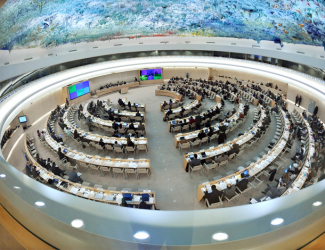
Jean-Marc Ferré | Flickr (CC BY-NC-ND 2.0)
A general view of participants at the 16th session of the Human Rights Council in Geneva, Switzerland.

Special Focus

AWID is an international, feminist, membership organisation committed to achieving gender equality, sustainable development and women’s human rights

Human Rights Council (HRC)

The Human Rights Council (HRC) is the key intergovernmental body within the United Nations system responsible for the promotion and protection of all human rights around the globe. It holds three regular sessions a year: in March, June and September. The Office of the UN High Commissioner for Human Rights (OHCHR) is the secretariat for the HRC.

The HRC works by:

  • Debating and passing resolutions on global human rights issues and human rights situations in particular countries

  • Examining complaints from victims of human rights violations or activist organizations on behalf of victims of human rights violations

  • Appointing independent experts (known as “Special Procedures”) to review human rights violations in specific countries and examine and further global human rights issues

  • Engaging in discussions with experts and governments on human rights issues

  • Assessing the human rights records of all UN Member States every four and a half years through the Universal Periodic Review

Learn more about the HRC


AWID works with feminist, progressive and human rights partners to share key knowledge, convene civil society dialogues and events, and influence negotiations and outcomes of the session.

With our partners, our work will:

◾️ Monitor, track and analyze anti-rights actors, discourses and strategies and their impact on resolutions

◾️ Raise awareness of the findings of the 2017 and 2021 OURs Trends Reports.

◾️Support the work of feminist UN experts in the face of backlash and pressure

◾️Advocate for state accountability
 
◾️ Work with feminist movements and civil society organizations to advance rights related to gender and sexuality.
 

Related Content

Ȃurea Mouzinho

Biography

Ȃurea Mouzinho es una activista feminista por la justicia económica de Luanda, Angola, que tiene una carrera de diez años en investigación, otorgamiento de subvenciones, incidencia y construcción de movimientos por los derechos de las mujeres y la justicia económica en toda África y en el Sur global. Actualmente es Directora de Programa para África en Thousand Currents, y es parte del consejo editorial de Feminist Africa. También integra Ondjango Feminista, una colectiva feminista que cofundó en 2016. Recientemente ha sido madre de un niño de Géminis, y disfruta los días tranquilos con su joven familia y los largos paseos por la playa. Ocasionalmente publica tweets con el nombre de usuarie @kitondowe.

Add to stories
Off

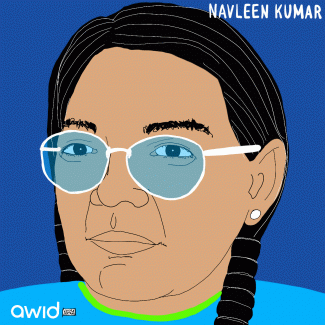
Navleen Kumar

"She was not a person. She was a power."
- a fellow activist remembering Navleen Kumar

Navleen Kumar was a fervent land rights and social justice activist in India.

With commitment and integrity, she worked for more than a decade to protect and restore the lands of Indigenous people (adivasi) in Thane district, an area taken away by property and land developers using such means as coercion and intimidation. She fought this injustice and crime through legal interventions at different courts, realizing that manipulation of land records was a recurrent feature in most cases of land acquisition. In one of the cases, that of the Wartha (a tribal family), Navleen found out that the family had been cheated with the complicity of government officials.

Through her work, she helped restore the land back to the Wartha family and continued to pursue other cases of adivasi land transfers.

“Her paper on the impact of land alienation on adivasi women and children traces the history and complexities of tribal alienation from the 1970s, when middle class families began to move to the extended suburbs of Mumbai as the real estate value in the city spiralled.

Housing complexes mushroomed in these suburbs, and the illiterate tribals paid the price for this. Prime land near the railway lines fetched a high price and builders swooped down on this belt like vultures, to grab land from tribals and other local residents by illegal means.”
-Jaya Menon, Justice and Peace Commission 

During the course of her activism, Navleen received numerous threats and survived several attempts on her life. Despite these, she continued working on what was not only important to her but contributed to changing the lives and realities of many she supported in the struggle for social justice. 

Navleen was stabbed to death on 19 June 2002 in her apartment building. Two local gangsters were arrested for her murder. 
Snippet FEA Principles of Work Antiracism (FR)

Poing noir levé

ANTI-RACISME

Publications - Homepage - fr

Publications

Lisez nos recherches sur le financement, sur les défenseuses des droits humains, sur la création de mouvements, sur les fondamentalismes, la justice économique et beaucoup plus

Lire la suite

Snippet - Home page promo WITM - ES

«¿Dónde está el dinero para las organizaciones feministas?»

Sobre la base de nuestros 20 años de historia movilizando más y mejor financiamiento para el cambio social encabezado por los feminismos, AWID te invita a responder la nueva edición de nuestra encuesta insignia, WITM

¡RESPONDE LA ENCUESTA! Obtén más información

Fatima Qureshi

Biography

A nomad of cultures, born in Hong Kong, rooted in Turkish-Pakistani heritage, Fatima’s love for narratives - both in reading and co-creating them - fueled her passion for communications activism. Supported by her education in journalism, Fatima has worked for 7 years in digital and media communications fields with NGOs that provide education opportunities and legal aid to refugee and asylum seekers, as well as with the Muslim feminist movement which applies feminist and rights-based lenses in understanding and searching for equality and justice within Muslim legal tradition. She is a regular op-ed writer on feminist issues in the Global South.

Through storytelling in this hyper-digital age of social media, Fatima continues to collaborate with community organizers and grassroots activists to create audiovisual content with the aim to cultivate bridges of understanding towards collective liberation and decolonization. On days when she’s not working, she intently watches independent feminist films coming from Iran, Morocco and Pakistan and on other days, she performs spoken word poetry with her comrades in Kuala Lumpur.

Position
ICM Digital Communications and Partnerships Lead
Add to stories
Off

Nadyn Jouny

Lo personal es político, y la apasionada y valiente Nadyn Jouny personificó este mantra feminista. Nadyn experimentó de primera mano el dolor de la violencia estructural de los sistemas legales que despojan a las mujeres de sus derechos.

Cuando Nadyn decidió solicitar el divorcio, los tribunales religiosos chiítas, bajo las Leyes de Estatuto Personal Libanesas, le negaron la custodia de su joven hijo Karam. Nadyn, como tantas otras mujeres del Líbano y de otros países, se vio atrapada entre el dolor imposible de dejar una relación no deseada y abusiva y de perder a la vez los derechos sobre su hijo.  Sin embargo, Nadyn se defendió, y lo habría de hacerlo hasta el último día.

Nadyn utilizó su  habilidad con los medios de comunicación para convertirse en una voz  franca a favor de las mujeres que luchan contra la discriminación en la legislación familiar, en el Líbano y a nivel internacional. Nadyn cofundó el grupo autofinanciado "Protecting Lebanese Women" [Protegiendo a las Mujeres Libanesas] (PLW, por sus siglas en inglés) y se unió a muchas otras madres libanesas que se enfrentaban a problemas similares de custodia. Juntas, trabajaron para crear conciencia sobre las injusticias extremas a las que se enfrentaban, a nivel nacional, protestaron ante los tribunales religiosos por sus derechos y, a nivel internacional, llamaron la atención de los medios de comunicación.

Nadyn también trabajó con ABAAD - Resource Center for Gender Equality [Centro de Recursos para la Igualdad de Género], otra organización por los derechos de las mujeres en el Líbano, para realizar campañas en favor de los derechos de las mujeres, la igualdad en la legislación familiar y relativa a las custodias y contra los matrimonios forzados y precoces.

Para muchxs de sus colegas, Nadyn llegó a "simbolizar la lucha de una madre libanesa contra la supresión y la misoginia de todo tipo" (en inglés), al utilizar "su experiencia personal y trayectoria individual de empoderamiento, dio a otras mujeres esperanza para que ellas también pudieran ser un catalizador para el cambio positivo" - ABAAD - Centro de Recursos para la Igualdad entre los Géneros, Líbano.

El 6 de octubre de 2019, Nadyn murió trágicamente en un accidente de automóvil cuando se dirigía a protestar por los injustos aumentos de impuestos en un país que ya se enfrentaba a una espiral de crisis financiera. Nadyn Jouny tenía solo 29 años en el momento de su muerte.

Snippet FEA Title Main (EN)


The Feminist Economies

WE LOVE


FRMag - Freeing the Church

Freeing the Church, Decolonizing the Bible for West Papuan Women

by Rode Wanimbo

I was born and grew up in Agamua, the Central Highlands of West Papua. My father belongs to the Lani tribe and my mother comes from Walak. (...)

Read


< artwork: “Offerings for Black Life” by Sokari Ekine

Forum Homepage Banner

Register for the Forum!

When people come together on a global scale, as individuals and movements, we generate a sweeping force. Join us in Bangkok, Thailand and online in December 2024.

Learn more Register

Nana Abuelsoud

Biography

Nana es una organizadora feminista e investigadora en derechos reproductivos y políticas demográficas que reside en Egipto. Es miembro de RESURJ (organización feminista por la justicia sexual y reproductiva), del Órgano Asesor del Proyecto A del Líbano y de la Comisión de la Comunidad de Mama Cash. Nana tiene una maestría en Salud Pública del Instituto KIT y la Universidad Vrije de Ámsterdam. En su trabajo, da seguimiento y contextualiza las políticas demográficas nacionales, al tiempo que reúne información para abordar la eugenesia moderna, las ayudas internacionales de carácter regresivo y el autoritarismo. Anteriormente, formó parte de la Fundación de Ginebra para la Educación y la Investigación Médica, la Iniciativa Egipcia para los Derechos Personales y el Colectivo Feminista Ikhtyar de El Cairo.

Add to stories
Off

Doris Valenzuela Angulo

Doris Valenzuela Angulo était une activiste sociale, leader et défenseure des droits humains afrodescendante de Buenaventura, en Colombie. Elle faisait partie du réseau national Comunidades Construyendo Paz en Colombia (CONPAZ, Communautés construisant la paix en Colombie) composé d’organisations présentes dans les communautés affectées par le conflit armé œuvrant en faveur de la non-violence et la justice socio-environnementale.

Doris s’opposait à la violence paramilitaire continue, aux pressions incessantes des mégaprojets cherchant à déplacer sa communauté, et à la complicité de  l’État. Confrontée à l’un des contextes les plus difficiles de son pays, elle joua un rôle de premier plan dans l’initiative de résistance non-violente sans précédent Espacio Humanitario Puente Nayero, un lieu urbain conçu pour assurer la cohésion communautaire, la sécurité, la créativité et l’action collective. 

Ce combat non-violent unique en son genre des familles de l’Espacio Humanitario Puente Nayero attira l’attention et le soutien des agences tant locales qu’internationales. En septembre 2014, la Commission interaméricaine des droits de l’Homme accorda des mesures de protection préventives à la communauté, ordonnant au gouvernement colombien d’adopter des mesures nécessaires en vue de protéger la vie et l’intégrité physique des habitant·e·s. Les menaces et la violence des paramilitaires se poursuivirent néanmoins. Malgré l’assassinat de son fils Cristian Dainer Aragón Valenzuela en juillet 2015,Doris continua à mettre toute son énergie à éviter le recrutement forcé des enfants et des jeunes par les néo-militaires. Elle devint alors également une cible, recevant constamment des menaces pour son activisme et le travail qu’elle accomplissait.

Les incessantes agressions et menaces de mort dont elle était l’objet forcèrent Doris à quitter la Colombie. Elle vécut en Espagne de février 2017 à février 2018, dans le cadre du programme de protection temporaire d’Amnesty International pour les défenseur·e·s des droits humains en danger.

Doris a été assassinée en avril 2018 à Murcie, en Espagne, par son ex-compagnon. Elle n’avait que 39 ans. 


Hommages :

« Doris, cette année passée avec toi nous a montré combien une personne peut avoir la capacité de transformer et créer de l’espoir en dépit des événements profondément négatifs et dévastateurs qui jalonnent sa vie... Nous poursuivons notre engagement à défendre tous les droits humains. Ton courage et ta lumière nous guideront toujours. » - Montserrat Román, Amnesty International, Groupe de La Palma, Espagne

Extrait de « Mots pour Doris Valenzuela Angulo », d’Elsa López

« ... Tu le savais. Tu l’as toujours su. Et malgré tout cela, tu as résisté sans faillir à tant d’injustice, de misère, de persécution. Tu t’es élevée, fière et acharnée, contre ceux qui continuaient à vouloir que tu abandonnes tout espoir, que tu t’abaisses, que tu te rendes. Debout, tu as réclamé haut et fort ta liberté et la nôtre, qui était la tienne. Rien ni personne n’est parvenu à paralyser tes efforts pour changer le monde et le rendre plus généreux et plus vivable. Tu vis parmi nous, aujourd’hui plus vivante que jamais malgré la mort. Tu vis encore par tes actes, par ton courage, par ta grandeur lorsque tu pleurais pour cette terre promise que tu invoquais à chacun de tes cris, pour tous ces déserts que tu as habités. Toi. Toujours en vie. Doris Valenzuela Angulo.
Ce ne sont que des mots. Je sais. Je le sais, moi aussi. Mais les mots nous unissent, nous protègent, nous donnent la force et le soutien nécessaires pour continuer à aller vers la lumière que tu défendais tant... »

Snippet - Podcast Intro (ES)

Estamos encantadxs de anunciar el lanzamiento del nuevo podcast de AWID: ESE FUEGO FEMINISTA. Esta serie narrativa revela más de 40 años de movimientos feministas e imagina nuevos caminos a seguir.

En nuestra temporada piloto, escucharán cinco historias cautivadoras que forman parte de la actual constelación de activismo feminista. Presentado por nuestra Gopika Bashi, subdirectora de programas de AWID, cada episodio explora realidades feministas únicas pero interconectadas que están logrando una mayor justicia de género y asegurando derechos humanos.

ESE FUEGO FEMINISTA es producido en asociación con lxs ganadorxs de Webby, Hueman Group Media. Puedes suscribirte al podcast y escuchar nuestro primer episodio aquí.

Encuéntranos en Apple Podcasts, Spotify o donde sea que obtengas tus podcasts. ¡Comparte con tu red! Ayúdanos a difundir historias que enciendan nuestro fuego feminista y nos muevan a la acción.

Suscríbete aquí

FRMag - Our neighbourhood, our network

Nuestro barrio, nuestras redes, nuestra fuerza

por Marta Plaza Fernández 

Tejer redes en las que nos sostenemos unas a otras: esa potencia es la realidad feminista que quiero compartirles. (...)

Leer

arte: «Healing Together» [Sanar juntxs], Upasana Agarwal >

Snippet - CSW69 spaces to watch out for - ES

Espacios para tener en cuenta en la CSW69

Obtén más información sobre los próximos eventos de la CSW69 que AWID está coorganizando

¿Cómo se inició AWID?

AWID surgió en 1982 y se ha ido transformando con el paso de los años en una verdadera organización mundial.

Saber más de nuestra historia

Leer «From “WID” to “GAD” to Women’s Rights: The First Twenty Years of AWID» (en inglés)

Diana Isabel Hernández Juárez

Diana Isabel Hernández Juárez was a Guatemalan teacher, human rights defender and environmental and community activist. She was the coordinator of the environmental program at Our Lady of Guadalupe Parish on the South coast of the country. 

Diana dedicated her life to co-creating environmental awareness, working especially closely with local communities to address environmental issues and protect natural resources. She initiated projects such as forest nurseries, municipal farms, family gardens and clean-up campaigns. She was active in reforestation programmes, trying to recover native species and address water shortages, in more than 32 rural communities.

On 7 September 2019, Diana was shot and killed by two unknown gunmen while she was participating in a procession in her hometown. Diana was only 35 years old at the time of her death.