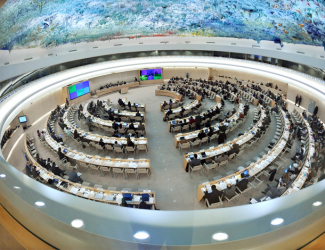
The Human Rights Council (HRC) is the key intergovernmental body within the United Nations system responsible for the promotion and protection of all human rights around the globe. It holds three regular sessions a year: in March, June and September. The Office of the UN High Commissioner for Human Rights (OHCHR) is the secretariat for the HRC.
The HRC works by:
Debating and passing resolutions on global human rights issues and human rights situations in particular countries
Examining complaints from victims of human rights violations or activist organizations on behalf of victims of human rights violations
Appointing independent experts (known as “Special Procedures”) to review human rights violations in specific countries and examine and further global human rights issues
Engaging in discussions with experts and governments on human rights issues
Assessing the human rights records of all UN Member States every four and a half years through the Universal Periodic Review
AWID works with feminist, progressive and human rights partners to share key knowledge, convene civil society dialogues and events, and influence negotiations and outcomes of the session.
With our partners, our work will:
◾️ Monitor, track and analyze anti-rights actors, discourses and strategies and their impact on resolutions
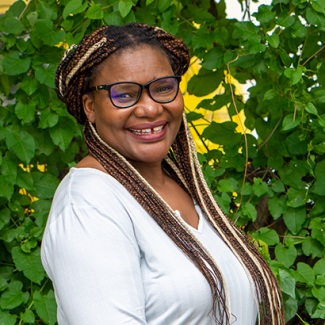
Tshegofatso Senne est un·e féministe noir·e atteint·e d’une maladie chronique et genderqueer qui fait le maximum. Une grande partie de son travail est axée sur le plaisir, la communauté et le rêve et s’alimente de l’abolitionnisme somatique et du handicap, de la guérison et des justices transformatives. Tshegofatso écrit, fait des recherches et s’exprime sur des questions concernant le féminisme, la communauté, la justice sexuelle et reproductive, le consentement, la culture du viol et la justice, et élabore depuis 8 ans des théories sur la façon dont le plaisir recoupe ces différents thèmes. Tandis qu’iel dirige sa propre entreprise, Thembekile Stationery, sa plateforme communautaire Hedone rassemble les gens pour explorer et comprendre le pouvoir du plaisir et de la prise de conscience de traumatismes dans leur vie quotidienne.
Le corps. Notre maison la plus permanente.
C’est dans notre corps, et non dans notre cerveau pensant, que nous expérimentons la plupart de nos douleurs, nos plaisirs, nos joies, et là où nous traitons la majeure partie de ce qui nous arrive. C’est également là que nous faisons la plupart de notre travail de guérison, et notamment notre guérison émotionnelle et psychologique. Et c’est là où nous faisons l’expérience de la résilience et d’une sorte de flux.
Ces mots, ceux de Resmaa Menakem dans son roman My Grandmother’s Hands résonnent toujours en moi
Le corps contient nos expériences. Nos mémoires. Notre résilience. Et comme l’a écrit Menakem, le corps contient également nos traumatismes. Il emploie des mécanismes spontanés de protection pour arrêter ou prévenir les dommages supplémentaires. Le pouvoir du corps. Le traumatisme, ce n’est pas l’événement, c’est la manière dont nos corps répondent aux événements qui nous semblent dangereux. Et le trauma reste souvent coincé dans notre corps, jusqu’à ce que nous l’abordions. Il n’est pas possible de faire autrement – c’est ainsi que notre corps l’entend.
En utilisant l’appli Digital Superpower de Ling Tan, j’ai observé les réactions de mon corps alors que je me promenais dans différents quartiers de ma ville, Johannesburg, en Afrique du Sud. L’appli est une plateforme en ligne pilotée par le mouvement qui permet de suivre nos perceptions pendant que l’on se déplace dans un lieu, en saisissant et en enregistrant les données. Je m’en suis servie pour faire le suivi de mes symptômes psychosomatiques – les réactions physiques connectées à une cause psychologique. Il pouvait s’agir de flash-backs. D’attaques de panique. De serrement de poitrine. L’accélération du rythme cardiaque. De maux de tête dus à la tension. De douleurs musculaires. D’insomnie. De difficulté à respirer. J’ai suivi ces symptômes tout en marchant et en me déplaçant dans différents coins de Johannesburg. Et je me suis demandé.e :
Où pouvons-nous être en sécurité? Peut-on être en sécurité?
Les réponses psychosomatiques peuvent avoir plusieurs causes, certaines moins sévères que d’autres. Lorsque l’on a vécu un traumatisme, on peut être dans une détresse très intense lors d’événements ou de situations similaires. J’ai fait le relevé de mes sensations, sur une échelle de 1 à 5, où 1 correspond aux cas où je n’ai ressenti presque aucun de ces symptômes – plutôt à l’aise que sur mes gardes et à fleur de peau, ma respiration et mon rythme cardiaque étaient stables, je ne regardais pas par-dessus mon épaule – et 5 à l’opposé : des symptômes qui me rapprochaient de l’attaque de panique.
En tant que personne noire. En tant que personne queer. En tant que personne de genre queer qui pouvait être perçue comme une femme, selon mon expression de genre ce jour-là.
Je me suis demandé.e : Où pouvons-nous être en sécurité?
Même dans les quartiers que l’on pourrait considérer comme « sûrs », je me sentais constamment en panique. Je regardais autour de moi pour vérifier que je n’étais pas suivie, ajustant la manière dont mon T-shirt tombait pour que mes seins ne soient pas trop moulés, regardant autour de moi pour m’assurer que je connaissais plusieurs sorties, si je sentais tout à coup un danger là où j’étais. Une route sans personne fait monter l’anxiété. Une route bondée aussi. Prendre un Uber aussi. Marcher dans une rue publique également. Et être dans mon appartement aussi. Tout comme de récupérer une livraison au pied de mon immeuble.
Peut-on être en sécurité?
Pumla Dineo Gqola parle de l’usine de peurs féminines. Vous en avez peut-être une vague idée, mais si vous êtes une personne socialisée en tant que femme, vous connaîtrez très bien ce sentiment. Ce sentiment d’avoir à planifier chaque pas que vous faites, que vous vous rendiez au travail, à l’école, ou fassiez simplement une course. Ce sentiment d’avoir à surveiller la manière dont on s’habille, on parle, on s’exprime en public et dans les espaces privés. Ce sentiment au creux de l’estomac si on doit se déplacer la nuit, aller chercher une livraison, ou avoir affaire à toute personne qui continue à se socialiser en tant qu’homme cis. Harcelées dans la rue, toujours sous la menace de la violence. Exister pour nous, quel que soit l’espace, s’accompagne d’une peur innée.
La peur est un phénomène à la fois individuel et sociopolitique. Au niveau individuel, la peur peut faire partie d’un système d’avertissement sain qui se développe bien […] Lorsque l’on pense à la peur, il est important de prendre en compte à la fois les notions d’expérience émotive individuelle et les modalités politiques par lesquelles la peur a été utilisée à des fins de contrôle à diverses époques. - Pumla Dineo Gqola, dans son ouvrage Rape: A South African Nightmare
En Afrique du Sud, les femmes cis, les femmes et les queers savent que chaque pas que nous faisons à l’extérieur – des pas pour faire des choses ordinaires comme se rendre dans un magasin, prendre un taxi jusqu’au travail, un Uber pour rentrer d’une fête – toutes ces actions sont une négociation avec la violence. Cette peur, elle fait partie du traumatisme. Pour s’adapter au traumatisme que l’on porte dans nos corps, nous élaborons des réponses à la détection du danger – on examine les réactions émotives des personnes autour de nous, à la recherche d’« amabilité ». Nous sommes constamment sur nos gardes.
Jour après jour. Année après année. Vie après vie. Génération après génération.
L’auteur de The Body Keeps the Score, Bessel van der Kolk, explique à propos de la difficulté supplémentaire que pose ce système de défense acquis, que
Elle perturbe la capacité à correctement lire les autres, ce qui rend les survivant·e·s de traumatisme moins à même de détecter le danger, ou plus à même de croire avoir perçu un danger là où il n’y en a pas. Il faut une énergie considérable pour continuer à fonctionner tout en portant la mémoire de la terreur, et la honte d’une faiblesse et d’une vulnérabilité infinie.
Comme le dit Resmaa Menakem, le traumatisme est partout; il s’infiltre dans l’air que nous respirons, l’eau que nous buvons, la nourriture que nous ingérons. Il est présent dans les systèmes qui nous gouvernent, l’institution qui nous enseigne et qui nous traumatise aussi, et au sein des contrats sociaux que nous concluons les un·e·s avec les autres. Plus important encore, nous prenons le traumatisme avec nous partout où nous allons, dans nos corps, nous épuisant et sapant notre santé et notre bonheur. Nous portons cette vérité dans nos corps. Des générations d’entre nous l’ont fait.
Alors, pendant que je marche dans ma ville, que ce soit dans un quartier considéré « sûr » ou non, je porte les traumatismes de générations dont les réactions sont intégrées dans mon corps. Mon cœur palpite, je commence à avoir du mal à respirer, ma poitrine se resserre – parce que mon corps a l’impression que le traumatisme a lieu exactement à ce moment-là. Je vis avec une hypervigilance. Au point où l’on est soit trop sur ses gardes pour profiter de la vie sans souci, soit trop engourdi·e pour absorber de nouvelles expériences.
Pour que nous commencions à guérir, nous devons reconnaître cette vérité.
Ces vérités qui vivent dans nos corps.
Ce traumatisme est ce qui empêche nombre d’entre nous de vivre les vies que nous voulons. Demandez à n’importe quelle femme ou personne queer à quoi ressemble la sécurité pour elle, et elle vous donnera principalement des exemples de tâches très simples – pouvoir simplement vivre une vie joyeuse, sans la menace constante de la violence.
Les sentiments de sécurité, de confort et d’aise sont spatiaux. Incarner nos traumatismes influence la manière dont nous percevons notre propre sécurité, affecte les manières dont nous interagissons avec le monde et modifie les possibilités pour nous de vivre et d’incarner toute chose plaisante ou joyeuse.
Nous devons refuser cette encombrante responsabilité et nous battre pour un monde sûr pour nous toutes et tous. Nous, qui nous déplaçons avec nos blessures, sommes des battantes. Le patriarcat peut nous terroriser et nous brutaliser, nous ne cesserons pas le combat. Alors que nous continuons à descendre dans la rue, en défiant la peur de manière spectaculaire et apparemment insignifiante, nous nous défendons et parlons en notre propre nom. - Pumla Dineo Gqola, dans son ouvrage Rape: A South African Nightmare
Où pouvons-nous être en sécurité? Comment commencer à se défendre, pas simplement physiquement mais également émotionnellement, psychologiquement et spirituellement?
« Le traumatisme nous transforme en armes » déclarait Adrienne Maree Brown dans un entretien mené par Justin Scott Campbell. Et son ouvrage, Pleasure Activism, propose plusieurs méthodes pour guérir ce traumatisme et nous ancrer dans la compréhension que la guérison, la justice et la libération peuvent également être des expériences plaisantes. Et particulièrement pour celles d’entre nous qui sont les plus marginalisées, qui ont peut-être été éduquées à faire rimer souffrance avec « ce travail ». Ce travail que tant d’entre nous ont entamé en tant qu’activistes, bâtisseuses communautaires et travailleuses, celles qui sont au service des plus marginalisées, ce travail que nous souffrons à réaliser, nous épuisant et ne prenant que rarement soin de nos esprits et de nos corps. L’alternative est d’être mieux informées à propos de nos traumatismes, capables d’identifier nos propres besoins et de devenir profondément incarnées. Cette incarnation signifie que nous sommes tout simplement plus à même de faire l’expérience du monde à travers les sens et les sensations de notre corps, en reconnaissant ce qu’ils nous disent plutôt qu’en supprimant et en ignorant l’information qu’ils nous communiquent.
Être en conversation continue avec notre corps vivant et pratiquer ces conversations avec intention nous connecte plus profondément à l’incarnation. Cela nous permet de rendre tangibles les émotions que nous ressentons lorsque nous interagissons avec le monde, que nous apprenons à apprivoiser notre corps et que nous comprenons tout ce qu’il essaie de nous enseigner. En comprenant le traumatisme et l’incarnation de pair, nous pouvons commencer à débuter la guérison et à accéder au plaisir de manière plus holistique, sainement et dans notre vie de tous les jours sans honte ou culpabilité. Nous pouvons commencer à accéder au plaisir en tant qu’outil de changement individuel et social, en puisant dans le pouvoir de l’érotique, comme le décrivait Audre Lorde. Un pouvoir qui nous permet de partager la joie à laquelle nous accédons et dont nous faisons l’expérience, élargissant notre capacité à être heureuses et à comprendre que nous le méritons, même avec notre traumatisme.
Puiser dans le plaisir et incarner l’érotique nous gratifie de la possibilité d’être délibérément vivantes, de nous sentir ancrées et stables et de comprendre notre système nerveux. Cela nous permet de comprendre et de nous défaire des bagages générationnels que nous portions sans le réaliser; nous pouvons acquérir du pouvoir grâce à la connaissance que même aussi traumatisées que nous le sommes, aussi traumatisées que nous pourrions potentiellement l’être à l’avenir, nous méritons tout de même des vies plaisantes et joyeuses, et que nous pouvons partager ce pouvoir avec nos gens. C’est l’aspect communautaire qui manque aux manières dont nous prenons soin de nous-mêmes; l’autosoin ne peut exister sans soin communautaire. Nous sommes en mesure de sentir une confiance interne plus profonde, une sécurité et un pouvoir en nous-mêmes, particulièrement face à des traumatismes ultérieurs qui déclencheraient des réactions en nous, car nous savons comment nous apaiser et nous stabiliser. Toute cette compréhension nous mène à un pouvoir interne profond et nourri, qui nous permet de relever tous les défis qui se présentent à nous.
Comme celles qui vivent avec des traumatismes générationnels profonds, nous en sommes venues à perdre confiance, voire à penser que nous sommes incapables de contenir et d’accéder au pouvoir que nous avons. Dans « Uses of the Erotic: The Erotic as Power », Lorde nous enseigne que l’érotique offre une source de régénération, une manière d’exiger mieux pour nous-mêmes et pour nos vies.
Car l’érotique n’est pas simplement une question de ce que nous faisons; c’est de savoir dans quelle mesure nous pouvons précisément et entièrement ressentir le faire. Dès lors que nous connaissons la mesure dans laquelle nous sommes capables de ressentir ce sens de satisfaction et de complétude, nous pouvons alors observer quelle activité dans notre vie nous rapproche le plus de cette complétude.
Je ne dis rien de tout ça à la légère – je sais que c’est plus facile à dire qu’à faire. Je sais que nombre d’entre nous sont empêchées de comprendre ces réalités, de les internaliser, voire de les guérir. La résistance s’accompagne d’actes où l’on se sent en insécurité, mais elle n’est pas impossible. Résister à des structures de pouvoir qui maintiennent les plus puissants en sécurité mettra toujours en danger celles d’entre nous qui sont poussées dans la marge. Reconnaître les traumatismes que vous avez affrontés, c’est réclamer vos expériences vécues, celles qui sont passées et celles qui suivront; c’est la résistance qui incarne cette connaissance que nous méritons, plutôt que les miettes que ces systèmes nous ont obligées à avaler. C’est une résistance qui comprend que le plaisir est compliqué par le traumatisme, mais que l’on peut y accéder de manière arbitraire et puissante. C’est une résistance qui reconnaît que notre traumatisme est une ressource qui nous connecte les unes aux autres et qui peut nous permettre de nous sentir mutuellement en sécurité. C’est une résistance qui comprend que même avec le plaisir et la joie, ce n’est pas une utopie; nous blesserons encore et serons de nouveau blessées, mais nous serons mieux outillées pour survivre et nous épanouir dans une communauté de soins et de gentillesse diversifiés. Une résistance qui fait de la place à la guérison et à la connexion à notre être humain en entier. La guérison ne sera jamais une balade agréable, mais elle commence avec la reconnaissance de la possibilité. Lorsque l’oppression nous fait croire que le plaisir est quelque chose auquel tout le monde a un accès égal, une des manières par lesquelles nous commençons à faire le travail de réclamation de nos êtres entiers – nos êtres entiers libérés et libres – est de réclamer notre accès au plaisir.
Leah Lakshmi Piepzna-Samarasinha a écrit dans sa contribution à Pleasure Activism,
Je sais que, pour la plupart des gens, les mots « soins » et « plaisir » ne peuvent absolument pas faire partie d’une même phrase. Nous nageons toutes dans la haine validiste de nos corps qui ont des besoins, et on nous propose un choix vraiment merdique : n’avoir aucun besoin et obtenir l’autonomie, la dignité et le contrôle de notre vie ou admettre que nous avons besoin de soins et perdre tout cela.
Le pouvoir que cela a? Nous comprenons nos traumatismes, donc nous comprenons ceux des autres; nous incarnons les sensations que nous vivons et y prêtons attention plutôt que de les négliger ou les éviter. Les manières dont nous accédons au plaisir nous donnent envie de partager cette joie dans nos communautés. En tenant compte des traumatismes, on se donne davantage de place pour faire l’expérience de tout cela et on se donne à nous-mêmes, et aux autres, la permission de guérir. Imaginez une communauté dans laquelle tout le monde a accès à des ressources et a le temps de vivre une vie plaisante, de la manière dont toutes et tous le veulent et le méritent. Dans laquelle les traumatismes spatiaux sont atténués parce que les personnes qui occupent ces espaces ont conscience des traumatismes, sont pleines d’attention bienveillante. N’est-ce pas ça, la guérison? N’est-ce pas un travail au niveau des traumatismes générationnels? N’est-ce pas la base pour un avenir plus sain et durable pour tout le monde?
Il est temps de nous reconnecter à cette sagesse ancestrale selon laquelle nous méritons de vivre des vies pleines. Nous devons reprendre contact avec notre droit naturel à la joie et à l’existence pour nous-mêmes. De ressentir du plaisir pour le simple plaisir. De ne pas vivre des vies de terreur. Cela paraît radical ; cela semble radical. Dans un monde où nous avons été socialisées et traumatisées à taire, à avoir peur, à ressentir et à rester impuissantes, à être cupides et à vivre avec ces problèmes structurels qui entraînent des maladies mentales, quel cadeau et quel émerveillement que de commencer à ressentir, d’être dans une communauté avec celles qui ressentent, dans laquelle nous sommes sainement interdépendantes, de s’aimer mutuellement et complètement. La sensation est radicale. Le plaisir est radical. La guérison est radicale.
Vous avez la permission de ressentir du plaisir. Vous avez la permission de danser, créer, faire l’amour à vous-même et à d’autres, célébrer et cultiver la joie. Vous êtes encouragées à le faire. Vous avez la permission de guérir. Ne le retenez pas à l’intérieur, n’essayez pas de traverser cela toute seule. Vous avez la permission de faire le deuil. Et vous avez la permission de vivre. - Adrienne Marre Brown « You Have Permission »
L’incarnation somatique nous permet d’explorer notre traumatisme, d’y travailler et de faire des connexions significatives avec nous-mêmes et avec le collectif. Faire cela sur la durée entretient notre guérison. Tout comme le traumatisme, la guérison n’est pas un événement à occurrence unique. Cette guérison nous aide à aller vers la libération individuelle et collective.
Dans « A Queer Politics of Pleasure », Andy Johnson parle de la manière dont le fait de rendre le plaisir queer nous apporte des sources de guérison, d’acceptation, de relâchement, de jeu, d’entièreté, de défiance, de subversion et de liberté. Quelle ouverture! En incarnant le plaisir de manière si holistique, si queer, nous sommes en mesure de reconnaître la limite.
Rendre le plaisir queer nous pose également les questions à l’intersection de nos rêves et de nos réalités vécues.
Qui est assez libre ou considéré assez méritant pour ressentir du plaisir? Quand sommes-nous autorisés à ressentir le plaisir ou à être satisfaits? Avec qui pouvons-nous faire l’expérience du plaisir? Quel type de plaisir est accessible? Qu’est-ce qui nous limite dans notre accès total à notre potentiel érotique et de satisfaction? - Andy Johnson, « A Queer Politics of Pleasure »
Lorsque nos pratiques de plaisir, qui prennent en compte le traumatisme, sont ancrées dans les soins communautaires, nous commençons à répondre à quelques-unes de ces questions. Nous commençons à en comprendre le potentiel libérateur. En tant qu’activistes du plaisir, c’est la réalité au sein de laquelle nous nous ancrons. La réalité qui dit : « mon plaisir peut-être fractal, mais il a le potentiel de guérir non seulement moi et ma communauté, mais des lignées futures ».
Je suis un système entier; nous sommes des systèmes entiers. Nous ne sommes pas que nos douleurs, que nos peurs, et que nos pensées. Nous sommes des systèmes entiers prévus pour le plaisir et nous pouvons apprendre comment dire oui depuis l’intérieur. - Prentis Hemphill, entretien mené par Shar Jossell
Il y a un monde de plaisir qui nous permet de commencer à nous comprendre de manière holistique, avec des façons qui nous donnent la place de reconstruire les réalités qui affirment que nous sommes capables et que nous méritons du plaisir quotidien. Le BDSM, un de mes plaisirs les plus profonds, me permet d’entrevoir ces réalités où je peux sentir et guérir mon traumatisme, tout en sentant les incommensurables possibilités de dire oui depuis l’intérieur. Alors que le traumatisme me bloque dans un cycle de combat ou de fuite, le bondage, l’agenouillement, l’impact et les jeux de respiration m’encouragent à rester ancrée et connectée, me reconnectant à ma restauration. Le plaisir ludique me permet de guérir, d’identifier où l’énergie traumatique est emmagasinée dans mon corps et d’y centrer mon énergie. Il me permet d’exprimer les sensations que ressent mon corps avec des cris de douleur et de satisfaction, d’exprimer mon « non » sans aucune peur et de me délecter dans le « oui, carrément ». Avec un plan de sécurité, des soins après la pratique et une compréhension approfondie du traumatisme, la perversion offre un lieu de plaisir et de guérison d’une valeur inestimable.
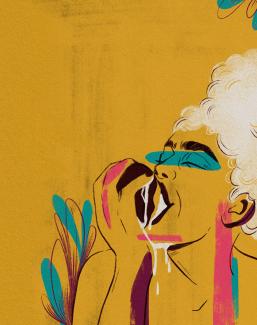
Donc, que votre plaisir prenne la forme de la préparation d’un repas à votre rythme, d’avoir des relations sexuelles, de rester au lit plusieurs jours avec vos partenaires, de participer à des collectifs de soins adaptés aux situations de handicap, d’avoir quelqu’un qui vous crache dans la bouche, de faire des sorties accessibles, d’avoir des rendez-vous de câlins, de participer à une soirée dansante en ligne, de passer du temps dans votre jardin, d’être étouffée dans un donjon,
J’espère que vous prenez le plaisir avec vous partout où vous allez. J’espère qu’il vous guérit, vous et celleux qui vous entourent.
Reconnaître le pouvoir de l’érotique au sein de nos vies peut nous donner l’énergie de poursuivre le véritable changement au sein de notre monde. - Audre Lorde, « Uses of the Erotic: The Erotic as Power »
Continuez à explorer Incarnations transnationales
Cette édition du journal, en partenariat avec Kohl : a Journal for Body and Gender Research (Kohl : une revue pour la recherche sur le corps et le genre) explorera les solutions, propositions et réalités féministes afin de transformer notre monde actuel, nos corps et nos sexualités.
نصدر النسخة هذه من المجلة بالشراكة مع «كحل: مجلة لأبحاث الجسد والجندر»، وسنستكشف عبرها الحلول والاقتراحات وأنواع الواقع النسوية لتغيير عالمنا الحالي وكذلك أجسادنا وجنسانياتنا.
Diana Isabel Hernández Juárez was a Guatemalan teacher, human rights defender and environmental and community activist. She was the coordinator of the environmental program at Our Lady of Guadalupe Parish on the South coast of the country.
Diana dedicated her life to co-creating environmental awareness, working especially closely with local communities to address environmental issues and protect natural resources. She initiated projects such as forest nurseries, municipal farms, family gardens and clean-up campaigns. She was active in reforestation programmes, trying to recover native species and address water shortages, in more than 32 rural communities.
On 7 September 2019, Diana was shot and killed by two unknown gunmen while she was participating in a procession in her hometown. Diana was only 35 years old at the time of her death.
Investissement à impact de genre et émergence de fausses solutions :
une analyse pour les mouvements féministes
L'investissement à impact de genre est désormais considéré comme une solution contre les inégalités de genre. Et pourtant, comme le montre notre rapport, il fait partie du problème. Les institutions publiques et privées en font la promotion en tant que moyen pour parvenir à l'égalité de genre et pour accroître les ressources des femmes et des filles.
Mais en aucun cas, ces affirmations ne sont étayées par des preuves.
Au contraire, l’investissement à impact de genre constitue plutôt une nouvelle version de vies et de sociétés soumises à une même logique financière, qui continue de façonner les profondes inégalités de notre monde.
Avec ce rapport, l'AWID offre aux lecteurs·rices - féministes, défenseur·euse·s de la justice de genre et autres parties prenantes de l'investissement à impact de genre - une analyse critique et des preuves étayées pour comprendre l’investissement à impact de genre, ses récits et les implications économiques et politiques qu’il a pour les mouvements féministes.
Snippet - CSW69 - Feminist Solidarity Space - FR
Espace de solidarité féministe
✉️ Sur inscription pour les grands groupes. Espace ouvert pour les petits groupes. Inscrivez-vous ici
📅 Mardi 11 mars 2025
🕒12.00h-14.00h et 16.00h-18.00h EST
🏢 Chef's Kitchen Loft with Terrace, 216 East 45th St 13th Floor New York
Organisé par : AWID
FRMag - Let the invisible be visible
Hagamos que lo invisible sea visible: manifiesto de unx fisicoculturista de género fluido en Hong Kong
por Siufung Law
«¡97…! 98… ¿dónde está 98? ¡98! ¡Por favor, vuelve a la formación!... ¡99! ¡100!...» La dama detrás del escenario le pedía incesantemente a cada atleta que formara una fila en el espacio húmedo, transpirado y abarrotado detrás de escena. (...)
< arte: «When They See Us» [Cuando nos ven], Lame Dilotsotlhe
40 ans de la fondation de AWID: L'album
Rassembler, semer et perturber.
L’année 2022 marque les 40 ans de la fondation de AWID. Nous profitons de ce moment pour nous pencher sur les années passées et apprendre du chemin parcouru, tout en nous préparant à l’avenir et au travail qui nous attend. À mesure de notre progression entre les cycles de progrès et de repli , nous avons appris que les luttes pour les droits des femmes et la justice de genre sont itératives et non linéaires. En collaboration avec l'artiste Naadira Patel, nous avons créé un album qui met en lumière une sélection de moments marquants, représentatifs des quatre décennies de soutien de AWID aux mouvements féministes.
Nous n’avons pas fait tout cela toutes seules. Nous vous faisons part de cela avec une profonde reconnaissance envers la myriade d’activistes et de groupes féministes qui ont rendu ce travail possible. Dans ce contexte de si nombreuses crises convergentes, nous accueillons l’occasion de célébrer le pouvoir et la résilience des mouvements féministes autour du monde…
Jaitun, comúnmente conocida como «Amma», estaba comprometida con garantizar los derechos reproductivos de las mujeres y niñas de India. Se dedicó, particularmente, a abogar por quienes viven en la pobreza y son más marginadas, incluidas las mujeres y niñas dalit y musulmanas.
Jaitun fue la fuerza vital detrás del caso Jaitun versus Janpura Maternity Home & Ors. Su perseverancia por la justicia llevó a que la Corte Suprema de Delhi emitiera una sentencia innovadora, que obligó al gobierno indio a hacerse responsable del incumplimiento de cierto número de obligaciones legalmente vinculantes, tales como la atención a la salud reproductiva y el derecho a la alimentación.
A su hija Fatema, quien vivía por debajo de la línea de pobreza, se le negaron los servicios reproductivos, y tuvo que dar a luz en público, bajo un árbol. En ese momento, tanto Jaitun como Fatema estaban en situación de calle, ya que su casa había sido demolida por el gobierno como parte del programa de reurbanización y gentrificación de Nueva Delhi.
«Desde entonces, esta sentencia ha sido utilizada por innumerables abogadxs y activistas de todo el mundo, incluyendo al ex-Relator Especial de la ONU sobre el derecho a la salud, no solamente como fuente de inspiración, sino como una sólida plataforma para promover la justicia.» - Jameen Kaur
Jaitun ha sido una inspiración para que muchas otras mujeres que viven en la pobreza reclamen sus derechos. Falleció en 2017.
«Con la muerte de Jaitun, hemos perdido una incomparable guerrera de la justicia, pero su espíritu de desafío pervive.» -Jameen Kaur
«En mis dieciocho años como defensora de los derechos humanos, nunca he encontrado una mujer que me inspirara ni que conmoviera mi espíritu de la forma en que lo hacía Amma. Su sonora valentía, su inimitable humor (solíamos compararla con la actriz de Bollywood, Hema Melini) cuando se sentía molesta porque habíamos pasado tanto tiempo lejos de ella... con un brillo en los ojos, decía “Ustedes se han olvidado de Amma, Amma ahora no les habla”, y luego con gran dramatismo se ponía de espaldas para darse vuelta enseguida riendo y estirando los brazos para un abrazo. Su bondad y, en definitiva, su amor y su alegría por el amor y el derecho de todxs nosotrxs a vivir con dignidad. La extraño terriblemente.» - Jameen Kaur
J’ai une vieille photo, floue, devant les yeux. J’y suis vêtue tout de blanc, des perles nacrées attachées à mes cheveux, collés contre mes oreilles, à celles qui pendent de mes poignets. (...)
illustration : « Cultura Negra » (“Culture noire”), par Astrid Milena González Quintero >
Introducing AWID’s next Co-Executive Directors
Dear Feminist Movements,
On behalf of the AWID Board of Directors, I am proud to introduce AWID’s next Co-Executive Directors: Faye Macheke and Inna Michaeli!
Faye Macheke is a passionate Pan-African feminist, active in movements for women's rights, racial justice, migrant and labor rights, and environmental justice. Her activism builds on the legacy of the struggle against apartheid in South Africa and the aftermath of the apartheid era in Zimbabwe. In 2019, Faye joined AWID as the Director of Finance, Operations and Development. She brings extensive experience in feminist leadership, strategy, and all aspects of organisational development. Faye is a committed Board Member of UAF-Africa and other women's rights organizations. She is based in Cape Town, South Africa.
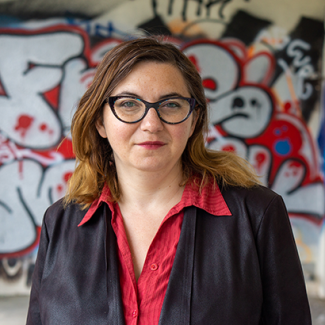
Inna Michaeli is a feminist lesbian queer activist and sociologist with many years of deep engagement in feminist and LGBTQI+ struggles, political education and organizing by and for migrant women, and Palestine liberation and solidarity. Inna joined AWID in 2016 and served in different roles, most recently as the Director of Programs. She brings extensive experience in research and knowledge building, policy advocacy and organizational development. Inna serves on the Board of the Jewish Voice for Peace - Germany. She is based in Berlin, Germany.
This decision is the result of a rigorous process with full participation of the Board and the staff of AWID. The Board recognised and honoured the skills and talents of AWID staff by opening an internal hiring search. As a result, we had two brilliant candidates, who embody the integrity, ethic of care, and feminist intersectional values that drive AWID’s work, apply together as a team. Faye and Inna brought forward a brave and exciting vision to meet the challenges of this moment: building a global feminist community, resisting and disrupting systems of oppression, and supporting feminist movements to thrive.
As AWID celebrates 40 years we are excited for Inna and Faye to co-lead AWID into our next strategy and a new phase of evolving, pushing boundaries, and supporting feminist movements worldwide.
Appointing and supporting AWID’s Co-Executive Directors to lead the organisation is a fiduciary responsibility we take seriously as a Board. How we engage those processes is also a reflection of AWID’s brilliant and diverse membership, which elects AWID’s Board.
As we say good-bye to Cindy and Hakima, we, the Board, unanimously and enthusiastically welcome Faye and Inna as our next Co-EDs as of September 5, 2022. Stay tuned for more updates about our leadership transition in the months ahead.
Most of all, thank you for your ongoing support!
In feminist solidarity and love, Margo Okazawa-Rey
President, AWID Board
Isabel Cabanillas de la Torre était une jeune artiste et activiste féministe très appréciée de Ciudad Juárez, au Mexique. Elle était connue pour ses belles peintures textiles, très expressives. Les yeux faisaient partie des représentations emblématiques de son travail. Ses peintures murales ont métamorphosé les immeubles décrépis et laissés à l’abandon du centre-ville de Ciudad Juárez, ornant leurs façades de messages de vie et de commentaires politiques.
Isabel voulait, à travers son art et son activisme politique, attirer l’attention sur les violences basées sur le genre omniprésentes dans sa ville natale. Elle était bénévole dans le réseau Mesa de Mujeres pour l’Observatoire citoyen sur le genre, qui supervise le travail des juges, procureurs et avocats de la défense dans les affaires de féminicides et autres violations basées sur le genre. Elle était également membre de Hijas de su Maquilera Madre, un collectif féministe dont le nom fait référence aux filles de mères qui travaillent dans les maquiladoras, ou zones de traitement pour l’exportation. Certaines de ces mères ont figuré parmi les premières victimes de féminicide dans la ville.
Le dernier projet d’Isabel, toujours en cours, était une installation artistique pour protester contre une entreprise canadienne qui cherchait à extraire du cuivre dans le désert de Samalayuca.
Le 18 janvier 2020, Isabel a été tuée par balle alors qu’elle rentrait chez elle à vélo dans le centre de Juárez, dansce qui semble avoir été un acte ciblé, son corps ayant été retrouvé à côté de son vélo.
Le meurtre d’Isabel a déclenché une nouvelle vague d’indignation contre les féminicides dans la région, des centaines de personnes ont manifesté jusqu’au pont frontalier entre le Mexique et les États-Unis, le bloquant pendant des heures et scandant « Ni Una Menos » (pas une de plus) alors que des collectifs féministes continuaient de manifester contre les meurtres de femmes dans tout le pays. Au cours de la seule année 2019, 3 142 femmes et filles ont été tuées au Mexique. Un grand nombre ont été spécifiquement ciblées du fait de leur genre.
Elle adorait faire du vélo.
« Le vélo était son symbole de liberté. Il symbolisait le fait d’être libre dans les rues. » - Marisol (une amie d’Isabel)
Il n'y a rien de tel que d'être dans un espace partagé, d'échanger des énergies corporelles, de regarder dans les yeux de quelqu'un et de tisser des liens, de voir le monde et de faire quelque chose ensemble. Des événements comme le Forum sont parmi les plus forts du mouvement féministe mondial... - Jac s m Kee, Malaisie
📅 Thursday, March 13, 2025
🕒 09.30-11.30am EST
🏢 Outright International Office, 17th Floor, 216 E 45th Street, New York
🎙️AWID speaker: Inna Michaeli, Co-Executive Director
Organizer: Outright International
Film club - Finding Sally
Finding Sally (2020) Amharic | English with English subtitles
A personal investigation into the mysterious life of the director's Aunt Sally, an Ethiopian aristocrat-turned-communist-rebel who disappeared after the revolution that lead to the overthrow of Emperor Haile Selassie.
Live Conversation with Tamara Dawit, the filmmaker of “Finding Sally”
June 23 at 12:30pm EST on IG Live
Carta de amor a los movimientos feministas #2
Mi querida colectiva feminista:
La integro desde que tengo uso de razón. De jovencita, no sabía que existía una palabra — «feminista» — para nosotrxs, quienes aspiramos a superar y desmantelar el patriarcado; quienes buscamos refugio en los brazos de la inclusión y la interseccionalidad; quienes tratamos a las personas como iguales independientemente de su género, raza, sexualidad, religión y etnia; quienes estamos continuamente aprendiendo a obrar mejor, a ser mejores y a usar nuestros privilegios para que otras personas mejoren.
Cuando tenía 14 años, mi profesor de francés de la escuela secundaria, un hombre de 1,80 metros de altura y 30 años de edad, agredió a una alumna de mi clase delante de todxs nosotrxs. La alumna, que era amiga mía desde la infancia, y varias chicas más fuimos a la dirección para denunciarlo, madres y padres se involucraron y toda la clase, treinta alumnxs, expresó su apoyo a la chica. Pero todos nuestros intentos para que el profesor rindiera cuentas por lo que había hecho fracasaron: la administración ocultóó la denunciaa y el profesor nunca fue despedido ni perseguido. Mis compañeras y yo estábamos indignadas, así que hicimos lo que toda joven feminista furiosa haría: LE TIRAMOS HUEVOS A SU AUTO. Si bien los huevos se lavaron con facilidad, costó más sacar la pintura que usamos para escribir las palabras «Cerdo» y «Khamaj» (basura). Nunca olvidaré cómo nos hizo sentir eso: liberadas, enfurecidas, felices, muy unidas y con poder. La misma emoción se repite en todos los ámbitos feministas en los que he estado desde entonces. La feminista adolescente que hay en mí creció y participó en Women Deliver, AWID, Unootha, facilitó talleres feministas en la universidad, e incluso fue perseguida por su filiación feminista a los 19 años, pero esa es otra historia para otra carta.
Los movimientos y espacios feministas me brindan seguridad y empoderamiento. Son las madres que hubiéramos deseado tener y los vínculos que necesitábamos para conectarnos y organizarnos, a pesar de nuestras diferencias, contra un enemigo común, el patriarcado, que nos ha estado perjudicando a todxs. Con ustedes aprendí a ser resiliente y a reunir mis fuerzas y habilidades para estimular a otras personas, para sacar a la luz la situación de las personas marginadas, y dar voz a quienes no la tienen.
Lo que más me gusta de ustedes, movimientos feministas, es que a veces hacen mal las cosas, desprecian y también marginan, tienen prejuicios como cualquier otro movimiento, pero lo que los diferencia es que siempre se esfuerzan por ser mejores. La rendición de cuentas no es algo a lo que le teman, y son un colectivo en constante cambio que refleja cómo el altruismo y la filantropía que se proponen lograr la equidad de género también cambian con el paso del tiempo.
Que crezcan siempre, que obren mejor, que siempre se enfurezcan, que siempre rujan, que siempre amen, que siempre hablen distintas lenguas y que siempre sientan su poder.
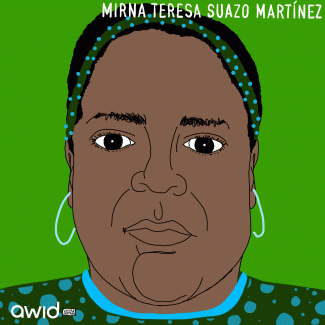
Mirna Teresa Suazo Martínez was part of the Garifuna (Afro-descendent and Indigenous) Masca community, living on the North Caribbean coast of Honduras. She was a community leader and a fervent defender of the Indigenous territory, a land that was violated when the National Agrarian Institute of Honduras gave territorial licenses to people outside of the community.
This deplorable deed resulted in repeated harassment, abuse and violence against the Masca, where economic interests of different groups met those of Honduran armed forces and authorities. According to the Black Fraternal Organization of Honduras (OFRANEH), the strategy of these groups is to evict and exterminate the Indigenous population.
“Masca, the Garifuna community located next to the Cuyamel Valley, is part of the area of influence of one of the supposed model cities, a situation that has triggered territorial pressures along the Garifuna coast.” - OFRANEH, 8 September 2019
Mirna Teresa, president of the Board of Trustees of the Masca Community in Omoa, was also firmly rejecting the construction of two hydroelectric plants on the river that carries the same name as her community, Masca.
“The Garífuna community attributes the worsening of the situation in their region to their opposition to tourist exploitation, the monoculture of African palm and drug trafficking, at the same time that it seeks to build an alternative life through the cultivation of coconut and other products for self-consumption.” - Voces Feministas, 10 September 2019
Mirna Teresa was murdered on 8 September 2019 in her Restaurant “Champa los Gemelos”.
She was one of six Garifuna women defenders murdered between September and October 2019 alone. According to OFRANEH, there was no investigation by the authorities into these crimes.
“In the case of the Garífuna communities, a large part of the homicides are related to land tenure and land management. However, squabbles between organized crime have resulted in murders, such as the recent ones in Santa Rosa de Aguán.” - OFRANEH, 8 September 2019