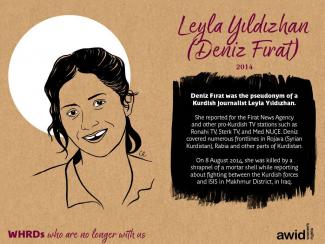
Leyla Yıldızhan (Deniz Fırat)
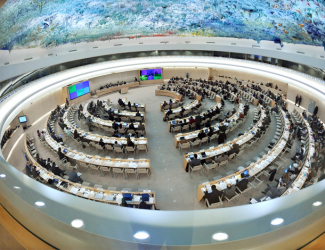
The Human Rights Council (HRC) is the key intergovernmental body within the United Nations system responsible for the promotion and protection of all human rights around the globe. It holds three regular sessions a year: in March, June and September. The Office of the UN High Commissioner for Human Rights (OHCHR) is the secretariat for the HRC.
Debating and passing resolutions on global human rights issues and human rights situations in particular countries
Examining complaints from victims of human rights violations or activist organizations on behalf of victims of human rights violations
Appointing independent experts (known as “Special Procedures”) to review human rights violations in specific countries and examine and further global human rights issues
Engaging in discussions with experts and governments on human rights issues
Assessing the human rights records of all UN Member States every four and a half years through the Universal Periodic Review
AWID works with feminist, progressive and human rights partners to share key knowledge, convene civil society dialogues and events, and influence negotiations and outcomes of the session.
La encuesta mundial ¿Dónde está el dinero? es un pilar fundamental de la tercera edición de nuestra investigación orientada a la acción: ¿Dónde está el dinero para las organizaciones feministas? (abreviadamente, ¿Dónde está el dinero? y WITM). Los resultados de la encuesta se desarrollarán y analizarán en mayor profundidad mediante conversaciones exhaustivas con activistas y donantes, y se contrastarán con otros análisis e investigaciones disponibles acerca del estado del financiamiento para las organizaciones feministas y por la igualdad de género en todo el mundo.
El informe completo ¿Dónde está el dinero para las organizaciones feministas? se publicará en 2026.
 Para conocer más información acerca de cómo AWID ha arrojado luz sobre el dinero destinado en favor y en contra de los movimientos feministas, consulta nuestra historia ¿Dónde está el dinero? y nuestros informes anteriores aquí.
We see Taipei as the location in the Asia Pacific region that will best allow us to build that safe and rebelious space for our global feminist community.
Taipei offers a moderate degree of stability and safety for the diversity of Forum participants we will convene. It also has strong logistical capacities, and is accessible for many travellers (with a facilitated e-visa process for international conferences).
The local feminist movement is welcoming of the Forum and keen to engage with feminists from across the globe.
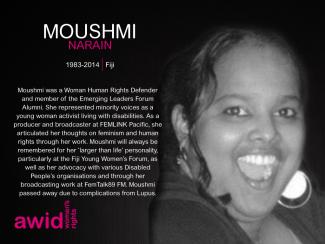
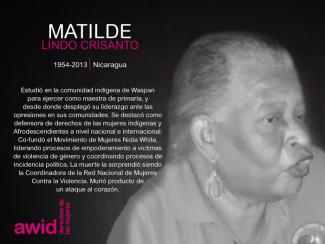
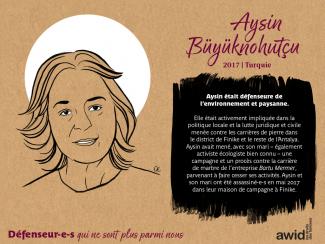
Estas defensoras lucharon por los derechos sobre la tierra, de las mujeres y de los pueblos indígenas; haciendo frente a las industrias extractivas, escribiendo poesía y promoviendo el amor. Una de ellas desapareció hace ya 19 años. Únete a nosotras para recordar y honrar a estas defensoras de derechos humanos, su trabajo y su legado, compartiendo los memes aquí incluidos; y tuiteando las etiquetas #WHRDTribute y #16Días.
Por favor, haz click en cada imagen de abajo para ver una versión más grande y para descargar como un archivo.



The key objective of the WITM survey is to shine light on the financial status of diverse feminist, women’s rights, gender justice, LBTQI+ and allied movements globally. Based on this, we hope to further strengthen the case for moving more and better money, as well as shift power, to feminist movements.
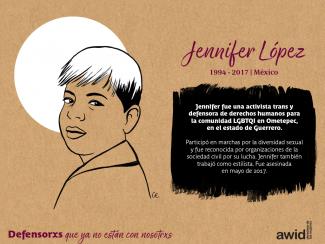
These transgender women were murdered because of their activism and their gender identity. There are insufficient laws recognizing trans* rights, and even where these laws exist, very little is being done to safeguard the rights of trans* people. Please join AWID in honoring these defenders, their activism and legacy by sharing the memes below with your colleagues, networks and friends and by using the hashtags #WHRDTribute and #16Days.
Please click on each image below to see a larger version and download as a file


No. Solicitamos una sola respuesta a la encuesta por agrupación.
This section highlights key resources recommended by AWID so you can conduct your own WITM research.
In this section
Online tools
Once you gather these resources, you can estimate the costs for your research using our “Ready to Go? Worksheet”

The Ready to Go? Worksheet helps you estimate resources, staff and budget needed for your research
Listen to the story here:

Sauf si vous avez des problèmes d’accessibilité et/ou que vous répondez aux questions de l’enquête dans une autre langue, nous vous encourageons fortement à utiliser KOBO pour une collecte et une analyse standardisées des données WITM.