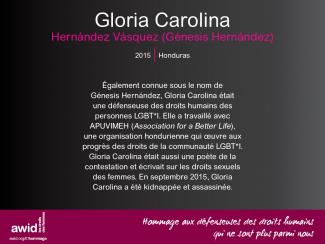
Gloria Carolina Hernández Vásquez
WHRDs are self-identified women and lesbian, bisexual, transgender, queer and intersex (LBTQI) people and others who defend rights and are subject to gender-specific risks and threats due to their human rights work and/or as a direct consequence of their gender identity or sexual orientation.
WHRDs are subject to systematic violence and discrimination due to their identities and unyielding struggles for rights, equality and justice.
The WHRD Program collaborates with international and regional partners as well as the AWID membership to raise awareness about these risks and threats, advocate for feminist and holistic measures of protection and safety, and actively promote a culture of self-care and collective well being in our movements.
WHRDs are exposed to the same types of risks that all other defenders who defend human rights, communities, and the environment face. However, they are also exposed to gender-based violence and gender-specific risks because they challenge existing gender norms within their communities and societies.
We work collaboratively with international and regional networks and our membership
We aim to contribute to a safer world for WHRDs, their families and communities. We believe that action for rights and justice should not put WHRDs at risk; it should be appreciated and celebrated.
Promoting collaboration and coordination among human rights and women’s rights organizations at the international level to strengthen responses concerning safety and wellbeing of WHRDs.
Supporting regional networks of WHRDs and their organizations, such as the Mesoamerican Initiative for WHRDs and the WHRD Middle East and North Africa Coalition, in promoting and strengthening collective action for protection - emphasizing the establishment of solidarity and protection networks, the promotion of self-care, and advocacy and mobilization for the safety of WHRDs;
Increasing the visibility and recognition of WHRDs and their struggles, as well as the risks that they encounter by documenting the attacks that they face, and researching, producing, and disseminating information on their struggles, strategies, and challenges:
Mobilizing urgent responses of international solidarity for WHRDs at risk through our international and regional networks, and our active membership.
Esta publicación (zine) colaborativa surgió de una serie de círculos de intercambio que reunieron a feministas de todo el mundo durante 2022. El propósito fue intercambiar ideas y aprender mutuamente de qué manera las comunidades responden a la crisis climática en diversos contextos locales.
Sara AbuGhazal es una feminista palestina que vive en Beirut. Es cofundadora de Sawt al-Niswa, un colectivo que produce conocimiento en Beirut. Es codirectora de The Knowledge Workshop [«Taller del conocimiento»], una organización feminista con sede en Beirut que trabaja en la historia oral y el archivo feminista. Sara es actualmente la Coordinadora Regional de la Coalición Regional para Defensoras de los Derechos Humanos en el Medio Oriente y África del Norte.
Sara lucha para ayudar a crear espacios de transformación feminista y solidaridad. Su trabajo se centra principalmente en la construcción de movimientos sostenibles en la región del MOAN. Sara se empeña en temas de la Palestina, la producción de conocimiento y la transformación feminista. Publica regularmente en sawtalniswa.org y su obra de ficción también aparece en la revista electrónica Romman

We welcome applications across the full range of thematic areas and intersections important to feminist and gender justice movements. In the application form, you will be able to mark more than one theme that fits your activity.
by Chinelo Onwualu
On September 2nd, 2021, the amazing feminist and social justice activists of AWID’s Crear | Résister | Transform festival came together not only to share resistance strategies, co-create, and transform the world, but also to talk dirty on Twitter.
Hola de nuevo, y de nuevo, y de nuevo. Los he conocido y amado durante toda mi vida adulta, desde que los encontré, significativamente, después de graduarme de la universidad. Los había visto una vez antes. Fue cuando ustedes aparecieron como Betty Friedan en un programa de entrevistas de televisión en el Medio Oeste de los Estados Unidos, a finales de la década de 1960. En ese momento, la Sra. Wells (mi otra madre) y yo comentamos las ideas exageradas y disparatadas de las que esta mujer estaba tratando de convencernos. Desde entonces, década tras década, me he enamorado cada vez más profundamente de ustedes, mis amados movimientos, y he entendido y presenciado su genialidad política y teórica, su autoridad ética y moral, su creatividad, su alegría, y su amor, sobre todo. Casi sesenta años después, sé que somos compañerxs para siempre.
Los primeros años de nuestra relación fueron buenos. Yo estaba bastante autoinvolucrada (tratando de entender la identidad racial, de género y sexual; aclarando mis políticas, valores y ética fundamentales; completando mi educación formal), y ustedes me brindaron numerosos escenarios, centros sociales intelectuales y ambientes de contención acogedores donde y a través de los cuales pude elaborar los componentes fundamentales de la feminista y el ser humano en que me convertiría.
Los movimientos de mujeres predominantemente blancas de Cambridge y Boston, incluyendo Daughters of Bilitis [Hijas de Bilitis], fueron mi punto de partida. Eso me vino bien en ese momento, pero pronto me di cuenta de que deseaba algo más. ¡Poof! Mágicamente (descubrimiento casual), me conecté con un pequeño grupo de mujeres radicales, antiimperialistas, negras, socialistas y lesbianas y, pronto, nos convertimos en el Combahee River Collective [Colectivo del Río Combahee].
Esa temprana experiencia de Combahee -combinada con aprendizajes vitales críticos y, en particular, con las políticas raciales inmigrantes afroamericanas y coreanas de principios de la década de 1990 en los Estados Unidos- me prepararon para el viaje que me ha llevado a identificarme y a trabajar como feminista transnacional para enfrentar el militarismo y a dedicarme a imaginar otros mundos donde todos los seres vivos prosperen.
Los dos momentos críticos siguientes del movimiento de mujeres ocurrieron décadas después de los años de Combahee, pero estuvieron profundamente vinculados. Primero, fue conocer y ser invitada al movimiento feminista coreano que se estaba organizando contra las bases militares estadounidenses y apoyaba a las «mujeres kijichon» [«mujeres de confort»], las mujeres coreanas cuyas vidas (que para algunas incluía a sus hijxs mestizxs) giraban alrededor del variado servicio al personal militar estadounidense en las aldeas y los pueblos adyacentes a las bases. Las amadas feministas coreanas, especialmente Kim Yon-Ja y Ahn Il Soon (las primeras hermanas que conocí y con quienes viajé), me hicieron ver y comprender la importancia crítica de la nación como principio analítico y organizativo. El «toque final» fue vivir y trabajar en la Palestina ocupada. La difunta Maha Abu-Dayyeh me introdujo al movimiento de mujeres palestinas, con un comentario profundo: «puedes dejar Palestina, pero Palestina nunca te dejará». Cuánta verdad. Y todo mi trabajo y mis experiencias a través de muchas fronteras me llevaron a AWID, mi segundo hogar.
Como saben, amados movimientos, estar con ustedes no ha sido fácil ni simple. De hecho, son demandantes, están sistemáticamente plagados de contradicciones y, a veces, hasta resultan hirientes. No obstante, continúan creciendo y desarrollándose, a medida que sostienen mi propio crecimiento y desarrollo político, emocional y espiritual. Supongo que nos cultivamos mutuamente: un proceso muy profundo al cual dedicaré el resto de mi tiempo bajo mi forma actual.
El eje de ser/estar con ustedes todas estas décadas es esto:
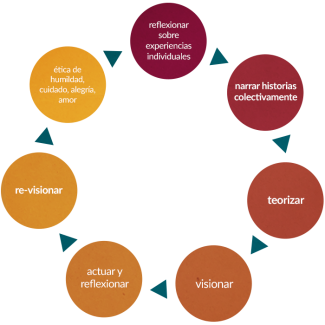
Feministas que comprometen colectivamente sus cabezas, corazones, manos y espíritus para transformar nuestros mundos
¡Mucho amor, movimientos feministas!
Su Margo
alias DJ MOR Love and Joy
Wellfleet, Massachusetts, Estados Unidos
As world leaders gather in Brazil, feminist movements are advocating, gathering and disrupting the status quo- at COP30 and beyond! We're heading alongside other feminists to Belém, Brazil for COP30, from 10 November – 21 November 2025, where we will continue to denounce false solutions.
Salome est une activiste féministe originaire de Tbilisi, Géorgie, qui se consacre à la justice de genre et sociale. Titulaire d’une Maîtrise en études sur le genre, elle s’est impliquée auprès de mouvements féministes, queers et écologiques au cours des neuf dernières années, travaillant entre autres sur les questions de la violence liée au genre, la violence domestique, la santé sexuelle et reproductive et les droits afférents, les droits LGBTIQ et la sécurité et les droits holistiques et numériques.
Depuis 2014, elle travaille activement sur les questions de sécurité et de sûreté des activistes et des femmes défenseures des droits humains, organisant des ateliers sur la sécurité intégrée et la sécurité numérique spécialement pour les activistes de groupes défavorisés (personnes homosexuelles, minorités ethniques et religieuses, femmes et filles rurales, etc.) ainsi que pour de grandes organisations féministes. Salome est membre de l’Independent Group of Feminists (Groupe indépendant de féministes)- une initiative non-formelle, non hiérarchique et non enregistrée qui réunit des féministes géorgiennes ayant différents parcours. Elle travaille actuellement avec le Fonds pour les femmes de Géorgie, où elle est pleinement impliquée dans la construction de mouvements de femmes/féministes, tout en offrant un financement féministe et encourageant la philanthropie féministe locale.
Participants will come together in Bangkok, Thailand. We can’t wait!
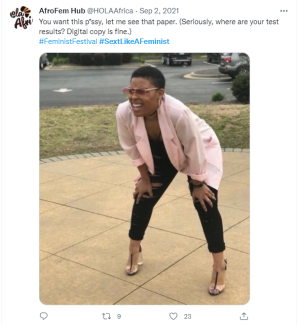
Si quieres esta concha, déjame ver ese papel (En serio, ¿dónde está el resultado de tu prueba? En versión digital está bien)
Le corps est une entité puissante. En tant que femmes, notre corps est contrôlé, opprimé et policé depuis l'utérus. Notre apparence, nos mouvements, nos vêtements, notre façon de marcher, de parler, nos gestes et notre rire. Je me suis souvent interrogée sur les raisons des peurs patriarcales liées au pouvoir du corps féminin.
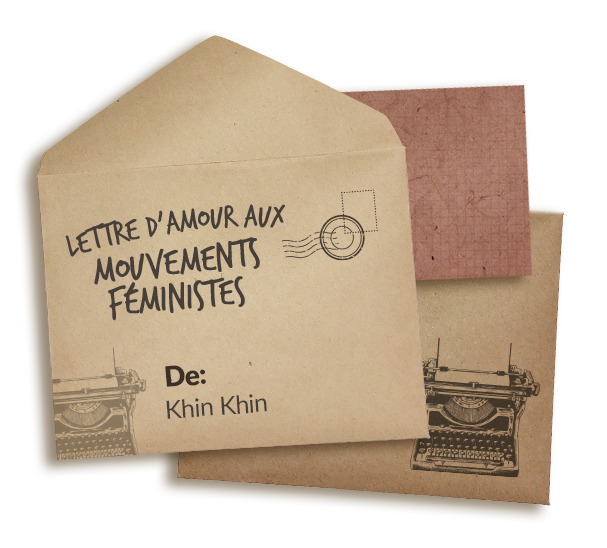
Là d'où je viens, le travail du sexe et les travailleur.se.s du sexe étaient évoqué.e.s avec un mélange de mépris, de dégoût, de fascination, de pitié et de condamnation.
J'ai entré en contact avec le travail du sexe et les travailleur.se.s du sexe pour la première fois à l'âge de 22 ans. À partir de simples conversations, assis.e.s en cercle, autour d'un café ou d'un thé, nous avons exploré la vie, les expériences, les pensées et les sentiments de chacun.e.
Pour les travailleur.se.s du sexe, le travail du sexe était le choix le plus intéressant parmi toutes les autres options : payer les factures, soutenir la famille, bénéficier d’horaires de travail plus flexibles, avoir des relations sexuelles. Tout comme j'ai choisi mon travail comme étant le choix le plus intéressant pour payer les factures, soutenir la famille, avoir des heures de travail plus flexibles.
Ces personnes, femmes et hommes, m'ont appris que je prenais mes propres décisions concernant mon corps... duquel je concentre sa vie et son énergie, si je l'utilise pour le plaisir ou la douleur, si je l'échange ou le donne librement, et comment je veux m’y sentir. Cette prise de conscience était aussi excitante qu’autonomisante.
Crear | Résister | Transform : un festival pour les mouvements féministes - 2021... vous m'avez accompagnée dans une série de moments qui ont changé ma vie (!!!)
Nous appelons cela des « événements », mais en réalité, vos espaces d'apprentissage féministes sont selon moi des lieux où je prends un peu de ce que j'ai en moi, un peu de ce que disent vos intervenants et un peu des discussions pour approfondir notre compréhension.
Partager... Participer... S'immerger...
dans la force, dans la vulnérabilité, dans le plaisir.
Être simplement la féministe transformatrice que je suis, sans prétentions, sans appréhensions...
Accueillir la féministe transformatrice que j'ai toujours été, sans même connaître le terme ou le reconnaître de cette manière ou en ces termes...
Trouver un foyer pour la féministe transformatrice féroce qui vit en moi...
Malgré la colère, la rage et la frustration de ne pas être traitée sur un pied d'égalité et d'être traitée comme « moins __ que ».
Je ne me suis pas toujours considérée comme une féministe ni reconnue dans le mouvement ou le discours féministe... En réalité, j'apprécie que l'on m'ouvre les portes, que l'on me tire les chaises pour m'asseoir, que l'on reconnaisse ma féminité en tant que femme.
Parfois, j'ai rejeté le patriarcat avec agacement, parfois j'ai réagi avec frustration et colère, mais je ne l'ai pas abordé... Je n'ai pas remarqué sa toxicité sinistre et insidieuse... J'étais assez privilégiée de pouvoir travailler à travers lui, d'y survivre, de le surmonter, d'exceller malgré lui... Je n'ai pas suffisamment remis en question, pas suffisamment défié, pas suffisamment repoussé mes limites... Je n'en ai pas fait assez...
se connecter avec les travailleur.se.s du sexe, explorer la sexualité, et les femmes pour la paix et la sécurité....
Jusqu'à ce que je prenne pleinement conscience et comprenne que les implications des privilèges et de l'oppression étaient intersectionnelles.
Jusqu'à ce que je réalise ce que signifie se battre pour la justice de genre et pas seulement pour « l'égalité pour tous ».
Je ne suis plus une praticienne et une animatrice, mais bien une praticienne et une animatrice féministe transformatrice.
Être féministe signifie que je vais agir
Plonger dans un avenir incertain, fragile, complexe (et peut-être assez violent)...
Je vous suis profondément reconnaissante et je promets de rester féroce dans la prise en compte et le redressement des questions problématiques liées au genre, à la race, à l'ethnicité, à la classe sociale, à l'orientation sexuelle et aux capacités, et de rester présente et fidèle à la lutte pour l'inclusion, l'équité et la justice.
Khin Khin
Enciende tu fuego feminista leyendo nuestras investigaciones y publicaciones varias sobre financiamiento, defensoras de derechos humanos, construcción de movimientos, fundamentalismos, justicia económica, seguimiento y evaluación feminista y más
Patience is a global human resources professional with over a decade of experience in human resources (HR) management in the not-for-profit sector. Patience previously worked at Mercy Corps as the Global HR Officer for Africa supporting the full employee life cycle for expatriates in the Eastern and Southern African region and provided HR technical guidance to Human Resources leaders in country offices within the African region. Before joining the global people team, she was the Country Human Resources and Safeguarding Focal Point, she was part of the senior management team leading on all human resources and safeguarding matters. Prior to Mercy Corps she led the HR and Operations department at SNV Netherlands Development Organization and was a member of the country management team. She also has HR Consultancy experience which she gained while she was still studying for her BSc Honors degree in Human Resource Management. She has a passion for HR, loves working with people and she takes wellbeing and safeguarding as her core values and in her professional work. As someone who loves sports, you can also find Patience at the basketball court, the tennis court or on the soccer field.
ใหม่
ผู้เข้าร่วมประชุมจะได้เข้าร่วมตามสถานที่ต่างๆนอกเพื้นที่ในการจัดงานที่กรุงเทพฯ และตามส่วนต่างๆของ โลกในแต่ละวันของการประชุม สถานที่ประชุมที่ผู้เข้าร่วมจัดการเองทั้งหมดนั้นจะเชื่อมต่อกับสถานที่จัดงาน
จริงในกรุงเทพฯเช่นเดียวกับบุคคลที่เชื่อมต่อทางออนไลน์ ผู้เข้าร่วมในจุดศูนย์กลาง Hub นี้จะสามารถ ดำเนินรายการในหัวข้อกิจกรรมต่างๆ เข้าร่วมอภิปราย แลกเปลี่ยน และเพลิดเพลินไปกับโปรแกรม ที่หลากหลาย
ที่ตั้งจุดศูนย์กลาง Hub จะประกาศในปี 2567
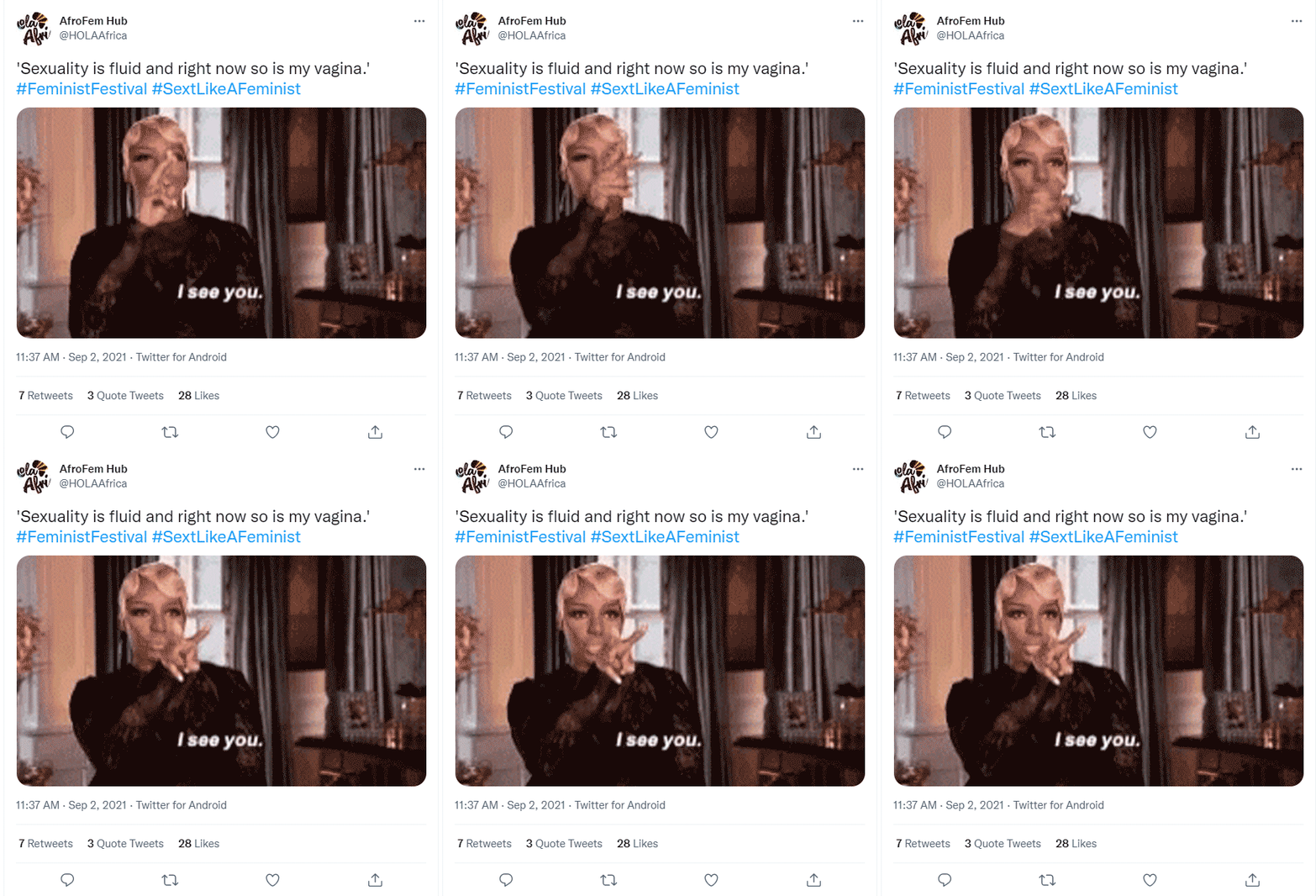
« La sexualité est fluide, et là mon vagin aussi. »
#FeministFestival #SextLikeAFeminist
Across the world and social movements, those who want to innovate tend to feel lonely and powerless before the ‘movement status quo’. Historically, the AWID Forums have played a role in supporting these innovators by offering them a platform where their ideas and practices are welcomed and strengthened by the thoughts and actions of others – in different regions and communities – who have already explored them. Sara Abu Ghazal, Palestinian feminist in Lebanon, tells the story of what the Forums meant for a new generation of feminists in the MENA (Middle East and North Africa) region that introduced new ways of organising, new understandings of feminism and new issues to the regional women’s rights landscape.
Du 27 au 30 avril 2026, l’AWID participera à la Conférence Women Deliver 2026, en co‑créant un espace politique avec les mouvements féministes et de justice de genre, ancré dans le care et la solidarité transnationaux.
À une époque où le fascisme et la militarisation continuent de progresser à l’échelle mondiale, la connexion féministe et la solidarité au‑delà des frontières sont plus que jamais essentielles. Nous organisons plusieurs espaces, à Women Deliver et en ligne, pour connecter les mouvements entre eux à travers des espaces de dialogue, afin de construire des agendas féministes de solidarité et d’action.
Durante sus 38 años de carrera, Debbie Stothard ha trabajado con diferentes comunidades y activistas para involucrar en los derechos humanos y la justicia a los Estados, organizaciones intergubernamentales y otras partes interesadas a lo largo de Asia, África, Europa y las Américas. Su trabajo está enfocado en las prioridades temáticas de las empresas y en los derechos humanos, en la prevención de las atrocidades y en el liderazgo de las mujeres. Por ello, ha sido facilitadora o persona de referencia en casi 300 eventos de capacitación durante los últimos 15 años. La mayoría fueron talleres orientados a las bases, desarrollados en el terreno, centrados en la incidencia en derechos humanos, alfabetización económica, en empresas y derechos humanos, y en justicia transicional y prevención de las atrocidades. Su trabajo en justicia transicional y prevención de las atrocidades ha estado enfocado principalmente en Burma/Myanmar, aunque también ha proveído asesoramiento para responder a situaciones de otros países alrededor del mundo.
Entre 1981 y 1996, Debbie trabajó como periodista especializada en crímenes, activista estudiantil, analista política, académica, consejera de gobierno y proveedora de comida en Malasia y Australia, mientras era voluntaria en causas de derechos humanos. En 1996, fundó ALTSEAN-Burma, que encabezó una variedad de programas de innovación y empoderamiento en derechos humanos. Entre ellos, el programa intensivo permanente de liderazgo de ALTSEAN para diferentes mujeres jóvenes de Burma, que, durante los últimos 22 años, ha ayudado a fortalecer y ampliar el liderazgo de las mujeres en las zonas afectadas por el conflicto. Se desempeñó como integrante de la Junta de la Federación Internacional de Derechos Humanos (FIDH) durante 9 años como secretaria general adjunta (2010-2013) y secretaria general (2013-2019), durante los cuales promovió la misión y el perfil de la FIDH en, aproximadamente, 100 reuniones y conferencias por año.