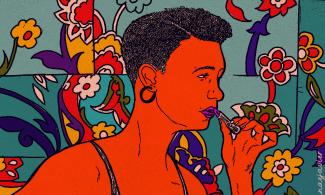
WHRDs are self-identified women and lesbian, bisexual, transgender, queer and intersex (LBTQI) people and others who defend rights and are subject to gender-specific risks and threats due to their human rights work and/or as a direct consequence of their gender identity or sexual orientation.
WHRDs are subject to systematic violence and discrimination due to their identities and unyielding struggles for rights, equality and justice.
The WHRD Program collaborates with international and regional partners as well as the AWID membership to raise awareness about these risks and threats, advocate for feminist and holistic measures of protection and safety, and actively promote a culture of self-care and collective well being in our movements.
Risks and threats targeting WHRDs
WHRDs are exposed to the same types of risks that all other defenders who defend human rights, communities, and the environment face. However, they are also exposed to gender-based violence and gender-specific risks because they challenge existing gender norms within their communities and societies.
By defending rights, WHRDs are at risk of:
Physical assault and death
Intimidation and harassment, including in online spaces
Judicial harassment and criminalization
Burnout
A collaborative, holistic approach to safety
We work collaboratively with international and regional networks and our membership
to raise awareness about human rights abuses and violations against WHRDs and the systemic violence and discrimination they experience
to strengthen protection mechanisms and ensure more effective and timely responses to WHRDs at risk
We work to promote a holistic approach to protection which includes:
emphasizing the importance of self-care and collective well being, and recognizing that what care and wellbeing mean may differ across cultures
documenting the violations targeting WHRDs using a feminist intersectional perspective;
promoting the social recognition and celebration of the work and resilience of WHRDs ; and
building civic spaces that are conducive to dismantling structural inequalities without restrictions or obstacles
Our Actions
We aim to contribute to a safer world for WHRDs, their families and communities. We believe that action for rights and justice should not put WHRDs at risk; it should be appreciated and celebrated.
Promoting collaboration and coordination among human rights and women’s rights organizations at the international level to strengthen responses concerning safety and wellbeing of WHRDs.
Supporting regional networks of WHRDs and their organizations, such as the Mesoamerican Initiative for WHRDs and the WHRD Middle East and North Africa Coalition, in promoting and strengthening collective action for protection - emphasizing the establishment of solidarity and protection networks, the promotion of self-care, and advocacy and mobilization for the safety of WHRDs;
Increasing the visibility and recognition of WHRDs and their struggles, as well as the risks that they encounter by documenting the attacks that they face, and researching, producing, and disseminating information on their struggles, strategies, and challenges:
Mobilizing urgent responses of international solidarity for WHRDs at risk through our international and regional networks, and our active membership.
Related Content
Animation : On appelle toutes les superhéroïnes féministes!
Animation:
On appelle toutes les superhéroïnes féministes!
Suivez notre super-héroïne alors qu'elle se lance dans une quête pour récupérer le récit des acteurs anti-droits à travers le monde.
Thank you for taking a step further to change the world!
Your generous contribution will help us support feminist movements across the globe working to achieve gender justice and women’s human rights worldwide.
You can also support our work as an AWID Member. Find out how here.
Mi pregunta no está respondida aquí
Para preguntas adicionales, por favor utiliza nuestro formulario de contacto. ¡Continuaremos actualizando este documento en base a las consultas que vayamos recibiendo de ustedes!
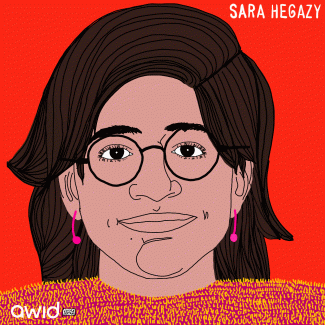
Sara Hegazy, a bold Egyptian LGBTQI+ rights activist, lived in a society where the members of her community, their bodies and lives often face lethal prejudice. The roots of Sara’s resistance were in the deconstruction of a dominant, oppressive and patriarchal system, and its anti-rights actors.
"[In Egypt], every person who is not male, Muslim, Sunni, straight, and a supporter of the system, is rejected, repressed, stigmatized, arrested, exiled, or killed. This matter is related to the patriarchal system as a whole, since the state cannot practice its repression against citizens without a pre-existing oppression since childhood." - Sara Hegazy wrote on March 6, 2020
The suppression of Sara’s voice by the Egyptian government reached its violent peak in 2017, when she was arrested for raising a rainbow flag at the Mashrou’ Leila (Lebanese band whose lead vocalist is openly gay) concert in Cairo. What followed were charges of joining an illegal group along with “promoting sexual deviancy and debauchery”.
"It was an act of support and solidarity — not only with the [Mashrou' Leila] vocalist but for everyone who is oppressed...We were proud to hold the flag. We wouldn't have imagined the reaction of society and the Egyptian state. For them, I was a criminal — someone who was seeking to destroy the moral structure of society." - Sara Hegazy
Sara was jailed for three months, where she was tortured and sexually assaulted. In January 2018, after being released on bail, she sought asylum in Canada where she was safe but imprisoned by the memories of the abuse and violence her body and soul had gone through.
"I left this experience after three months with a very intense, serious case of PTSD [post-traumatic stress disorder]. Prison killed me. It destroyed me." - Sara Hegazy told NPR
Sara took her own life on 14 June 2020, leaving a handwritten note in Arabic:
“To my siblings – I tried to find redemption and failed, forgive me.”
“To my friends – the experience [journey] was harsh and I am too weak to resist it, forgive me.
“To the world – you were cruel to a great extent, but I forgive.”
Her legacy and courage will be carried forward by those who love her and believe in what she fought for.
Tributes:
“To Sarah: Rest, just rest, spared from this relentless violence, this state-powered lethal patriarchy. In rage, in grief, in exhaustion, we resist.” - Rasha Younes, an LGBT rights researcher at Human Rights Watch. Read the complete text
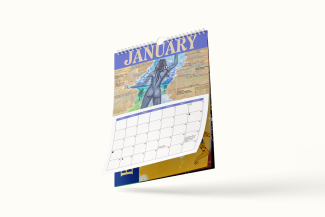
Considera este calendario como un obsequio, que te llega a ti y a 9500 afiliades de nuestra comunidad feminista mundial. Un obsequio de esperanza, conexiones renovadas, acción y comunidad en un momento de inmensas injusticias y violencias.
Que estas historias te recuerden que a través de las fronteras y a lo largo de las luchas, somos muches, somos fuertes y, en conjunto, construimos los mundos que merecemos.
As an online participant, you can facilitate activities, connect and converse with others, and experience first-hand the creativity, art and celebration of the AWID Forum. Participants connecting online will enjoy a rich and diverse program, from workshops and discussions to healing activities and musical performances. Some activities will focus on connection among online participants, and others will be truly hybrid, focusing on connection and interaction among online participants and those in Bangkok.
Feminists have long asserted that the personal is political. Crear, Resister, Transform Festival created spaces for feminists to discuss issues around body, gender and sexualities, and explored the interconnections of how these issues are both deeply embodied experiences, and simultaneously a terrain where rights are constantly disputed and at risk in society.
The power of feminist movements lie in how we organise and take coordinated action, not only amongst our own communities and movements, but with allied social justice causes and groups. This space provided opportunities for movements to share and strengthen organizing and tactical strategies with each other.
The COVID-19 global health pandemic has made the failures of neo-liberal capitalism even more apparent than ever before, exposed the cracks in our systems, and highlighted the need and opportunities to build new realities. A feminist economic and social recovery requires all of us to make it together. This journal edition in partnership with Kohl: a Journal for Body and Gender Research, will explore feminist solutions, proposals and realities for transforming our current world, our bodies and our sexualities.
Cette campagne est menée par 8 organisations partenaires sur différents continents, et construit des alternatives féministes à la crise climatique, aux écocides et aux génocides.
Across the globe, feminist, women’s rights and gender justice defenders are challenging the agendas of fascist and fundamentalist actors. These oppressive forces target women, persons who are non-conforming in their gender identity, expression and/or sexual orientation, and other oppressed communities.
Discriminatory ideologies are undermining and co-opting our human rights systems and standards, with the aim of making rights the preserve of only certain groups. In the face of this, the Advancing Universal Rights and Justice (AURJ) initiative promotes the universality of rights - the foundational principle that human rights belong to everyone, no matter who they are, without exception.
We create space for feminist, women’s rights and gender justice movements and allies to recognize, strategize and take collective action to counter the influence and impact of anti-rights actors. We also seek to advance women’s rights and feminist frameworks, norms and proposals, and to protect and promote the universality of rights.
Our actions
Through this initiative, we:
Build knowledge: We support feminist, women’s rights and gender justice movements by disseminating and popularizing knowledge and key messages about anti-rights actors, their strategies, and impact in the international human rights systems through AWID’s leadership role in the collaborative platform, the Observatory on the Universality of Rights (OURs)*.
Advance feminist agendas: We ally ourselves with partners in international human rights spaces including, the Human Rights Council, the Commission on Population and Development, the Commission on the Status of Women and the UN General Assembly.
Create and amplify alternatives: We engage with our members to ensure that international commitments, resolutions and norms reflect and are fed back into organizing in other spaces locally, nationally and regionally.
Mobilize solidarity action: We take action alongside women human rights defenders (WHRDs) including trans and intersex defenders and young feminists, working to challenge fundamentalisms and fascisms and call attention to situations of risk.
Related Content
CFA 2023 - Themes - EN
Themes
We welcome applications across the full range of thematic areas and intersections important to feminist and gender justice movements. In the application form, you will be able to mark more than one theme that fits your activity.
Free Bodies, Free Spirits: all things bodily autonomy, gender and sexuality, reproductive health and rights, freedom from gender-based violence, freedom to live in safety, pleasure and joy in our diverse bodies, identities and communities, and much, much more.
Resisting Anti-Rights: locally and globally, feminists are leading the way in resisting all forms of intersectional oppressions, including fascisms, fundamentalisms, and authoritarian regimes; we have a lot to share and strategize with each other about.
Movements and Organizing: let us get to know each other’s movements. From navigation of power (internal and external) to protection strategies in the face of the repression of women and gender-diverse human rights defenders, from alliance-building to creative and successful forms of organizing, let’s learn and be inspired by each other.
Economic Justice and Feminist Economies: this theme encompasses all feminist efforts to transform our economies, from challenging dominant extractive models and defending labor rights to embodying and living feminist economic practices and alternatives in everyday life.
Funding/Resourcing Activism: securing much-needed funding is a shared challenge for movements across the world; let us together unpack the feminist funding ecosystem, from critical analysis to first-hand experiences and practical ways to fund feminist work.
Climate, Environmental Justice, Land and Water: ecological and climate justice has deep roots in many of our movements and communities; from ancient traditions to futuristic visions, from ecology villages to campaigns to end extractivism and health justice, we invite a full scope of activities on all aspects of climate and environmental justice.
Militarization, War and Conflict: we aim to spotlight feminist organizing, analysis and experiences often on the frontline of crisis response and helping to sustain life, community and justice in the harshest times of war and protracted conflict.
Decolonization: decolonization is central to each and every one of our themes, yet it also stands on its own, as a key feminist agenda of resistance and world-building in many colonial and post-colonial realities.
Digital Realities and Feminist Tech: we welcome an opportunity to celebrate the incredible feminist initiatives that transform digital worlds, challenge big tech power structures, and democratize technology as truly by and for the people.
Healing Justice: there is an incredible diversity of approaches to collective care and healing justice. Worldwide, healers and movements are reclaiming healing justice as a political principle, a set of practices, a learning journey, a way of life, and much more.
Sexting Like a Feminist: Humor in the Digital Feminist Revolution Snippet Small
Sexting Like a Feminist: Humor in the Digital Feminist Revolution
by Chinelo Onwualu
On September 2nd, 2021, the amazing feminist and social justice activists of AWID’s Crear | Résister | Transform festival came together not only to share resistance strategies, co-create, and transform the world, but also to talk dirty on Twitter.