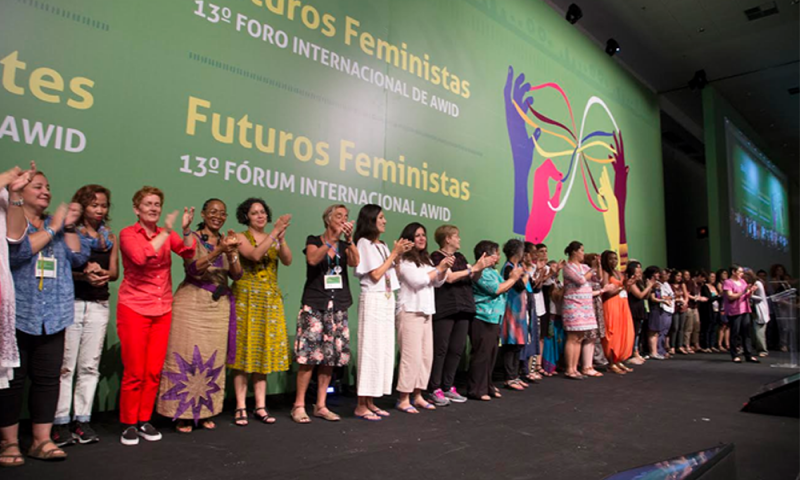
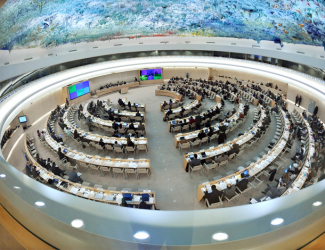
Jean-Marc Ferré | Flickr (CC BY-NC-ND 2.0)
A general view of participants at the 16th session of the Human Rights Council in Geneva, Switzerland.

Special Focus

AWID is an international, feminist, membership organisation committed to achieving gender equality, sustainable development and women’s human rights

Human Rights Council (HRC)

The Human Rights Council (HRC) is the key intergovernmental body within the United Nations system responsible for the promotion and protection of all human rights around the globe. It holds three regular sessions a year: in March, June and September. The Office of the UN High Commissioner for Human Rights (OHCHR) is the secretariat for the HRC.

The HRC works by:

  • Debating and passing resolutions on global human rights issues and human rights situations in particular countries

  • Examining complaints from victims of human rights violations or activist organizations on behalf of victims of human rights violations

  • Appointing independent experts (known as “Special Procedures”) to review human rights violations in specific countries and examine and further global human rights issues

  • Engaging in discussions with experts and governments on human rights issues

  • Assessing the human rights records of all UN Member States every four and a half years through the Universal Periodic Review

Learn more about the HRC


AWID works with feminist, progressive and human rights partners to share key knowledge, convene civil society dialogues and events, and influence negotiations and outcomes of the session.

With our partners, our work will:

◾️ Monitor, track and analyze anti-rights actors, discourses and strategies and their impact on resolutions

◾️ Raise awareness of the findings of the 2017 and 2021 OURs Trends Reports.

◾️Support the work of feminist UN experts in the face of backlash and pressure

◾️Advocate for state accountability
 
◾️ Work with feminist movements and civil society organizations to advance rights related to gender and sexuality.
 

Related Content

Fadila M.

Fadila M. était une activiste “tribale” Soulaliyate d’Azrou, dans la province marocaine d’Ifrane. Elle s'est battue contre une forme spécifique de discrimination à l'égard des femmes “tribales” liée à la propriété foncière.

Dans le cadre du Mouvement en faveur des droits fonciers des femmes Soulaliyates, elle a travaillé pour la révision de la législation-cadre relative à la gestion des biens communautaires, avec l'adoption en 2019 de trois projets de lois garantissant l'égalité des femmes et des hommes. 

Selon le droit coutumier en vigueur, les femmes n'avaient pas le droit de bénéficier de la terre, surtout celles qui étaient célibataires, veuves ou divorcées. Au Maroc, les droits à la terre collective se transmettaient traditionnellement entre les membres masculins de plus de 16 ans issus d’une même famille. Depuis 2007, Fadila M. faisait partie du mouvement des femmes, à savoir la première mobilisation populaire nationale de revendication de leurs droits fonciers. Parmi leurs victoires, citons le fait qu'en 2012, les femmes Soulaliyates ont pu, pour la première fois, s'inscrire sur les listes de bénéficiaires et disposer d'une indemnisation liée à la cession des terres. Le mouvement a également réussi à faire modifier le dahir de 1919 (décret du roi du Maroc) de façon à garantir aux femmes le droit à l'égalité.

Fadila M. s’est éteinte le 27 septembre 2018. Les circonstances de sa mort, survenue alors qu’elle participait à une marche de protestation sur la question des terres collectives, ne sont pas claires. Si les autorités déclarent que sa mort est accidentelle et qu'elle a fait un arrêt cardiaque sur le chemin de l'hôpital, la section locale de l'Association marocaine des droits de l'homme (AMDH), affirme quant à elle que Fadila a été étouffée par un membre des forces policières arborant un drapeau marocain. Sa famille a demandé qu’une enquête soit menée mais les résultats de l'autopsie n'ont pas été communiqués.

Apprenez-en davantage sur le Mouvement en faveur des droits fonciers des femmes Soulaliyates 


Veuillez noter: Nous n'avons pu trouver aucune photo de Fadima M. C'est pourquoi cette illustration (au lieu d'un portrait) représente ce pour quoi elle s'est battue et a travaillé : la terre et le droit d'y vivre et d'avoir accès à cette terre et ce qui y pousse.

How can I fund my participation in the AWID Forum?

If your group or organization receives funding, you might want to discuss with your funder already now if they are able to support your travel and participation to the Forum. Many institutions plan their budgets for next year early in 2023, so better not delay this conversation for next year.

Snippet2 - WCFM Registration status - EN

Clipboard icon

Registration status:

Search for funders based on their requirements for groups to be registered.

Cookies

We’re committed to protecting your privacy, so here we explain how we use cookies on our website.

If you have any questions, please get in touch via the form on our contact page.

What are cookies?

A cookie is a small data file downloaded by your web browser (for example Chrome or Internet Explorer) and stored on your computer. They are downloaded automatically when you visit websites. Cookies are used to perform essential tasks on a website, to record how people use a website and to gather data for marketing.

How we use cookies

We provide essential information on our website to millions of people every year. To do this, we have to manage our website effectively and to reach out to more people who need our support and information. Cookies are a small, but essential way to make all this happen. We use cookies to:

  1. To measure how people use our website. This helps us understand how well different sections of our website are performing. It also helps us track numbers of visitors and helps us ensure our website is robust and works well for every single one of the millions of people who use it.
  2. To record actions so that the website will work well for you. For example, our online shop uses cookies to record items that you place in your shopping basket. We also use cookies in our online donations process and in other tools such as our online breath test.
  3. We also record actions so we can reach people more effectively. This works by using a cookie to remember what pages you have visited so we can tailor our marketing messages based on your interests.

Change your cookie settings

You can update your cookie preferences by clicking on the button below.

Cookie Settings

In addition, most browsers allow you to manage cookies saved on your device – just go to the help section of your browser. To learn more about cookies and how to manage them, visit the ICO website.

Your rights

Cookies never record your credit card details or easily identifiable personal data such as your name and address. You have every right to refuse to accept cookies from our website.

If you disable cookies you will still be able to access nearly all the information on our website. But please remember that this may affect some functionality.

How to disable cookies

You can disable cookies by changing your settings in your web browser or you can use the incognito option on Google Chrome. To find out more about your browser settings, visit the relevant support page below:

Cookies used by this site

Bibliothèque de ressources « Nos droits en danger »

Bibliothèque de ressources « Nos droits en danger »

Collection évolutive de ressources en soutien aux mouvements féministes, aux décideur·euse·s et aux allié·e·s pour contrer les fascismes, les fondamentalismes et résister aux tendances antidroits.

agent in action

Dorothy Masuka

“I didn’t plan to be a singer, singing planned to be in me.” - Dorothy Masuka (interview with Mail & Guardian)

Dorothy Masuka, born 1935 in Bulawayo (then Southern Rhodesia, now Zimbabwe), grew up in South Africa to become a well-known songwriter, composer, jazz singer and activist, a fervent advocate of the struggle against apartheid. Called “an architect of the discourse of popular African liberation music”, Dorothy often sang about politics in indigenous African languages and throughout her work she confronted the racist policies of the South African government.

One such song titled “Dr. Malan” (named after the pro-apartheid politician D.F. Malan) was banned. She went on to record “Lumumba” (1961), a song about the assassination of the anti-colonial leader Patrice Lumumba. Dorothy’s work and activism attracted the attention of the Special Branch of the South African police and she was forced into a political exile that would span over three decades. Throughout this time, she worked with pro-independence groups including the African National Congress. In 1992, as apartheid started to crumble and Nelson Mandela was released from prison, she returned to South Africa. 

Some of her other work includes the first song she recorded in 1953 entitled “Hamba Notsokolo”, a hit in the 1950s and a valued classic. She also wrote “El Yow Phata Phata”, a song that was adapted by Miriam Makeba, making “Pata, Pata” popular internationally.

Rooted in resistance, Dorothy’s music and activism were intertwined, leaving a magnificent and inspiring legacy. She was also widely known as “Auntie Dot”. 

On 23 February 2019 at the age of 83, Dorothy passed away in Johannesburg due to ill health. 


Watch Dorothy Masuka in an interview with Mail & Guardian

Listen to some of her music:

Hamba Nontsokolo
El Yow Phata Phata
 

¿Cómo se conecta el Foro de AWID con espacios regionales y otros?

Estamos en comunicación con reuniones regionales, temáticas y de donantes planificadas para 2023-2024, para garantizar el flujo de conversaciones y conexiones. Si estás organizando un evento y deseas establecer una conexión con el Foro de AWID, ¡por favor contáctanos!

sinppet-annual-budget-size-4-4

Key factors impacting 
budget size

→Region
→Level of organizing
→Registration status
→Priorities and Agendas


Read and download the insights here

Privacy and cookies - before 25 Apr 2023

AWID Privacy Policy, Your rights to privacy and cookies

This policy governs all pages hosted at www.awid.org, and any other websites under the control of the AWID (the “Website”) and registrations for these sites. It does not apply to pages hosted by organisations other than AWID, to which we may link and whose privacy policies may differ. Please read the following policy to understand our privacy policy regarding nature, purpose, using and sharing of your personal identifiable information that is collected via this website.

1. Types of information collected on this site

Generally, you can browse this website without submitting your personal information to us. However, in some circumstances, we will ask for your personal information.

1.1 Information you provide to us

When you are on the website and are asked for personal information, you are sharing that information only with AWID.

1.1.1 The information you provide to get updates from AWID:

When you register to use the website – for example, subscribe to receive emails from us or apply to become a member - you provide us with the mandatory information about you like Name, country, language to receive email updates and email address. This information is provided by you through secure forms and is stored on secure servers.

1.1.2 The payment information you provide to become member or registering for a paid event:

Also, while becoming a member or registering for events, you may need to provide payment information. AWID doesn’t store any credit card information on its servers and uses payment gateway to process the payment information.

1.1.3 The optional information you chose to give us as AWID member (with consent)

When you communicate with AWID, provide optional information through forms on the website or use the site to communicate with other members, we collect information about your communication and any information you choose to provide.

1.1.4 Information you provide us through contact forms or when you directly communicate with us

When you communicate with us, we collect your communication and any other information you choose to provide us.

1.2 Information that is automatically collected (third party cookies)

In addition, when you interact with the Website, our servers may keep an activity log that does not identify you individually (“Non-Personal Information”). Generally, we collect the following categories of Non-Personal Information:

  • We may collect certain demographic data such as age and gender as part of collecting personal information;
  • We collect and store certain device information about your computer, mobile device, or other device that you use to access the Website. This information may include IP address, geolocation information, unique device identifiers, browser type, browser language, and other transactional information;
  • We automatically log certain usage information about your use of the Website. This information includes a reading history of the pages you view. We use this information to provide you with a more customized experience on the Website;
  • We collect and store additional “traffic data” such as time of access, date of access, software crash reports, session identification number, access times, and referring website addresses; and
  • We collect and store your search terms and search results.
  • We also collect and store certain other information regarding our users’ use of the Website so that third parties may provide us with reports and analysis regarding usage and browsing patterns of the Website.

For more information about cookies, please see www.allaboutcookies.org.

If you do not wish to receive cookies you can easily modify your web browser to refuse cookies, or to notify you when you receive a new cookie, see how here.

2. Use of information collected on this website

AWID uses the information we collect about you to:

  • Better understand how you are using our website and what we could do to improve your experience.
  • Communicate with you via email to share resources and analysis in the field of women's rights, connect with you and provide opportunities to engage with our work, keep you updated about developments at AWID and with our partners.
  • Comply with our legal obligations to:
    • Detect and prevent fraud, spam, abuse, security incidents, and other harmful activity.
    • Conduct security investigations and risk assessments.
    • Verify or authenticate information provided by you (such as to verify your authorization to act as an agent on behalf of a nonprofit organization).
    • Conduct checks against databases and other information sources, to the extent permitted by applicable laws.
    • Resolve any disputes with any of our users or customers and enforce our agreements with third parties.
    • Enforce our Terms of Use and other policies.

3. Distribution of information

If you have subscribed to AWID´s e-newsletters or email updates or you have become a member, we will send you regular communications as specified in the relevant area of the website. You are able to unsubscribe from any of the e-newsletters or email updates at any time by using the unsubscribe information provided in our emails.

4. Accessing, changing and removing information

The accuracy of your individual identifying information is important to AWID. We are always looking for ways to make it easier for you to review and correct the information that AWID maintains about you through our website. If you change your email address, or if any of the other information we hold is inaccurate or out of date, please write to us here.

  • Where you have provided AWID with consent to use your personal data, you can withdraw it any time by sending us a communication and specifying which consent you are withdrawing. Please note that the withdrawal of your consent does not affect the lawfulness of any processing activities based on such consent before its withdrawal.
  • Where applicable, you may also have a right to receive a machine-readable copy of your personal data. If you would like to have a copy of the personal data we hold on you or if you think that we hold incorrect personal data about you, please write to us.
  • You also have the right to ask us to delete your personal data or restrict how it is used. There may be exceptions to the right to erasure for specific legal reasons which, if applicable, we will set out for you in response to your request.
  • At any time, regardless of applicable law, you may object to us processing your personal information for direct marketing purposes. You may, at any time, ask AWID to cease processing your data for these direct marketing purposes by Contacting Us.


5. Sharing information

Except as explained below, AWID will not disclose any of your personally identifiable information, and will not sell or rent lists containing your information to third parties. AWID may disclose information when it has your permission to do so or under special circumstances, such as when it believes in good faith that the law requires it.

6. Information security

We are continuously implementing and updating administrative, technical, and physical security measures to help protect your information against unauthorized access, loss, destruction, or alteration. Some of the safeguards we use to protect your information are firewalls and data encryption, and information access controls. If you know or have reason to believe that your AWID membership credentials have been lost, stolen, misappropriated, or otherwise compromised or in case of any actual or suspected unauthorized use of your AWID membership account, please contact us through on Contact Us.

7. Changes to this policy & Contacting us

This policy may change from time to time. The changed policy will be posted on this website and Last updated date at the end of the policy will be updated. There will be an email update sent to you for the revised policy and if you do not agree with the revised policy, you will have the option to cancel you registration(s) with us. You can also write to us here. We welcome your feedback!

Last updated: May 2019

Rights at Risk: The Observatory on the Universality of Rights Trends Report 2017

Report:

Rights at Risk - OURs Trends Report 2017

The first report from the Observatory on the Universality of Rights acts as a compendium of information on anti-rights trends in international spaces. Find out about key anti-rights religious actors, discourses, and tactics within the UN.

Get the report

Mirna Teresa Suazo Martínez

Mirna Teresa Suazo Martínez era parte de la comunidad garífuna (afrodescendiente e indígena) de Masca, en la costa norte del Caribe de  Honduras. Era una líder comunitaria, y una ferviente defensora del territorio indígena, tierra que fue vulnerada cuando el Instituto Nacional Agrario de Honduras otorgó licencias territoriales a gente ajena a la comunidad.

Este acto deplorable derivó en repetidos acosos, abusos y violencia contra la comunidad de Masca, dado que los intereses económicos de diferentes grupos se unieron a los de las fuerzas armadas y las autoridades hondureñas. Según la Organización Fraternal Negra Hondureña (OFRANEH), la estrategia de estos grupos es expulsar y exterminar a la población indígena.

«Masca, la comunidad Garífuna localizada junto al valle del Cuyamel, forma parte de la zona de influencia de una de las supuestas ciudades modelo, situación que ha disparado las presiones territoriales a lo largo de la costa Garífuna.» - OFRANEH, 8 de septiembre de 2019

Mirna Teresa, presidenta del Patronato de la comunidad de Masca en Omoa, también rechazaba con firmeza la construcción de dos plantas hidroeléctricas sobre el río que lleva el mismo nombre que su comunidad, Masca.

«La comunidad garífuna atribuye el agravamiento de la situación en su región a su oposición  contra la explotación turística, el monocultivo de palma africana y  el narcotráfico, al mismo tiempo que busca construir una vida alternativa a través del cultivo del coco y de otros productos de autoconsumo.» - Voces Feministas, 10 de septiembre de 2019

Mirna Teresa fue asesinada el 8 de septiembre de 2019 en su restaurante «Champa los Gemelos».

Fue una de las seis defensoras garífunas asesinadas solo entre septiembre y octubre de 2019. Según OFRANEH, las autoridades no han investigado estos crímenes.

«En el caso de las comunidades Garífunas, buena parte de los homicidios están relacionados con la tenencia y el manejo de la tierra. No obstante, las rencillas entre el crimen organizado han tenido como resultado asesinatos, como los recientemente ocurridos en Santa Rosa de Aguán.» - OFRANEH, 8 de septiembre de 2019

Qu'en est-il de la justice climatique? Est-ce vraiment le moment d'effectuer autant de vols internationaux ?

Nous nous posons la même question et nous pensons qu'elle n’admet pas de réponse simple. Le Forum de l’AWID pourrait être, pour de nombreux participant·e·s, l'un des rares voyages internationaux qu'ils·elles effectueront au cours de leur vie. La pandémie nous a révélé les possibilités mais aussi les limites des espaces virtuels pour la construction de mouvements : rien ne vaut une rencontre en personne. Les mouvements ont besoin de connexions transfrontalières pour renforcer leur pouvoir collectif face aux menaces qui pèsent sur eux, notamment la crise climatique. Nous sommes d'avis que le prochain Forum de l'AWID pourrait ouvrir un espace stratégique afin d'organiser ces conversations et explorer les alternatives qui se posent aux voyages internationaux. L'élément hybride du Forum est une composante importante de cette exploration.

WITM - Refreshed INFOGRAPHIC 3 EN

How feminists resource themselves

Feminist and women’s rights organizations don’t just rely on institutional funding, we resource ourselves. Our organizing is powered by passion, political commitment, solidarity and collective care.
These resources are self- generated and autonomous, and often invisible in our budgets, but they are the backbone of our organizing.

 Explore the data on autonomous resourcing

Gracias por visitar AWID. 

Les agradecemos su interés por visitar el sitio web de AWID. Para obtener más información sobre nuestro trabajo, visiten https://www.awid.org/es

Crear | Résister | Transform: A Walkthrough of the Festival! | Content Snippet EN

As heteropatriarchal capitalism continues to force us into consumerism and compliance, we are finding that our struggles are being siloed and separated by physical as well as virtual borders.

And with the additional challenges of a global pandemic to overcome, this divide-and-conquer strategy has been favorable for the proliferation of exploitation across many areas.

Yet, From September 1 to September 30, 2021, Crear | Résister | Transform: a festival for feminist movements! took us on a journey of what it means to embody our realities in virtual spaces. At the festival, feminist activists from across the world came together, not only to share experiences of hard-won freedoms, resistances, and cross-borders solidarities, but to articulate what a transnational form of togetherness could look like. 

It is this togetherness that has the potential to defy borders, weaving a vision for a future that is transformative because it is abolitionist and anti-capitalist. Spread out over a month, across digital infrastructures that we occupied with our queerness, our resistance, and our imaginaires, the festival showed a way to deviate from the systems that make us complicit in the oppression of others and ourselves. 

Though Audre Lorde taught us that the master’s tools will never dismantle the master’s house, Sara Ahmed showed us that we can misuse them. Because we had to make space for assembly, in spite of all the other demands on our time, it became possible to imagine a disruption to the reality of heteropatriarchal capitalism.

Now, if we understand assembly as a form of pleasure, then it becomes possible to make the link between transgressive pleasure and transnational/transdigital resistance. Between the kinds of pleasure that challenges borders on the one hand, and queerness, campiness, land and indigenous struggle, anti-capitalism, and anti-colonial organizing on the other. 

This issue attempted to capture a sense of how the festival’s exercise in assembly took on multiple shapes and imaginations. Beyond direct collaborations with some of its speakers and dreamers, we brought on a plethora of other voices from the Global South to be in conversation with many of its themes and subjects. Below is a map of some of the festival’s panels that most inspired us.

Barbara Allimadi

Barbara Allimadi était une militante politique et des droits humains originaire d’Ouganda. En 2012, elle a coorganisé une manifestation contre l’agression policière télévisée d’Ingrid Turinawe, opposante politique dont le sein a été pressé par un officier de police. Durant la manifestation, Barbara et d’autres activistes se sont déshabillées et n’ont gardé que leur soutien-gorge devant le poste central de police de Kampala. Cet épisode fut par la suite  désigné par la tristement célèbre « manifestation en soutien-gorge » en Ouganda. 

« Nous avons opté pour une manifestation en soutien-gorge. Nous avons pensé qu’elle serait la plus appropriée par rapport aux faits. Ce n’est pas comme si nous étions en train de dire que nous ne nous respections pas. Nous étions dégoûtées par les actes commis. »  - Barbara Allimadi, 2013 (Daily Monitor)

Diplômée en électronique et en ingénierie des communications de l’Université métropolitaine de Londres, Barbara était ingénieure réseau au Royaume-Uni et une fervente amatrice de musique reggae. Elle retourna en Ouganda en 2007, au moment du décès de sa mère. 

En 2019, elle fut désignée Coordonnatrice pour les affaires internationales et la diaspora de l’Alliance for National Transformation (alliance pour la transformation nationale, ANT), un parti politique lancé la même année par un leader d’opposition.    

« Nous voulons disposer d’une vie sûre et de biens, sans souffrance, sans blessure ni même de mort aux mains des forces de sécurité, qui sont censées nous protéger. Nous voulons surtout un environnement stable et propice dans lequel nous pourrons réaliser nos rêves et nos ambitions. » - Barbara Allimadi, vidéo de l’ANT

Barbara est décédée le 27 avril 2020. 


Hommages :

« J’étais tellement fière de ma sœur pour plein de raisons, mais surtout pour sa recherche téméraire de la paix, de la démocratie, de la justice et de l’égalité en Ouganda. Au summum de son activisme, elle conduisait de nombreuses marches dans les rues de Kampala, jusqu’aux postes de police et au Parlement. » - Doris Allimadi, sœur de Barbara

« C’est avec une tristesse profonde que nous avons appris le décès précoce de Barbara Allimadi. Elle était une force vaillante, infatigable et courageuse pour le mouvement de libération en Ouganda. Nous adressons nos sincères condoléances à sa famille. Elle nous manquera terriblement. » - Akina Mama wa Afrika (tweet du 28 avril 2020)

« Le décès de Barbara est extrêmement triste pour nous, et pour toute sa famille. Elle s’est dévouée entièrement à lutter pour la justice, la liberté et les droits des autres, tout en servant la société civile jusqu’à sa récente adhésion au parti. » Maj Gen Mugisha Muntu, coordonnateur national de l’ANT

« Une soeur magnifique, charmante, drôle, charismatique et inspirante. Mes enfants ont perdu leur tante. L’Ouganda a perdu une combattante pour les libertés, brave et courageuse. Barbara disait autrefois “tant que vous pouvez respirer, continuez à agir pour atteindre vos rêves”  » - Doris Allimadi, sœur de Barbara

CFA 2023 - breadcrumbs Menu _ awid-forum-fr