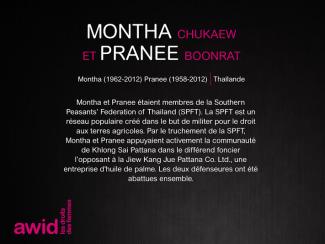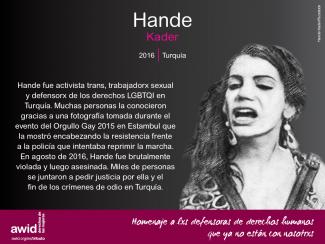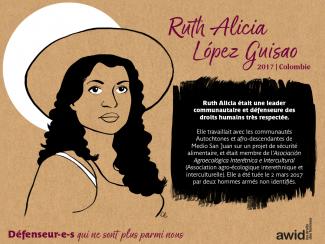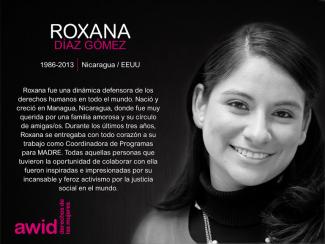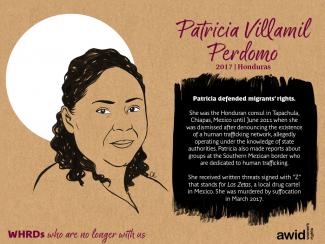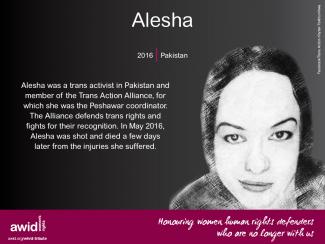

Philippe Leroyer | Flickr (CC BY-NC-ND 2.0)

Women Human Rights Defenders

WHRDs are self-identified women and lesbian, bisexual, transgender, queer and intersex (LBTQI) people and others who defend rights and are subject to gender-specific risks and threats due to their human rights work and/or as a direct consequence of their gender identity or sexual orientation.

WHRDs are subject to systematic violence and discrimination due to their identities and unyielding struggles for rights, equality and justice.

The WHRD Program collaborates with international and regional partners as well as the AWID membership to raise awareness about these risks and threats, advocate for feminist and holistic measures of protection and safety, and actively promote a culture of self-care and collective well being in our movements.


Risks and threats targeting WHRDs  

WHRDs are exposed to the same types of risks that all other defenders who defend human rights, communities, and the environment face. However, they are also exposed to gender-based violence and gender-specific risks because they challenge existing gender norms within their communities and societies.

By defending rights, WHRDs are at risk of:

  • Physical assault and death
  • Intimidation and harassment, including in online spaces
  • Judicial harassment and criminalization
  • Burnout

A collaborative, holistic approach to safety

We work collaboratively with international and regional networks and our membership

  • to raise awareness about human rights abuses and violations against WHRDs and the systemic violence and discrimination they experience
  • to strengthen protection mechanisms and ensure more effective and timely responses to WHRDs at risk

We work to promote a holistic approach to protection which includes:

  • emphasizing the importance of self-care and collective well being, and recognizing that what care and wellbeing mean may differ across cultures
  • documenting the violations targeting WHRDs using a feminist intersectional perspective;
  • promoting the social recognition and celebration of the work and resilience of WHRDs ; and
  • building civic spaces that are conducive to dismantling structural inequalities without restrictions or obstacles

Our Actions

We aim to contribute to a safer world for WHRDs, their families and communities. We believe that action for rights and justice should not put WHRDs at risk; it should be appreciated and celebrated.

  • Promoting collaboration and coordination among human rights and women’s rights organizations at the international level to  strengthen  responses concerning safety and wellbeing of WHRDs.

  • Supporting regional networks of WHRDs and their organizations, such as the Mesoamerican Initiative for WHRDs and the WHRD Middle East and North Africa  Coalition, in promoting and strengthening collective action for protection - emphasizing the establishment of solidarity and protection networks, the promotion of self-care, and advocacy and mobilization for the safety of WHRDs;

  • Increasing the visibility and recognition of  WHRDs and their struggles, as well as the risks that they encounter by documenting the attacks that they face, and researching, producing, and disseminating information on their struggles, strategies, and challenges:

  • Mobilizing urgent responses of international solidarity for WHRDs at risk through our international and regional networks, and our active membership.

Related Content

Kate McInturff

From Peacebuild to the Canadian Feminist Alliance for International Action, Amnesty International, and the Canadian Centre for Policy Alternatives (CCPA), Kate had a lifelong passion for women’s rights and gender equality and dedicated her career to fighting inequality and making the world a more compassionate place.

Kate was a member of the Coordinating Committee of Social Watch and a contributor to the Canadian National Social Watch reports.  As a Senior Researcher at the CCPA, Kate received national acclaim for researching, writing, and producing the annual “The Best and Worst Places to be a Woman in Canada” report.

Kate died peacefully surrounded by her family, following a three-year battle with colon cancer. She is described by loved ones as a “Funny, Fearless, Unapologetically Feminist.”


Kate McInturff, Canada

Snippet FEA Sopo Japaridze (EN)

Meet Sopo Japaridze, fierce feminist, union leader and chair of the independent service trade union at the Solidarity Network.

She left the country when she was very young to go to the United States where she first became very politically active as a labor organizer. She kept Georgia in the back of her mind all that time, until one day, two decades later, she decided to return.

The existing Georgian union confederation back then was less than ideal. So, equipped with her skills, knowledge and labor organizing experience, Sopo went back to Georgia and built her own union.

Sopo is a passionate researcher and writer. She studies labor and social relations, writes for various publications and is the contributing editor of LeftEast, an Eastern European analytical platform. She also co-founded the political history initiative and podcast, Reimagining Soviet Georgia, where she explores the complexities and nuances of the country's experiences under the Soviet Union, to better understand its past in order to shed light on how to build a better future.

¿Cómo se inició AWID?

AWID surgió en 1982 y se ha ido transformando con el paso de los años en una verdadera organización mundial.

Saber más de nuestra historia

Leer «From “WID” to “GAD” to Women’s Rights: The First Twenty Years of AWID» (en inglés)

6. Menez une recherche documentaire

La recherche documentaire peut se dérouler tout au long de votre initiative. Elle peut vous aider à encadrer vos travaux, à choisir des questions de sondage et à comprendre vos résultats.

Dans cette section

Préciser le contexte

La réalisation de recherches documentaires tout au long de votre initiative peut vous aider à encadrer vos travaux, à choisir les questions de sondage et à vous fournir une clarté contextuelle, tout en rehaussant votre compréhension des résultats de votre sondage. Vous pourriez notamment comparer les similarités et les différences entre les résultats de votre sondage et l’information diffusée par la société civile et les donateurs.

Il se peut que vous déceliez des tendances dans les résultats de votre sondage et que vous souhaitiez mieux les comprendre.

Par exemple, vos données de sondage pourraient révéler que les budgets des organisations diminuent, mais cela ne vous dit pas pour quelle raison cette situation se produit. L’analyse des publications vous donne un contexte et vous révèle certaines des raisons pour lesquelles ces tendances surviennent.

Haut de page


Exploiter les connaissances existantes

La recherche documentaire garantit également que vous appuyez votre recherche sur les connaissances existantes touchant à votre sujet d’intérêt, confirmant ainsi la validité et la pertinence de vos résultats.

Vos résultats pourraient être complémentaires ou contradictoires par rapport aux connaissances actuelles, mais ils doivent faire référence aux données existantes sur le sujet.

Pour que votre recherche soit complète et englobe tout le panorama du financement qui entoure votre sujet, examinez une gamme de secteurs de financement.

Vous pouvez notamment considérer :

  • Les fonds pour les femmes
  • Les fondations privées et publiques
  • Les organisations non gouvernementales internationales (ONGI)
  • Les agences bilatérales et multilatérales
  • Les acteurs et actrices du secteur privé
  • Les philanthropes
  • Les groupes de financement participatif

Inclure tout secteur pertinent dans le cadre de référence de votre recherche.

Par exemple, vous pourriez décider qu’il est important d’effectuer des recherches sur les organisations non gouvernementales (ONG) locales.

Haut de page


Sources éventuelles d’information pour la recherche documentaire (liste non exhaustive)

1. Sites Web et rapport annuels des donateurs

Voici des sources directes d’information sur les actions des bailleurs de fonds qui contiennent habituellement des renseignements sur les politiques et les budgets. Si vous réalisez vos recherches avant d’interviewer les donateurs, vos questions seront mieux ciblées et vos interviews plus solides.

2. Sources d’information en ligne

Haut de page


Étape précédente

5. Menez des interviews

Étape suivante

7. Synthétisez les résultats de votre recherche


Temps estimé :

• 1-2 mois

Personnel requis :

• 1 personne (ou plus) chargée de la recherche


Étape précédente

5. Menez des interviews

Étape suivante

7. Synthétisez les résultats de votre recherche


Êtes-vous prêts-tes ?

Télécharger la Boîte à outils en PDF

Reason to join 4

Think big! With our international reach, we combine analytical work with political and practical tools for advocacy and transformation to advance the cause of feminist movements at all levels.

هل ستكون لي الفرصة بمشاركة افكاري بأمور لا تغطيها أسئلة الاستطلاع؟

نعم. ندعوكم/ن لمشاركتنا بالأمور التي تجدونها مهمة بالنسبة لكم/ن عن طريق الإجابة على الأسئلة المفتوحة في نهاية الاستطلاع.

Madiha El Safty

Madiha fue una destacada profesora de Sociología con activa participación en la sociedad civil como defensora de los derechos de las mujeres en la región árabe.

Presidió la Alianza para las Mujeres Árabes y dentro del Consejo Nacional de Mujeres fue miembro del Comité de la Sociedad Civil y del Comité para el Desarrollo de la Gobernación de Minia. Fue autora de numerosas publicaciones en las que analizó y arrojó luz sobre las desigualdades de género y la discriminación contra las mujeres.

Es recordada con cariño por colegas, estudiantes y amigxs.


Madiha El Safty, Egypt

Snippet FEA Criminalization of sex workers (ES)

La mayoría de los Estados miembros de la Unión Europea tienen leyes y prácticas que penalizan o controlan a las trabajadoras sexuales de formas inaceptables para ellas. La criminalización de las trabajadoras sexuales y/o sus clientes solo contribuye a aumentar la vulnerabilidad de las trabajadoras sexuales, que ya enfrentan el estigma, la discriminación y la exclusión por parte del Estado y de la sociedad a diario, especialmente las mujeres trabajadoras, lxs trabajadorxs trans, migrantes y/o racializadxs. En España por ejemplo, el gobierno esta actualmente intentando pasar una Ley Orgánica para la Abolición de la Prostitución, que resultara en mas clandestinidad y violencia. Ven a conocer las historias de trabajadoras sexuales y organizadores sindicales que luchan para decriminilizar el trabajo sexual y promover derechos laborales y condiciones de trabajo digno para lxs trabajadxs sexuales.

Quels sont les enjeux sur lesquels travaille l’AWID ?

L’AWID œuvre à renforcer la justice de genre et les droits humains des femmes.

Nous travaillons à renforcer les voix et l'impact des défenseuses des droits humains, des organisations et des mouvements.

Nos Domaines prioritaires sont étroitement liés aux réalités internationales. Ils sont le reflet de situations de plus en plus précaires qui sapent les droits des femmes à l’échelle mondiale.

  • La justice économique 
  • Les ressources pour les droits des femmes
  • S'opposer aux fondamentalismes religieux
  • Les défenseuses des droits humains
  • L'activisme des jeunes féministes

Découvrir les domaines prioritaires de l’AWID

5 Major Threats

In the current context, we have identified five major threats to the struggle towards feminist just economies.


1. Financialisation of the world economy.

“Financialisation refers to the increasing importance of financial markets, financial motives, financial institutions, and financial elites in the operation of the economy and its governing institutions both at the national and international levels”. - Gerald Epstein

Epstein Gerald A. 2006: Financialization and the World Economy. Edward Elgar Publishing.

Financial institutions exert a strong influence over economic governance and the direction of development policy. The growing dominance of the corporate sector and international financial institutions in defining local and global public policies, has resulted in the capture of the State in the interest of capital. The current financial system, including controversial credit and debt policies, are integral to the reproduction and expansion of capital accumulation processes.

This raises important questions of how to regulate and re-think the global financial system, not only to avoid serious negative consequences of debt-driven crises,but to allow for sustainable livelihoods and the realization of economic and social rights without retrogression.

For more details, see the article by Balakrishnan and Heintz  “Debt, Power, and Crisis: Social Stratification and the Inequitable Governance of Financial Markets

2. Harmful trade agreements.

For the past 20 years, trade agreements (both bilateral or multilateral) have expanded their role demonstrating increased interest in Intellectual Property Rights (IPR) to be given to corporations.

IPR has clearly benefitted transnational corporations with huge impacts on the ability of poorer nations and peoples to realize human rights, notably:

  • the right to food,
  • the right to conserve,
  • the right to use and sell seeds, and
  • the right to access to essential medicines.

In addition, agriculture import liberalisation resulting in an influx of cheap goods jeopardise women’s self-employed farmers in poor countries and food security. Investment protection clauses included in trade agreements limit the policy space of national governments to create and enforce regulations on issues as crucial as environmental protection, labour rights, and the duration of copyrights.

Feminist movements have been, and are, at the forefront of resistance to these agreements exposing its pitfalls.

(See for example, the reactions by feminist networks around the globe to both the Transatlantic and TransPacific Trade and Investment Partnership Agreement negotiations.)

3. Unprecedented scale of threat to ecosystems and biodiversity.

The commodification of the Earth’s resources and resulting environmental degradation and climate change produced by decades of aggressive industrialisation, plunder and extractivism of the world’s resources, have damaged biodiversity and ecological resilience. These damages are now threatening the existence of human society itself.

The international community has failed to address production and consumption patterns sitting at the root of the problem. Instead, governments –with the support of large corporations interested in making a profit - are leaning towards a “green economy” approach promoting “energy-efficient technologies” (including nuclear energy, biofuels, genetically modified organisms and geo-engineering) and carbon trade schemes as the silver bullet.

4.Commodification of land and accelerating global phenomenon of land and resource grabbing.

While the processes of land and resource appropriation is not new – in fact, they are central struggles in colonial histories- what is new is the advanced means by which land and natural resource wealth are becoming commodities in new markets.

International Financial Institutions play a central role in promoting land markets in developing countries. These institutions finance land reforms that enable powerful actors to use land for speculative gain in exchange of meagre promises of jobs and growth. Land-grabbing has far reaching negative impacts on local peoples’ access to essential goods and services apart from displacement and environmental degradation that are associated with it.

People who are resisting land grabbing, among them women human rights defenders, face diverse forms of violence including physical attacks and sexual abuse, on a daily basis.

5. Entrenched patriarchal foundations that structure the capitalist system

This patriarchal foundation is particularly hegemonic in today’s neoliberal models.

The many ways in which political economy and development are connected to sexuality or gender is evident: think how capitalism defines what can even be characterized as labour and ties human worth to wage-labour productivity.

For the most part, women’s position in the global economy continues to be one of gender-based labour exploitation with women’s work undervalued in precarious jobs, domestic subsistence, reproduction, and in unwaged household production.  Because reproductive labour has been naturalized as women's unpaid work, it has provided an immense subsidy to capitalism at the same time as a source of gender oppression and subjugation.

This situation is aggravated by the fact that as social protection mechanisms begin to dwindle, women’s care burden increases.

Further, the phenomenon of global migration spurred on by thousands of economic refugees escaping oppressive poverty across the globe is not estranged to that of capitalist gender power relations. Remittances become a major source of development financing for the families and communities, but at a major cost for women migrants who struggle to earn a living wage in their new country.

In the same vein, we have seen how patriarchal capitalist systems are using violence and oppression to maintain their status quo. Rising global expenditures in militarism and violence, both perpetrated by state and non-state actors, is increasingly used to control dissent, women’s bodies and voice and settle economic, political and social disputes.

Across the world, violence, incarceration and discrimination disproportionately targets

  • women, communities of colour,
  • indigenous peoples,
  • people with disabilities,
  • sex workers,
  • impoverished people, and
  • LGBTQI people.

An intersectional analysis linking gender, race, ethnicity, age, ability, nationality, sexual orientation and gender identity, among other status is needed to challenge structural violence and its links with a capitalist global system.

A profound crisis in the current global governance system is also evident in the feeble inter-governmental agreements reached and how they often lack the most fundamental accountability mechanisms. The multilateral system that served global governance before is failing to respond to the current multiple crises. The same system continues to be deeply undemocratic, with increasing presence and power by corporations occupying the spaces where States used to be.

Rethinking, Renewing & Reactivating

These threats challenge feminists to re-think our framework and strategies. To renew and reactivate our commitment to movement building with others for a just economy.

They challenge us to consider broad agendas for socio-economic transformations, from a feminist perspective, in ways that address the realities of the majority of the impoverished. Now is the time to bring about change for a just economy and to address the persistent systemic challenges.


See also

Where does the project come from?

Our vision

Our values - Human Rights

Derechos humanos

Sostenemos la completa aplicación del principio de derechos, incluidos aquellos consagrados en leyes internacionales, y afirmamos la convicción de que todos los derechos humanos están interrelacionados y son interdependientes e indivisibles. Estamos comprometidxs a trabajar por la erradicación de todas las discriminaciones basadas en el género, la sexualidad, la religión, la edad, la capacidad, la etnia, la raza, la nacionalidad, la clase, u otros factores.

Является ли мое участие конфиденциальным?

Да. Ваши ответы будут удалены по окончании обработки и анализа данных и будут использованы исключительно в исследовательских целях. Данные НИКОГДА не будут переданы за пределы AWID и будут обрабатываться только сотрудниками AWID и консультантками(-тами), работающими с нами над проектом «Где деньги?». Для нас ваша конфиденциальность и безопасность– приоритет. С нашей политикой конфиденциальности можно подробно ознакомиться здесь.

Teresia Teaiwa

Considérée par le Guardian comme l'une des icônes nationales de Kiribati, Teresia était une avocate téméraire.

Elle travaillait en étroite collaboration avec des groupes féministes aux îles Fidji. Ses travaux de recherche ont servi à aborder les problèmes du féminisme et de l'égalité de genre dans le Pacifique. Elle était également corédactrice de l’International Feminist Journal of Politics. En Océanie, son influence a traversé les frontières académiques, ainsi que les mouvements pour la justice sociale.


Teresia Teaiwa, Fiji

Snippet FEA Unio Otras Photo 3 (FR)

Photo de Sabrina Sanchez parlant à côté d'un écran de la réunion d'Ilga World.

I am a young feminist. How can I engage in AWID’s work?

Young feminist activists are at the heart of AWID’s work.

In fact, 38% of our members are under the age of 30.

We believe that young feminists are both the present and the future of the struggle for women’s rights. We promote young leaders in the global women’s rights movement and our Young Feminist Activism program cuts across all aspects of our work.

At the same time, by defining young feminist activists as one of our Priority Areas, we contribute new analysis to current debates and ensure that young feminist activists are able to articulate their priorities and voice their concerns.

Find out more about our Young Feminist Activism Program

Reivindicar los bienes comunes

Definición

La activista y académica Soma Kishore Parthasarathy señala que existen diversas formas de pensar los bienes comunes.

En un sentido más convencional, se los entiende como recursos naturales destinados a ser usados por quienes dependen de su uso. Sin embargo, el concepto de «bienes comunes» se ha expandido para incluir recursos como los conocimientos, la herencia, la cultura, espacios virtuales e incluso el clima. Es un concepto anterior al régimen de propiedad individual y que aportó las bases para la organización social. Las definiciones que aportan las entidades gubernamentales limitan su alcance a los recursos de la tierra y materiales.

El concepto de los bienes comunes se apoya en la práctica cultural de compartir espacios de subsistencia y recursos como dones de la naturaleza, para el bien común, y para la sostenibilidad de lo que es común a todxs.

Contexto

Los bienes comunes de la humanidad están cada vez más amenazados porque las naciones y fuerzas del mercado continúan colonizándolos, explotándolos y ocupándolos.

En algunos contextos favorables, los «bienes comunes» tienen el potencial de habilitar una posición de autonomía sobre todo para las mujeres bajo opresión económica desde la que pueden negociar sus múltiples necesidades y aspiraciones.

Perspectiva feminista

Cuando a las mujeres y a otros géneros oprimidos se les niega el acceso a los bienes comunes y la posibilidad de controlarlos, se refuerza el patriarcado.

Por eso, una economía feminista busca restaurar los derechos legítimos de las comunidades a estos recursos comunes. Esa autonomía les permite mantenerse a sí mismas al mismo tiempo que desarrollan sistemas más igualitarios de gobernabilidad y de uso de esos recursos. Una economía feminista reconoce los roles de las mujeres y les ofrece las mismas oportunidades para tomar decisiones, es decir, las coloca en igualdad de condiciones como demandantes de esos recursos.


Para leer más acerca de esta propuesta:

Membership why page - Kirthi Jayakumar quote

En participant à une activité exclusive pour les membres, j'ai été particulièrement touchée de voir que chacun·e y avait sa place et qu’il n’y avait pas le moindre jugement. Toute la session a été dynamique et vivante.- Kirthi Jayakumar, Fondatrice, The Gender Security Project, Inde