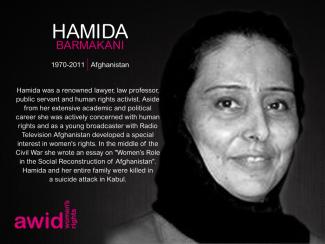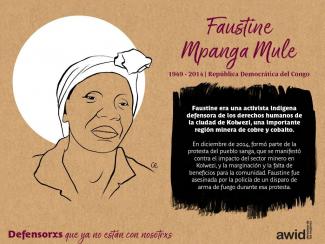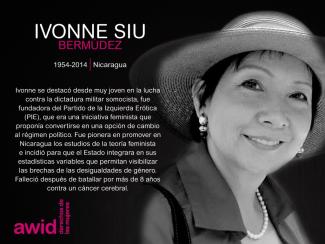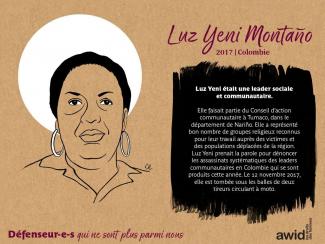
Women Human Rights Defenders
WHRDs are self-identified women and lesbian, bisexual, transgender, queer and intersex (LBTQI) people and others who defend rights and are subject to gender-specific risks and threats due to their human rights work and/or as a direct consequence of their gender identity or sexual orientation.
WHRDs are subject to systematic violence and discrimination due to their identities and unyielding struggles for rights, equality and justice.
The WHRD Program collaborates with international and regional partners as well as the AWID membership to raise awareness about these risks and threats, advocate for feminist and holistic measures of protection and safety, and actively promote a culture of self-care and collective well being in our movements.
Risks and threats targeting WHRDs
WHRDs are exposed to the same types of risks that all other defenders who defend human rights, communities, and the environment face. However, they are also exposed to gender-based violence and gender-specific risks because they challenge existing gender norms within their communities and societies.
By defending rights, WHRDs are at risk of:
- Physical assault and death
- Intimidation and harassment, including in online spaces
- Judicial harassment and criminalization
- Burnout
A collaborative, holistic approach to safety
We work collaboratively with international and regional networks and our membership
- to raise awareness about human rights abuses and violations against WHRDs and the systemic violence and discrimination they experience
- to strengthen protection mechanisms and ensure more effective and timely responses to WHRDs at risk
We work to promote a holistic approach to protection which includes:
- emphasizing the importance of self-care and collective well being, and recognizing that what care and wellbeing mean may differ across cultures
- documenting the violations targeting WHRDs using a feminist intersectional perspective;
- promoting the social recognition and celebration of the work and resilience of WHRDs ; and
- building civic spaces that are conducive to dismantling structural inequalities without restrictions or obstacles
Our Actions
We aim to contribute to a safer world for WHRDs, their families and communities. We believe that action for rights and justice should not put WHRDs at risk; it should be appreciated and celebrated.
-
Promoting collaboration and coordination among human rights and women’s rights organizations at the international level to strengthen responses concerning safety and wellbeing of WHRDs.
-
Supporting regional networks of WHRDs and their organizations, such as the Mesoamerican Initiative for WHRDs and the WHRD Middle East and North Africa Coalition, in promoting and strengthening collective action for protection - emphasizing the establishment of solidarity and protection networks, the promotion of self-care, and advocacy and mobilization for the safety of WHRDs;
-
Increasing the visibility and recognition of WHRDs and their struggles, as well as the risks that they encounter by documenting the attacks that they face, and researching, producing, and disseminating information on their struggles, strategies, and challenges:
-
Mobilizing urgent responses of international solidarity for WHRDs at risk through our international and regional networks, and our active membership.
Related Content
Snippet - WITM To share - ES

Para compartir tu experiencia con el financiamiento de tu organización.
Les hommes peuvent-ils adhérer à l’AWID ?
Oui, l’adhésion à l’AWID est ouverte à tous ceux et à toutes celles qui partagent nos valeurs.
Nombre d’hommes qui partagent notre engagement vis-à-vis du féminisme et des droits humains des femmes sont membres de l’AWID.
Snippet FEA Occupation’s kitchen Instagram (FR)
Campagne publicitaire d'Ocupação 9 de Julho :
![]() |
![]() |
![]() |
![]() |
![]() |
![]() |
![]() |
![]() |
Les Femmes Maintiennent les Soins | Les Soins Soutiennent la Vie | La Vie Soutient l'Économie | Qui s'Occupe des Femmes ? | Pas Une de Moins1 | Ensemble | Déjeuner du Dimanche
1Nenhuna a menos se traduit littéralement par « pas une femme de moins » ou « ni una menos » en espagnol - un célèbre slogan féministe en Amérique latine qui a émergé en Argentine en réponse à l'augmentation de la violence sexiste.
Gauri Lankesh
Contenido relacionado
Reporteros sin Fronteras: India: Asesinada la periodista Gauri Lankesh
Global Voices: Asesinan a Gauri Lankesh, periodista crítica con la derecha india, a la entrada de su casa
Roberta Galler
Snippet - WITM Why now_col 1 - EN
Why should I take it now?

Feminist, women’s rights, gender justice, LBTQI+ and allied movements around the world are at a critical juncture, facing a powerful backlash on previously-won rights and freedoms. Recent years have brought the rapid rise of authoritarianism, violent repression of civil society, criminalization of women and gender-diverse human rights defenders, escalating war and conflict in many parts of our world, continued perpetuation of economic injustices, and the intersecting health, ecology and climate crises.
I am interested in working for women’s rights. How do I get started?
Snippet FEA Clemencia (EN)
Meet Clemencia Carabalí Rodallega, an extraordinary Afro-Colombian feminist.
She has worked relentlessly for three decades towards the safeguarding of human rights, women’s rights and peace-building in conflict areas on the Pacific Coast of Colombia.
Clemencia has made significant contributions to the fight for truth, reparations and justice for the victims of Colombia’s civil war. She received the National Award for the Defense of Human Rights in 2019, and also participated in the campaign of newly elected Afro-Colombian and long-time friend, vice-president Francia Marquez.
Although Clemencia has faced and continues to face many hardships, including threats and assassination attempts, she continues to fight for the rights of Afro-Colombian women and communities across the country.
Edith "Edie" Windsor
Contenu lié
Rolling Stone Magazine: Décès d’Edith Windsor: la communauté LGBT pleure une icône
Le Monde: L’Américaine Edith Windsor, figure LGBT, est morte
Kazuko Kawaguchi
Snippet - WITM Our objectives - EN
Our research objectives
1 |
Provide AWID members, movement partners and funders with an updated, powerful, evidence-based, and action-oriented analysis of the resourcing realities of feminist movements and current state of the feminist funding ecosystem. |
2 |
Identify and demonstrate opportunities to shift more and better funding for feminist organizing, expose false solutions and disrupt trends that make funding miss and/or move against gender justice and intersectional feminist agendas. |
3 |
Articulate feminist visions, proposals and agendas for resourcing justice. |
Soy una mujer defensora de los derechos humanos (MDDH) y actualmente me encuentro bajo amenaza. ¿A dónde puedo acudir por ayuda?
Snippet FEA Metzineres activists (ES)
![]() |
![]() |
![]() |
![]() |
![]() |
|
|
|
Activistas de Metzineres en acción |
Matrine Chuulu
Jyotika Singh
Why should I consider responding to the survey?
There are many reasons why your response to the WITM survey matters. The survey offers the opportunity to share your lived experience of mobilizing funding to support your organizing; claim your power as an expert on how money moves and who it reaches; and contribute to collective and consistent advocacy to funders moving more and better funding. Over the last two decades, AWID’s WITM research has proven to be a key resource for activists and funders. We wholeheartedly invite you to join us in its third iteration to highlight the actual state of resourcing, challenge false solutions, and point out how funding must change for movements to thrive and meet the complex challenges of our times.
2008: la Conférence internationale de Doha se déroule avec des résultats limités
Conférence internationale de suivi sur le financement du développement, Doha, Qatar
- La Conférence de Doha visait à dresser le bilan de la mise en œuvre du Consensus de Monterrey. Les six domaines du financement du développement y ont été examinés mais les progrès tangibles constatés ont été peu nombreux.
- Si la Conférence de Doha a permis d’aller au-delà de Monterrey du point de vue de l’égalité des genres, ses résultats restent insuffisants dans ce domaine. Dans une déclaration , le WWG on FfD (Groupe de travail des femmes sur le FdD) a souligné le fait que les engagements en faveur de l’égalité des genres figurant dans la Déclaration de Doha ne prendraient sens que si les questions systémiques qui sous-tendent la pauvreté et l’inégale répartition du pouvoir et des ressources dans l’économie politique mondiale étaient fermement traitées.
- À Doha, un forum de la société civile s’est tenu en parallèle à la conférence principale. Rassemblée au sein du Groupe des ONG de Doha pour le financement du développement (Doha NGO Group on Financing for Development), la société civile a exigé des changements économiques structurels ainsi que des politiques qui placent les droits des peuples au premier rang de leur liste de priorités et qui respectent et promeuvent les droit humains.
Snippet FEA Get Involved 1 (FR)
ENGAGEZ-VOUS!
Vous pouvez suivre le travail de ces collectifs sur les réseaux sociaux et sites internet suivant:
- Cozinha Ocupação 9 Julho: Instagram, Facebook and site internet
- Association des Femmes Afro-Descendantes du Nord du Cauca: Instagram, Facebook and site internet
- Metzineres: Instagram, Facebook and site internet