Women human rights defenders (WHRDs) worldwide defend their lands, livelihoods and communities from extractive industries and corporate power. They stand against powerful economic and political interests driving land theft, displacement of communities, loss of livelihoods, and environmental degradation.
Why resist extractive industries?
Extractivism is an economic and political model of development that commodifies nature and prioritizes profit over human rights and the environment. Rooted in colonial history, it reinforces social and economic inequalities locally and globally. Often, Black, rural and Indigenous women are the most affected by extractivism, and are largely excluded from decision-making. Defying these patriarchal and neo-colonial forces, women rise in defense of rights, lands, people and nature.
Critical risks and gender-specific violence
WHRDs confronting extractive industries experience a range of risks, threats and violations, including criminalization, stigmatization, violence and intimidation. Their stories reveal a strong aspect of gendered and sexualized violence. Perpetrators include state and local authorities, corporations, police, military, paramilitary and private security forces, and at times their own communities.
Acting together
AWID and the Women Human Rights Defenders International Coalition (WHRD-IC) are pleased to announce “Women Human Rights Defenders Confronting Extractivism and Corporate Power”; a cross-regional research project documenting the lived experiences of WHRDs from Asia, Africa and Latin America.
We encourage activists, members of social movements, organized civil society, donors and policy makers to read and use these products for advocacy, education and inspiration.
AWID acknowledges with gratitude the invaluable input of every Woman Human Rights Defender who participated in this project. This project was made possible thanks to your willingness to generously and openly share your experiences and learnings. Your courage, creativity and resilience is an inspiration for us all. Thank you!
Related Content
Cartas de amor a los movimientos feministas: una carta de Inna y Faye
Queridos movimientos feministas,
El amor es lo que mantiene encendido nuestro fuego feminista. Junto con el cuidado de nuestras comunidades, la ira y la rabia ante la injusticia, y el coraje para actuar.
En septiembre de 2022, asumimos con gran entusiasmo nuestros roles de liderazgo en AWID, como Co-Directoras Ejecutivas. Sentimos el calor y el abrazo de la sororidad feminista cuando ustedes nos recibieron.
Reflexionando sobre nuestras memorias más preciadas como feministas, recordamos momentos poderosos de unión en protestas callejeras, análisis agudos y voces valientes que sacuden el status quo en las reuniones. Mantuvimos esas conversaciones íntimas hasta bien entrada la noche, nos reímos durante horas y bailamos juntes en fiestas.
Es necesario alimentar los fuegos feministas, especialmente en tiempos difíciles cuando no faltan los desafíos externos, desde la crisis climática y el ascenso de las fuerzas de derecha, hasta las economías explotadoras y los patrones persistentes de opresión dentro de nuestros propios movimientos sociales. Son estos fuegos, que arden por todas partes, los que iluminan nuestros caminos y nos mantienen calientes, pero no podemos ignorar los efectos agotadores de la violencia política y la represión dirigida contra muchas de nuestras luchas, movimientos y comunidades
Entendemos el deseo de cambiar el mundo como un ingrediente esencial de la organización feminista. Nunca podemos olvidar que somos quienes hemos estado esperando, en la construcción de alternativas y la configuración de nuestro futuro. Sin embargo, la vibrante energía feminista no puede darse por sentada y debe salvaguardarse de muchas maneras. En este sentido, seguiremos vigilantes. Mejor y más equitativo acceso a la atención y el bienestar, a la sanación y al placer, no son solo instrumentales para prevenir el agotamiento y sostener nuestros movimientos, aunque esa es una función importante; ante todo, son la forma en que esperamos vivir nuestras vidas.
Estamos encantades de arremangarnos y trabajar con ustedes. El nuevo plan estratégico de AWID "Fierce Feminisms: Together We Rise" (“Feminismos Osados: Juntos Nos Levantamos”) refleja nuestra convicción de que ahora es el momento de ser desenfadades y sin temores en nuestras agendas mientras hacemos un esfuerzo por conectar a través de los movimientos y llegar a conocer verdaderamente las realidades individuales, para que podamos ponernos en pie juntes, porque, para nosotres, este es el único camino.
¡Nuestros planes incluyen el tan esperado Foro de AWID! Esperamos conocerles a todes en persona y en línea en 2024. Escuchamos de ustedes la necesidad de conectarse y recargar energías, descansar y sanar, ser desafiados e inspirados, compartir buena comida y reír y bailar juntes. Pocas cosas en este mundo son tan poderosas y transformadoras, como la unión de feministas de todas partes del mundo, y realmente esperamos con ansias por este momento, porque sabemos la magia que podemos crear juntes.
Nuestra conexión con la membresía ha cobrado vida propia a través de la Comunidad AWID (nuestra plataforma en línea), y nuestro enfoque en construir conexión y solidaridad resuena con muches de ustedes. Únase y conéctese con nosotres y otras personas en los movimientos feministas de todo el mundo. Conocemos la importancia de la conexión en un tiempo y espacio donde las reglas no están hechas para nosotres, y mantenemos cerca nuestra comunidad, donde cada uno de nosotres importa.
Junto con nuestres fantásticas colegas de AWID, prometemos hacer todo lo posible para apoyar los movimientos feministas, como es la misión y el propósito de AWID. Por favor, observen y exijan lo mejor de nosotres.
Durante los últimos 40 años, ustedes, los movimientos feministas, han dado forma a la historia de AWID y nos han impulsado a ser más valientes, creatives y radicales. 40 es una edad fabulosa, y esperamos cumplir otros 40 años más junto a ustedes. Esperamos con ansias las asociaciones, los llamados a la justicia, la colaboración, la influencia política y el poder feminista genial que todes traen para navegar la resistencia cada vez mayor a la justicia de género, racial y ambiental. Tenemos mucho que aprender de ustedes y unes de otres, mientras construimos colectivamente los mundos en los que creemos.
Cindy Clark y Hakima Abbas, gracias por abrirnos el camino y prepararnos para llenar sus enormes zapatos. Siempre apreciamos a todes sobre cuyos hombros nos apoyamos y continuamos de pie. Nos entendemos como parte de un panorama de movimiento más amplio, historias feministas, presentes y futuros valientes.
A la Junta Directiva de AWID, les agradecemos el apoyo y el amor feminista que nos muestran, y su compromiso con el liderazgo del Sur Global y el modelo de co-liderazgo. Enviamos nuestro amor y respeto a todes y cada une de les compañeres de AWID, nos sentimos honradas de trabajar con un equipo feminista tan excepcional de profesionales dedicadas.
Esta es la primera vez que escribimos una carta de amor juntes, ¿cómo podríamos concluir sin expresar amor, cuidado y respeto mutuo? ¡Es una relación bastante intensa en la que hemos entrado! Ambas aportamos nuestras diferentes y diversas perspectivas y habilidades a nuestro trabajo y, de manera individual, también aportamos nuestras experiencias vividas y nuestras “yo” auténticas.
Junto con todes ustedes, somos una historia en desarrollo, una parte de un bello tejido, y a menudo hermosamente desafiante, un tapiz que continuará en el futuro. Nos divertimos al comenzar este viaje juntes y con ustedes, y tenemos muchas esperanzas de mantener vivo el romance.
En solidaridad, con amor y cuidado.
Inna y Faye
¡Reserva la fecha!
21 de febrero de 2023, Fiesta Feminista #5, sobre Políticas Feministas con Faye e Inna.
Por favor, calcula los costos de viaje a Bangkok, alojamiento y viáticos, visado, cualquier necesidad de accesibilidad y gastos incidentales, además de la tarifa de inscripción que se anunciará próximamente. Los hoteles en la zona de Sukhumvit en Bangkok tienen un rango de precios de USD$50 a $200 por noche en ocupación doble.
Lxs afiliadxs de AWID reciben un descuento al registrarse, por lo tanto, si aún no te has sumado a la membresía, te invitamos a considerar unirte y formar parte de nuestra comunidad feminista global.
Anti-rights actors adopt a double strategy. As well as launching outright attacks on the multilateral system, anti-rights actors also undermine human rights from within. Anti-rights actors engage with the aim of co-opting processes, entrenching regressive norms, and undermining accountability.
Je n'ai jamais su que j'avais une famille proche qui m'aime et qui veut que je m'épanouisse, Ma mère a toujours été là pour moi, mais je n'aurais jamais imaginé que j'aurais des milliers de familles qui ne sont pas liées à moi par le sang.
J'ai découvert que les familles ne sont pas seulement des personnes liées par le sang, mais des personnes qui vous aiment inconditionnellement, sans se soucier de votre orientation sexuelle, de votre état de santé, de votre statut social ou de votre race.
Je pense aux moments précieux où j'ai écouté toutes mes sœurs du monde entier qui sont des féministes fortes, des personnes que je n'ai pas rencontré.e.s physiquement, mais qui me soutiennent, m'enseignent, se battent pour moi : je suis à court de mots, les mots ne peuvent pas exprimer à quel point je vous aime, vous les mentor.esse.s et les autres féministes, vous êtes une mère, une sœur, une amie pour des millions de filles.
Vous êtes incroyables, vous vous êtes battu.e.s pour des personnes que vous ne connaissez pas - et c'est ce qui vous rend si spéciales.aux.
Cela me fait plaisir de l'exprimer par écrit.
Je vous aime tou.te.s et je continuerai à vous aimer. Je n'ai vu aucun.e d'entre vous physiquement, mais il me semble que nous nous connaissons depuis des décennies.
Nous sommes féministes et nous sommes fières d'être des femmes.
Nous continuerons à faire savoir au monde que notre courage est notre couronne.
Une lettre d'amour de FAITH ONUH, une jeune féministe du Nigeria.
Nous avons parfaitement conscience des obstacles pratiques et de la détresse émotionnelle générés par les voyages internationaux, en particulier pour les personnes originaires des pays du Sud mondial. L'AWID collabore avec le TCEB (Thailand Convention and Exhibition Bureau) afin d'aider les participant·e·s au Forum à obtenir un visa. De plus amples informations concernant l'aide à l'obtention de visas seront disponibles au moment de l'inscription, y compris les coordonnées indiquant où et comment déposer votre demande.
En esta historieta de la ilustradora Sophia, se puede seguir a nuestra superheroína feminista que recupera las narrativas capturadas por lxs actores anti-derechos en distintos lugares y salva al mundo.
Coming Out at the Highest Point in My Life: The Black Feminisms Forum
Many participants experience the AWID Forums as a unique space of freedom where they are embraced and celebrated as they are. In a world where even the most privileged feminists often find themselves not fully fitting in, for those whose identities are criminalized or otherwise condemned in their everyday contexts this experience of freedom and celebration can be deeply transformative (and restorative). The story of how OluTimehin Kukoyi – a first time participant – experienced the Black Feminist Forum (BFF) and the AWID Forum in Bahia (2016) powerfully illustrates this.
AWID’s working languages are English, French and Spanish. Thai will be added as the local language, as well as sign language & other accessibility measures. Other languages may be added if funding permits, so check back regularly for updates. We care about language justice and will try to include as many languages as we can and as our resources allow. We hope to create multiple opportunities for many of us to be present in our languages and to communicate with each other.
Lorsque notre travail incarné devient un profit entre les mains de systèmes que nous cherchons à démanteler, il n’est pas étonnant que nos sexualités et nos plaisirs soient une fois de plus relégués à la marge – surtout lorsqu’ils ne sont pas assez rentables. À plusieurs reprises au cours de la production de ce numéro, nous nous sommes demandé ce qui se passerait si nous refusions de nous plier aux services essentiels du capitalisme. Mais pouvons-nous oser poser cette question, lorsque nous sommes épuisé·e·s par le monde? Peut-être que nos sexualités sont si facilement rejetées parce qu’elles ne sont pas considérées comme des formes de soins. Peut-être que ce dont nous avons besoin, c’est de réimaginer le plaisir comme une forme de soin radical – un soin qui est également anticapitaliste et anti-institutionnel.
Veuillez cliquer ici pour consulter la version précédente de notre politique de confidentialité.
La présente politique de confidentialité présente la manière dont l'Association pour les droits des femmes dans le développement et nos filiales et sociétés affiliées (« AWID », « nous » ou « notre ») traitent les données personnelles que nous recueillons via notre site Web, renvoyant à la présente politique de confidentialité (le « site »), ainsi que via les réseaux sociaux, nos activités de marketing, nos événements en direct et autres activités décrites dans la présente politique de confidentialité (le « Service »).
Index
Les données personnelles que nous recueillons
Comment nous utilisons vos données personnelles
Comment nous partageons vos données personnelles
Vos choix
Autres sites et services
Sécurité
Transferts internationaux de données
Personnes mineures
Modifications de la politique de confidentialité
Comment nous contacter
Avis aux utilisateurs·trices européen·ne·s
Les données personnelles que nous recueillons
Les données que vous nous communiquez. Les données personnelles que vous êtes susceptibles de nous fournir par l'intermédiaire du Service ou d'une autre manière comprennent :
Données de communication basées sur nos échanges avec vous, y compris lorsque vous nous contactez par le biais du Service, des médias sociaux ou autrement.
Les données de contact, telles que nom et prénom, formule de salutation, adresse électronique, adresses de facturation et postale, titre professionnel et nom de société, et numéro de téléphone.
Les données démographiques, telles que ville, état, pays de résidence, code postal, date de naissance, genre, pronoms, langue de communication préférée et données concernant la façon dont vous vous identifiez (race/ethnie, handicaps, migrant·e, travailleur·euse du sexe, etc.).
Les données de communication basées sur nos échanges avec vous, y compris lorsque vous nous contactez via le Service, les réseaux sociaux ou de toute autre façon.
Les données marketing, telles que vos préférences pour la réception de nos communications commerciales et les détails concernant ce que vous en faites.
Les données de contenus générés par l'utilisateur·trice, telles que les photos de profil, les photos, les images, la musique, les vidéos, les commentaires, les questions, les messages, les œuvres d'auteur·trice et tout autre contenu ou information que vous générez, transmettez ou rendez autrement disponible sur le Service, ainsi que les métadonnées qui y sont associées.Les métadonnées comprennent des informations sur la façon, le moment, le lieu et la personne qui a recueilli un élément de contenu et sur la façon dont ce contenu a été formaté ou édité. Les métadonnées comprennent également les informations que les utilisateurs·trices peuvent ajouter ou faire ajouter à leur contenu, telles que les mots-clés, les informations géographiques ou de localisation, et d'autres données apparentées.
Les données de paiement nécessaires à la réalisation des transactions, y compris les informations relatives à la carte de paiement ou le numéro de compte bancaire.
D'autres données qui ne sont pas spécifiquement énumérées ici, que nous utiliserons comme décrit dans la présente politique de confidentialité ou comme indiqué autrement au moment de la collecte.
Collecte automatique de données. Nous, nos fournisseurs de services et nos partenaires commerciaux pouvons enregistrer automatiquement certaines informations vous concernant, concernant votre ordinateur ou appareil mobile, et votre interaction au fil du temps avec le Service, nos communications et autres services en ligne, telles que :
Les données spécifiques de votre appareil, telles que le type et la version du système d'exploitation de votre ordinateur ou de votre appareil mobile, le fabricant et le modèle, le type de navigateur, la résolution de l'écran, la taille de la RAM et du disque, l'utilisation du processeur, le type d'appareil (par exemple, téléphone, tablette), l'adresse IP, les identifiants uniques, les paramètres de langue, l'opérateur de l'appareil mobile, les informations radio/réseau (par exemple, Wi-Fi, LTE, 3G) et les informations générales de localisation telles que la ville, l'état ou la zone géographique.
Les données d'activité en ligne, telles que les pages que vous avez consultées ou les fenêtres que vous avez ouvertes, le temps que vous avez passé sur une page ou une fenêtre, le site Internet que vous avez visité avant de naviguer vers le Service, les chemins de navigation entre les pages ou les fenêtres, les informations sur votre activité sur une page ou une fenêtre, les heures d'accès et la durée de l'accès, et si vous avez ouvert nos courriels ou cliqué sur les liens qu'ils contenaient.
Cookies et technologies apparentées. Une partie de la collecte automatique décrite ci-dessus est facilitée par les cookies, qui sont de petits fichiers texte que les sites Internet stockent sur les appareils des utilisateurs·trices et qui permettent aux serveurs Web d'enregistrer les activités de navigation Web des utilisateurs·trices et de se souvenir de leurs informations, de leurs préférences et de leur statut de connexion lorsqu'ils naviguent sur un site. Les cookies utilisés sur nos sites comprennent à la fois des « cookies de session » qui sont supprimés lorsqu'une session se termine, des « cookies persistants » qui restent plus longtemps, des cookies de « première partie » que nous plaçons et des cookies de « tierce partie » placés par nos partenaires commerciaux et nos fournisseurs de services de tiers.
Comment nous utilisons vos données personnelles
Vos données personnelles pourront être utilisées aux fins suivantes ou selon les modalités décrites au moment de la collecte :
Prestation de services et exploitation commerciale. Nous sommes susceptibles d’utiliser vos données personnelles pour :
alimenter, faire fonctionner et améliorer le Service;
vous faire part des informations concernant le Service, notamment en vous envoyant des annonces, des mises à jour, des alertes de sécurité et des messages d'assistance et d'administration;
vous tenir au courant des événements ou des concours auxquels vous participez;
comprendre vos besoins et vos intérêts, et personnaliser votre expérience du Service et de nos communications; et
assurer la maintenance du Service et répondre à vos demandes, questions et commentaires.
Recherche et développement. Nous sommes susceptibles d'utiliser vos données personnelles à des fins de recherche et de développement, notamment pour analyser et améliorer le Service. Dans le cadre de ces activités, nous pouvons créer des données agrégées, dépersonnalisées et/ou anonymisées à partir des données personnelles que nous recueillons. Nous transformons les données personnelles en données dépersonnalisées ou anonymes en supprimant les informations qui permettent de vous identifier personnellement. Nous pouvons utiliser ces données agrégées, dépersonnalisées ou autrement anonymisées et les partager avec des tiers à nos fins commerciales légales, y compris pour analyser et améliorer le Service et promouvoir nos activités.
Publicité. Nos fournisseurs de services et nous-mêmes pouvons recueillir et utiliser vos données personnelles pour vous envoyer des communications de marketing direct. Vous pouvez demander à ne plus recevoir de communications promotionnelles comme décrit dans la section Désengagement du marketing ci-dessous.
Conformité et protection. Nous sommes susceptibles d’utiliser vos données personnelles pour :
respecter les lois applicables, les demandes légales et les procédures judiciaires, par exemple pour répondre à des citations à comparaître ou à des demandes émanant des autorités gouvernementales;
protéger nos droits, notre vie privée, notre sécurité ou nos biens, les vôtres ou ceux d'autrui (y compris en portant plainte et en défendant des droits en justice);
vérifier nos processus internes pour s'assurer qu'ils sont conformes aux exigences légales et contractuelles ou à nos politiques internes;
faire respecter les conditions générales qui régissent le Service; et
prévenir, identifier, dissuader les activités frauduleuses, nuisibles, non autorisées, contraires à l'éthique ou illégales, y compris les cyberattaques et l'usurpation d'identité, et enquêter sur ces dernières.
Avec votre consentement. Dans certains cas, nous pourrons vous demander expressément votre accord avant de collecter, utiliser ou partager vos données personnelles, notamment lorsque la loi l'exige.
Cookies et technologies apparentées. En plus des autres utilisations incluses dans cette section, nous sommes susceptibles d’utiliser les Cookies et technologies apparentées décrites ci-dessus aux fins suivantes :
Exploitation technique. Pour permettre l'exploitation technique du Service, par exemple en mémorisant vos sélections et vos préférences lorsque vous naviguez sur le site.
Fonctionnalité. Pour améliorer les performances et la fonctionnalité de nos services.
Analyse. Pour nous aider à comprendre l'activité des utilisateurs·trices sur le Service, y compris les pages les plus et les moins visitées et la façon dont les visiteurs·euses se déplacent sur le Service, ainsi que les interactions des utilisateurs·trices avec nos courriels. À cet effet, nous utilisons par exemple Google Analytics. Vous trouverez plus d'informations sur Google Analytics et sur la façon d'empêcher l'utilisation de Google Analytics relative à la façon dont vous utilisez nos sites ici : https://tools.google.com/dlpage/gaoptout?hl=fr.
Conservation. Nous conservons généralement les données personnelles pour atteindre les fins pour lesquelles nous les avons recueillies, y compris pour satisfaire à toute exigence légale, comptable ou de déclaration, pour établir ou défendre des réclamations légales, ou à des fins de prévention de la fraude. Pour déterminer la période de conservation appropriée des données personnelles, nous pouvons prendre en compte des facteurs tels que la quantité, la nature et la sensibilité des données personnelles, le risque potentiel de préjudice lié à l'utilisation ou à la divulgation non autorisée de vos données personnelles, les fins auxquelles nous traitons vos données personnelles et si nous pouvons atteindre ces fins par d'autres moyens, ainsi que les exigences légales applicables.
Une fois que nous n'avons plus besoin des informations personnelles que nous avons collectées à votre sujet, nous pouvons soit les supprimer, soit les rendre anonymes, soit les exclure de tout traitement ultérieur.
Comment nous partageons vos données personnelles
Nous sommes susceptibles de partager vos données personnelles avec les parties suivantes et comme décrit par ailleurs dans la présente politique de confidentialité ou au moment de la collecte :
Sociétés affiliées. Notre société mère, nos filiales et nos sociétés affiliées, à des fins compatibles avec la présente politique de confidentialité.
Fournisseurs de services. Les tiers qui fournissent des services en notre nom ou qui nous aident à exploiter le Service ou notre entreprise (tels que l'hébergement, la technologie de l'information, l'assistance à la clientèle, la livraison de courriels, le marketing, la recherche sur les consommateurs·trices et l'analyse de sites Internet).
Processeurs de paiement. Toute information de carte de paiement que vous utilisez pour effectuer un achat sur le Service est collectée et traitée directement par nos processeurs de paiement, tels que Stripe. Stripe se réserve le droit d'utiliser ces données de paiement conformément à sa politique de confidentialité, à l'adresse https://stripe.com/fr/privacy. Vous pouvez également demander à être facturé·e par votre fournisseur de communications mobiles, qui utilisera vos données de paiement conformément à sa propre politique de confidentialité.
Tiers désignés par vous. Nous nous réservons le droit de partager vos données personnelles avec des tiers dès lors que vous nous en avez donné l'instruction ou que vous nous avez donné votre accord pour le faire. Nous partagerons les informations personnelles requises pour que ces autres entreprises puissent fournir les services que vous aurez sollicités. De plus, vous pouvez choisir de traduire le contenu généré par les utilisateurs·trices à l'aide de Google Translate. Google se réserve le droit d’utiliser ce contenu conformément à sa politique de confidentialité, https://policies.google.com.
Conseillers·ères professionnel·le·s. Les conseillers·ères professionnel·le·s, tel·le·s que les avocat·e·s, les auditeurs·trices, les banquiers·ières et les compagnies d'assurance or asureur·e·s, lorsque cela est nécessaire dans le cadre des services professionnels qu'ils·elles nous fournissent.
Autorités et autres. Les forces de l'ordre, les autorités gouvernementales et les parties privées, si nous estimons de bonne foi que cela est nécessaire ou approprié aux fins de conformité et de protection décrites ci-dessus.
Autres utilisateurs·trices. Votre profil et les autres données de contenu généré par les utilisateurs·trices (à l'exception des messages) sont potentiellement visibles par d'autres utilisateurs·trices du Service. Par exemple, d'autres utilisateurs·trices du Service peuvent avoir accès à vos informations si vous avez choisi de mettre votre profil ou d'autres données personnelles à leur disposition par le biais du Service, par exemple lorsque vous publiez des commentaires, des critiques, des réponses à des sondages ou que vous partagez d'autres contenus. Ces informations peuvent être vues, collectées et utilisées par d'autres, y compris être mises en cache, copiées, capturées à l'écran ou stockées ailleurs par d'autres (par exemple, les moteurs de recherche), et nous ne prenons pas la responsabilité d'une telle utilisation de ces informations.
Vos choix
Dans cette section, nous décrivons les droits et les choix disponibles pour tous les utilisateurs·trices. Les utilisateurs·trices qui se trouvent au Royaume-Uni, en Suisse et dans l’Espace économique européen peuvent trouver des informations supplémentaires sur leurs droits ci-dessous.
Refus des communications publicitaires. Vous pouvez renoncer à recevoir des courriels à caractère commercial en suivant les instructions d’opposition ou de désabonnement figurant au bas du courriel, ou en nous contactant. Notez que si vous choisissez de vous désabonner des courriels à caractère publicitaire, vous continuerez peut-être à recevoir des courriels liés au Service et d'autres courriels à caractère non publicitaire.
Refuser de fournir des informations. Il nous est nécessaire de collecter des données personnelles pour fournir certains services. Si vous ne fournissez pas les informations que nous jugeons requises ou obligatoires, nous pourrions ne pas être en mesure de fournir ces services.
Supprimer votre contenu ou mettre fin à votre adhésion. Vous pouvez choisir de supprimer certains contenus que vous nous avez fournis. Si vous souhaitez faire la demande de mettre fin à votre adhésion, veuillez nous contacter.
Autres sites et services
Le Service est susceptible de contenir des liens vers des sites Internet, des applications mobiles et d'autres services en ligne exploités par des tiers. En outre, il peut arriver que notre contenu soit intégré à des pages Internet ou à d'autres services en ligne qui ne nous sont pas associés. Ces liens et intégrations ne constituent pas une approbation de notre part, ni ne signifient que nous sommes affiliés à une tierce partie. Nous ne contrôlons pas les sites Internet, les applications mobiles ou les services en ligne exploités par des tiers, et nous ne sommes pas responsables de leurs actions. Nous vous encourageons à lire les politiques de confidentialité des autres sites Internet, applications mobiles et services en ligne que vous utilisez.
Sécurité
Nous employons un certain nombre de mesures de protection techniques, organisationnelles et physiques conçues pour protéger les données personnelles que nous recueillons. Cependant, le risque de sécurité est inhérent à toutes les technologies de l'Internet et de l'information et nous ne pouvons pas garantir la sécurité de vos données personnelles.
Transferts internationaux de données
Notre siège social se trouve aux États-Unis mais nous nous réservons le droit de faire appel à des fournisseurs de services exerçant leurs activités dans d'autres pays. Vos données personnelles sont susceptibles d'être transférées aux États-Unis ou à d'autres endroits où les lois sur la protection de la vie privée pourraient ne pas être aussi protectrices que celles en vigueur dans votre État, votre province ou votre pays.
Il est recommandé aux utilisateurs·trices du Royaume-Uni, de la Suisse et de l'Espace économique européen de lire les informations importantes fournies ci-dessous concernant le transfert de données personnelles effectué en dehors de l'Union européenne.
Personnes mineures
Le Service n'est pas destiné à être utilisé par des personnes âgées de moins de 18 ans. Si vous êtes le parent ou un·e tuteur·trice d'un enfant auprès duquel vous pensez que nous avons recueilli des données personnelles de manière illégale, veuillez nous contacter. Si nous apprenons que nous avons recueilli des données personnelles par le biais du Service auprès d'une personne mineure sans le consentement de son parent ou de tuteur·trice tel que l'exige la loi, nous nous conformerons aux exigences légales applicables pour supprimer ces informations.
Modification de la politique de confidentialité
Nous nous réservons le droit de modifier cette politique de confidentialité à tout moment. Si nous y apportons des modifications importantes, nous vous en informerons en mettant à jour la date de cette politique de confidentialité et en l'affichant sur le Service ou par d'autres moyens appropriés. Toute modification de la présente politique de confidentialité entrera en vigueur dès que nous aurons publié la version modifiée (ou comme indiqué autrement au moment de la publication). Dans tous les cas, l'utilisation du Service après la date d'entrée en vigueur de toute politique de confidentialité modifiée indique que vous reconnaissez que la politique de confidentialité modifiée s'applique à vos interactions avec le Service et notre entreprise.
Par courrier : 192 Spadina Ave, Suite 300, Toronto, ON L1T 0G7
Par téléphone : 416 594-3773
Avis aux utilisateurs·trices européen·ne·s
Domaines d’application du présent avis aux utilisateurs·trices européen·ne·s. Les informations fournies dans cette section « Avis aux utilisateurs·trices européen·ne·s » ne s'appliquent qu'aux personnes situées dans l'EEE ou au Royaume-Uni (les juridictions de l'EEE et du Royaume-Uni sont ensemble désignées par le terme « Europe »).
Données personnelles. Les références aux « données personnelles » dans la présente politique de confidentialité doivent être comprises comme incluant une référence aux « données personnelles » (telles que définies dans le RGPD) - c'est-à-dire les informations sur les individus à partir desquelles ils sont soit directement identifiés, soit identifiables. Elles n'incluent pas les « données anonymes » (c'est-à-dire les informations se rapportant à l'identité d’un individu ayant été définitivement supprimée). Les données personnelles que nous recueillons auprès de vous sont identifiées et décrites plus en détail dans la section « Informations personnelles que nous recueillons ».
Responsable du traitement. L’AWID est responsable du traitement de vos données personnelles couvertes par la présente politique de confidentialité aux fins de la législation européenne sur la protection des données (c'est-à-dire le RGPD de l'UE et le dénommé « RGPD du Royaume-Uni » (le « RGPD », le cas échéant)). Voir la section Comment nous contacter ci-dessus pour obtenir nos coordonnées.
Nos bases légales en matière de traitement de l'information. Le RGPD exige que nous nous assurions de disposer d'une « base légale » permettant l’utilisation de vos données personnelles pour toute raison que ce soit.
Nos bases légales pour le traitement de vos données personnelles décrites dans la présente politique de confidentialité sont énumérées ci-dessous.
Lorsqu'il nous est nécessaire de traiter vos données personnelles pour vous fournir nos Services (y compris notre Site) (« Nécessité contractuelle »).
Lorsque ces données sont nécessaires à nos intérêts légitimes et que vos intérêts et droits fondamentaux ne prévalent pas sur ces intérêts (« Intérêts légitimes »). Vous trouverez plus de détails concernant les intérêts légitimes spécifiques poursuivis pour chaque Finalité (« Finalité »)pour laquelle nous utilisons vos données personnelles dans le tableau ci-dessous.
Lorsque nous devons nous conformer à une obligation légale ou réglementaire (« Obligation légale »).
Lorsque nous avons obtenu votre accord spécifique afin d’effectuer le traitement pour la Finalité en question (« Consentement »).
Nous avons présenté ci-dessous, sous forme de tableau, les bases légales sur lesquelles nous nous appuyons en ce qui concerne lesdites Finalités justifiant l'utilisation de vos données personnelles - pour plus d'informations sur ces Finalités et les types de données concernés, voir Comment nous utilisons vos données personnelles ci-dessus.
Finalité
Catégories de données personnelles concernées
Base légale
Prestation de services et exploitation
Données de contact
Données démographiques
Données sur le contenu généré par les utilisateurs·trices
Données de communication
Données de paiement
La nécessité contractuelle
Recherche et développement
Tout type de données pertinentes selon les circonstances
Les intérêts légitimes. Nous avons un intérêt légitime à comprendre ce qui peut intéresser nos client·e·s, à améliorer les relations et l'expérience avec les client·e·s, à fournir un contenu pertinent à nos client·e·s, à mesurer et à comprendre l'efficacité du contenu que nous proposons aux client·e·s.
Le consentement, en ce qui concerne tous les cookies facultatifs utilisés à cette fin.
Marketing direct
Données de contact
Données sur le contenu généré par l'utilisateur·trice
Données de paiement
Données de communication
Données de marketing
Les intérêts légitimes. Nous avons un intérêt légitime à promouvoir nos opérations et nos objectifs en tant qu'organisation et à envoyer des communications commerciales à cette fin.
Le consentement, lorsque les circonstances le justifient ou dans les juridictions où le consentement est requis en vertu des lois sur la protection des données en vigueur pour l'envoi de toute communication commerciale donnée.
Conformité et protection
Tout type de données pertinentes selon les circonstances
L’obligation légale.
Les intérêts légitimes. Lorsque l'obligation légale n'est pas applicable, nous et tous les tiers concernés avons un intérêt légitime à participer, à soutenir et à suivre les procédures et demandes légales, y compris en coopérant avec les autorités. Nous et tout tiers concerné pouvons également avoir un intérêt légitime à assurer la protection, le maintien et l'application de nos et de leurs droits, de leur propriété et/ou de leur sécurité.
Autres utilisations
Tout type de données pertinentes selon les circonstances
La base légale initiale est invoquée, si l'utilisation ultérieure pertinente est compatible avec l'objectif initial pour lequel les données personnelles ont été collectées.
Le consentement, si l'utilisation ultérieure pertinente n'est pas compatible avec l'objectif initial pour lequel les données personnelles ont été collectées.
Conservation. Nous conservons les données personnelles aussi longtemps que nécessaire pour atteindre l’objectif pour lequel nous les avons recueillies, y compris pour satisfaire à toute exigence légale, comptable ou de déclaration, pour établir ou défendre des réclamations légales, ou à des fins de conformité et de protection, à moins qu'il ne soit spécifiquement autorisé de les conserver plus longtemps.
Pour déterminer la période de conservation appropriée des données personnelles, nous tenons compte de la quantité, de la nature et de la sensibilité des données personnelles, du risque potentiel de préjudice lié à l'utilisation ou à la divulgation non autorisée de vos données personnelles, des fins auxquelles nous traitons vos données personnelles et de la possibilité d'atteindre ces objectifs par d'autres moyens, ainsi que des exigences légales applicables.
Une fois que nous n'aurons plus besoin des données personnelles que nous avons recueillies à votre sujet, nous les supprimerons ou les rendrons anonymes ou, si cela n'est pas possible (par exemple, parce que vos données personnelles ont été stockées dans des archives de sauvegarde), nous conserverons vos données personnelles en toute sécurité et les exclurons de tout traitement ultérieur jusqu'à ce qu'il soit possible de les effacer. Dans le cas où nous rendons anonymes vos données personnelles (afin qu'elles ne puissent plus vous être associées), nous sommes en droit d'utiliser ces informations indéfiniment sans vous en informer davantage.
Informations complémentaires
Pas d’obligation de fournir des données personnelles. Vous n'êtes pas obligé·e de nous fournir des données personnelles. Cependant, dans le cas où nous devrions traiter vos données personnelles soit pour nous conformer à la loi applicable, soit pour vous fournir nos Services, et que vous ne nous communiqueriez pas ces données personnelles lorsque nous vous le demandons, nous pourrions ne pas être en mesure de vous fournir une partie ou la totalité de nos Services. Nous vous en informerons, si c'est le cas à ce moment-là.
Pas de prise de décision automatisée ni de profilage. Dans le cadre des Services, nous n'effectuons pas de prise de décision automatisée ni/ou de profilage entraînant des effets juridiques ou des effets significatifs similaires. Nous ne manquerons pas de vous faire savoir si la mise à jour de la présente politique de confidentialité entraîne quelque changement que ce soit.
Sécurité. Nous avons mis en place des procédures conçues pour faire face aux violations de données personnelles. Dans le cas de telles violations, nous avons adopté des procédures qui nous permettent de travailler avec les organismes de réglementation applicables. En outre, dans certaines circonstances (y compris lorsque nous sommes légalement tenu·e·s de le faire), nous pouvons vous avertir des violations affectant vos données personnelles.
Vos droits
Généralités. Les lois européennes sur la protection des données garantissent certains droits concernant vos données personnelles. Si vous résidez en Europe, vous pouvez nous demander de prendre l'une des mesures suivantes en ce qui concerne les données personnelles que nous détenons :
L’accès. Vous renseigner sur le traitement de vos données personnelles et vous donner accès à ces dernières.
Rectifier. Mettre à jour vos données personnelles ou en corriger les inexactitudes.
Supprimer. Effacer vos données personnelles lorsqu'il n'y a aucune raison légale pour que nous continuions à les stocker ou à les traiter, lorsque vous avez exercé avec succès votre droit d'opposition au traitement de vos données (voir ci-dessous), lorsque nous avons peut-être traité vos informations de manière illégale ou lorsque nous sommes tenu·e·s d'effacer vos données personnelles pour nous conformer à la législation locale. Notez toutefois que nous ne pourrons pas toujours accéder à votre demande de suppression pour des raisons légales spécifiques qui vous seront notifiées, le cas échéant, au moment de votre demande.
Transférabilité. Transférer une copie lisible par machine de vos données personnelles à vous ou à une tierce partie de votre choix, dans certains cas. Notez que ce droit ne s'applique qu'aux informations automatisées que vous avez initialement consenti à nous laisser utiliser ou lorsque nous avons utilisé ces informations pour exécuter un contrat avec vous.
Restreindre. Restreindre le traitement de vos données personnelles, si, (i) vous voulez que nous établissions l'exactitude des données personnelles; (ii) lorsque notre utilisation des données personnelles est illégale mais que vous ne voulez pas que nous les effacions; (iii) lorsque vous avez besoin que nous conservions les données personnelles même si nous n'en avons plus besoin car vous en avez besoin pour établir, exercer ou défendre des réclamations légales; ou (iv) si vous vous êtes opposé·e à notre utilisation de vos données personnelles mais que nous devons vérifier si nous avions des motifs légitimes impérieux d'utilisation.
Exercer son droit d’opposition. S'opposer au traitement de vos données personnelles lorsque nous nous appuyons sur des intérêts légitimes (ou ceux d'un tiers) et que vous vous trouvez dans une situation particulière qui vous incite à vous opposer au traitement de vos données, car vous pensez qu'il a un impact sur vos droits et libertés fondamentaux - vous avez également le droit d’exercer votre droit d’opposition lorsque nous traitons vos données personnelles à des fins de marketing direct.
Retirer son consentement. Lorsque nous utilisons vos données personnelles sur la base de votre consentement, vous avez le droit de retirer ce consentement à tout moment. La légalité de tout traitement de données ayant été effectué avant que vous ne retiriez votre consentement ne s'en trouvera pas affectée.
Comment faire valoir ses droits. Vous pouvez soumettre ces demandes par courrier électronique. Voir la section Comment nous contacter ci-dessus pour nos coordonnées. Nous sommes susceptibles de vous demander des informations spécifiques pour nous aider à confirmer votre identité et à traiter votre demande. Le fait que nous soyons tenu·e·s ou non de répondre à votre demande dépendra d'un certain nombre de facteurs (par exemple, pourquoi et comment nous traitons vos données personnelles), si nous rejetons une demande que vous pourriez faire (que ce soit en totalité ou en partie), nous vous communiquerons alors les raisons de cette décision, sous réserve de toute restriction légale. En règle générale, vous n'aurez pas de frais à payer pour exercer vos droits; cependant, nous pouvons exiger des frais raisonnables si votre demande est manifestement infondée, répétitive ou excessive. Nous essayons de répondre à toutes les demandes légitimes dans un délai d'un mois. Cela peut nous prendre plus d'un mois si votre requête est particulièrement complexe ou si vousen avez déposé plusieurs; dans ce cas, nous vous en informerons et vous tiendrons au courant.
Le droit de déposer une plainte auprès de votre autorité de surveillance. Outre les droits qui vous sont conférés ci-dessus, vous pouvez, si notre réponse à une demande que vous nous avez adressée ou la façon dont nous traitons vos données personnelles ne vous satisfont pas, déposer une plainte auprès de l'autorité de contrôle de la protection des données de votre lieu de résidence habituel.
Pour les utilisateurs·trices de l'Espace économique européen - les coordonnées de l'autorité de contrôle de la protection des données dont dépend votre lieu de résidence se trouvent ici : https://edpb.europa.eu/about-edpb/about-edpb/members_fr.
Pour les utilisateurs·trices basé·e·s au Royaume-Uni, les coordonnées de l’organisme britannique de réglementation de la protection des données sont indiquées ci-dessous :
Traitement des données en dehors de l'Europe; nous sommes une société basée aux États-Unis et nombre de nos prestataires de services, conseillers·ères, partenaires ou autres destinataires de données sont également basé·e·s aux États-Unis. Cela veut dire que vos données personnelles seront nécessairement consultées et traitées aux États-Unis si vous utilisez les Services. Elles peuvent également être fournies à des destinataires dans d'autres pays en dehors de l'Europe.
Pour rappel, les États-Unis ne font pas l'objet d'une « décision d'adéquation » au titre du RGPD - ce qui signifie, en substance, que le régime juridique américain n'est pas considéré par les organismes européens compétents comme offrant un niveau de protection des données personnelles adéquat et équivalent à celui fourni par les lois européennes en vigueur.
Lorsque nous partageons vos données personnelles avec des tiers qui sont basés en dehors de l'Europe, nous nous efforçons de garantir un degré de protection similaire conformément aux lois applicables en matière de protection de la vie privée en nous assurant que l'un des mécanismes suivants est bien mis en œuvre :
Transferts vers des territoires ayant fait l'objet d'une décision d'adéquation. Nous pouvons transférer vos données personnelles vers des pays ou des territoires dont les lois ont été jugées comme offrant un niveau de protection adéquat en matière de données personnelles par la Commission européenne ou le gouvernement britannique (selon les cas) ( le cas échéant).
Transferts vers des territoires n'ayant pas fait l'objet d'une décision d'adéquation.
Nous sommes susceptibles de transférer vos données personnelles vers des pays ou territoires dont les lois n'ont pas été jugées comme offrant un tel niveau de protection adéquat (par exemple, les États-Unis, voir ci-dessus).
Toutefois, dans ces cas :
nous nous appuyons sur des garanties spécifiques appropriées, conçues pour offrir aux données personnelles la même protection qu'en Europe - par exemple, des contrats types approuvés par les autorités compétentes à cette fin; ou
dans certaines circonstances limitées, nous pouvons invoquer une exception ou recourir à une « dérogation », qui nous permet de transférer vos données personnelles vers ledit pays malgré l'absence d'une « décision d'adéquation » ou de « garanties appropriées » - par exemple, en nous fondant sur votre consentement explicite à ce transfert.
Pour plus d'informations concernant le mécanisme spécifique utilisé lors du transfert de vos données personnelles en dehors de l'Europe, n'hésitez pas à nous contacter.
ours 2021 - chapter 2 en
Chapter 2
Understanding the Context of Anti-Rights Threats
The rising power of anti-rights actors is not happening in a vacuum. Understanding the rise of ultra-nationalism, unchecked corporate power, growing repression, and diminishing civic space is key to contextualize the anti-rights threats we face today.
Consider this calendar a gift, one that goes out to you and 9,500 members of our global feminist community. A gift of hope, renewed connection, action and community in a time of immense injustice and violence.
Let its stories remind you that across borders and struggles, we are many, we are powerful, and together we are building the worlds we deserve.
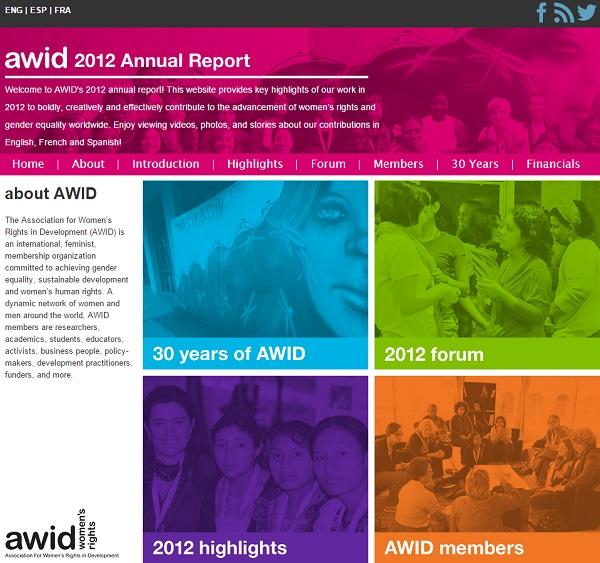
Our 2012 Annual Report provides key highlights of our work during the year to boldly, creatively and effectively contribute to the advancement of women’s rights and gender equality worldwide.
Enjoy viewing videos, photos, and stories about our contributions.
As an online participant, you can facilitate activities, connect and converse with others, and experience first-hand the creativity, art and celebration of the AWID Forum. Participants connecting online will enjoy a rich and diverse program, from workshops and discussions to healing activities and musical performances. Some activities will focus on connection among online participants, and others will be truly hybrid, focusing on connection and interaction among online participants and those in Bangkok.