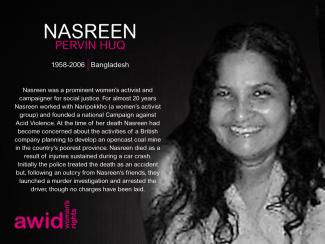
Nasreen Pervin Huq
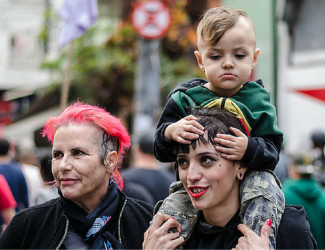
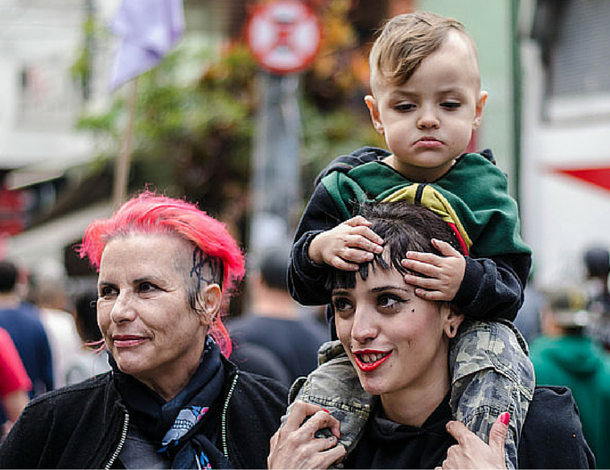
Over the past few years, a troubling new trend at the international human rights level is being observed, where discourses on ‘protecting the family’ are being employed to defend violations committed against family members, to bolster and justify impunity, and to restrict equal rights within and to family life.
The campaign to "Protect the Family" is driven by ultra-conservative efforts to impose "traditional" and patriarchal interpretations of the family, and to move rights out of the hands of family members and into the institution of ‘the family’.
Since 2014, a group of states have been operating as a bloc in human rights spaces under the name “Group of Friends of the Family”, and resolutions on “Protection of the Family” have been successfully passed every year since 2014.
This agenda has spread beyond the Human Rights Council. We have seen regressive language on “the family” being introduced at the Commission on the Status of Women, and attempts made to introduce it in negotiations on the Sustainable Development Goals.
AWID works with partners and allies to jointly resist “Protection of the Family” and other regressive agendas, and to uphold the universality of human rights.
In response to the increased influence of regressive actors in human rights spaces, AWID joined allies to form the Observatory on the Universality of Rights (OURs). OURs is a collaborative project that monitors, analyzes, and shares information on anti-rights initiatives like “Protection of the Family”.
Rights at Risk, the first OURs report, charts a map of the actors making up the global anti-rights lobby, identifies their key discourses and strategies, and the effect they are having on our human rights.
The report outlines “Protection of the Family” as an agenda that has fostered collaboration across a broad range of regressive actors at the UN. It describes it as: “a strategic framework that houses “multiple patriarchal and anti-rights positions, where the framework, in turn, aims to justify and institutionalize these positions.”
We are living in a world where the destruction of Nature fuels our current global economy. |
Even in times of climate crisis, governments continue to encourage large-scale agriculture industries to expand. These activities poison the land, threaten biodiversity, and destroy local food production and livelihoods. Meanwhile, while women produce the majority of our food in the world, they own almost none of the land. |
|
What if we perceived land and Nature not as private property to exploit, but as a whole to live in, learn from, and harmoniously coexist with? What if we repaired our relationships with the land and embraced more sustainable alternatives that nurture both the planet and its communities? Nous Sommes la Solution (We Are the Solution, NSS) is one of many women-led movements striving to do this. This is their story. |
|
AWID honra a lxs feministas y defensoras de los derechos humanos que han muerto y cuyas contribuciones al progreso de los derechos humanos se echa mucho en falta.
El Tributo de AWID a las defensoras de derechos humanos es una exhibición fotográfica que presenta a activistxs del feminismo, de los derechos de las mujeres y de la justicia social de todo el mundo que ya no están con nosotrxs.
El Tributo fue lanzado por primera vez en 2012, en el 12º Foro Internacional de AWID, en Turquía. Tomó la forma de una exposición física de retratos y biografías de feministas y activistxs que fallecieron. La iniciativa fue descrita por lxs participantes del Foro como una manera única, emotiva y energizante de conmemorar nuestra historia colectiva.
En el 13º Foro Internacional, en Brasil, honramos a lxs activistas y a las defensoras de derechos humanos con una ceremonia de inauguración de un mural en cuatro idiomas, un espectáculo de danza y un ritual brasileño.
Entre los eventos, el Tributo permanece como una galería en línea que se actualiza cada año como parte de la Campaña de los 16 Días de Activismo Contra la Violencia de Género (25 de noviembre al 10 de diciembre).
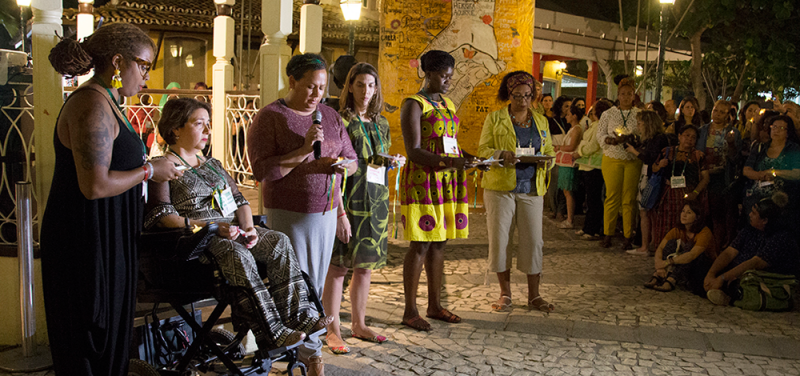
Desde 2012, a través de nuestro Tributo anual a las defensoras de derechos humanos que ya no están con nosotrxs, hemos presentado más de 400 feministas y defensorxs de 11 regiones y 80 países.
AWID quiere agradecer a las familias y organizaciones que compartieron sus historias personales y contribuyeron a este homenaje. Nos unimos a ellxs para continuar con el notable trabajo de estas mujeres y redoblar esfuerzos para asegurar que se logre justicia en los casos que permanecen en la impunidad.
Visite la exhibición en línea del Tributo a las Defensoras de Derechos Humanos
Además de rendir homenaje a estxs increíbles activistas, el Tributo arroja luz sobre la gravedad de la situación de las defensoras de derechos humanos que han sido asesinadas o están desaparecidas.
Un tercio de las personas presentadas en el Tributo fueron activistas asesinadxs o están desaparecidxs en circunstancias sospechosas. Fueron atacadxs específicamente por ser quiénes eran y por haber desafiado:
Mujeres como Agnes Torres, de México, fueron asesinadas debido a su identidad de género y orientación sexual; o Cheryl Ananayo, una activista ambientalista de Filipinas que fue asesinada mientras luchaba contra una compañía minera; o Ruqia Hassan, una periodista y bloguera independiente siria asesinada por sus críticas al Estado Islámico de Iraq y Levante (EIIL, ISIS en inglés). Y muchas otras.
Con el Tributo a las defensoras de derechos humanos lxs traemos a todxs a nuestra memoria colectiva y llevamos su legado de lucha como nuestra antorcha en los movimientos feministas y por los derechos de las mujeres. Reconocemos que la seguridad y el autocuidado deben ser una prioridad en todas nuestras agendas políticas. Y hacemos un llamamiento a los gobiernos y a los organismos internacionales para que aborden colectivamente la violencia contra lxs feministas y las defensoras de derechos humanos.
Visite la exhibición en línea del Tributo a las Defensoras de Derechos Humanos
Unless there are accessibility issues and/or you are filling the survey in other languages, we strongly encourage you to use KOBO for WITM standardized data collection and analysis.
This is Mariama Sonko, an inspiring small-scale rural farmer, eco-feminist and a woman human rights defender.
She lives in Niaguiss, a town in the southwest of Senegal. Growing up in a family and community of rural farmers, she witnessed the essential role of women in food production and seed preservation from a very early age, while also being immersed in the rhythms and working of the land. Mariama has been defending local agricultural knowledge and peasant practices since the 1990s. As a mother of five children, the food she grows herself is the main source of sustenance for her family.
She is currently the president of “Nous Sommes la Solution'' and is involved in promoting agroecological practices and family farming, encouraging food sovereignty, biodiversity and farmer seed preservation, and demanding equitable access to resources and land for women across West Africa.
Source: AWID’s Feminist Realities Festival Crear | Résister | Transform - Day 2/ 2ème jour/ 2º día
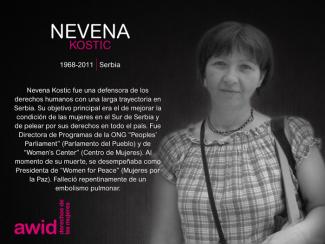
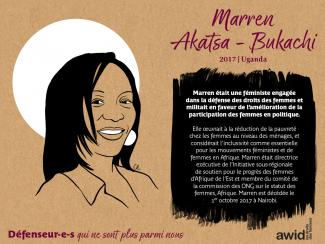
This year we are honoring 18 Women Human Rights Defenders from the Latin America and the Caribbean region. Alone 15 of those were murdered, among which 6 are journalists and 4 LGBTQI and/or sex workers’ rights defenders. Please join us in commemorating the life and work of these women by sharing the memes below with your colleagues, friends and networks and by tweeting using the hashtag #AWIDTribute.


Sí, es accesible para personas con diverso grado de discapacidades auditivas, visuales, cognitivas y de movilidad.
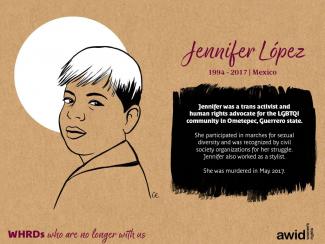
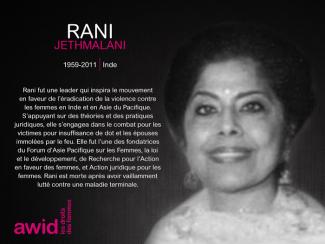
Las 3 defensoras de derechos humanos del Pacífico que honramos en el Tributo Virtual de este año trabajaron en los medios, defendieron los derechos de las personas con discapacidad y promovieron los derechos de las mujeres. Extrañamos sus contribuciones y las honramos mediante este Tributo. Únete a AWID para honrar a estas defensoras de derechos humanos, su trabajo y su legado, compartiendo los memes aquí incluidos con tus colegas, amistades y redes; y tuiteando las etiquetas #WHRDTribute y #16Días.
Por favor, haz click en cada imagen de abajo para ver una versión más grande y para descargar como un archivo.


La durée est estimée à 30 minutes.
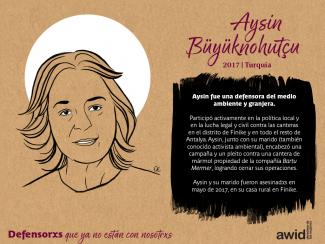
Écoutez cette histoire ici :
