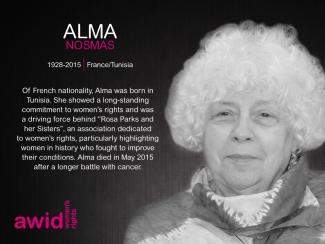
Alma Nosmas

WHRDs are self-identified women and lesbian, bisexual, transgender, queer and intersex (LBTQI) people and others who defend rights and are subject to gender-specific risks and threats due to their human rights work and/or as a direct consequence of their gender identity or sexual orientation.
WHRDs are subject to systematic violence and discrimination due to their identities and unyielding struggles for rights, equality and justice.
The WHRD Program collaborates with international and regional partners as well as the AWID membership to raise awareness about these risks and threats, advocate for feminist and holistic measures of protection and safety, and actively promote a culture of self-care and collective well being in our movements.
WHRDs are exposed to the same types of risks that all other defenders who defend human rights, communities, and the environment face. However, they are also exposed to gender-based violence and gender-specific risks because they challenge existing gender norms within their communities and societies.
We work collaboratively with international and regional networks and our membership
We aim to contribute to a safer world for WHRDs, their families and communities. We believe that action for rights and justice should not put WHRDs at risk; it should be appreciated and celebrated.
Promoting collaboration and coordination among human rights and women’s rights organizations at the international level to strengthen responses concerning safety and wellbeing of WHRDs.
Supporting regional networks of WHRDs and their organizations, such as the Mesoamerican Initiative for WHRDs and the WHRD Middle East and North Africa Coalition, in promoting and strengthening collective action for protection - emphasizing the establishment of solidarity and protection networks, the promotion of self-care, and advocacy and mobilization for the safety of WHRDs;
Increasing the visibility and recognition of WHRDs and their struggles, as well as the risks that they encounter by documenting the attacks that they face, and researching, producing, and disseminating information on their struggles, strategies, and challenges:
Mobilizing urgent responses of international solidarity for WHRDs at risk through our international and regional networks, and our active membership.
Il n'y a rien de tel que d'être dans un espace partagé, d'échanger des énergies corporelles, de regarder dans les yeux de quelqu'un et de tisser des liens, de voir le monde et de faire quelque chose ensemble. Des événements comme le Forum sont parmi les plus forts du mouvement féministe mondial...
- Jac s m Kee, Malaisie
Rosane Santiago Silveira was affectionately known as Rô Conceição. A Brazilian environmental and human rights activist, she fervently fought to protect the environment where it was most threatened.
This included defending it on the island of Barra Velha, where it was endangered by oil exploration, as well as safeguarding it by campaigning against land-grabbing and expansion of eucalyptus plantations in Bahia State, where Rosane was a member of the Cassurubá Extractivist Reserve Council.
“Extractive Reserve is a protected area where resident families make their living off natural products extracted from the forest. These activities help maintain the forest integrity.” - Global Justice Ecology Project (original source: Rede Brasil Atual)
She was part of trade union activities, human rights and cultural movements. Rosane dedicated much of herself to causes that were not only close to her but are also of concern to land, forests, rivers, and communities whose rights and lives are continuously at risk.
She was tortured and murdered on 29 January 2019 in Nova Viçosa, a city in southern Bahia.
“Unfortunately, today there is a feeling of total insecurity, because of the State’s absence in prosecuting these crimes. We were with her at Christmas, and everyone realised that she was worried and now we know that she had received three death threats,” - Tuian, Rosane’s son in an interview with Rádio Brasil Atual (original source: Rede Brasil Atual)

La financiación para el desarrollo encierra amenazas y oportunidades concretas para los derechos de las mujeres y los derechos humanos de todas las personas. Una financiación y políticas para el desarrollo que sean transformadoras pueden constituir un aporte importante para los cambios sistémicos que se necesitan a fin de garantizar el respeto, la protección y la realización de los derechos humanos de las mujeres.
El año 2015 es importante en el proceso de la FpD. La tercera Conferencia Internacional sobre la FpD tuvo lugar del 13 al 16 de julio de 2015 en Adís Abeba, Etiopía, y los gobiernos están finalizando la Agenda de Desarrollo Post-2015 que incluye acuerdos acerca de cómo se van a financiar los Objetivos de Desarrollo Sostenible.
En su actual etapa, el proceso de la FpD ofrece una oportunidad importante para fijar un marco de financiación que garantice un apoyo financiero efectivo para la implementación de la Agenda Post-2015 y de los Objetivos de Desarrollo Sostenible (ODS). También constituye una oportunidad para abordar las condiciones estructurales y los cambios sistémicos necesarios para la plena implementación de otras agendas y compromisos como los tratados internacionales de derechos humanos y la Plataforma de Acción de Beijing.
En estos últimos trece años, organizaciones por los derechos de las mujeres y feministas han participado activamente en el proceso de la FpD.
A personal investigation into the mysterious life of the director's Aunt Sally, an Ethiopian aristocrat-turned-communist-rebel who disappeared after the revolution that lead to the overthrow of Emperor Haile Selassie.
June 23 at 12:30pm EST on IG Live
Les mouvements féministes ont besoin de financements de base et pérennes —notamment des économies et des réserves— afin de pouvoir continuer de se focaliser sur le changement systémique. Les réserves ne sont pas des extras, elles sont essentielles à leur viabilité.
Je n'ai jamais su que j'avais une famille proche qui m'aime et qui veut que je m'épanouisse, Ma mère a toujours été là pour moi, mais je n'aurais jamais imaginé que j'aurais des milliers de familles qui ne sont pas liées à moi par le sang.

J'ai découvert que les familles ne sont pas seulement des personnes liées par le sang, mais des personnes qui vous aiment inconditionnellement, sans se soucier de votre orientation sexuelle, de votre état de santé, de votre statut social ou de votre race.
Je pense aux moments précieux où j'ai écouté toutes mes sœurs du monde entier qui sont des féministes fortes, des personnes que je n'ai pas rencontré.e.s physiquement, mais qui me soutiennent, m'enseignent, se battent pour moi : je suis à court de mots, les mots ne peuvent pas exprimer à quel point je vous aime, vous les mentor.esse.s et les autres féministes, vous êtes une mère, une sœur, une amie pour des millions de filles.
Vous êtes incroyables, vous vous êtes battu.e.s pour des personnes que vous ne connaissez pas - et c'est ce qui vous rend si spéciales.aux.
Cela me fait plaisir de l'exprimer par écrit.
Je vous aime tou.te.s et je continuerai à vous aimer. Je n'ai vu aucun.e d'entre vous physiquement, mais il me semble que nous nous connaissons depuis des décennies.
Nous sommes féministes et nous sommes fières d'être des femmes.
Nous continuerons à faire savoir au monde que notre courage est notre couronne.
Une lettre d'amour de FAITH ONUH, une jeune féministe du Nigeria.
Each Forum takes place in a different region, and it is time for the AWID Forum to come back to Asia! We visited many countries in the region, consulted feminist movements, and conducted detailed assessments of logistics, accessibility, safety, visas and more. Eventually, the AWID Board enthusiastically approved Bangkok, Thailand, as the best option. We are excited to come back to Bangkok, where we held the AWID Forum in 2005.

«Soy una maravilla... ¡Por lo tanto, he nacido de una madre! Cuando comienzo a balbucear, Mi vida ha sido como ninguna otra...» - Ayanda Denge (lee el poema completo más abajo)
Como comprometida y ferviente activista por la justicia social, luchó por los derechos de lxs trabajadorxs sexuales, de las personas trans y de quienes viven con VIH y SIDA. Era también conferencista motivacional para concientizar sobre el cáncer, y hacía campaña por viviendas sociales económicas, en especial, para la gente pobre y de clase trabajadora. Ayanda se erguía, alta como una montaña, contra los distintos y, a menudo, abusivos rostros de la discriminación.
«Ser transgénero no es una dosis doble, sino una dosis triple de estigmatización y discriminación. Te discriminan por tu identidad sexual, te discriminan por tu trabajo, y te discriminan por tu estatus de VIH.» - Ayanda Denge, 2016
Ayanda presidía la organización Sex Workers Education and Advocacy Taskforce (SWEAT) [ Grupo de Trabajo para la Educación y la Defensa de Trabajadorxs Sexuales], y trabajaba también como coordinadora de promoción comunitaria en Sisonke, un movimiento nacional de trabajadorxs sexuales de Sudáfrica.
«Desde nosotrxs, desde nuestra sede regional, hasta SWEAT, de la que integro la Junta Directiva, o hasta Sisonke, un movimiento de trabajadorxs sexuales de Ciudad del Cabo, todxs nos amalgamamos, tenemos un solo grito y es un grito que ha sido reconocido internacionalmente por lxs trabajadorxs sexuales internacionales. Queremos la descriminalización del trabajo sexual.» - Ayanda Denge, 2016
Vivía en la Ahmed Kathrada House, que estaba siendo ocupada por la campaña Reclaim the City [Recuperar la Ciudad] en favor de las viviendas sociales. En 2018, Ayanda fue elegida líder de la casa. El 24 de marzo de 2019 fue apuñalada en su habitación. El año anterior, otrx residente había sido asesinadx.
Reclaim the City señala una conexión entre la seguridad de lxs residentes de la casa, el corte del servicio de electricidad por parte del gobierno provincial, y el derecho humano al agua:
«No podemos separar la seguridad de las mujeres y de las personas LGBTQI que están viviendo en la casa ocupada de la negativa a reestablecer los servicios de electricidad y agua en la Ahmed Kathrada House por parte del gobierno de la Provincia del Cabo Occidental.
De noche, la casa está completamente oscura. Necesitamos luces para protegernos unxs a otrxs. Es como si la Provincia quisiera castigar a la gente pobre y de clase trabajadora, cuyo único crimen es necesitar un hogar. Si bien pueden estar en desacuerdo con nuestros motivos por ocuparla, deberían avergonzarse de priorizar la política en detrimento de la seguridad y la dignidad de lxs residentes de esta ciudad.
Descansa en paz, camarada Ayanda Denge. Te recordaremos mientras mantenemos viva la llama de la lucha por una vivienda decente y bien ubicada.»
Poema de Ayanda:
Soy una maravilla…
¡Por lo tanto, nací de una madre!
Cuando comienzo a balbucear,
Mi vida ha sido como ninguna otra.
Nacida en el dolor
Nutrida por la lluvia
Para mí ganar
Era vivir en un desagüe.
Mientras se me cae una lágrima
Me pongo de pie y empuño mi lanza.
Las voces hacen eco, no temas
Habrá desafíos dentro del año,
Desafíos de daño se ciernen sobre mí;
La comunidad aplaude porque asume que he ganado mi carrera;
Pero en realidad mi trabajo avanza a paso de tortuga;
De rodillas me inclino y pido gracia.
Porque el Señor
Es mi espada
Para recordar a la humanidad
Que Él brinda cordura.
¿Por qué Señor soy esta maravilla?
El Señor me responde con la lluvia y el trueno,
Por cuestionar a mi padre
Que tiene en el libro de los corderos
Un nombre llamado Ayanda.
Desde las calles mi vida nunca fue dulce
La gente que tenía que encontrar;
A veces yo nunca saludaba,
Aun a pesar de que tenía que comer;
Optaba por inclinarme
En lugar de sentarme
Escucha el poema en la voz de Ayanda
«Porque mi vida representa la de una flor de loto, ya que de las turbias y turbulentas aguas florecí para ser hermosa y fuerte...» - Ayanda Denge, mira y escucha
«Ayanda, quiero decirte que todavía eres una sobreviviente, en nuestros corazones y nuestras mentes. Te has ido, pero estás en todas partes, porque eres amor. Qué hermoso es ser amadx, y dar amor. Y Ayanda, ese es el regalo que nos has dado. Gracias por todo el amor, verdaderamente te necesitábamos. De ahora en adelante, te prometo que todxs nos comprometeremos a continuar la lucha a la que tanta energía y tiempo dedicaste. Y nos comprometeremos a buscar justicia por este horrible final de tu vida.» - transcripción de un mensaje en un tributo de despedida a Ayanda
«Ayanda era una activista por naturaleza. Sabía cuáles eran sus derechos y no le importaba pelear por los derechos de otrxs. Para mí, no fue una sorpresa que se involucrara en muchas organizaciones, y era sabido que era una persona de la gente. Ella representaba no solo los derechos de las personas LGBTI, representaba los derechos de todxs.» - hermana de Ayanda

For any questions related to the Call for Forum Activities please contact us, selecting Forum Call for Activities as the subject of your email.
some text some text some text some text some text some text some text some text some text some text some text some text
Comment les mouvements résistent aux agendas fascistes en lien avec le changement climatique.
📅 Mardi 11 novembre 2025
📍 Beira Rio Hôtel, Belém, Pará

Many participants experience the AWID Forums as a unique space of freedom where they are embraced and celebrated as they are. In a world where even the most privileged feminists often find themselves not fully fitting in, for those whose identities are criminalized or otherwise condemned in their everyday contexts this experience of freedom and celebration can be deeply transformative (and restorative). The story of how OluTimehin Kukoyi – a first time participant – experienced the Black Feminist Forum (BFF) and the AWID Forum in Bahia (2016) powerfully illustrates this.
Por favor, calcula los costos de viaje a Bangkok, alojamiento y viáticos, visado, cualquier necesidad de accesibilidad y gastos incidentales, además de la tarifa de inscripción que se anunciará próximamente. Los hoteles en la zona de Sukhumvit en Bangkok tienen un rango de precios de USD$50 a $200 por noche en ocupación doble.
Lxs afiliadxs de AWID reciben un descuento al registrarse, por lo tanto, si aún no te has sumado a la membresía, te invitamos a considerar unirte y formar parte de nuestra comunidad feminista global.

This information will only be available when registration opens.
Anti-rights actors adopt a double strategy. As well as launching outright attacks on the multilateral system, anti-rights actors also undermine human rights from within. Anti-rights actors engage with the aim of co-opting processes, entrenching regressive norms, and undermining accountability.
En vigueur à compter du 25 avril 2023.
Veuillez cliquer ici pour consulter la version précédente de notre politique de confidentialité.
La présente politique de confidentialité présente la manière dont l'Association pour les droits des femmes dans le développement et nos filiales et sociétés affiliées (« AWID », « nous » ou « notre ») traitent les données personnelles que nous recueillons via notre site Web, renvoyant à la présente politique de confidentialité (le « site »), ainsi que via les réseaux sociaux, nos activités de marketing, nos événements en direct et autres activités décrites dans la présente politique de confidentialité (le « Service »).
Index
Les données personnelles que nous recueillons
Comment nous utilisons vos données personnelles
Comment nous partageons vos données personnelles
Vos choix
Autres sites et services
Sécurité
Transferts internationaux de données
Personnes mineures
Modifications de la politique de confidentialité
Comment nous contacter
Avis aux utilisateurs·trices européen·ne·s
Les données que vous nous communiquez. Les données personnelles que vous êtes susceptibles de nous fournir par l'intermédiaire du Service ou d'une autre manière comprennent :
Données de communication basées sur nos échanges avec vous, y compris lorsque vous nous contactez par le biais du Service, des médias sociaux ou autrement.
Collecte automatique de données. Nous, nos fournisseurs de services et nos partenaires commerciaux pouvons enregistrer automatiquement certaines informations vous concernant, concernant votre ordinateur ou appareil mobile, et votre interaction au fil du temps avec le Service, nos communications et autres services en ligne, telles que :
Cookies et technologies apparentées. Une partie de la collecte automatique décrite ci-dessus est facilitée par les cookies, qui sont de petits fichiers texte que les sites Internet stockent sur les appareils des utilisateurs·trices et qui permettent aux serveurs Web d'enregistrer les activités de navigation Web des utilisateurs·trices et de se souvenir de leurs informations, de leurs préférences et de leur statut de connexion lorsqu'ils naviguent sur un site. Les cookies utilisés sur nos sites comprennent à la fois des « cookies de session » qui sont supprimés lorsqu'une session se termine, des « cookies persistants » qui restent plus longtemps, des cookies de « première partie » que nous plaçons et des cookies de « tierce partie » placés par nos partenaires commerciaux et nos fournisseurs de services de tiers.
Vos données personnelles pourront être utilisées aux fins suivantes ou selon les modalités décrites au moment de la collecte :
Prestation de services et exploitation commerciale. Nous sommes susceptibles d’utiliser vos données personnelles pour :
Recherche et développement. Nous sommes susceptibles d'utiliser vos données personnelles à des fins de recherche et de développement, notamment pour analyser et améliorer le Service. Dans le cadre de ces activités, nous pouvons créer des données agrégées, dépersonnalisées et/ou anonymisées à partir des données personnelles que nous recueillons. Nous transformons les données personnelles en données dépersonnalisées ou anonymes en supprimant les informations qui permettent de vous identifier personnellement. Nous pouvons utiliser ces données agrégées, dépersonnalisées ou autrement anonymisées et les partager avec des tiers à nos fins commerciales légales, y compris pour analyser et améliorer le Service et promouvoir nos activités.
Publicité. Nos fournisseurs de services et nous-mêmes pouvons recueillir et utiliser vos données personnelles pour vous envoyer des communications de marketing direct. Vous pouvez demander à ne plus recevoir de communications promotionnelles comme décrit dans la section Désengagement du marketing ci-dessous.
Conformité et protection. Nous sommes susceptibles d’utiliser vos données personnelles pour :
Avec votre consentement. Dans certains cas, nous pourrons vous demander expressément votre accord avant de collecter, utiliser ou partager vos données personnelles, notamment lorsque la loi l'exige.
Cookies et technologies apparentées. En plus des autres utilisations incluses dans cette section, nous sommes susceptibles d’utiliser les Cookies et technologies apparentées décrites ci-dessus aux fins suivantes :
Conservation. Nous conservons généralement les données personnelles pour atteindre les fins pour lesquelles nous les avons recueillies, y compris pour satisfaire à toute exigence légale, comptable ou de déclaration, pour établir ou défendre des réclamations légales, ou à des fins de prévention de la fraude. Pour déterminer la période de conservation appropriée des données personnelles, nous pouvons prendre en compte des facteurs tels que la quantité, la nature et la sensibilité des données personnelles, le risque potentiel de préjudice lié à l'utilisation ou à la divulgation non autorisée de vos données personnelles, les fins auxquelles nous traitons vos données personnelles et si nous pouvons atteindre ces fins par d'autres moyens, ainsi que les exigences légales applicables.
Une fois que nous n'avons plus besoin des informations personnelles que nous avons collectées à votre sujet, nous pouvons soit les supprimer, soit les rendre anonymes, soit les exclure de tout traitement ultérieur.
Nous sommes susceptibles de partager vos données personnelles avec les parties suivantes et comme décrit par ailleurs dans la présente politique de confidentialité ou au moment de la collecte :
Sociétés affiliées. Notre société mère, nos filiales et nos sociétés affiliées, à des fins compatibles avec la présente politique de confidentialité.
Fournisseurs de services. Les tiers qui fournissent des services en notre nom ou qui nous aident à exploiter le Service ou notre entreprise (tels que l'hébergement, la technologie de l'information, l'assistance à la clientèle, la livraison de courriels, le marketing, la recherche sur les consommateurs·trices et l'analyse de sites Internet).
Processeurs de paiement. Toute information de carte de paiement que vous utilisez pour effectuer un achat sur le Service est collectée et traitée directement par nos processeurs de paiement, tels que Stripe. Stripe se réserve le droit d'utiliser ces données de paiement conformément à sa politique de confidentialité, à l'adresse https://stripe.com/fr/privacy. Vous pouvez également demander à être facturé·e par votre fournisseur de communications mobiles, qui utilisera vos données de paiement conformément à sa propre politique de confidentialité.
Tiers désignés par vous. Nous nous réservons le droit de partager vos données personnelles avec des tiers dès lors que vous nous en avez donné l'instruction ou que vous nous avez donné votre accord pour le faire. Nous partagerons les informations personnelles requises pour que ces autres entreprises puissent fournir les services que vous aurez sollicités. De plus, vous pouvez choisir de traduire le contenu généré par les utilisateurs·trices à l'aide de Google Translate. Google se réserve le droit d’utiliser ce contenu conformément à sa politique de confidentialité, https://policies.google.com.
Conseillers·ères professionnel·le·s. Les conseillers·ères professionnel·le·s, tel·le·s que les avocat·e·s, les auditeurs·trices, les banquiers·ières et les compagnies d'assurance or asureur·e·s, lorsque cela est nécessaire dans le cadre des services professionnels qu'ils·elles nous fournissent.
Autorités et autres. Les forces de l'ordre, les autorités gouvernementales et les parties privées, si nous estimons de bonne foi que cela est nécessaire ou approprié aux fins de conformité et de protection décrites ci-dessus.
Autres utilisateurs·trices. Votre profil et les autres données de contenu généré par les utilisateurs·trices (à l'exception des messages) sont potentiellement visibles par d'autres utilisateurs·trices du Service. Par exemple, d'autres utilisateurs·trices du Service peuvent avoir accès à vos informations si vous avez choisi de mettre votre profil ou d'autres données personnelles à leur disposition par le biais du Service, par exemple lorsque vous publiez des commentaires, des critiques, des réponses à des sondages ou que vous partagez d'autres contenus. Ces informations peuvent être vues, collectées et utilisées par d'autres, y compris être mises en cache, copiées, capturées à l'écran ou stockées ailleurs par d'autres (par exemple, les moteurs de recherche), et nous ne prenons pas la responsabilité d'une telle utilisation de ces informations.
Dans cette section, nous décrivons les droits et les choix disponibles pour tous les utilisateurs·trices. Les utilisateurs·trices qui se trouvent au Royaume-Uni, en Suisse et dans l’Espace économique européen peuvent trouver des informations supplémentaires sur leurs droits ci-dessous.
Refus des communications publicitaires. Vous pouvez renoncer à recevoir des courriels à caractère commercial en suivant les instructions d’opposition ou de désabonnement figurant au bas du courriel, ou en nous contactant. Notez que si vous choisissez de vous désabonner des courriels à caractère publicitaire, vous continuerez peut-être à recevoir des courriels liés au Service et d'autres courriels à caractère non publicitaire.
Refuser de fournir des informations. Il nous est nécessaire de collecter des données personnelles pour fournir certains services. Si vous ne fournissez pas les informations que nous jugeons requises ou obligatoires, nous pourrions ne pas être en mesure de fournir ces services.
Supprimer votre contenu ou mettre fin à votre adhésion. Vous pouvez choisir de supprimer certains contenus que vous nous avez fournis. Si vous souhaitez faire la demande de mettre fin à votre adhésion, veuillez nous contacter.
Le Service est susceptible de contenir des liens vers des sites Internet, des applications mobiles et d'autres services en ligne exploités par des tiers. En outre, il peut arriver que notre contenu soit intégré à des pages Internet ou à d'autres services en ligne qui ne nous sont pas associés. Ces liens et intégrations ne constituent pas une approbation de notre part, ni ne signifient que nous sommes affiliés à une tierce partie. Nous ne contrôlons pas les sites Internet, les applications mobiles ou les services en ligne exploités par des tiers, et nous ne sommes pas responsables de leurs actions. Nous vous encourageons à lire les politiques de confidentialité des autres sites Internet, applications mobiles et services en ligne que vous utilisez.
Nous employons un certain nombre de mesures de protection techniques, organisationnelles et physiques conçues pour protéger les données personnelles que nous recueillons. Cependant, le risque de sécurité est inhérent à toutes les technologies de l'Internet et de l'information et nous ne pouvons pas garantir la sécurité de vos données personnelles.
Notre siège social se trouve aux États-Unis mais nous nous réservons le droit de faire appel à des fournisseurs de services exerçant leurs activités dans d'autres pays. Vos données personnelles sont susceptibles d'être transférées aux États-Unis ou à d'autres endroits où les lois sur la protection de la vie privée pourraient ne pas être aussi protectrices que celles en vigueur dans votre État, votre province ou votre pays.
Il est recommandé aux utilisateurs·trices du Royaume-Uni, de la Suisse et de l'Espace économique européen de lire les informations importantes fournies ci-dessous concernant le transfert de données personnelles effectué en dehors de l'Union européenne.
Le Service n'est pas destiné à être utilisé par des personnes âgées de moins de 18 ans. Si vous êtes le parent ou un·e tuteur·trice d'un enfant auprès duquel vous pensez que nous avons recueilli des données personnelles de manière illégale, veuillez nous contacter. Si nous apprenons que nous avons recueilli des données personnelles par le biais du Service auprès d'une personne mineure sans le consentement de son parent ou de tuteur·trice tel que l'exige la loi, nous nous conformerons aux exigences légales applicables pour supprimer ces informations.
Nous nous réservons le droit de modifier cette politique de confidentialité à tout moment. Si nous y apportons des modifications importantes, nous vous en informerons en mettant à jour la date de cette politique de confidentialité et en l'affichant sur le Service ou par d'autres moyens appropriés. Toute modification de la présente politique de confidentialité entrera en vigueur dès que nous aurons publié la version modifiée (ou comme indiqué autrement au moment de la publication). Dans tous les cas, l'utilisation du Service après la date d'entrée en vigueur de toute politique de confidentialité modifiée indique que vous reconnaissez que la politique de confidentialité modifiée s'applique à vos interactions avec le Service et notre entreprise.
Avis aux utilisateurs·trices européen·ne·s
Domaines d’application du présent avis aux utilisateurs·trices européen·ne·s. Les informations fournies dans cette section « Avis aux utilisateurs·trices européen·ne·s » ne s'appliquent qu'aux personnes situées dans l'EEE ou au Royaume-Uni (les juridictions de l'EEE et du Royaume-Uni sont ensemble désignées par le terme « Europe »).
Données personnelles. Les références aux « données personnelles » dans la présente politique de confidentialité doivent être comprises comme incluant une référence aux « données personnelles » (telles que définies dans le RGPD) - c'est-à-dire les informations sur les individus à partir desquelles ils sont soit directement identifiés, soit identifiables. Elles n'incluent pas les « données anonymes » (c'est-à-dire les informations se rapportant à l'identité d’un individu ayant été définitivement supprimée). Les données personnelles que nous recueillons auprès de vous sont identifiées et décrites plus en détail dans la section « Informations personnelles que nous recueillons ».
Responsable du traitement. L’AWID est responsable du traitement de vos données personnelles couvertes par la présente politique de confidentialité aux fins de la législation européenne sur la protection des données (c'est-à-dire le RGPD de l'UE et le dénommé « RGPD du Royaume-Uni » (le « RGPD », le cas échéant)). Voir la section Comment nous contacter ci-dessus pour obtenir nos coordonnées.
Nos bases légales en matière de traitement de l'information. Le RGPD exige que nous nous assurions de disposer d'une « base légale » permettant l’utilisation de vos données personnelles pour toute raison que ce soit.
Nos bases légales pour le traitement de vos données personnelles décrites dans la présente politique de confidentialité sont énumérées ci-dessous.
Nous avons présenté ci-dessous, sous forme de tableau, les bases légales sur lesquelles nous nous appuyons en ce qui concerne lesdites Finalités justifiant l'utilisation de vos données personnelles - pour plus d'informations sur ces Finalités et les types de données concernés, voir Comment nous utilisons vos données personnelles ci-dessus.
|
|
|
|
|
|
|
|
|
|
|
|
|
|
|
|
|
|
|
|
Conservation. Nous conservons les données personnelles aussi longtemps que nécessaire pour atteindre l’objectif pour lequel nous les avons recueillies, y compris pour satisfaire à toute exigence légale, comptable ou de déclaration, pour établir ou défendre des réclamations légales, ou à des fins de conformité et de protection, à moins qu'il ne soit spécifiquement autorisé de les conserver plus longtemps.
Pour déterminer la période de conservation appropriée des données personnelles, nous tenons compte de la quantité, de la nature et de la sensibilité des données personnelles, du risque potentiel de préjudice lié à l'utilisation ou à la divulgation non autorisée de vos données personnelles, des fins auxquelles nous traitons vos données personnelles et de la possibilité d'atteindre ces objectifs par d'autres moyens, ainsi que des exigences légales applicables.
Une fois que nous n'aurons plus besoin des données personnelles que nous avons recueillies à votre sujet, nous les supprimerons ou les rendrons anonymes ou, si cela n'est pas possible (par exemple, parce que vos données personnelles ont été stockées dans des archives de sauvegarde), nous conserverons vos données personnelles en toute sécurité et les exclurons de tout traitement ultérieur jusqu'à ce qu'il soit possible de les effacer. Dans le cas où nous rendons anonymes vos données personnelles (afin qu'elles ne puissent plus vous être associées), nous sommes en droit d'utiliser ces informations indéfiniment sans vous en informer davantage.
Informations complémentaires
Pas d’obligation de fournir des données personnelles. Vous n'êtes pas obligé·e de nous fournir des données personnelles. Cependant, dans le cas où nous devrions traiter vos données personnelles soit pour nous conformer à la loi applicable, soit pour vous fournir nos Services, et que vous ne nous communiqueriez pas ces données personnelles lorsque nous vous le demandons, nous pourrions ne pas être en mesure de vous fournir une partie ou la totalité de nos Services. Nous vous en informerons, si c'est le cas à ce moment-là.
Pas de prise de décision automatisée ni de profilage. Dans le cadre des Services, nous n'effectuons pas de prise de décision automatisée ni/ou de profilage entraînant des effets juridiques ou des effets significatifs similaires. Nous ne manquerons pas de vous faire savoir si la mise à jour de la présente politique de confidentialité entraîne quelque changement que ce soit.
Sécurité. Nous avons mis en place des procédures conçues pour faire face aux violations de données personnelles. Dans le cas de telles violations, nous avons adopté des procédures qui nous permettent de travailler avec les organismes de réglementation applicables. En outre, dans certaines circonstances (y compris lorsque nous sommes légalement tenu·e·s de le faire), nous pouvons vous avertir des violations affectant vos données personnelles.
Vos droits
Généralités. Les lois européennes sur la protection des données garantissent certains droits concernant vos données personnelles. Si vous résidez en Europe, vous pouvez nous demander de prendre l'une des mesures suivantes en ce qui concerne les données personnelles que nous détenons :
Comment faire valoir ses droits. Vous pouvez soumettre ces demandes par courrier électronique. Voir la section Comment nous contacter ci-dessus pour nos coordonnées. Nous sommes susceptibles de vous demander des informations spécifiques pour nous aider à confirmer votre identité et à traiter votre demande. Le fait que nous soyons tenu·e·s ou non de répondre à votre demande dépendra d'un certain nombre de facteurs (par exemple, pourquoi et comment nous traitons vos données personnelles), si nous rejetons une demande que vous pourriez faire (que ce soit en totalité ou en partie), nous vous communiquerons alors les raisons de cette décision, sous réserve de toute restriction légale. En règle générale, vous n'aurez pas de frais à payer pour exercer vos droits; cependant, nous pouvons exiger des frais raisonnables si votre demande est manifestement infondée, répétitive ou excessive. Nous essayons de répondre à toutes les demandes légitimes dans un délai d'un mois. Cela peut nous prendre plus d'un mois si votre requête est particulièrement complexe ou si vous en avez déposé plusieurs; dans ce cas, nous vous en informerons et vous tiendrons au courant.
Le droit de déposer une plainte auprès de votre autorité de surveillance. Outre les droits qui vous sont conférés ci-dessus, vous pouvez, si notre réponse à une demande que vous nous avez adressée ou la façon dont nous traitons vos données personnelles ne vous satisfont pas, déposer une plainte auprès de l'autorité de contrôle de la protection des données de votre lieu de résidence habituel.
The Information Commissioner’s Office
Water Lane, Wycliffe House
Wilmslow - Cheshire SK9 5AF
Tel. +44 303 123 1113
Site Internet : https://ico.org.uk/make-a-complaint/
Traitement des données en dehors de l'Europe; nous sommes une société basée aux États-Unis et nombre de nos prestataires de services, conseillers·ères, partenaires ou autres destinataires de données sont également basé·e·s aux États-Unis. Cela veut dire que vos données personnelles seront nécessairement consultées et traitées aux États-Unis si vous utilisez les Services. Elles peuvent également être fournies à des destinataires dans d'autres pays en dehors de l'Europe.
Pour rappel, les États-Unis ne font pas l'objet d'une « décision d'adéquation » au titre du RGPD - ce qui signifie, en substance, que le régime juridique américain n'est pas considéré par les organismes européens compétents comme offrant un niveau de protection des données personnelles adéquat et équivalent à celui fourni par les lois européennes en vigueur.
Lorsque nous partageons vos données personnelles avec des tiers qui sont basés en dehors de l'Europe, nous nous efforçons de garantir un degré de protection similaire conformément aux lois applicables en matière de protection de la vie privée en nous assurant que l'un des mécanismes suivants est bien mis en œuvre :
Pour plus d'informations concernant le mécanisme spécifique utilisé lors du transfert de vos données personnelles en dehors de l'Europe, n'hésitez pas à nous contacter.