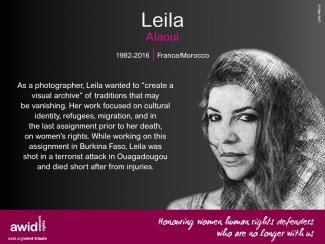
Leila Alaoui
WHRDs are self-identified women and lesbian, bisexual, transgender, queer and intersex (LBTQI) people and others who defend rights and are subject to gender-specific risks and threats due to their human rights work and/or as a direct consequence of their gender identity or sexual orientation.
WHRDs are subject to systematic violence and discrimination due to their identities and unyielding struggles for rights, equality and justice.
The WHRD Program collaborates with international and regional partners as well as the AWID membership to raise awareness about these risks and threats, advocate for feminist and holistic measures of protection and safety, and actively promote a culture of self-care and collective well being in our movements.
WHRDs are exposed to the same types of risks that all other defenders who defend human rights, communities, and the environment face. However, they are also exposed to gender-based violence and gender-specific risks because they challenge existing gender norms within their communities and societies.
We work collaboratively with international and regional networks and our membership
We aim to contribute to a safer world for WHRDs, their families and communities. We believe that action for rights and justice should not put WHRDs at risk; it should be appreciated and celebrated.
Promoting collaboration and coordination among human rights and women’s rights organizations at the international level to strengthen responses concerning safety and wellbeing of WHRDs.
Supporting regional networks of WHRDs and their organizations, such as the Mesoamerican Initiative for WHRDs and the WHRD Middle East and North Africa Coalition, in promoting and strengthening collective action for protection - emphasizing the establishment of solidarity and protection networks, the promotion of self-care, and advocacy and mobilization for the safety of WHRDs;
Increasing the visibility and recognition of WHRDs and their struggles, as well as the risks that they encounter by documenting the attacks that they face, and researching, producing, and disseminating information on their struggles, strategies, and challenges:
Mobilizing urgent responses of international solidarity for WHRDs at risk through our international and regional networks, and our active membership.
Isabel Cabanillas de la Torre fue una activista joven y una artista feminista muy querida de Ciudad Juárez, México, conocida por sus hermosos diseños evocadores de indumentaria pintada a manoen los que los ojos eran una característica emblemática de su trabajo. Sus murales transformaron los edificios abandonados y vacíos del centro de Ciudad Juárez, al sumarles vida y crítica política a sus paredes.
A través de su arte y de su activismo político, Isabel buscó llamar la atención sobre la violencia de género que se extendía por su ciudad natal. Colaboró como voluntaria con la red Mesa de Mujeres en el proyecto «Observatorio Ciudadano de Género», que monitoreaba la actuación de jueces, fiscales y defensorxs públicxs en casos de femicidios y otras violaciones a los derechos basadas en el género. Integró también «Hijas De Su Maquilera Madre», una colectiva feminista cuyo nombre alude a las hijas de madres que son trabajadoras de la maquila. Algunas de estas madres fueron las primeras víctimas de femicidio en Ciudad Juárez.
El último proyecto de Isabel (todavía en curso) fue una instalación artística para protestar contra una compañía canadiense que quería extraer cobre de los Médanos de Samalayuca.
El 18 de enero de 2020 Isabel fue atacada a balazos mientras volvía a su casa del centro de Ciudad Juárez en bicicleta, víctima, aparentemente, de un asesinato selectivo. Su cuerpo fue encontrado junto a su bicicleta.
El asesinato de Isabel desató una nueva ola de indignación contra los femicidios de la región: cientos de personas marcharon hacia el puente de la frontera entre EEUU y México, y lo bloquearon durante horas mientras cantaban «Ni una más», que es la protesta continua de las colectivas feministas contra los asesinatos de las mujeres en todo México. Solamente en 2019, 3.142 mujeres y niñas fueron asesinadas en el país; muchas de ellas fueron atacadas específicamente por su género.
Amaba andar en bicicleta.
«La bicicleta era un símbolo de libertad para ella. Simbolizaba ser libre en las calles.» - Marisol, amiga de Isabel
Este informe recuerda y celebra el primer año del nuevo plan estratégico de AWID, cuando dimos nuestros primeros pasos hacia los resultados deseados: el apoyo a los movimientos feministas para que prosperen, la impugnación de las agendas antiderechos, y la creación conjunta de realidades feministas.

Trabajamos con feministas para desestabilizar las agendas antiderechos, y logramos importantes victorias, peleadas y ganadas dentro del sistema de Naciones Unidas, cuando se logró la inclusión de lenguaje innovador sobre discriminación estructural, derechos sexuales y obligaciones de los Estados en una cantidad de resoluciones. Sí, el sistema multilateral está en crisis y necesita un sólido fortalecimiento, pero estas victorias son importantes, ya que contribuyen a la legitimidad de las demandas feministas, brindando a los movimientos feministas más puntos de presión y más impulso para promover nuestras agendas.
Ensayamos y pusimos a prueba distintas formas de construir conocimientos con los movimientos feministas a través de seminarios en línea, podcasts y conversaciones «en vivo». Desarrollamos guías de facilitación con educadorxs populares para recuperar saberes en pos de la justicia social y de género, incluso sobre un tópico tan aparentemente opaco como los flujos financieros ilícitos. Auspiciamos blogs y opiniones sobre cómo los grupos feministas obtienen fondos y recursos, y señalamos las amenazas que enfrentan nuestros sistemas de derechos humanos.
Dentro de AWID, pusimos en práctica y aprendimos de nuestro enfoque de liderazgo compartido, y relatamos la historia de las dificultades y tribulaciones de dirigir conjuntamente una organización global virtual. No tenemos una respuesta definitiva sobre cómo es un liderazgo feminista, pero un año más tarde sabemos que el compromiso continuo con la experimentación y el aprendizaje colectivos nos ha permitido seguir construyendo una organización con la cual nos entusiasma contribuir.
Al recordar este año, queremos agradecer a todxs nuestrxs amigxs y promotorxs, colegas y compañerxs, que han aportado su tiempo y han compartido su bagaje de conocimiento y sabiduría con nosotrxs. Queremos agradecer a nuestrxs afiliadxs, que han ayudado a construir nuestro plan estratégico y se han unido a nosotrxs para formular demandas feministas. No podríamos hacer este trabajo sin ustedes.
Tandis que les dirigeant·es du monde entier se réunissent au Brésil, les mouvements féministes manifestent, se rassemblent et bouleversent le statu quo à la COP30 et partout ailleurs ! Nous voilà en route vers Belém au Brésil, aux côtés d’autres féministes, pour assister à la COP30 du 10 au 21 novembre 2025. Nous continuerons d’y dénoncer les fausses solutions.
We welcome applications across the full range of thematic areas and intersections important to feminist and gender justice movements.
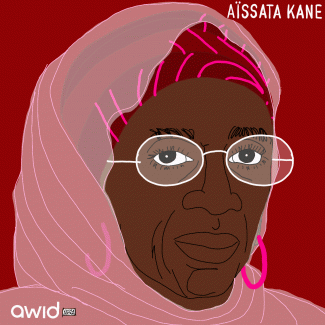
Aïssata Kane, surnommée affectueusement “Yaye Kadia” (Mère Kadia), a de tout temps été une féministe engagée dans la défense des droits des femmes africaines, et particulièrement mauritaniennes.
Au cours de sa carrière politique, en 1975, elle fut nommée ministre de la protection de la famille et des affaires sociales et travailla avec ardeur à l’amélioration du statut des femmes dans son pays; c’était la première fois qu'une femme occupait un tel poste.
Ce travail consista notamment à promouvoir l’éducation des filles et des femmes, à lutter contre la pratique du gavage sur les jeunes femmes, à faire pression pour l’inclusion d’une disposition sur les droits maritaux et à plaider en faveur de la création d’un quota de représentation féminine au Parlement.
“[Aïssata] a réalisé toutes ses passions avec humilité, courage et détermination. Elle ne voulait déranger personne avec ce combat qu’elle menait sur tous les fronts à la fois.” Ball Halimata Dem, la nièce d’Aïssata
Ayant fondé l'Union nationale des femmes de Mauritanie (UNFM), elle avait cocréé et publié pour elles le magazine Marienou, dédié à l’émancipation des femmes mauritaniennes. Aïssata dirigea également plusieurs organisations sous-régionales et locales, notamment en tant que présidente de l'Association internationale des femmes francophones (AIFF) et, en écologiste résolue, fut présidente de l'Association pour la protection de l'environnement en Mauritanie (APEM).
En 2018, on lui décerna le Prix de la Femme africaine pionnière. Ce prix honore son engagement à faire progresser le statut de la femme en Mauritanie et reconnaît son grand leadership et son sens de l'innovation.
Aïssata est décédée le 10 août 2019.
Nuestro plan estratégico “Realidades Feministas” completó su último año a finales de 2022. Durante los últimos cinco años, este intrépido marco nos empujó a ir más allá de los futuros feministas y a reconocer las soluciones y formas de vida feministas que ya existen aquí y ahora. Realidades que deben ser enaltecidas, celebradas y popularizadas. El proyecto de historias multimedia Las Economías Feministas que Amamos y el centro de conocimiento Our Resource sobre modos autónomos de dotar de recursos al activismo feminista son sólo dos ejemplos de este trabajo visionario, siempre profundamente colectivo y en colaboración con diversos movimientos feministas.
Descargar el informe anual 2022
Con la presente reflexión sobre este año, te invitamos a celebrar con nosotrxs hermosos finales y auspiciosos comienzos. El cambio y las transiciones son una parte inseparable de la vida y de los movimientos, que procuramos abrazar con un sentido de responsabilidad y cuidado.
กำหนดเส้นตายในการปิดรับรายละเอียดกิจกรรมใหม่ : 1 กุมภาพันธ์ 2567
ด้วยเจตนารมณ์ของประเด็นสาระหลักของเวทีนี้ เราจึงขอเชิญท่านร่วมเสนอหัวข้อและรูปแบบของกิจกรรม อันหลากหลายซึ่งจะ
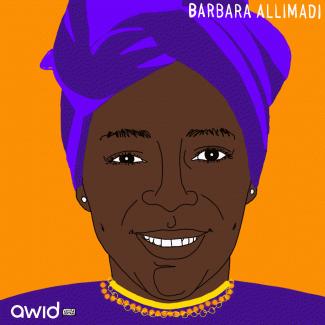
Barbara Allimadi was a political and human rights activist from Uganda. In 2012, she co-organized a protest against a televised police assault of Ingrid Turinawe, an opposition politician who had her breast squeezed by a police officer.
During the protest, Barbara, along with other fellow activists stripped to their bras in front of the Central Police Station in Kampala. This came to be known as the infamous ‘bra protest’ in Uganda.
“We settled on the bra protest. We thought it would be most appropriate for what had happened. It’s not like we were saying we don’t respect ourselves. We were disgusted by what had been done.” - Barbara Allimadi, 2013 (Daily Monitor)
With a Degree in Electronics and Communications Engineering from the London Metropolitan University, Barbara was a network engineer in the United Kingdom and an avid fan of reggae music. She returned to Uganda In 2007, when her mother passed away.
In 2019, she was appointed Coordinator for International and Diaspora Affairs at the Alliance for National Transformation (ANT), a political party launched that year by an opposition leader.
“We want security of life and property, not pain, injury and even death at the hands of security forces who are meant to protect us. Most importantly, we want a stable and enabling environment where we can realize our dreams and aspirations.” - Barbara Allimadi, ANT video
Barbara passed away on 27 April 2020.
“I was so proud of my sister for many things but in particular her fearless pursuit of peace, democracy, justice and equality in Uganda. At the height of her activism she led many marches on the streets of Kampala, to police stations, and Parliament.” - Doris Allimadi, Barbara’s sister
“It is with deep sadness that we have learnt of the untimely passing of Barbara Allimadi. She has been a valiant, relentless and courageous force for the liberation movement of Uganda. Our deepest condolences to her family. She will be sorely missed.” - Akina Mama wa Afrika (tweet on 28 April 2020)
“The passing on of Barbara is so sad for us and her entire family. She dedicated herself to fighting for justice, freedom and rights of others while serving in the civil society until she recently joined us at the party.” Maj Gen Mugisha Muntu, ANT national coordinator
“A beautiful, charming, funny, charismatic and inspirational sister. My children lost their aunty. Uganda lost a brave and courageous freedom fighter. Barbara once said, ‘As long as there is still breath in you, keep working towards your dreams.’” - Doris Allimadi, Barbara’s sister
Isabel is a feminist from the United Kingdom with over a decade of experience in feminist responses to fascisms, fundamentalisms, and anti-rights trends. At AWID, her work centers on knowledge-building and has included leading the production of the Rights at Risk series in collaboration with the Observatory on the Universality of Rights (OURs). She holds a Master’s degree in Gender Studies from the School of Oriental and African Studies (SOAS) and previously worked with Women Living Under Muslim Laws (WLUML). She is passionate about cross-movement work, movement-centered knowledge-building, and the use of creative expression to disrupt systems of oppression. Outside of work, Isabel is active in various disability justice spaces for collective care, learning, and advocacy.
Zuhour Mahmoud est la stratège en communication de Kohl. Écrivaine, rédactrice et DJ à ses heures, elle est basée à Berlin. Son travail se concentre sur les approches critiques de la musique, de la technologie et de la politique et sur leurs cycles de vie au sein de la sphère numérique.
Regístrate para ser miembrx de AWID y conectar con más de 9,600 movimientos feministas globales y co-crear una variedad de plataformas y espacios diseñados especialmente para activistas y organizaciones, desde espacios de aprendizaje hasta espacios de solidaridad y encuentros entre miembrxs.
La comunidad de membresía de AWID está disponible como una app. Descarga la app y comienza a conectar con movimientos!
 |
 |