Fatima Ahmed Ibrahim
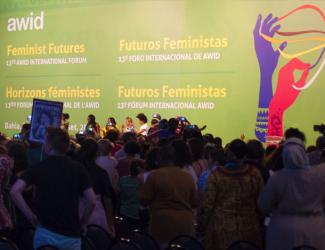
In September 2016, the 13th AWID international Forum brought together in Brazil over 1800 feminists and women’s rights advocates in a spirit of resistance and resilience.
This section highlights the gains, learnings and resources that came out of our rich conversations. We invite you to explore, share and comment!
One of the key takeaways from the 2016 Forum was the need to broaden and deepen our cross-movement work to address rising fascisms, fundamentalisms, corporate greed and climate change.
With this in mind, we have been working with multiple allies to grow these seeds of resistance:
And through our next strategic plan and Forum process, we are committed to keep developing ideas and deepen the learnings ignited at the 2016 Forum.
AWID Forums started in 1983, in Washington DC. Since then, the event has grown to become many things to many peoples: an iterative process of sharpening our analyses, vision and actions; a watershed moment that reinvigorates participants’ feminisms and energizes their organizing; and a political home for women human rights defenders to find sanctuary and solidarity.

Este calendario es un obsequio para ti y para todes les 8000 integrantes de nuestra comunidad feminista global. Es nuestra promesa de conexión futura y de encuentro con los movimientos en el año próximo. Este año que pasó ha sido testigo de injusticias inenarrables. Damos la bienvenida a un nuevo año pleno de un potente espíritu de movimiento, de soluciones y estrategias esperanzadas. Por un mundo mejor para todes.
Cuando pases las páginas, nota la diversidad artística de nuestres integrantes artistas, que utilizan su obra para difundir e interconectar a nuestros distintos movimientos bajo el paraguas feminista. ¿Te ves a ti misme, a tu movimiento, a tus comunidades, en estas páginas? Te alentamos a utilizar este calendario como herramienta práctica para marcar el tiempo y el espacio, pero también para anotar las ocasiones de conectarte con feministas y activistas.
To claim your power as an expert on the state of resourcing for feminist movements
Feminist Realities are the living, breathing examples of the just world we are co-creating. They exist now, in the many ways we live, struggle and build our lives.
Feminist Realities go beyond resisting oppressive systems to show us what a world without domination, exploitation and supremacy look like.
These are the narratives we want to unearth, share and amplify throughout this Feminist Realities journey.
Create and amplify alternatives: We co-create art and creative expressions that center and celebrate the hope, optimism, healing and radical imagination that feminist realities inspire.
Build knowledge: We document, demonstrate & disseminate methodologies that will help identify the feminist realities in our diverse communities.
Advance feminist agendas: We expand and deepen our collective thinking and organizing to advance just solutions and systems that embody feminist values and visions.
Mobilize solidarity actions: We engage feminist, women’s rights and gender justice movements and allies in sharing, exchanging and jointly creating feminist realities, narratives and proposals at the 14th AWID International Forum.
As much as we emphasize the process leading up to, and beyond, the four-day Forum, the event itself is an important part of where the magic happens, thanks to the unique energy and opportunity that comes with bringing people together.
Build the power of Feminist Realities, by naming, celebrating, amplifying and contributing to build momentum around experiences and propositions that shine light on what is possible and feed our collective imaginations
Replenish wells of hope and energy as much needed fuel for rights and justice activism and resilience
Strengthen connectivity, reciprocity and solidarity across the diversity of feminist movements and with other rights and justice-oriented movements
Learn more about the Forum process
We are sorry to announce that the 14th AWID International Forum is cancelled
Given the current world situation, our Board of Directors has taken the difficult decision to cancel Forum scheduled in 2021 in Taipei.

 |
 |
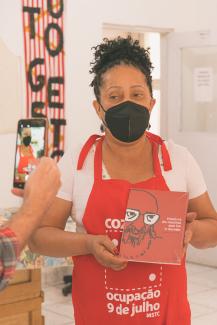 |
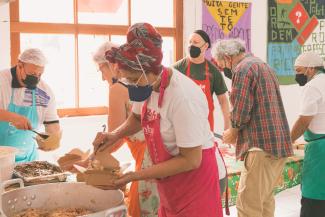
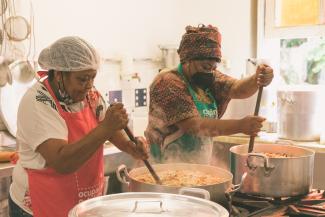
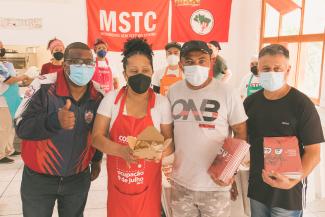 Women and collaborators at the occupation’s kitchen |
 |
Meet Aura Roig, the visionary feminist activist, anthropologist, director and founder of the Metzineres cooperative.
She spent the last two decades researching, designing and implementing drug policies from the perspective of harm reduction, human rights and intersectional feminism.
Having experienced and learned from communities who use drugs around the world, she returned to Barcelona and created Xarxa de Dones que Usen Drogues (the Network of Women Who Use Drugs, XADUD). XADUD was a space of mutual support and solidarity with the struggle to secure rights for marginalized groups, which later became the Metzineres cooperative.
Aura is currently working on expanding the Metzineres model to provide support to bigger constituencies, while also extensively documenting their prolific journey and learnings.
NOUS SOMMES LA SOLUTION
We are the Solution

Listen to the story here:
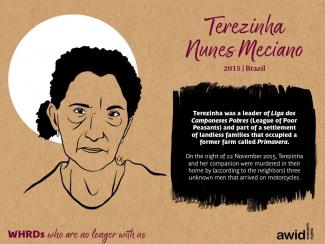
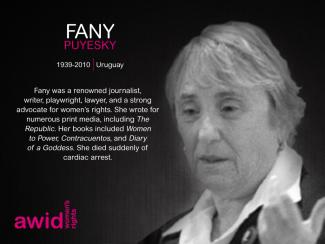
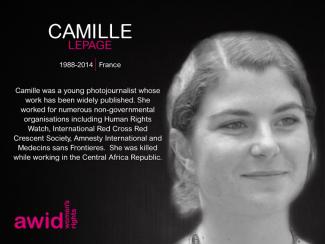
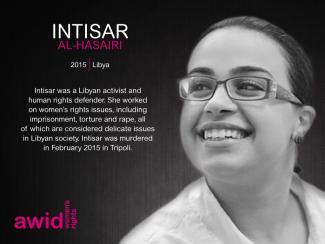
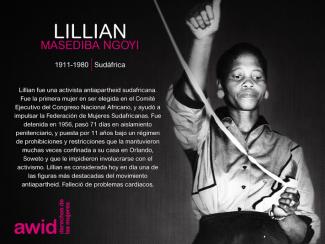
Ces défenseuses ont fait campagne pour les droits fonciers et ont lutté pour les droits des femmes et des peuples autochtones. Elles se sont opposées aux industries extractives, ont écrit de la poésie et se sont battues pour que l'amour prévale. L'une d'entre elles nous a quitté il y a dix-neuf ans. Nous vous invitons à vous joindre à nous pour rendre hommage à ces défenseuses, à leur travail et à l’héritage qu’elles nous ont laissé. Faites circuler ces mèmes auprès de vos collègues et amis ainsi que dans vos réseaux et twittez en utilisant les hashtags #WHRDTribute et #16Jours.
S'il vous plaît cliquez sur chaque image ci-dessous pour voir une version plus grande et pour télécharger comme un fichier


Only a year after it was founded, the members of Nadia Echazú started to work in haute couture and organized a fashion show in the historic Bauen Hotel.
They showcased five models and some workers of the textile cooperative walked down the runway with their own designs.
This was revolutionary not only because they were designing alternatives to mainstream fashion, but also because they were creating accessible, inclusive clothes for all trans and travesti bodies.
Feminist economies should also be about feeling amazing and comfortable in the clothes we are wearing.
This section will guide you on how to ensure your research findings are representative and reliable.
In this section:
- Collect your data
1. Before launch
2. Launch
3. During launch- Prepare your data for analysis
1. Clean your data
2. Code open-ended responses
3. Remove unecessary data
4. Make it safe- Create your topline report
- Analyze your data
1. Statistical programs
2. Suggested points for analysis
If you also plan to collect data from applications sent to grant-making institutions, this is a good time to reach out them.
When collecting this data, consider what type of applications you would like to review. Your research framing will guide you in determining this.
Also, it may be unnecessary to see every application sent to the organization – instead, it will be more useful and efficient to review only eligible applications (regardless of whether they were funded).
You can also ask grant-making institutions to share their data with you.
Your survey has closed and now you have all this information! Now you need to ensure your data is as accurate as possible.
Depending on your sample size and amount of completed surveys, this step can be lengthy. Tapping into a strong pool of detail-oriented staff will speed up the process and ensure greater accuracy at this stage.
Also, along with your surveys, you may have collected data from applications sent to grant-making institutions. Use these same steps to sort that data as well. Do not get discouraged if you cannot compare the two data sets! Funders collect different information from what you collected in the surveys. In your final research report and products, you can analyze and present the datasets (survey versus grant-making institution data) separately.
There are two styles of open-ended responses that require coding.
Questions with open-ended responses
For these questions, you will need to code responses in order to track trends.
Some challenges you will face with this is:
If using more than one staff member to review and code, you will need to ensure consistency of coding. Thus, this is why we recommend limiting your open-ended questions and as specific as possible for open-ended questions you do ask.
For example, if you had the open-ended question “What specific challenges did you face in fundraising this year?” and some common responses cite “lack of staff,” or “economic recession,” you will need to code each of those responses so you can analyze how many participants are responding in a similar way.
For closed-end questions
If you provided the participant with the option of elaborating on their response, you will also need to “up-code” these responses.
For several questions in the survey, you may have offered the option of selecting the category “Other” With “Other” options, it is common to offer a field in which the participant can elaborate.
You will need to “up-code” such responses by either:
Analyze the frequency of the results
For each quantitative question, you can decide whether you should remove the top or bottom 5% or 1% to prevent outliers* from skewing your results. You can also address the skewing effect of outliers by using median average rather than the mean average. Calculate the median by sorting responses in order, and selecting the number in the middle. However, keep in mind that you may still find outlier data useful. It will give you an idea of the range and diversity of your survey participants and you may want to do case studies on the outliers.
* An outlier is a data point that is much bigger or much smaller than the majority of data points. For example, imagine you live in a middle-class neighborhood with one billionaire. You decide that you want to learn what the range of income is for middle-class families in your neighborhood. In order to do so, you must remove the billionaire income from your dataset, as it is an outlier. Otherwise, your mean middle-class income will seem much higher than it really is.
Remove the entire survey for participants who do not fit your target population. Generally you can recognize this by the organizations’ names or through their responses to qualitative questions.
To ensure confidentiality of the information shared by respondents, at this stage you can replace organization names with a new set of ID numbers and save the coding, matching names with IDs in a separate file.
With your team, determine how the coding file and data should be stored and protected.
For example, will all data be stored on a password-protected computer or server that only the research team can access?
A topline report will list every question that was asked in your survey, with the response percentages listed under each question. This presents the collective results of all individual responses.
Tips:
- Consistency is important: the same rules should be applied to every outlier when determining if it should stay or be removed from the dataset.
- For all open (“other”) responses that are up-coded, ensure the coding matches. Appoint a dedicated point person to randomly check codes for consistency and reliability and recode if necessary.
- If possible, try to ensure that you can work at least in a team of two, so that there is always someone to check your work.
Now that your data is clean and sorted, what does it all mean? This is the fun part where you begin to analyze for trends.
Are there prominent types of funders (government versus corporate)? Are there regions that receive more funding? Your data will reveal some interesting information.
Smaller samples (under 150 responses) may be done in-house using an Excel spreadsheet.
Larger samples (above 150 responses) may be done in-house using Excel if your analysis will be limited to tallying overall responses, simple averages or other simple analysis.
If you plan to do more advanced analysis, such as multivariate analysis, then we recommend using statistical software such as SPSS, Stata or R.
NOTE: SPSS and Stata are expensive whereas R is free.
All three types of software require staff knowledge and are not easy to learn quickly.
Try searching for interns or temporary staff from local universities. Many students must learn statistical analysis as part of their coursework and may have free access to SPSS or Stata software through their university. They may also be knowledgeable in R, which is free to download and use.

• 2 - 3 months
• 1 or more research person(s)
• Translator(s), if offering survey in multiple languages
• 1 or more person(s) to assist with publicizing survey to target population
• 1 or more data analysis person(s)
• List of desired advisors: organizations, donors, and activists
• Optional: an incentive prize to persuade people to complete your survey
• Optional: an incentive for your advisors
Survey platforms:
• Survey Monkey
• Survey Gizmo (Converts to SPSS for analysis very easily)
Examples:
• 2011 WITM Global Survey
• Sample of WITM Global Survey
• Sample letter to grantmakers requesting access to databases
Visualising Information for Advocacy:
• Cleaning Data Tools
• Tools to present your data in compelling ways
• Tutorial: Gentle Introduction to Cleaning Data

 While funders committed significantly more money to gender equality over the last decade, still only 1% of philanthropic and development funding has actually been moved to directly resource feminist-led social change.
In solidarity with movements that continue to be invisibilized, marginalized and without access to core, long-term, flexible and trust-based funding, the WITM survey highlights the actual state of resourcing, challenges false solutions, and points to how funding models must change for movements to thrive and meet the complex challenges of our times.

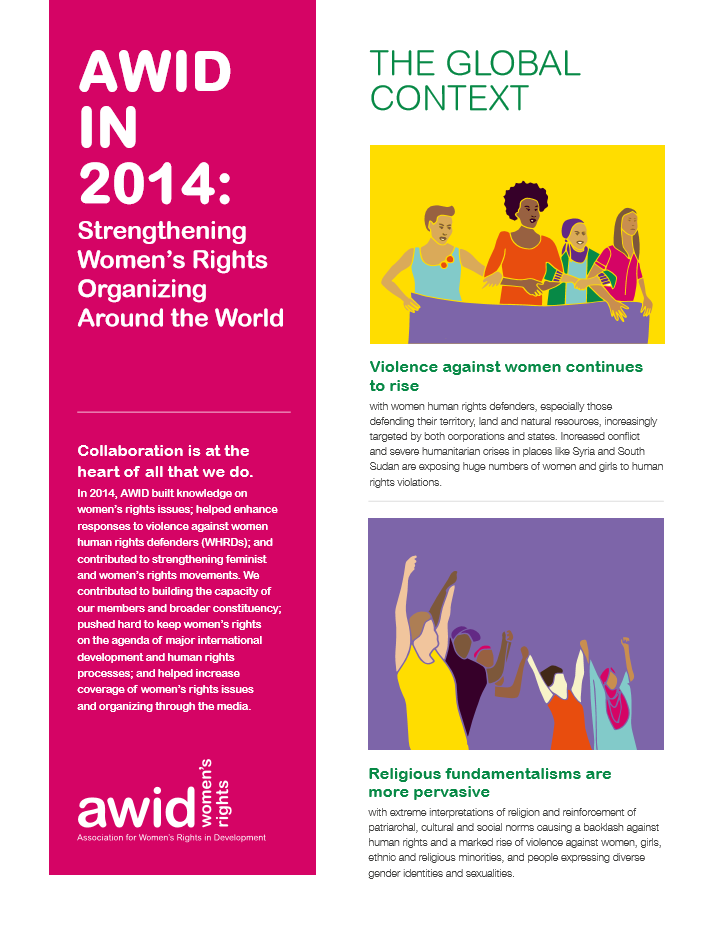
AWID is very pleased to share our 2014 Annual Report.
From building knowledge on women’s rights issues to amplifying responses to violence against women human rights defenders (WHRDs), our work last year continued to strengthen feminist and women’s rights movements across the world.
Get learn how we built the capacity of our members and broader constituency, pushed hard to keep women’s rights on the agenda of major international development and human rights processes, and helped increase coverage of women’s rights issues and organizing through the media. You'll find a panoramic sampling of our projects and some concrete numbers demonstrating our impact.
Collaboration is at the heart of all that we do, and we look forward to another year of working together to take our movements to the next level.
Despite an increasingly challenging panorama, there are important signs of hope for advancing women’s rights agendas. Women’s rights activists remain crucial in creating openings to demand structural change, sustaining their communities, opposing violence and holding the line on key achievements. And there are important opportunities to influence new actors and to mobilize greater resources to support women’s rights organizations.
In this context, strong collective action and organizing among women’s rights activists remains essential.
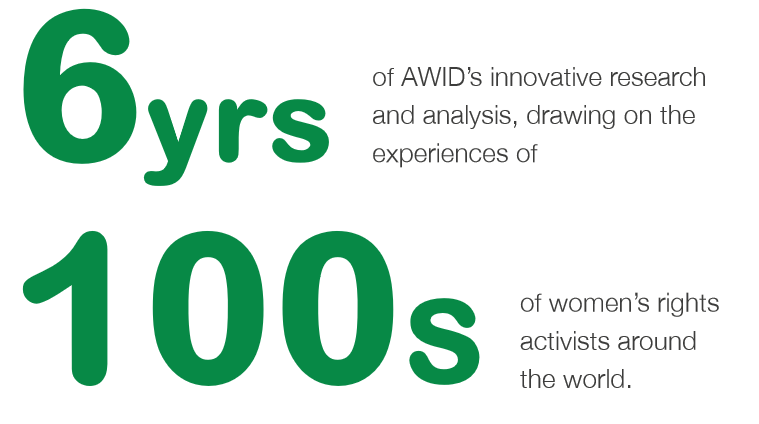
I am sincerely thrilled by AWID’s accomplishments since 1982 and hope to be able to pay at least a modest contribution to its hard work for the benefit of women and situation of gender equality.” — Aleksandra Miletic-Santic, Bosnia Herzegovina


نرحب بالطلبات عبر مجموعة كاملة من المواضيع والتقاطعات المهمة للحركات النسوية وحركات العدالة الجندرية. في نموذج الطلب، ستتمكن/ين من تحديد أكثر من موضوع يناسب نشاطك.
Provide AWID members, movement partners and funders with an updated, powerful, evidence-based, and action-oriented analysis of the resourcing realities of feminist movements and current state of the feminist funding ecosystem.
Identify and demonstrate opportunities to shift more and better funding for feminist organizing, expose false solutions and disrupt trends that make funding miss and/or move against gender justice and intersectional feminist agendas.
Articulate feminist visions, proposals and agendas for resourcing justice.


Louise Malherbe est une programmatrice/commissaire de films et une critique de cinéma basée à Berlin. Elle a travaillé comme programmatrice de films pour l’association Metropolis Cinema à Beyrouth et coordonne aujourd’hui le projet Reel Streams qui vise à soutenir la diffusion du cinéma indépendant dans la région arabe. Elle est responsable de la programmation du Soura Film Festival, un festival de films queer centré sur la région S.W.A.N.A., écrit des critiques de films pour Manifesto XXI et est depuis peu commissaire de films et de festivals pour Cinema Akil.