Imma Sala

Young feminist activists play a critical role in women’s rights organizations and movements worldwide by bringing up new issues that feminists face today. Their strength, creativity and adaptability are vital to the sustainability of feminist organizing.
At the same time, they face specific impediments to their activism such as limited access to funding and support, lack of capacity-building opportunities, and a significant increase of attacks on young women human rights defenders. This creates a lack of visibility that makes more difficult their inclusion and effective participation within women’s rights movements.
AWID’s young feminist activism program was created to make sure the voices of young women are heard and reflected in feminist discourse. We want to ensure that young feminists have better access to funding, capacity-building opportunities and international processes. In addition to supporting young feminists directly, we are also working with women’s rights activists of all ages on practical models and strategies for effective multigenerational organizing.
We want young feminist activists to play a role in decision-making affecting their rights by:
Fostering community and sharing information through the Young Feminist Wire. Recognizing the importance of online media for the work of young feminists, our team launched the Young Feminist Wire in May 2010 to share information, build capacity through online webinars and e-discussions, and encourage community building.
Researching and building knowledge on young feminist activism, to increase the visibility and impact of young feminist activism within and across women’s rights movements and other key actors such as donors.
Promoting more effective multigenerational organizing, exploring better ways to work together.
Supporting young feminists to engage in global development processes such as those within the United Nations
Collaboration across all of AWID’s priority areas, including the Forum, to ensure young feminists’ key contributions, perspectives, needs and activism are reflected in debates, policies and programs affecting them.


AWID is a part of an incredible ecosystem of feminist movements working to achieve gender justice and social justice worldwide. With our 40th anniversary, we are celebrating all that we’ve built over these last 40 years. As a global feminist movement support organization we know that working with fierce feminisms is our way forward, acknowledging both the multiplicity of feminisms and the value of fierce and unapologetic drive for justice. The state of the world and of feminist movements calls for brave conversations and action. We look forward to working together with our members, partners and funders in creating the worlds we believe in, celebrating the wins and speaking truth to power in service of feminist movements globally.
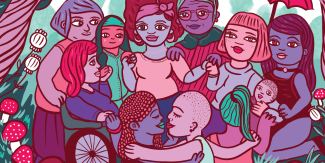
The 2023 Feminist Calendar is our gift to movements. It features the artwork of some of our amazing AWID members.
Get it in your preferred language! |
Select image quality |
| English | Print Quality | Digital Version |
| Français | Print Quality | Digital Version |
| Español | Print Quality | Digital Version |
| Português | Print Quality | Digital Version |
| عربي | Print Quality | Digital Version |
| Русский | Print Quality | Digital Version |
As part of our commitment to engage more deeply with artists and the practice of co-creating Feminist Realities, AWID collaborated with an Artist Working Group to advance and strengthen feminist agendas and realities in their communities and movements through their creative expression. Our intention here is to bring feminist creatives together in a powerful and brave space where they grow and live freely, and where they shatter toxic narratives to replace them with transformative alternatives.
Nous vous conseillons de demander conseil à un-e avocat-e, de communiquer avec un refuge pour femmes ou un centre d’accueil près de chez vous.
Les HotPeachPages, une ressource en ligne, contiennent des liens vers les refuges pour femmes dans le monde entier. L’AWID ne peut garantir l’exactitude ou la qualité de ces listes, mais elles peuvent constituer un bon point de départ si vous ne connaissez aucune organisation près de chez vous.
We’re committed to protecting your privacy, so here we explain how we use cookies on our website.
If you have any questions, please get in touch via the form on our contact page.
A cookie is a small data file downloaded by your web browser (for example Chrome or Internet Explorer) and stored on your computer. They are downloaded automatically when you visit websites. Cookies are used to perform essential tasks on a website, to record how people use a website and to gather data for marketing.
We provide essential information on our website to millions of people every year. To do this, we have to manage our website effectively and to reach out to more people who need our support and information. Cookies are a small, but essential way to make all this happen. We use cookies to:
You can update your cookie preferences by clicking on the button below.
In addition, most browsers allow you to manage cookies saved on your device – just go to the help section of your browser. To learn more about cookies and how to manage them, visit the ICO website.
Cookies never record your credit card details or easily identifiable personal data such as your name and address. You have every right to refuse to accept cookies from our website.
If you disable cookies you will still be able to access nearly all the information on our website. But please remember that this may affect some functionality.
You can disable cookies by changing your settings in your web browser or you can use the incognito option on Google Chrome. To find out more about your browser settings, visit the relevant support page below:
Follow-up International Conference on Financing for Development, Doha, Qatar
Related content
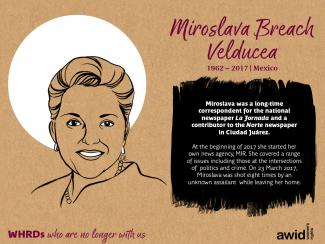
BBC: Miroslava Breach third Mexican journalist to be killed this month
Committee to Protect Journalists: Miroslava Breach Velducea
Amnesty International: Mexico: "Open season" on journalists as third reporter killed in a month
TeleSUR: New Award to Honor Murdered Journalists in Latin America
This policy governs all pages hosted at www.awid.org, and any other websites under the control of the AWID (the “Website”) and registrations for these sites. It does not apply to pages hosted by organisations other than AWID, to which we may link and whose privacy policies may differ. Please read the following policy to understand our privacy policy regarding nature, purpose, using and sharing of your personal identifiable information that is collected via this website.
Generally, you can browse this website without submitting your personal information to us. However, in some circumstances, we will ask for your personal information.
When you are on the website and are asked for personal information, you are sharing that information only with AWID.
When you register to use the website – for example, subscribe to receive emails from us or apply to become a member - you provide us with the mandatory information about you like Name, country, language to receive email updates and email address. This information is provided by you through secure forms and is stored on secure servers.
Also, while becoming a member or registering for events, you may need to provide payment information. AWID doesn’t store any credit card information on its servers and uses payment gateway to process the payment information.
When you communicate with AWID, provide optional information through forms on the website or use the site to communicate with other members, we collect information about your communication and any information you choose to provide.
When you communicate with us, we collect your communication and any other information you choose to provide us.
In addition, when you interact with the Website, our servers may keep an activity log that does not identify you individually (“Non-Personal Information”). Generally, we collect the following categories of Non-Personal Information:
For more information about cookies, please see www.allaboutcookies.org.
If you do not wish to receive cookies you can easily modify your web browser to refuse cookies, or to notify you when you receive a new cookie, see how here.
AWID uses the information we collect about you to:
If you have subscribed to AWID´s e-newsletters or email updates or you have become a member, we will send you regular communications as specified in the relevant area of the website. You are able to unsubscribe from any of the e-newsletters or email updates at any time by using the unsubscribe information provided in our emails.
The accuracy of your individual identifying information is important to AWID. We are always looking for ways to make it easier for you to review and correct the information that AWID maintains about you through our website. If you change your email address, or if any of the other information we hold is inaccurate or out of date, please write to us here.
Except as explained below, AWID will not disclose any of your personally identifiable information, and will not sell or rent lists containing your information to third parties. AWID may disclose information when it has your permission to do so or under special circumstances, such as when it believes in good faith that the law requires it.
We are continuously implementing and updating administrative, technical, and physical security measures to help protect your information against unauthorized access, loss, destruction, or alteration. Some of the safeguards we use to protect your information are firewalls and data encryption, and information access controls. If you know or have reason to believe that your AWID membership credentials have been lost, stolen, misappropriated, or otherwise compromised or in case of any actual or suspected unauthorized use of your AWID membership account, please contact us through on Contact Us.
This policy may change from time to time. The changed policy will be posted on this website and Last updated date at the end of the policy will be updated. There will be an email update sent to you for the revised policy and if you do not agree with the revised policy, you will have the option to cancel you registration(s) with us. You can also write to us here. We welcome your feedback!
Last updated: May 2019
Durante décadas, lxs investigadorxs y activistas feministas han articulado conceptos importantes en relación al género para entender y cuestionar la opresión y la discriminación. Ahora, esos conceptos se han convertido en el blanco de los actores anti-derechos, quienes afirman que los roles de género patriarcales y opresivos son de «sentido común» y, estratégicamente, presentan a todas las otras ideas, normas culturales y formas de vida social como una peligrosa ideología conspirativa.
Lee nuestro resumen Narrativas sobre la «Ideología de género»: Una amenaza para los derechos humanos
คุณสามารถคาดหวังว่าจะมีอุปกรณ์มาตราฐานสำหรับกิจกรรมและการนำเสนอเตรียมไว้ให้ ได้แก่ กระดาษฟลิปชาร์ท ปากกามาร์กเกอร์ โพสต์อิท รวมถึง โปรเจคเตอร์ อุปกรณ์ด้านภาพและเสียง อุปกรณ์เพิ่มเติมนอกเหนือจากนี้ถือเป็นความรับผิดชอบของผู้จัดกิจกรรม ฝ่ายโลจิสติกส์ AWID จะพร้อมที่จะตอบคำถามและให้คำแนะนำต่างๆ
Octubre de 2014: Inicio del proceso preparatorio intergubernamental para la tercera Conferencia Internacional sobre la Financiación para el Desarrollo
Contenido relacionado
BBC Mundo: El terrible asesinato de la joven Micaela García que conmociona a Argentina
TeleSUR: América Latina, la región con más violencia hacia la mujer