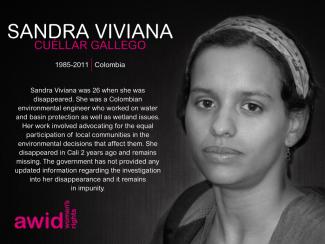
Sandra Viviana Cuellar Gallego
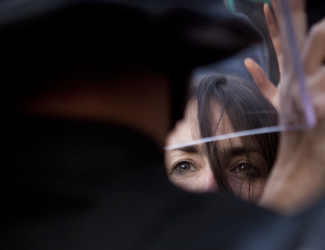
WHRDs are self-identified women and lesbian, bisexual, transgender, queer and intersex (LBTQI) people and others who defend rights and are subject to gender-specific risks and threats due to their human rights work and/or as a direct consequence of their gender identity or sexual orientation.
WHRDs are subject to systematic violence and discrimination due to their identities and unyielding struggles for rights, equality and justice.
The WHRD Program collaborates with international and regional partners as well as the AWID membership to raise awareness about these risks and threats, advocate for feminist and holistic measures of protection and safety, and actively promote a culture of self-care and collective well being in our movements.
WHRDs are exposed to the same types of risks that all other defenders who defend human rights, communities, and the environment face. However, they are also exposed to gender-based violence and gender-specific risks because they challenge existing gender norms within their communities and societies.
We work collaboratively with international and regional networks and our membership
We aim to contribute to a safer world for WHRDs, their families and communities. We believe that action for rights and justice should not put WHRDs at risk; it should be appreciated and celebrated.
Promoting collaboration and coordination among human rights and women’s rights organizations at the international level to strengthen responses concerning safety and wellbeing of WHRDs.
Supporting regional networks of WHRDs and their organizations, such as the Mesoamerican Initiative for WHRDs and the WHRD Middle East and North Africa Coalition, in promoting and strengthening collective action for protection - emphasizing the establishment of solidarity and protection networks, the promotion of self-care, and advocacy and mobilization for the safety of WHRDs;
Increasing the visibility and recognition of WHRDs and their struggles, as well as the risks that they encounter by documenting the attacks that they face, and researching, producing, and disseminating information on their struggles, strategies, and challenges:
Mobilizing urgent responses of international solidarity for WHRDs at risk through our international and regional networks, and our active membership.
نعم! نلاحظ ونقدّر الأسباب المختلفة لعدم تلق الحركات النسوية التمويل الخارجي، حيث من الممكن أن تكون غير مؤهلة لتقديم الطلبات للتمويل و\ أو تلقّي المال من خارج البلاد، أو الاعتماد على المصادر التي يتم إنتاجها بشكل مستقل كاستراتيجية سياسية. نريد أن نسمع منكم/ن بعيدا عن تجربتكم/ن مع التمويل الخارجي.
Madiha était une éminente professeure de sociologie qui s’est activement engagée auprès de la société civile en tant que défenseure des droits des femmes dans les pays arabes.
Elle a présidé l'Alliance pour les femmes arabes et a été membre du Comité sur la société civile et du Comité sur le développement du gouvernorat de Minia auprès du Conseil national pour les femmes. Elle a publié de nombreux articles qui ont éclairé et analysé les inégalités de genre et la discrimination à l'égard des femmes.
Ses collègues, étudiant-e-s et ami-e-s se souviennent d'elle avec tendresse.

AWID стремится к языковой справедливости, и мы сожалеем, что на данный момент проведение опроса на большем количестве языков не представляется возможным. Если вам нужна помощь в переводе или вы хотите заполнить анкету на любом другом языке, пожалуйста, свяжитесь с нами по адресу witm@awid.org
Mridula was a strong advocate for the advancement for women’s health at a time when the topic of women’s sexual and reproductive health were considered taboo in Fiji.
The initial works of the Fiji Women’s Rights Movement about sexual and reproductive rights were under her guidance, and in September 1999, the United Nations Population Fund presented her with a regional award for Reproductive Health and Rights. Mridula was a strong, dedicated and tireless campaigner who was passionate about women’s health and empowerment.
She was a valued member of the women’s and feminist movement in Fiji and her contributions will always be remembered. Mridula passed away due to natural causes in 2017.


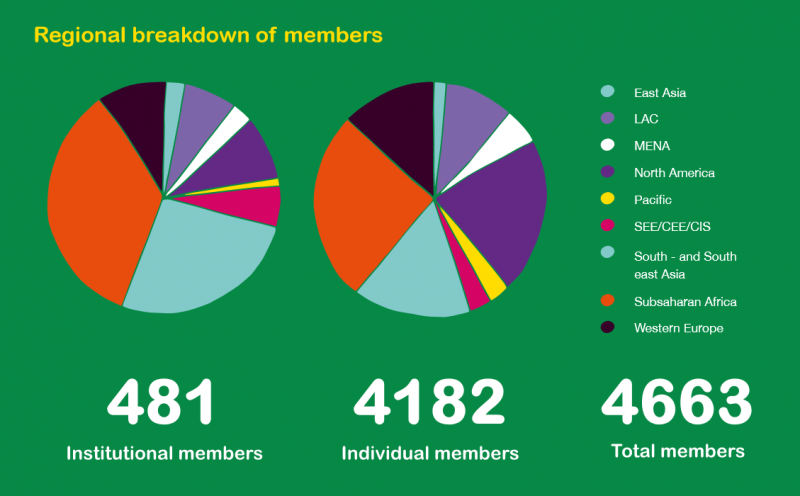
Faites partie d’une organisation et d’une communauté internationales, associatives et féministes. Nos membres sont établi·e·s dans toutes les régions du monde; iels apprennent les un·e·s des autres et se soutiennent mutuellement dans un réseau mondial fondé sur la solidarité.
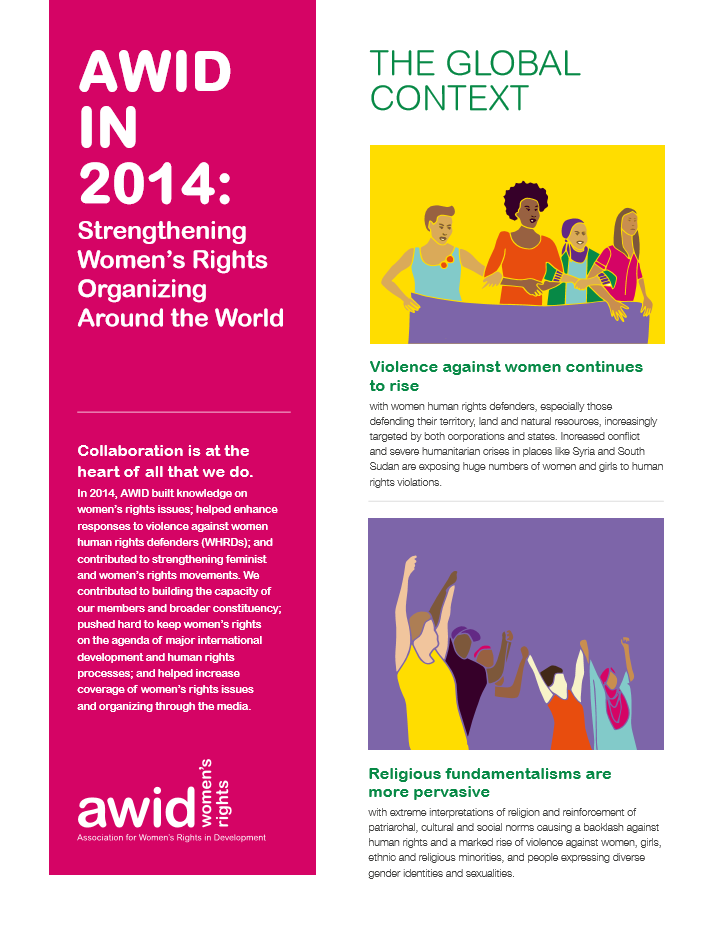
AWID is very pleased to share our 2014 Annual Report.
From building knowledge on women’s rights issues to amplifying responses to violence against women human rights defenders (WHRDs), our work last year continued to strengthen feminist and women’s rights movements across the world.
Get learn how we built the capacity of our members and broader constituency, pushed hard to keep women’s rights on the agenda of major international development and human rights processes, and helped increase coverage of women’s rights issues and organizing through the media. You'll find a panoramic sampling of our projects and some concrete numbers demonstrating our impact.
Collaboration is at the heart of all that we do, and we look forward to another year of working together to take our movements to the next level.
Despite an increasingly challenging panorama, there are important signs of hope for advancing women’s rights agendas. Women’s rights activists remain crucial in creating openings to demand structural change, sustaining their communities, opposing violence and holding the line on key achievements. And there are important opportunities to influence new actors and to mobilize greater resources to support women’s rights organizations.
In this context, strong collective action and organizing among women’s rights activists remains essential.
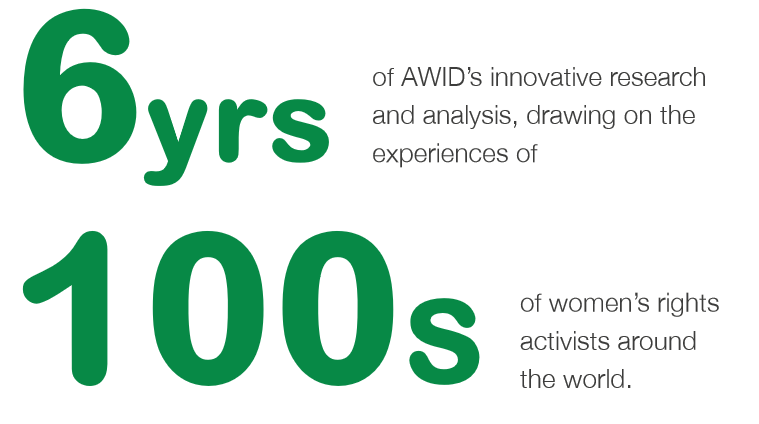
I am sincerely thrilled by AWID’s accomplishments since 1982 and hope to be able to pay at least a modest contribution to its hard work for the benefit of women and situation of gender equality.” — Aleksandra Miletic-Santic, Bosnia Herzegovina
Sim, ainda queremos a sua resposta, independentemente de terem recebido financiamento em três, dois, um, ou qualquer um dos anos entre 2021 e 2023.
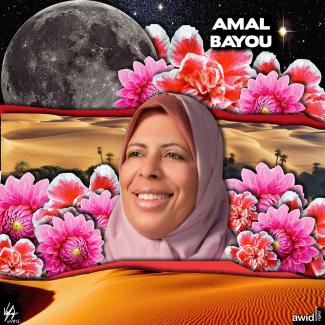
Amal fue una destacada política y parlamentaria de Libia.
Fue docente de la Universidad de Benghazi desde 1995 hasta su muerte, en 2017. Amal fue activista de la sociedad civil e integrante de varias iniciativas sociales y políticas. Asistió a las familias de lxs mártires y de lxs desaparecidxs y fue una de lxs fundadorxs de una iniciativa juvenil llamada «Juventud de Benghazi Libia».
En las elecciones parlamentarias de 2014, Amal fue elegida para la Cámara de Representantes con más de 14.000 votos (el mayor número de votos recibido por unx candidatx en las elecciones de 2014). Permanecerá en la memoria de muchxs como una mujer que actuó en política para garantizar un futuro mejor en uno de los contextos de la región más difíciles y afectados por los conflictos.
We take a position in solidarity with each other and diverse struggles for justice and freedoms. We strive to mobilize and strengthen collective action and practice meaningful ways of working with each other.
AWID comenzó a preparar este informe anual en el momento en que la pandemia global empezaba a desintegrar las formas en que nos reunimos, nos organizamos y vivimos nuestras vidas. Es imposible reseñar lo que hemos hecho sin que el COVID-19 afecte nuestra evaluación.
Descargar el informe anual 2019 completo (PDF)

Es una afirmación, urgentemente necesaria, de que existen otros modos, más justos, de organizar nuestras vidas. Durante 2019, cientos de grupos compartieron con nosotrxs sus experiencias y propuestas de realidades feministas, que van desde las redes radicales de apoyo comunitario que facilitan el aborto autogestionado en América Latina y las prácticas de economías comunitarias en Indonesia y de sistemas alimentarios comunitarios en India y EEUU, hasta la reconcepción y renovación de las prácticas no perjudiciales para ritos de iniciación en Sierra Leona. Estas son las experiencias que trazarán un camino hacia una «nueva normalidad».
Una parte clave de nuestro trabajo de 2019 fue alentar estas exploraciones a través de una guía que AWID lanzó para apoyar a aquellos grupos interesados en descubrir las historias y las aspiraciones que son los componentes esenciales de las proposiciones feministas.
Mientras nos focalizamos en nuestras propuestas para un mundo diferente, también reconocemos el complejo contexto que nos rodea. A través de alianzas con el Observatorio sobre la Universalidad de los Derechos, las Feministas por un Tratado Vinculante, el Consorcio Count Me In! y otras organizaciones, AWID ha continuado resistiendo contra el poder corporativo irrestricto y contra las agendas fascistas y fundamentalistas que socavan los derechos de las mujeres y la justicia de género. En vista de las escasas posibilidades de lograr un cambio transformador a través de procesos multilaterales y de la limitada receptividad de la mayoría de los Estados, estamos redoblando nuestros esfuerzos para garantizar que los movimientos feministas, en toda su diversidad, sean financiados de forma proporcional al papel crítico que desempeñan al apoyar a sus comunidades, reclamar derechos, y responder a las crisis. En 2019, introdujimos principios y enfoques feministas para fondos innovadores como la Iniciativa Spotlight y el Fondo Igualdad, y logramos obtener recursos a través de subvenciones de fondos semilla para realidades feministas provenientes de donantes feministas.
Si miramos hacia adelante, resulta claro que el contexto requiere una transformación de nuestras estrategias de organización:
AWID se está embarcando ahora en un nuevo modelo de membresía que reduce las barreras para el acceso y pone el énfasis en las oportunidades para la participación y la conexión entre afiliadxs. Seguiremos experimentando con distintas herramientas y procesos virtuales para construir comunidad. La interacción entre movimientos continuará siendo central para nuestro trabajo. Las acciones de AWID en solidaridad con los movimientos y las identidades que sufren opresión (incluso y especialmente cuando estas quedan marginalizadas dentro de los movimientos feministas) son importantes para impulsar el cambio y brindar apoyo a los movimientos amplios e inclusivos para todas las personas.
Somos resilientes, nos adaptamos, y nos hacemos presentes para lxs demás. Y tenemos que seguir haciéndolo mejor. Gracias a todxs ustedes, que son parte del viaje junto con nosotrxs.
نسأل عن هذه المعلومات كي نسهّل عملية المعالجة وكي نستطيع أن نتواصل مع مجموعتكم/ن في حالة لم تستطيعون تكملة الاستطلاع و\ أو في حالة كانت لديكم/ن شكوك أو أسئلة إضافية. يمكنكم/ن قراءة المزيد عن كيف نستعمل المعلومات التي نجمعها خلال عملنا هنا.