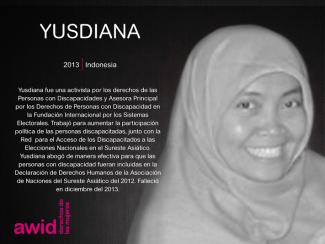
Yusdiana
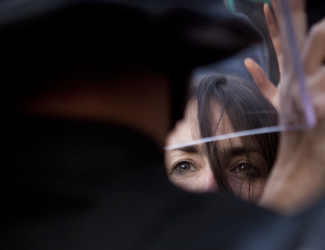
WHRDs are self-identified women and lesbian, bisexual, transgender, queer and intersex (LBTQI) people and others who defend rights and are subject to gender-specific risks and threats due to their human rights work and/or as a direct consequence of their gender identity or sexual orientation.
WHRDs are subject to systematic violence and discrimination due to their identities and unyielding struggles for rights, equality and justice.
The WHRD Program collaborates with international and regional partners as well as the AWID membership to raise awareness about these risks and threats, advocate for feminist and holistic measures of protection and safety, and actively promote a culture of self-care and collective well being in our movements.
WHRDs are exposed to the same types of risks that all other defenders who defend human rights, communities, and the environment face. However, they are also exposed to gender-based violence and gender-specific risks because they challenge existing gender norms within their communities and societies.
We work collaboratively with international and regional networks and our membership
We aim to contribute to a safer world for WHRDs, their families and communities. We believe that action for rights and justice should not put WHRDs at risk; it should be appreciated and celebrated.
Promoting collaboration and coordination among human rights and women’s rights organizations at the international level to strengthen responses concerning safety and wellbeing of WHRDs.
Supporting regional networks of WHRDs and their organizations, such as the Mesoamerican Initiative for WHRDs and the WHRD Middle East and North Africa Coalition, in promoting and strengthening collective action for protection - emphasizing the establishment of solidarity and protection networks, the promotion of self-care, and advocacy and mobilization for the safety of WHRDs;
Increasing the visibility and recognition of WHRDs and their struggles, as well as the risks that they encounter by documenting the attacks that they face, and researching, producing, and disseminating information on their struggles, strategies, and challenges:
Mobilizing urgent responses of international solidarity for WHRDs at risk through our international and regional networks, and our active membership.
.
Si tienes pasaporte de alguno de los siguientes países (el tiempo de estadía permitido varía según el país), NO necesitas visa para asistir al Foro de Taipéi:
Alemania, Andorra, Australia, Austria, Bélgica, Belice, Bulgaria, Brunei, Canadá, Chile, Ciudad del Vaticano, Croacia, Chipre, Dinamarca, Eslovaquia, Eslovenia, Estados Unidos de América, Estonia, España, Esuatini, Filipinas, Finlandia, Francia, Grecia, Guatemala, Haití, Honduras, Hungría, Irlanda, Islandia, Israel, Italia, Japón*, Letonia, Liechtenstein, Lituania, Luxemburgo, Malasia, Malta, Islas Marshall, Mónaco, Nauru, Nueva Zelanda, Nicaragua, Noruega, Países Bajos, Palaos, Paraguay, Polonia, Portugal, Reino Unido, República Checa, República de Corea, República Dominicana, Rumania, Rusia, San Cristóbal y Nieves, San Marino, Santa Lucía, San Vicente y las Granadinas, Singapur, Suecia, Suiza y Tuvalu.
Las personas con cualquier otro pasaporte NECESITARÁN VISA para ir a Taipéi.
Por favor ten en cuenta:
Es probable que, una vez que te hayas inscripto para asistir al Foro, te llegue un código relacionado con el evento que te permitirá tramitar tu visa en forma electrónica, cualquiera sea tu ciudadanía.
Brindaremos más información sobre este tema cuando se abra el proceso de inscripción.
Escucha esta historia aquí:
AWID gratefully acknowledges the many people whose ideas, analysis and contributions have shaped the “Where is the Money for Feminist Organizing?” research and advocacy over the years.
First and foremost, our deepest thanks goes to the AWID members and activists who engaged in WITM consultations and piloted this survey with us, sharing so generously of their time, analysis and hearts.
Our appreciation to feminist movements, allies and feminist funds, including but not limited to: Black Feminist Fund, Pacific Feminist Fund, ASTRAEA Lesbian Foundation for Justice, FRIDA Young Feminist Fund, Purposeful, Kosovo Women’s Network, Human Rights Funders Network, Dalan Fund and PROSPERA International Network of Women's Funds - for your rigorous research on the state of resourcing, sharp analysis and continued advocacy for more and better funding and power for feminist and gender justice organizing in all contexts.
Une communauté en ligne pour et par les jeunes féministes qui militent pour les droits humains des femmes, l'égalité de genre et la justice sociale dans le monde entier
Finance des projets initiés par de jeunes féministes. Vise à renforcer la capacité des organisations de jeunes féministes à mobiliser des ressources pour leurs actions et à encourager des bailleur-euse-s de fonds et d’autres allié-e-s à financer l’activisme des jeunes féministes.
Cette plateforme sera l’espace de référence pour accéder à des informations et à des ressources concernant la sauvegarde de l'universalité des droits humains dans les espaces internationaux et régionaux.
Visitez le site (en anglais)
Un site pour en savoir plus sur les mesures d’urgence entreprises pour protéger les défenseuses des droits humains et pour trouver des outils et des ressources au soutien de leur travail et de leur bien-être.
Une initiative régionale créée pour prévenir, répondre, documenter et rendre publics tous les cas de violence contre les défenseuses des droits humains dans la région mésoaméricaine.
Visitez le site (en anglais et en espagnol)
Un réseau qui réalise un travail de plaidoyer et propose des ressources pour protéger et soutenir les défenseuses des droits humains dans le monde entier.
Visitez le site (en anglais)
Une coalition d’organisations féministes, de droits des femmes, de développement, de justice sociale et d’organisations de terrain qui conteste le programme mondial de développement et plaide pour qu’il soit recadré.
Visitez le site (en anglais)
Le rôle du groupe consiste à assurer la pleine participation des groupes de femmes non gouvernementaux aux processus politiques de l'ONU sur le développement durable, le programme de l’après-2015 et les questions environnementales.
Visitez le site (en anglais)
Une alliance d’organisations et de réseaux de femmes qui font un travail de plaidoyer en faveur de l'égalité de genre, de l'autonomisation des femmes et des droits humains dans le cadre des processus des Nations unies relatifs à la composante Financement du développement (FdD).
Visitez le site (en anglais)

Absolutely, we want to hear about your experience with resourcing.
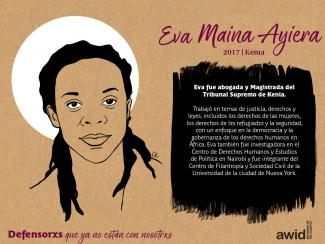
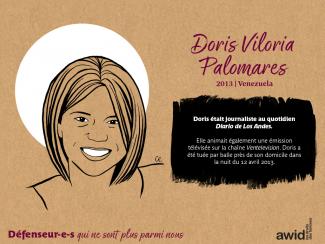
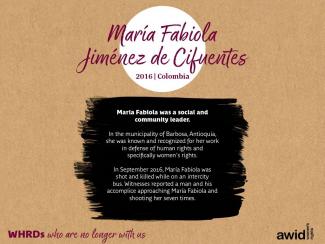
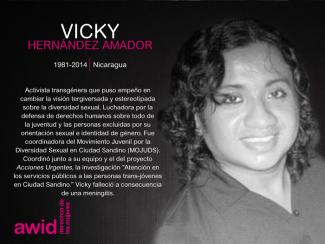
Estas 20 Defensoras de derechos humanos (WHRDs, por las siglas en inglés) trabajaron como periodistas, y de manera más amplia, en los medios comunicación de México, Colombia, Fiji, Libia, Nepal, Estados Unidos de Norteamérica, Nicaragua, Filipinas, Rusia, Alemania, Francia, Afganistán, y el Reino Unido. De ellas, 16 han sido asesinadas, y la causa de muerte en uno de los casos sigue sin ser esclarecida. Por esto, en este Día Mundial de la Libertad de Prensa, por favor únete a nosotrxs para conmemorar la vida y el trabajo de estas mujeres, compartiendo las memes aquí incluidas con tus colegas, amistades y redes, utilizando los hashtags #LibertadDePrensa y #WHRDs.
Los aportes del trabajo realizado por estas mujeres fueron celebrados y honrados en nuestro Tributo virtual para defensoras que ya no están con nosotrxs.
Por favor, haz click en cada imagen de abajo para ver una versión más grande y para descargar como un archivo.


Listen to the story here:
El financiamiento externo incluye donaciones y otras formas de financiamiento provenientes de fundaciones filantrópicas, gobiernos, donantes bilaterales, multilaterales y corporativos y de donantes individuales, ya sea que estos se encuentren radicados en tu país o en el exterior. Excluye aquellos recursos que las agrupaciones, organizaciones o movimientos generan de manera autónoma como, por ejemplo, cuotas de membresía, contribuciones voluntarias del personal, afiliadxs o adherentes, colectas comunitarias, alquiler de espacios propios o venta de servicios. Para consultar más referencias, en la propia encuesta se encuentran incluidas las definiciones de los distintos tipos de financiamiento y descripciones breves de distintos tipos de donantes.
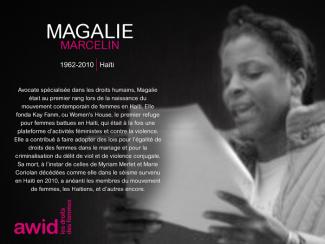
Les données que nous avons recueillies pour élaborer notre hommage montrent à quel point le Mexique est un pays dangereux pour les défenseuses. Sur les 12 femmes mexicaines défenseuses des droits humains que nous commémorons cette année, 11 ont été assassinées. Elles étaient des journalistes ou des activistes, des défenseuses des droits des femmes ou de ceux des personnes trans*. Nous vous invitons à vous joindre à nous pour rendre hommage à ces défenseuses, à leur travail et à l’héritage qu’elles nous ont laissé. Faites circuler ces mèmes auprès de vos collègues et amis ainsi que dans vos réseaux et twittez en utilisant les hashtags #WHRDTribute et #16Jours.
S'il vous plaît cliquez sur chaque image ci-dessous pour voir une version plus grande et pour télécharger comme un fichier


