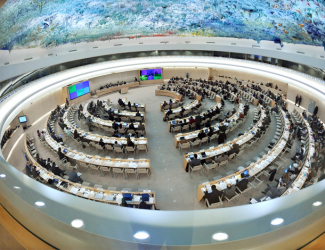
The Human Rights Council (HRC) is the key intergovernmental body within the United Nations system responsible for the promotion and protection of all human rights around the globe. It holds three regular sessions a year: in March, June and September. The Office of the UN High Commissioner for Human Rights (OHCHR) is the secretariat for the HRC.
The HRC works by:
Debating and passing resolutions on global human rights issues and human rights situations in particular countries
Examining complaints from victims of human rights violations or activist organizations on behalf of victims of human rights violations
Appointing independent experts (known as “Special Procedures”) to review human rights violations in specific countries and examine and further global human rights issues
Engaging in discussions with experts and governments on human rights issues
Assessing the human rights records of all UN Member States every four and a half years through the Universal Periodic Review
AWID works with feminist, progressive and human rights partners to share key knowledge, convene civil society dialogues and events, and influence negotiations and outcomes of the session.
With our partners, our work will:
◾️ Monitor, track and analyze anti-rights actors, discourses and strategies and their impact on resolutions
◾️Support the work of feminist UN experts in the face of backlash and pressure
◾️Advocate for state accountability
◾️ Work with feminist movements and civil society organizations to advance rights related to gender and sexuality.
Related Content
7. Sintetiza los resultados de la investigación
Ahora que has analizado toda la información que recogiste — de la encuesta, las entrevistas, la investigación secundaria y otras fuentes que hayas utilizado — ya puedes generar el producto final.
En esta sección:
El producto final
1. Escribe con claridad
2. Consigue que tenga un aspecto atractivo
El producto final será un documento que resume, analiza y critica la información que obtuviste. Será lo que compartas con la audiencia cuando les presentes tu investigación y se la expliques.
En AWID por lo general elaboramos un informe escrito exhaustivo en el que analizamos cada conjunto de información y sintetizamos todos los resultados que encontramos, para luego generar productos más breves como infografías o resúmenes (que explicaremos en la sección siguiente, «Finalización y formato»).
1. Escribe con claridad
Organiza la información según cómo te gustaría contar la historia. Puedes respetar el orden de la encuesta. O reagrupar algunas preguntas para que la conclusión surja de manera fluida y siga una progresión lógica.
Adapta el lenguaje al público. Utiliza un lenguaje universal y evita las jergas o los términos demasiado técnicos.
La importancia de la edición
El trabajo de edición implica corregir el texto, garantizar que la redacción sea concisa, revisar que los datos proporcionados sean exactos, señalar las inconsistencias que se deben resolver, acomodar el texto para que fluya y posiblemente también sugerir títulos.
Lo ideal es que la persona que haga este trabajo entienda y conozca tu labor en cuanto a WITM pero que no haya participado directamente de la investigación, así puede aportar una perspectiva nueva.
2. Consigue que el producto tenga un aspecto atractivo
Utiliza la información recogida para generar gráficos y tablas. Estas herramientas visuales constituyen una forma atractiva de subrayar los principales resultados de la investigación y validar los análisis.
Busca imágenes relevantes que puedan ilustrar el informe.
Destaca las principales cifras y/o los testimonios de impacto.
Recuerda: Cuanto más accesible sea el producto, más personas querrán leerlo (y compartirlo).
Cuando llegues a este momento, ya habrás compilado toda la información, la habrás analizado y convertido en un producto final, que probablemente sea un informe extenso.
1. Pule los resultados
Antes de encarar los pasos siguientes deberías compartir el producto final con organizaciones, activistas y donantes que puedan comentarlo (lxs «consultorxs»).
Este es un momento excelente para pedirles que revisen lo siguiente:
¿Hay algo fundamental que esté ausente delanálisis del panorama actual del financiamiento y sus tendencias?
¿Hay algo fundamental que esté ausente de las conclusiones?
¿Hay alguna inexactitud en la información que necesite ser corregida?
¿Tienen alguna sugerencia general sobre cómo fortalecer el informe para que cumpla con las metas que habías mencionado en el marco de la investigación?
Una vez que hayas incorporado todos los comentarios de las personas a las que consultaste, asegúrate de que la persona a cargo de la edición vuelva a revisar el informe.
Con esto ya tendrás la versión final y completa del informe. Si quieres publicarlo en otros idiomas, ahora es el momento de enviarlo a traducir.
2. Facilita los comentarios
Es probable que las personas a las que consultes estén ocupadas con su trabajo habitual. Asegúrate de darles un plazo razonable para que te hagan llegar sus comentarios.
Pídeles comentarios breves y específicos, para que les resulte fácil responder. Si quieres, puedes simplemente copiar y pegar los puntos que mencionamos en la sección anterior.
Si vas a publicar el informe en varios idiomas, asegúrate de contar con personas que también puedan revisar las versiones finales traducidas de el/los producto/s.
Las personas que revisen el informe (lxs «consultorxs») te estarán haciendo un aporte significativo. Considera la posibilidad de otorgarles alguna forma de reconocimiento.
• 1 persona (o más) de investigación
• 1 Editor (editor web o si crea un producto en línea)
• Traductores (si ofrece encuesta en varios idiomas)
Recursos necesarios
• Lista de organizaciones de asesores, activistas y financiadores.
• Documento de Síntesis (sección de "marco de su investigación")
• Los resultados de su(s) encuesta(s)
• Preguntas de la entrevista
• Resultados de las entrevistas
• Los datos de la investigación secundaria
• Todos otros datos utilizados en el informe
Rosa Candida Mayorga Muñoz était une travailleuse sociale, leader syndicale et défenseure des droits humains du Guatemala. On la surnommait affectueusement Rosita.
Dans les années 1980, Rosa devient la première femme à siéger au comité exécutif du syndicat de l’Institut d’électrification nationale (STINDE), syndicat qu’elle avait rejoint en premier lieu pour défendre les droits des femmes au travail. Cela signifiait, à ses yeux, de lutter pour l’égalité des chances dans une entreprise où de nombreuses femmes affrontaient un système discriminatoire et violent mis en place par la direction de l’entreprise. Rosa avait également subi du harcèlement sexuel sur son lieu de travail, tant de la part de collègues que de responsables. Elle n’entendait cependant pas rester silencieuse.
Rosa a continué à se battre et fait partie des efforts pour façonner la lutte afin qu’elle prenne la forme du « Pacte collectif pour les conditions de travail du INDE-STINDE ». Ce pacte était le premier du genre et le premier au Guatemala à caractériser le concept de harcèlement (sexuel). Il fait désormais référence dans la loi guatémaltèque pour les questions de travail, et sert d’encouragement aux autres syndicats.
« Elle n’avait d’autres outils pour se battre que ses propres idéaux... Elle a été intimidée à plusieurs reprises, harcelée pour abandonner la lutte, mais son courage a fait naître l’espoir chez les syndicalistes de la base. Rosita a créé une image de respect non seulement au sein de son syndicat mais également face aux autorités de l’institution et au sein du mouvement des femmes. Elle a été reconnue comme une pionnière du mouvement des femmes du syndicat, dans un espace qui avait davantage été dominé par les hommes. » - Maritza Velasquez, ATRAHDOM
Rosa est décédée le 4 avril 2018, elle avait 77 ans.
Diferentes personas de mi organización planean asistir al Foro. ¿Hay algún descuento para grupos en el Foro?
AWID no ofrece descuentos para grupos, pero sí ofrece descuentos en la inscripción a sus afiliadxs. (Haz clic aquí para obtener más información sobre cómo sumarte a la membresía)
ours chapter 6
Chapter 6
Anti-Rights Trends in Regional Human Rights Systems
In the African Commission and the Inter-American System, anti-rights actors push essentialist notions of culture and gender to hamper progress on rights and undermine accountability. As we see, anti-rights actors are exerting influence in regional human rights systems, as well as international spaces.
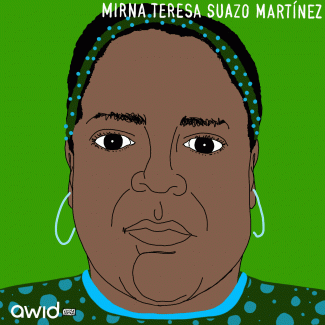
Mirna Teresa Suazo Martínez was part of the Garifuna (Afro-descendent and Indigenous) Masca community, living on the North Caribbean coast of Honduras. She was a community leader and a fervent defender of the Indigenous territory, a land that was violated when the National Agrarian Institute of Honduras gave territorial licenses to people outside of the community.
This deplorable deed resulted in repeated harassment, abuse and violence against the Masca, where economic interests of different groups met those of Honduran armed forces and authorities. According to the Black Fraternal Organization of Honduras (OFRANEH), the strategy of these groups is to evict and exterminate the Indigenous population.
“Masca, the Garifuna community located next to the Cuyamel Valley, is part of the area of influence of one of the supposed model cities, a situation that has triggered territorial pressures along the Garifuna coast.” - OFRANEH, 8 September 2019
Mirna Teresa, president of the Board of Trustees of the Masca Community in Omoa, was also firmly rejecting the construction of two hydroelectric plants on the river that carries the same name as her community, Masca.
“The Garífuna community attributes the worsening of the situation in their region to their opposition to tourist exploitation, the monoculture of African palm and drug trafficking, at the same time that it seeks to build an alternative life through the cultivation of coconut and other products for self-consumption.” - Voces Feministas, 10 September 2019
Mirna Teresa was murdered on 8 September 2019 in her Restaurant “Champa los Gemelos”.
She was one of six Garifuna women defenders murdered between September and October 2019 alone. According to OFRANEH, there was no investigation by the authorities into these crimes.
“In the case of the Garífuna communities, a large part of the homicides are related to land tenure and land management. However, squabbles between organized crime have resulted in murders, such as the recent ones in Santa Rosa de Aguán.” - OFRANEH, 8 September 2019
Et pour les visas ?
Nous avons parfaitement conscience des obstacles pratiques et de la détresse émotionnelle générés par les voyages internationaux, en particulier pour les personnes originaires des pays du Sud mondial. L'AWID collabore avec le TCEB (Thailand Convention and Exhibition Bureau) afin d'aider les participant·e·s au Forum à obtenir un visa. De plus amples informations concernant l'aide à l'obtention de visas seront disponibles au moment de l'inscription, y compris les coordonnées indiquant où et comment déposer votre demande.
En esta historieta de la ilustradora Sophia, se puede seguir a nuestra superheroína feminista que recupera las narrativas capturadas por lxs actores anti-derechos en distintos lugares y salva al mundo.
There are varied conceptualizations about the commons notes activist and scholar Soma Kishore Parthasarathy.
Conventionally, they are understood as natural resources intended for use by those who depend on their use. However, the concept of the commons has expanded to include the resources of knowledge, heritage, culture, virtual spaces, and even climate. It pre-dates the individual property regime and provided the basis for organization of society. Definitions given by government entities limit its scope to land and material resources.
The concept of the commons rests on the cultural practice of sharing livelihood spaces and resources as nature’s gift, for the common good, and for the sustainability of the common.
Context
Under increasing threat, nations and market forces continue to colonize, exploit and occupy humanity’s commons.
In some favourable contexts, the ‘commons’ have the potential to enable women, especially economically oppressed women, to have autonomy in how they are able to negotiate their multiple needs and aspirations.
Feminist perspective
Patriarchy is reinforced when women and other oppressed genders are denied access and control of the commons.
Therefore, a feminist economy seeks to restore the legitimate rights of communities to these common resources. This autonomy is enabling them to sustain themselves; while evolving more egalitarian systems of governance and use of such resources. A feminist economy acknowledges women’s roles and provides equal opportunities for decision-making, i.e. women as equal claimants to these resources.
Feminism And The Politics Of The Commons by Silvia Federici looks at the politics of the commons from a feminist standpoint shaped by the struggle against sexual discrimination and reproductive work, to clarify the conditions under which the principle of the common/s can become the foundation of an anti-capitalist program.
Where is the Money for Feminist Organizing? Survey Results
Thanks to our global feminist community! From May to August 2024, nearly 1,200 organizations working for Women's rights, gender justice, and LBTQI+ equality shared their experiences in the WITM survey. The results offer a unique picture of how feminist movements are resourced and where gaps remain.
Stay tuned for the upcoming report for more analysis!
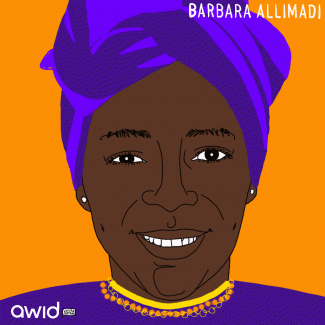
Barbara Allimadi fue una activista política y defensora de los derechos humanos de Uganda. En 2012, co-organizó una protesta contra la agresión policial a Ingrid Turinawe, una figura política de la oposición, que fue televisada y muestra cómo un policía le aprieta el pecho. Durante la protesta, Barbara, junto con otras compañeras activistas, se quitaron la ropa hasta quedarse en sujetador frente a la Estación Central de Policía de Kampala. Este hecho pasó a conocerse en Uganda como la infame "protesta de los sujetadores".
"Nos decidimos por la protesta de los sujetadores. Pensamos que sería lo más apropiado para lo que había sucedido. Con esta acción, no es que estuviésemos diciendo que no nos respetásemos a nosotras mismas. Estábamos indignadas con lo que había sucedido." - Barbara Allimadi, 2013 (Daily Monitor, en inglés)
Barbara se licenció en Ingeniería Electrónica y de Comunicaciones en la Universidad Metropolitana de Londres, y ejerció como ingeniera de redes en el Reino Unido. Era,además, una fan entusiasta de la música reggae. Regresó a Uganda en 2007, cuando su madre falleció.
En 2019, fue nombrada Coordinadora de Asuntos Internacionales y de la Diáspora de la Alianza para la Transformación Nacional (ANT, por sus siglas en inglés), un partido político lanzado ese año por un líder de la oposición.
"Queremos garantizar la seguridad de la vida y la propiedad, no el dolor, las lesiones o incluso la muerte a manos de unas fuerzas de seguridad que se supone deberían protegernos. Y lo más importante, queremos un entorno estable y propicio donde podamos realizar nuestros sueños y aspiraciones". - Barbara Allimadi, video de ANT (en inglés)
Barbara falleció el 27 de abril de 2020.
Tributos:
"Estaba muy orgullosa de mi hermana por muchas razones, pero, en particular, por su intrépida búsqueda de la paz, la democracia, la justicia y la igualdad en Uganda. En los momentos más álgidos de su activismo, Barbara lideró muchas marchas por las calles de Kampala, hacia las comisarías de policía y el Parlamento". - Doris Allimadi, hermana de Barbara
"Nos enteramos con profunda tristeza del prematuro fallecimiento de Barbara Allimadi. Ella ha sido una fuerza valiente, implacable y valerosa para el movimiento de liberación de Uganda. Queremos dar nuestro más sentido pésame a su familia. La echaremos mucho de menos". - Akina Mama wa Afrika (tweet, 28 April 2020)
"El fallecimiento de Barbara es una noticia muy triste para nosotrxs y para toda su familia. Barbara dedicó su vida a luchar por la justicia, la libertad y los derechos de las personas desde la sociedad civil, hasta que se unió, recientemente, al partido." Maj Gen Mugisha Muntu, coordinador nacional de la ANT (por sus siglas en inglés)
"Una hermana hermosa, encantadora, divertida, carismática e inspiradora. Mis hijxs han perdido a su tía. Uganda ha perdido a una audaz y valiente defensora de la libertad. Barbara dijo una vez: "Mientras siga habiendo aliento en ti, sigue trabajando por conseguir tus sueños". - Doris Allimadi, hermana de Barbara.
What are the Forum languages?
AWID’s working languages are English, French and Spanish. Thai will be added as the local language, as well as sign language & other accessibility measures. Other languages may be added if funding permits, so check back regularly for updates. We care about language justice and will try to include as many languages as we can and as our resources allow. We hope to create multiple opportunities for many of us to be present in our languages and to communicate with each other.
Note des éditeurices | Des mots perdus
Note des éditeurices
Des mots perdus
Lorsque notre travail incarné devient un profit entre les mains de systèmes que nous cherchons à démanteler, il n’est pas étonnant que nos sexualités et nos plaisirs soient une fois de plus relégués à la marge – surtout lorsqu’ils ne sont pas assez rentables. À plusieurs reprises au cours de la production de ce numéro, nous nous sommes demandé ce qui se passerait si nous refusions de nous plier aux services essentiels du capitalisme. Mais pouvons-nous oser poser cette question, lorsque nous sommes épuisé·e·s par le monde? Peut-être que nos sexualités sont si facilement rejetées parce qu’elles ne sont pas considérées comme des formes de soins. Peut-être que ce dont nous avons besoin, c’est de réimaginer le plaisir comme une forme de soin radical – un soin qui est également anticapitaliste et anti-institutionnel.
Despite their rigidity in matters of doctrine and worldview, anti-rights actors have demonstrated an openness to building new kinds of strategic alliances, to new organizing techniques, and to new forms of rhetoric. As a result, their power in international spaces has increased.
There has been a notable evolution in the strategies of ultra conservative actors operating at this level. They do not only attempt to tinker at the edges of agreements and block certain language, but to transform the framework conceptually and develop alternative standards and norms, and avenues for influence.
Strategy 1: Training of UN delegates
Ultra conservative actors work to create and sustain their relationships with State delegates through regular training opportunities - such as the yearly Global Family Policy Forum - and targeted training materials.
These regular trainings and resources systematically brief delegates on talking points and negotiating techniques to further collaboration towards anti-rights objectives in the human rights system. Delegates also receive curated compilations of ‘consensus language’ and references to pseudo-scientific or statistical information to bolster their arguments.
The consolidated transmission of these messages explains in part why State delegates who take ultra-conservative positions in international human rights debates frequently do so in contradiction with their own domestic legislation and policies.
Strategy 2: Holding international convenings
Anti-rights actors’ regional and international web of meetings help create closer links between ultra conservative Civil Society Organizations (CSOs), States and State blocs, and powerful intergovernmental bodies. The yearly international World Congress of Families is one key example.
These convenings reinforce personal connections and strategic alliances, a key element for building and sustaining movements. They facilitate transnational, trans-religious and dynamic relationship-building around shared issues and interests, which leads to a more proactive approach and more holistic sets of asks at the international policy level on the part of anti-rights actors.
Strategy 3: Placing reservations on human rights agreements
States and State blocs have historically sought to undermine international consensus or national accountability under international human rights norms through reservations to human rights agreements, threatening the universal applicability of human rights.
The Convention on the Elimination of Discrimination Against Women (CEDAW) has received by far the most reservations, most of which are based on alleged conflict with religious law. It is well-established international human rights law that evocations of tradition, culture or religion cannot justify violations of human rights, and many reservations to CEDAW are invalid as they are “incompatible with the object and purpose” of CEDAW. Nevertheless, reference to these reservations is continually used by States to dodge their human rights responsibilities.
‘Reservations’ to UN documents and agreements that are not formal treaties - such as Human Rights Council and General Assembly resolutions - are also on the rise.
Strategy 4: Creating a parallel human rights framework
In an alarming development, regressive actors at the UN have begun to co-opt existing rights standards and campaign to develop agreed language that is deeply anti-rights.
The aim is to create and then propagate language in international human rights spaces that validates patriarchal, hierarchical, discriminatory, and culturally relativist norms.
One step towards this end is the drafting of declarative texts, such as the World Family Declaration and the San Jose Articles, that pose as soft human rights law. Sign-ons are gathered from multiple civil society, state, and institutional actors; and they are then used a basis for advocacy and lobbying.
Strategy 5: Developing alternative ‘scientific’ sources
As part of a strategic shift towards the use of non-religious discourses, anti-rights actors have significantly invested in their own ‘social science’ think tanks. Given oxygen by the growing conservative media, materials from these think tanks are then widely disseminated by conservative civil society groups. The same materials are used as the basis for advocacy at the international human rights level.
While the goals and motivation of conservative actors derive from their extreme interpretations of religion, culture, and tradition, such regressive arguments are often reinforced through studies that claim intellectual authority. A counter-discourse is thus produced through a heady mix of traditionalist doctrine and social science.
Strategy 6: Mobilizing Youth
This is one of the most effective strategies employed by the religious right and represents a major investment in the future of anti-rights organizing.
Youth recruitment and leadership development, starting at the local level with churches and campuses, are a priority for many conservative actors engaged at the international policy level.
This strategy has allowed for infiltration of youth-specific spaces at the United Nations, including at the Commission on the Status of Women, and creates a strong counterpoint to progressive youth networks and organizations.
Key anti-rights strategies
Strategy 7: Defunding and delegitimizing human rights mechanisms
When it comes to authoritative expert mechanisms like the UN Special Procedures and Treaty Monitoring Bodies and operative bodies like the UN agencies, regressive groups realize their potential for influence is much lower than with political mechanisms[1].
In response, anti-rights groups spread the idea that UN agencies are ‘overstepping their mandate,’ that the CEDAW Committee and other Treaty Bodies have no authority to interpret their treaties, or that Special Procedures are partisan experts working outside of their mandate. Anti-rights groups have also successfully lobbied for the defunding of agencies such as the United Nations Population Fund (UNFPA).
This invalidation of UN mechanisms gives fuel to state impunity. Governments, when under international scrutiny, can defend their action on the basis that the reviewing mechanism is itself faulty or overreaching.
Strategy 8: Organizing online
Conservative non-state actors increasingly invest in social media and other online platforms to promote their activities, campaign, and widely share information from international human rights spaces.
The Spanish organization CitizenGo, for example, markets itself as the conservative version of Change.org, spearheading petitions and letter-writing campaigns. One recent petition, opposing the establishment of a UN international day on safe abortion, gathered over 172,000 signatures.
Overarching Trends:
Learning from the organizing strategies of feminists and other progressives.
Replicating and adapting successful national-level tactics for the international sphere.
Moving from an emphasis on ‘symbolic protest’ to becoming subversive system ‘insiders.’
By understanding the strategies employed by anti-rights actors, we can be more effective in countering them.
[1] The fora that are state-led, like the General Assembly, the Human Rights Council, and UN conferences like the Commission on the Status of Women and the Commission on Population and Development
Nuestro poder colectivo, nuestra sabiduría y nuestro compromiso no tienen límites. Pero nuestras cuentas bancarias sí.
Las instantáneas de datos están basadas en las respuestas de 1.174 organizaciones feministas, por los derechos de las mujeres, LGBTQI+ y aliadas (en adelante «organizaciones feministas y por los derechos de las mujeres») de 128 países a ¿Dónde está el dinero para las organizaciones feministas? la encuesta de AWID.