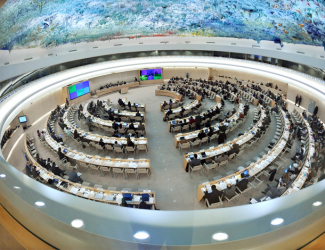
The Human Rights Council (HRC) is the key intergovernmental body within the United Nations system responsible for the promotion and protection of all human rights around the globe. It holds three regular sessions a year: in March, June and September. The Office of the UN High Commissioner for Human Rights (OHCHR) is the secretariat for the HRC.
The HRC works by:
Debating and passing resolutions on global human rights issues and human rights situations in particular countries
Examining complaints from victims of human rights violations or activist organizations on behalf of victims of human rights violations
Appointing independent experts (known as “Special Procedures”) to review human rights violations in specific countries and examine and further global human rights issues
Engaging in discussions with experts and governments on human rights issues
Assessing the human rights records of all UN Member States every four and a half years through the Universal Periodic Review
AWID works with feminist, progressive and human rights partners to share key knowledge, convene civil society dialogues and events, and influence negotiations and outcomes of the session.
With our partners, our work will:
◾️ Monitor, track and analyze anti-rights actors, discourses and strategies and their impact on resolutions
“[She] was a person who was characterized by her hard work in favor of the defense of human rights and the construction of peace in Nariño, especially in the municipality of Samaniego-Nariño.” - Jorge Luis Congacha Yunda for Página10
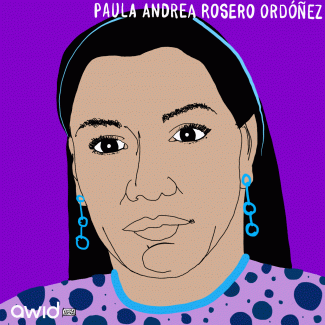
Paula Andrea Rosero Ordóñez was a trial lawyer in the office of the Public Ministry in Samaniego, Nariño, the main agency defending citizens’ rights in Colombia.
She focused on civil and political rights, issues of impunity and justice, and contributed to uncovering the abuse of power, including corruption. She also participated in peacebuilding projects in her hometown Samaniego, such as the Municipal Peace Council and the Municipal Women’s Board.
Paula received death threats after exposing the irregular handling of resources and complaining about acts of corruption at the Lorencita Villegas Hospital in the Nariñense municipality. She was murdered on 20 May 2019, when two men approached and shot her at close range.
A Joy to the World: Six Questions with Naike Ledan
Interviewed by Chinelo Onwualu
Naike Ledan is a social justice defendant, a committed feminist that brings forward 20 years of experience in human rights and health justice advocacy, women’s empowerment, the fight for universal access to basic services and social inclusion, as well as civil society capacity building. She has built extensive work in Canada, West and southern Africa, as well as in Haiti, in civil rights advocacy, capacity building for CSOs, while emphasising the social determinants of structural exclusion. She values the principles of shared leadership, anticolonial, anti-oppressive, and anti-patriarchal spaces.
Chinelo You’re billed as a trans rights activist; I’m curious about how you made that journey.
Naike So, I grew up in Haiti until I was 18, then I lived in Montreal for 19 years. Coming back to Haiti in 2016, I thought I would be coming back home, but the place had changed and I had to readjust. I did not necessarily reconnect in the way that I’d expected to with childhood family and friends. I came back as an expat with a comfortable work situation, and I felt very much like a foreigner for a very long time. And at the same time, I felt very much at home because of the language, the understood silence, the not having to explain when we start singing a commercial – you know, that thing we share, that energy, that space, that spirit.
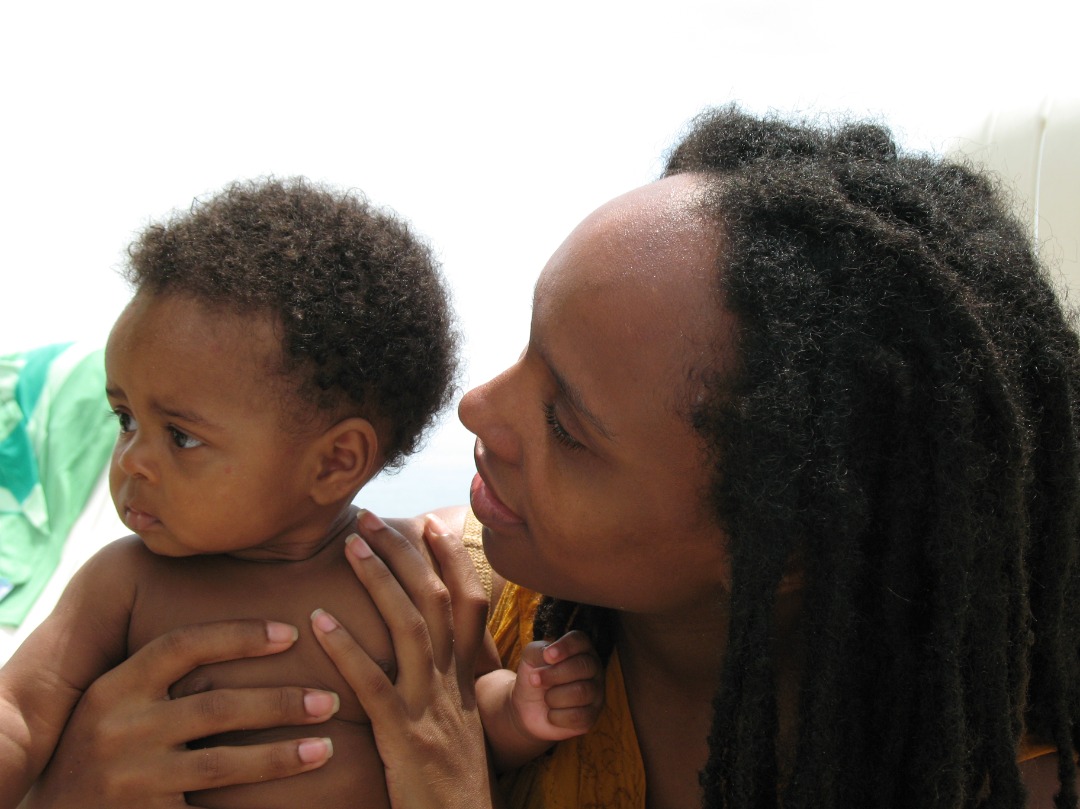
My return to self-love – I would call “rebirth” – coinciding with giving birth to my first child, giving birth to myself, and falling in love with my queerness or same-gender lovingness. (Photo credit: Naike Ledan)
What helped me was, I loved the work of going into the country and documenting people’s knowledge. So I left the comfort. I became a country director of a regional organisation that was queer as fuck! Most of my work was to find resources and build the capacity of civil society. My strategy was to go into the countryside, look for all these little organizations, help build their capacity, and fund them. I was not interested in politicians and shaking hands and taking pictures . I had a very good ally, Charlot Jeudy – the [queer] activist that got killed three years ago in his house. We got very close after an Afro-queer film festival we were planning got banned in Haiti. But it made a lot of noise and sparked conversations about queerness everywhere, so Charlot introduced me to every little CSO in every little corner of the country. And I would just be there to help organisation[s] with registering legally or building their strategic plan. So it’s been a lot of these kinds of work that made me a queer activist and by extension, a trans activist. Although I don’t call myself that – an activist. It’s such a loaded word, you know? And it’s something people call you. I think I’m just a lover and a fighter .
Chinelo Tell me about the workshop you conducted with AWID for the festival. What was it about and what was the context?
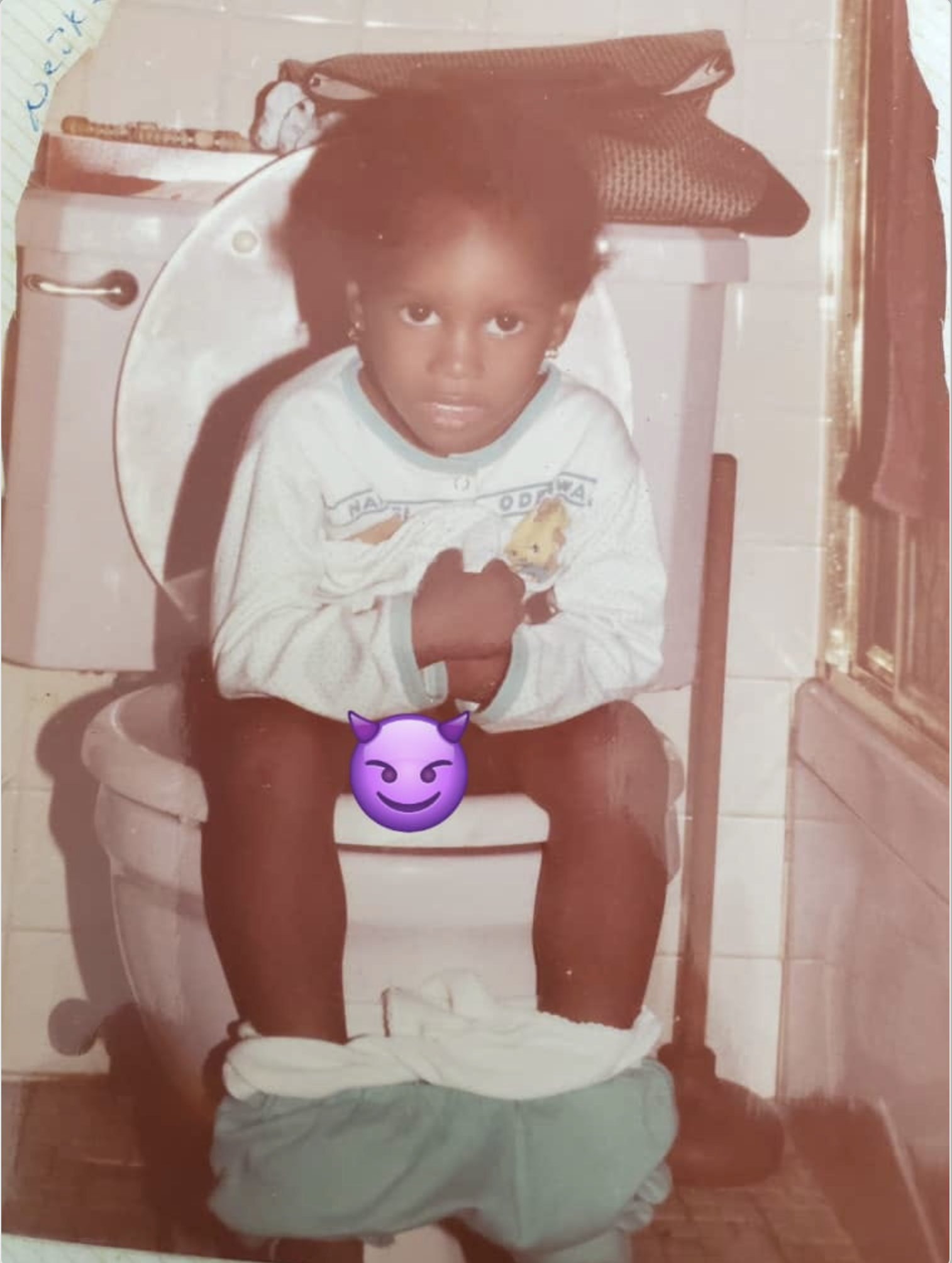
My deep self awareness during my childhood years and my engagement in questioning inequalities and injustice at a very very young age (+/- 4 years old). (Photo credit: Naike Ledan)
Naike International media doesn’t really talk about Haiti, but with a political environment that is as bad as ours, the economic environment is even more catastrophic. Being a more middle class Haitian, speaking different languages, having different passports, I was initially hesitant to take the space. But I often see myself as a bridge more than someone that would talk about themself. That is how I came to invite Semi, who is a brilliant young trans woman from outside Port-au-Prince, to take the space to talk for herself and walk us through the ecosystem of the realities for trans women in Haiti. We ended up building a session about uninclusive feminism – or, I would say, formal feminist spaces – and how trans girls in Haiti do not have spaces where they can contribute to women’s knowledge and sharing of women’s realities. So the AWID festival was the opportunity for me to give the space to the women who should have it. We had a wonderful time; we had wine online while hosting the conversation. My co-facilitator, Semi, shared what it is like to be a trans child/girl/woman at different stages of her life. She also shared the dangers of the street, of poverty, of exclusion, of “not passing,” and her victories as well.
Chinelo What is the relationship of trans women to feminist organizations in Haiti? What has been your experience with that?
Naike It’s been really hard – heartbreaking, actually – the experience of trans women in Haiti. From not existing at all to just being extremely sexualized. The other thing that’s been happening is how they’re being killed, and how those killings have gone unreported in the media. This is how non-existent, how erased trans women are. They’re everywhere but not in job settings, not in feminist settings, not in organizational settings. Not even in LGBT organizations. It’s only recently, and because of a lot of advocacy push, that some of these organization are kind of readjusting, but in feminist spaces, this is still out of the question. We are still having to deal with the old exclusionary discourse of “They’re not women. Of course, if they can pass…” The culture of passing, it’s a risk management conversation – how much you pass and how much you don’t pass and what it means for your body and the violence it inflicts. In the trans-exclusionary realities we live in, which are reproduced in a lot of feminist spaces, those that pass completely may be considered girls, but only to a certain extent. But how about falling in love, how about having a conversation, how about being in the closet, how about wanting a certain aesthetic, or a career? So really, the conversation about hormone therapy becomes about risk reduction, as Semi herself shared at the workshop. But we don’t have the option of hormone therapy, we don’t have the medical framework nor the system to support those who would like to pursue that option.
Chinelo When you talk about the way that trans people and queer people are thought of in society, it sounds like it might be similar to Nigeria, which can be a deeply homophobic environment.
Naike Haiti is a very complex country in a very beautiful way. Nothing is simple, you know, nothing is ever one way. Haitians are very tolerant – and they’re also very homophobic. You’re going to find regions in the countryside where people aren’t that homophobic at all because all the Vodou temples there, and this is a religion that respects life. One basic principle of the Vodou religion is that all children are children. So, there is no right or wrong in the religion. For the longest time, people thought of Haiti as a haven, a place where people are tolerant – we’re talking 70s, 80s, pre-HIV, 90s even. Then you had the earthquake [in 2010] where around 300,000 people died. And then all this money came from the south of the US through the Evangelicals to rebuild the country and find Jesus. So, the homophobia in Haiti is very recent. In the depth, in the heart of the soul of the culture, I cannot really say that it is homophobic. But in the everyday life, it surely lands on the skin of queer people, that violence. And that of women, of poor women, of dark women as well, because colorism runs deep in the Caribbean.
Chinelo How have you managed this? What’s been your strategy for survival?
My return to Haiti as part of my decolonizing process, and choosing to physically position my senses and my family’s senses to magic and blackness uncompromisingly. (Photo credit: Naike Ledan)
Naike I’m really in love with my work. I love working. When I first arrived, I was working with this horrible NGO but I was doing amazing work. I was always in the countryside, conversing and learning from people, from women. And that filled my heart for so long because I’m very much in love with my culture, with black people, with black women – old black women, black babies. It just fills me up in a spiritual way. When we were in Canada my kids were in these all-white schools and tokenized. They did not speak Creole nor French. And now, they’re running free in the yard and starting to fight in Creole. I also found hubs of survival with the people I met. I created bonds with the queers and others who were weirdos like me and it’s been really wonderful. But now I’m struggling because I don’t feel safe in Haiti anymore. We have about 40 kidnappings per week in Port-Au-Prince – and it’s been like that since 2018. I’ve developed anxiety and panic attacks. So It’s time to go, and I’ve been asking myself, “where is home?” I spent 19 years in Montreal but I never felt at home there. When I left, I never missed it so I don’t want to go back. I’ve been crying a lot lately because it feels like entering a second exile.
Chinelo What’s your relationship to pleasure, leisure, and rest?
Naike My relationship with pleasure, leisure, and rest are for me one and the same. It is the lived moment when I indulge in the heat of the sun on my face for example. It is pleasure, leisure, and rest at the same time.
Pleasure: My go-to space, most solely a haven of celebration of myself. I reserve myself the power and the right to be loud or quiet in the enjoyment of the pleasure I experience. All the pleasure I viciously and abundantly indulge in, including and not limited to the pleasure of solitude and silence.
Leisure: biking, music festivals, eating, wine discoveries, dancing in Haitian traditional Vodou dances are amongst many that occur at the moment.
Rest: is what I live for. As an overachiever and a person that is literally in love with work, it is a paradox how lazy I am. No one knows that because all of what the world sees is this: an accomplished overworker. They do not know how I can just, uncompromisingly and profoundly indulge in idleness.
ExploreTransnational Embodiments
This journal edition in partnership with Kohl: a Journal for Body and Gender Research, will explore feminist solutions, proposals and realities for transforming our current world, our bodies and our sexualities.
نصدر النسخة هذه من المجلة بالشراكة مع «كحل: مجلة لأبحاث الجسد والجندر»، وسنستكشف عبرها الحلول والاقتراحات وأنواع الواقع النسوية لتغيير عالمنا الحالي وكذلك أجسادنا وجنسانياتنا.
Kindle for your feminist fire! Browse AWID’s research on funding, WHRDs, movement building, fundamentalisms, economic justice, feminist monitoring & evaluation and more
AWID Community is an online social networking platform for specifically for AWID members. It’s a feminist space for connection, resistance and celebration. A space for critical feminist conversations, collective power and solidarity. It is also a space for post-event dialogues, navigating difficult political learnings and community care
Carol Thomas fue una pionera en el trabajo por los derechos sexuales y reproductivos de las mujeres en Sudáfrica. Fue una ginecóloga de gran talento y la fundadora del WomenSpace [EspacioDeMujeres].
No sólo las empleó en su práctica, sino que también abogó por proporcionar formas no tradicionales de asistencia sanitaria a las mujeres, ofreciendo servicios de alta calidad, empáticos y accesibles.
"Ella recibió no sólo la alegría de los embarazos y la llegada de nuevxs bebés, sino también la ansiedad que puede generar la infertilidad, un parto prematuro, el cáncer femenino, así como también la angustia de los abortos espontáneos y lxs mortinatxs". Helen Moffett
Carol pensó en nuevos paradigmas cuyo centro de atención fuesen las necesidades de las mujeres con menor acceso a los servicios y derechos que puede aportar una sociedad:
"El entorno socioeconómico imperante en el que nos encontramos hoy se traduce en una carga desproporcionada de enfermedades y desempleo que las mujeres tienen que soportar... Como mujer negra, desfavorecida en el pasado, tengo una idea clara de lo que está sucediendo en nuestras comunidades". - Carol Thomas
La innovadora y multipremiada empresa social de Carol, "“iMobiMaMa”, utilizaba los quioscos móviles y la tecnología interactiva para conectar directamente a las mujeres con servicios de salud prenatal y reproductiva, información y apoyo en las comunidades de toda Sudáfrica.
Carol apoyó a las mujeres tanto en los embarazos deseados como en los no deseados, y fue mentora de muchxs enfermerxs y doctorxs a lo largo de su vida.
Fue calificada, además, como ginecóloga de referencia "para las personas trans que podían recibir de ella una atención afirmativa. Ella supo cómo manejarse cuando muchas personas no tenían todavía en claro el lenguaje o los pronombres. Sus mantas calientes, su capacidad para escuchar y decir lo que necesitabas oír eran muy reconfortantes." -Marion Lynn Stevens.
Carol Thomas falleció el 12 de abril de 2019 a causa de una serie de complicaciones tras un doble trasplante de pulmón, en el punto más álgido de su carrera profesional.
Los homenajes que llegaron después de su muerte inesperada se refieren a ella de muchas formas: como " modelo a seguir, mujer guerrera, innovadora, líder dinámica, rompe-moldes, dínamo, científica brillante, doctora compasiva".
Sin duda, Carol Thomas será recordada y honrada por ser todo esto y mucho más.
La liga conspirativa de escritorxs | Wazina Zondon
Conocida también como la Red Teta Research, la liga conspirativa de escritorxs se fundó en 2021 en el contexto de los círculos de escritura semanales de Kohl. La Red consiste en un grupo transnacional de escritorxs queer y feministas que participan en procesos colectivos de escritura, reflexión y creación de universos.
Wazina Zondon es una afgana criada en Nueva York. Su trabajo de colección de historias y de narración se centra en las memorias y ritos colectivos de iniciación en la diáspora. Actualmente, trabaja en Faith: in Love/faith in love, donde (re)rastrea la historia de amor de su madre y su padre y la huella amorosa heredada de la familia.
El amor es contrabando en el infierno,
porque el amor es ácido
que devora las rejas.
Pero tú, yo y el mañana
nos tomaremos de las manos y haremos votos
para que la lucha se multiplique
La sierra de arco tiene dos cuchillas.
La escopeta tiene dos cañones.
Estamos preñadxs de libertad.
Somos una conspiración.
Es nuestro deber luchar por la libertad.
Es nuestro deber ganar.
Debemos amarnos y apoyarnos mutuamente.
No tenemos nada que perder, salvo nuestras cadenas.
- «Amor» por Assata Shakur
«Si podemos heredar un trauma, ¿podemos heredar una huella relacionada con el amor?»
Esta es la pregunta que se hace Wazina Zondon en sus memorias colectivas Loveprint (Improntas de amor). Loveprint es un deambular, una superposición, una desviación que (re)crea, en la intersección entre entrevistas y ensayos personales, las historias y reflexiones de nuestra familia sobre el amor, la pareja y el romance. Guiadxs por Wazina, la liga conspirativa de escritorxs se reunió e intentó reproducir literalmente este proyecto en forma de escritura colectiva, donde nuestras historias, nuestros géneros e identidades sexuales se complementan y contradicen entre sí. Con nuestras voces superponiéndose, fuimos completando las oraciones de lxs otrxs para crear una conversación, un memorial, pedazos de nosotrxs mismxs que hablan de unx «nosotrxs».
¿Cuáles son los orígenes de tu huella de amor?
Soy lo que han llamado un «accidente feliz». Se ha dicho mucho sobre esto: una vida imprevista que al mismo tiempo es totalmente deseada. Siento que esto moldeó mi forma de amar; no solo me enamoro, también me arriesgo a los resbalones que llevan a las caídas. Quizá fue esto lo que me convirtió en un tipo de persona amor fati.
Me dijeron que era una niña no deseada. Así que crecí hasta convertirme en una adulta no deseada. Los orígenes de mi huella de amor se basan en ser no deseada permanentemente. No soy fruto del amor ni de ningún sentimiento feliz; soy, más bien, dolor y carga. No tengo una impronta amorosa, al menos no en este sentido.
Sé con certeza que mis padres estuvieron enamoradxs en algún momento, pero la salud mental es un demonio, y hasta que unx no se enfrenta a sus demonios,
no hay quien gane.
Nunca asociaré el «amor» con mis padres o con la familia normativa. El amor bajo el que crecí fue un amor lleno de violencia y de responsabilidades que no busqué o para las que ni siquiera estaba preparada. Durante mucho tiempo sentí que la vida y el amor consistían en cargar una roca gigante cuesta arriba. Si bien mis padres «se amaban», crecí en un ambiente tóxico de violencia, celos e inseguridad. Crecí anhelando estabilidad; y esto es lo que soy ahora. Soy una persona que se arriesga pero nunca en mi «espacio de amor».
No sé por qué mi madre eligió albergar a una niña (yo) dentro de ella Ella no ama de esta forma.
Mi madre me dice que si tengo que pensar en «encontrar» el amor, que nunca tome su matrimonio como modelo. Mi huella de amor proviene en cambio de mi crianza de perros durante las últimas dos décadas (18 años para ser precisa). Al revés también es cierto: me criaron. En su compañía entiendo cada vez más sobre el amor y sus múltiples capas.
No he conocido el amor por una «huella». En nuestra casa no hablábamos de amor. Tuve que enseñarme a mí misma a amar. Fue un trabajo arduo. Aún así, fallo y sigo intentándolo, y fallo todos los días. Quizá el fracaso sea mi impronta de amor.
Mi impronta de amor es el cuidado, la calidez y la comprensión que
doy a quienes me rodean, sea unx extrañx, unx amigx,
unx familiar, unx amante. Mi impronta de amor es política – no es calculada ni pensada.
Nací bajo un fuerte bombardeo.
Mi impronta de amor es
lo opuesto a eso.
Lecciones aprendidas sobre el amor
Sé más de lo que no es el amor que de lo que es.
El amor no es ni ansiedad ni pánico.
El amor no es pedir permiso para vivir o respirar. Siempre se trata del amor, y no hay amor sin libertad.
Todo lo que haces tiene que ver con usar tu corazón, excepto el amor. El amor consiste en utilizar tu cabeza.
A veces temo que mi idioma de amor se pierda con la traducción.
--- Hay muchas maneras
de trazar los orígenes
de cómo
cómo no
amar
no amar
amar lo justo
amar demasiado
algo de amor
alguna pérdida
amar
amar lo perdido ---
No soporto la idea de la pareja. Tampoco soporto la idea de vivir sola mientras envejezco. Estoy cansada de hacer los quehaceres sola, de mudarme de casa sola, de pagar el alquiler y las cuentas sola... Me imagino que me da un ACV sola y me da miedo. No tengo planes de «ponerme en pareja». Quiero un mundo en el que pueda casarme con unx amigx, comprar una casa con unx amigx, no tener sexo.
Amar a muchxs personas no corrompe un amor
compartido entre dos; y que el amor sea romántico
o no, realmente no es tan importante.
Cuando reflexiono sobre el deplorable estado de mis relaciones, me doy cuenta de que estoy en la relación para la que me prepararon. Con toda mi «radicalidad» todavía no he desaprendido las normas de género de mierda.
Mi necesidad de estabilidad se siente «muy poco radical». Quiero salir de este etiquetado. Quiero algo que nunca tuve. Quiero que sea hermoso. Quiero sentirme hermosa y segura, y sólo la estabilidad me hace sentir eso. Segura, sana, sabiendo que el hogar no tiene que ver ni con la violencia ni con la discordia.
--- Impronta amorosa – amo oler los libros ver dónde
se imprimieron
Intento pensar en el origen de mi comprensión
y práctica del amor
¿Necesitamos el origen, no es lo mismo que la pureza?
No hay pureza ni origen del amor.
¿Por qué la comprensión y la práctica vienen
a la mente y no la «emoción»? ---
Cuando llamo a mis padres, no cuelgo el teléfono después de despedirnos,
de esa manera puedo escuchar los sonidos del hogar.
¿Qué necesitamos para ser/sentirnos amadxs al momento de morir?
Durante mi entierro suní, quiero que todas las mujeres y los hombres acudan juntxs a mi entierro. ¿Qué es eso de no poder ir a despedirse de lxs muertxs de otro sexo? Será suní porque mi madre querría que lo fuera. Será ecológico: una lápida no será necesaria. Me encantan todos los rituales de entierro. El Corán está bien, pero además quiero música. Me gustan mucho Asmahan, Um Kulthum y The Stone Roses.
Tengo una lista de reproducción de lunes a viernes, y dos diferentes para los fines de semana: una para los sábados, y otra para los domingos. Me gustaría que aquellxs que me amaron reprodujeran la música que yo solía escuchar, respetando los días – con cierto margen de tolerancia siempre que se ciñan a las listas de reproducción.
Quiero estar rodeada de quien o quienes me han amado, aunque haya sido por un momento. Que la música me envuelva así como flores frescas recién cortadas. No quiero que me descubran muerta; quiero morir en medio de una risa junto a seres queridxs.
Quiero ser recordada como alguien que amó.
No necesito sentirme amada en la muerte. Necesito que las personas que me rodean sientan que las he amado, incluso después de mi partida. Ser amadx en la muerte tiene que ver con quienes están vivxs. Así que pienso más en cómo nos unimos como una comunidad vital y amorosa ante la muerte de aquellxs a quienes amamos y con quienes vivimos. De qué manera mantenemos sus recuerdos en nosotrxs. Cómo nos convertimos en archivos de sus vidas.
--- A veces, sólo se puede amar a las personas en el momento de su muerte ---
Tengo que recordar que el cuerpo está conectado a un espacio. Mi familia es muy pequeña y, aunque venimos de diferentes lugares, es como si cada generación se trasladara a un lugar nuevo. Quizá es por eso que la muerte no está conectada con un lugar en especial, un cementerio. En nuestra familia es habitual enterrar a lxs muertxs sin nombres ni lápidas, o distribuir las cenizas al viento. Me siento en paz con este tipo de conmemoración sin espacio. La idea de que mis cenizas nutran a una nueva vida me hace sentir amada y recordada a través de la recreación. Mi abuela murió a principios de este año debido a complicaciones después de vacunarse. Dos horas después de su muerte, mi familia se sentó a reírse hasta las lágrimas de sus bromas, de su manera divertidísima de contar historias. Nos reímos y amamos, y fue como si ella estuviera sentada de nuevo con nosotrxs. Esto es lo que me haría sentir en paz: fertilizar la tierra, abonar las conversaciones y el recuerdo colectivo.
---Había
dos calles que utilizaba
para caminar
para correr
para jugar
para quedarme
Había
cinco horas en las que el sol
estaba caliente
el cielo era azul
y la tierra era verde
Había
una flor que podía
oler
tocar
apretar
aplastar
Estaban
lxs amigxs que podía
acariciar
La comida
que podía
tragar
El lenguaje
que saldría de mis
labios
Es probable que aún existan
esos muchos lugares
y cosas
y personas
después de mí ---
Quizá sea suficiente con la promesa de que seré «conmemorada espacialmente» como una planta y cuidada, por turnos, hasta que me convierta en un árbol. Sin nombre, sin lápida – solo una planta o un árbol, y saber que me cuidarán. En cuanto a mi cuerpo, quiero ser cremada sin ningún tipo de ritual, y que las cenizas de mis huesos sean liberadas en el mar Arábigo.
Necesito que mi cuerpo sea tratado de forma tan subversiva como vivió.
No quiero que me entierren junto a mi familia, en ese pequeño nicho junto a todas esas personas que nunca me conocieron. Atrapada en la muerte como lo estuve en vida. Quiero ser cremada, y que mis cenizas sean finalmente liberadas.
Quiero que me permitan pasar para no quedar suspendida en un estado intermedio y poder ser una presencia, un proceso activo, una invasión.
Esto es lo que te pido:
Que me sueltes y dejes pasar
Que no dejes que la nostalgia enturbie este momento porque solo te pediré que tus gestos sean normales
Para sustentarme ya he robado los suaves destellos y atesorado las pequeñas y grandes formas en que me amabas. Me mantuve viva gracias a ellas
Que fijes un tiempo limitado para tu duelo
Que recuerdes que no hay distinción en la belleza del amar; es infinita y se regenera sin el cuerpo
Quiero ser recordada por el amor que le doy al mundo.
Quiero que mi cuerpo sea donado, y que mis órganos sirvan para alimentar el amor en otra(s) vida(s).
--- El aroma del jazmín ---
ExplorarCorporalidades Transnacionales
Esta edición en alianza con Kohl: una publicación para Body and Gender Research analizará soluciones, propuestas y realidades feministas para transformar nuestro mundo actual, nuestros cuerpos y nuestras sexualidades.
نصدر النسخة هذه من المجلة بالشراكة مع «كحل: مجلة لأبحاث الجسد والجندر»، وسنستكشف عبرها الحلول والاقتراحات وأنواع الواقع النسوية لتغيير عالمنا الحالي وكذلك أجسادنا وجنسانياتنا.
< arte: «Proyecto fotográfico: La muerte sale por el Oriente», de Sonia Madrigal
AWID Community Jobs board - ES
Bolsa de Empleos Comunitaria
¿Estás buscando trabajo? Una de las ventajas de unirse a la Comunidad AWID es tener acceso a nuestra bolsa de empleos co-creada por la comunidad. Podrás explorar nuevas oportunidades y también tendrás la oportunidad de compartir vacantes y convocatorias de propuestas con todos los miembros.
Yamile Guerra était une avocate bien connue, leader communautaire et activiste politique dans la région de Santander en Colombie.
Activement impliquée dans la résolution de litiges entre les communautés locales et les promoteurs immobiliers, elle s’est battue contre l’appropriation des terres illégale. Yamile a occupé plusieurs fonctions politiques, dont celle de secrétaire générale du gouvernement de Santander à Bogota, et s’était également présentée comme candidate à la mairie de Bucaramanga. Au cours des dernières années de sa vie, Yamile s’était de plus en plus impliquée dans les causes environnementales, et particulièrement celle de la défense de la biodiversité des zones humides de Santurbán, une région qui approvisionnait près de deux millions de personnes en eau potable, contre les promoteurs du développement économique.
D’après sa famille et ses ami·e·s, Yamile recevait quotidiennement des menaces de mort et avait demandé la protection des autorités.
« Elle était tout à fait consciente de la question [du litige foncier] et avait à plusieurs reprises mentionné qu’elle se sentait en danger. » - Alixon Navarro Muñoz, journaliste et amie de la famille Guerra
Le 20 juillet 2019, Yamile a été tuée par balles par deux hommes à Floridablanca, Santander. Elle venait de clore une discussion avec eux en lien avec le litige foncier. Un suspect a ensuite été arrêté pour son meurtre, lequel a admis avoir été payé pour organiser son assassinat. Selon des rapports, Yamile est la troisième membre de sa famille a avoir été assassinée, en lien avec des litiges fonciers. Son père, Hernando Guerra, avait lui aussi été assassiné plusieurs années auparavant.
L’assassinat de Yamile s’inscrit dans une vague de violences et de meurtres systématiques de centaines d’activistes sociaux et défenseur·e·s des droits humains en Colombie. L’Institut d’études sur le développement et la paix (INDEPAZ) rapporte qu’au moment du décès de Yamile, plus de 700 leaders communautaires et activistes pour les droits humains ont été tué·e·s depuis la signature en août 2016 d’un traité de paix par la Colombie. La plupart furent assassiné·e·s pour s’être opposé·e·s à des trafics de drogue et des opérations minières; y compris les peuples autochtones, les Afro-Colombiens et les défenseures des droits humains étant les plus exposé·e·s.
Moins d’une semaine après le décès de Yamile, des milliers de Colombien·ne·s ont manifesté dans les petites et grandes villes, brandissant des photos en noir et blanc d’activistes tué·e·s, et sur lesquelles était écrit : « Il ne peut y avoir de paix sans leaders » et « Fini les bains de sang ».
Yamile Guerra n’avait que 42 ans au moment de son assassinat.
Snippet FEA We are living in a world right (FR)
Nous vivons dans un monde où la destruction de la Nature alimente notre économie mondiale actuelle. Même en période de crise climatique, les gouvernements continuent d'encourager les industries agricoles à grande échelle à se développer. Ces activités empoisonnent la terre, menacent la biodiversité et détruisent la production alimentaire et les moyens de subsistance locaux. Pendant ce temps, alors que les femmes produisent la majorité de la nourriture dans le monde, elles ne possèdent presque aucune terre.
Et si nous percevions la terre et la Nature non pas comme une propriété privée à exploiter, mais comme une totalité avec laquelle vivre, apprendre et coexister harmonieusement ? Et si nous réparions nos relations avec la terre et adoptions des alternatives plus durables qui nourrissent à la fois la planète et ses communautés?
Nous Sommes la Solution (NSS) est l'un des nombreux mouvements dirigés par des femmes qui s'efforcent d'atteindre cet objectif.
Our women ancestors form a circle
Sacred, alive, powerful
We are in the middle
Feeling their strength.
The drum beats a sound of earth
Our skin dresses in colours
We are green, red, orange, blue, violet, black
The drum beats a sound of earth
A voice vibrates, a scream emanates, a song rings out, lulling to sleep, awakening consciousness.
The drum beats a sound of earth
A gaze of complicity, friendship profound.
The drum beats a sound of earth
Ours is but one heart, beating a rhythm of the soul, inviting us to move, inspiring desire, and showing us a path.
One of communal togetherness, power of the people, self-government, a women’s revolution of subversive communal care.
The drum beats a sound of earth
And I invite you to join, to be voice, skin, gaze, seed, fire, song, communion.
The drum beats a sound of earth
And I invite you to discover it, to love it, to know it, and to defend it from the heart of the community
For 25 years they have lived along the same dusty streets, at the top of a hill named after a lion. They come from different places, many from traditional farming communities. Their skin is the colour of rebellion, the colour of a cardon cactus, because in them lives the spirit of the semi-arid Lara State, which is where their love for life comes from, their appreciation, care and protection of water and land. They are heiresses of the Gayon and Ayaman lineages, Indigenous communities that lived and live in the northern part of Lara State.
From the time they were very young they learned that maternity is a role from which it is not easy to escape. Caring for children, home and husband, washing, ironing, cooking, cleaning—everything had to be impeccable, people insisted.
And that was life—that and violence, insults, abuse, hitting, scheming, complaints were to be expected. It seemed almost natural, and that is how they spent their days. Everyday life on those dirt streets living in little houses of tin sheet metal without any electricity or running water. That was poverty, the precarity of when a man would arrive, yes, a man, a project. And then, an unusual revolution because it came about without war.
Then they were invited to go out, they were invited to take to the streets and occupy public space. In the process, the women tore down doors and windows, broke chains, let their hair down and they felt free, free like runaway slaves, Caribbean rebels, freedom fighters.
And those concepts of independence and sovereignty are something that those who had the chance to study had read about, but feeling it, feeling like the protagonists of a process of social transformation—that is an important victory that we have to mention and we cannot forget.
At the top of that hill one can feel the complicity, the shared fire, the years of struggle. They tell of how one of them would go around with her parasol in the afternoons from house to house having coffee and conversing with the people she would invite, convincing them
We are going to make a community council!
Let’s move forward together as a community!
Let’s make plans for education, sports, health, nutrition, a women and gender equality committee, the economy.
We can form our own People’s Government so our Neighbourhood can Be Beautiful!
And that is how the houses came, the doctor’s office, daycare, electricity, potable water. These are some of the community’s achievements, some of our common dreams come true.
And you might ask how a cuentera, a storyteller, made her way to a hill with the name of a lion
And I will tell you: it’s that I was born rowdy, always fighting, I was born a wanderer my grandmother would say, born ready Comandante Chavez would add, from so much walking, grumbling, fighting, and doubting that military man, that I would end up becoming convinced by the community project, by the idea of self-government, of the people managing their own resources, of all the power going to the communities, and so I was convinced.
But I knew something was missing because the women, the women of the community kept building up the people’s power and putting our hearts in the anti-imperialist and anti-capitalist fight, but there is something that hurts and continues to affect us. There are wounds from a patriarchy still present.
So one day, I found myself crying and the drum of the earth beat and our women ancestors spoke.
I found myself surrounded by a group of women who held me up, who contained me as I spilled over in front of them, as it both hurt and liberated me at the same time. That is how I discovered that love among women heals you, saves you, and that our friendship is profoundly political and that sisterhood is a way of being, of living life. From that moment on I never felt alone again, I never felt like an island again, because I know there is a group of women who carry me, bring me, love me, care for me and me for them. I know that this way of becoming a feminist with the mysticism of women loving life is an experience of feeling connected and loved by women, even if you never see them again. How not to want this that happened to me, to happen also to other women, this new beginning, this birth of a new heart is a gift from the goddesses that must be shared.
So I decided to join the women and I began walking from community to community to learn about others’ experiences. We began debating health, education, nutrition, we began preaching the anti-patriarchal word and calling for communities free of machismo. We insisted on recovering ancestral knowledge, intuition, we decided to defend life by talking about abortion and we found ourselves laughing, crying, debating, reflecting. I find myself with Macu, with the China, Yenni, Carolina, Maria, Ramona, Irma, and even with our sister Yenifer who left us not long ago.
This is my homage to them, the women of the hill, the lioness women, the ones who without a doubt have sown a seed in me with so much force it now beats with my heart.
Without a doubt they blaze a path, they are the ones who make caring for a family possible, collective care. They are also a force, a force in a territory that fights to overcome the embargo, the patriarchal violence, the political treason, to overcome the bureaucracy and the corruption.
Without a doubt they blaze a path
Without a doubt they are a compass
Without a doubt they are the heart of the community
Many thanks, I am Maria Bonita, Mharyha Morales from Venezuela. I hope you will continue to enjoy this beautiful festival that brings us women together, in all our diversity, that brings us together from the heart of the community to create, resist, and transform.
Thank you.
FRMag - Resistance from the Kitchen
Notre arepa: Cuisine en résistance
par Alejandra Laprea
Je vis dans le pays de l’impossible, où les bombes ne tombent pas alors que nous connaissons la guerre. (...)
Rejoignez-nous en prenant part aux conversations#FreezeFascisms!
(#BloquerLesFascismes) !
Alors que nous affrontons de multiples crises dans le monde entier, nos mouvements œuvrent sans relâche à construire une influence qui dépasse les structures de pouvoir traditionnelles. La vague de décrets présidentiels américains vise à nous intimider, mais aucune idéologie fasciste, quelle que soit son ampleur, ne peut effacer notre existence et notre résistance.
Nous vous invitons à rejoindre la campagne de solidarité pour dénoncer et résister aux forces fascistes qui sapent les mouvements féministes et de justice de genre dans vos communautés !
Déclenchez des conversations au sein d’un espace courageux : partagez vos initiatives de lutte et de résistance aux fascismes à votre échelle sur la plateforme de la Communauté AWID. Pas encore membre ? Rejoignez-nous ici.
Soutenez les mouvements qui ont été touchés : relayez les collectes de fonds, les ressources disponibles, les efforts d’entraide en utilisant #FreezeFascisms #BloquerLesFascismes (nous sommes toujours sur X, Instagram, Facebook, LinkedIn, mais aussi sur Bluesky !)
Mobilisez-vous autour d’alternatives : nous avons créé une communauté de pratiques à adopter pour des alternatives économiques féministes et un financement autonome. Inscrivez-vous pour en faire partie ici(en anglais)
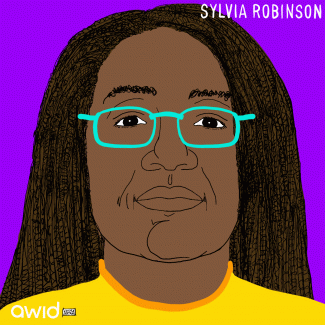
"Life is...about living in joy - waking up with purpose, feeling our creative energy, answering your calling." - Sylvia Robinson
Sylvia Robinson, a tireless community organizer and leader, was the founder and Executive Director of The Emergence Community Arts Collective (ECAC) in Washington DC.
This hub and performance space combine education, civic engagement, arts, social and spiritual services, and sustainable environmental practices. Sylvia envisioned it as a home where “there was a balance and synergy with the activities that people needed in order to sustain life.”
She was also one of the founding members of the Georgia Avenue Community Development Taskforce, a neighborhood group that works on social justice and organizing in Northwest DC to make sure the community has a voice in redevelopment and gentrification in the area.
“We're asking for affordable housing. We're asking that the small businesses that have been here for a long time don't get wiped out by new retail. We're asking for green space and space for people to get together to socialize. We're asking for streetscape improvements—better roads and lighting in the corridor.” - Sylvia Robinson about the Taskforce
Prior to becoming an organizer and after receiving a degree in computer science, Sylvia worked in air traffic control systems for over a decade. She then moved into drug and alcohol counselling, becoming increasingly engaged in community work.
“It was my call to be involved in community.” - Sylvia Robinson
Born in Washington D.C. on 14 August 1961, Sylvia passed away on 18 September 2017 after a battle with cancer.
“Sylvia's spirit and legacy will continue to inspire this community for many years to come.” - ECAC