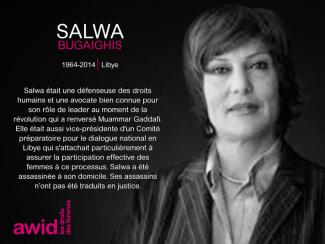
Salwa Bugaighis
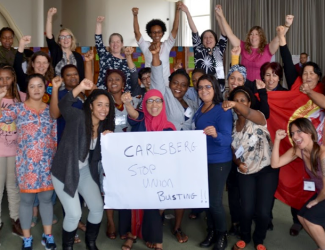
Women human rights defenders (WHRDs) worldwide defend their lands, livelihoods and communities from extractive industries and corporate power. They stand against powerful economic and political interests driving land theft, displacement of communities, loss of livelihoods, and environmental degradation.
Extractivism is an economic and political model of development that commodifies nature and prioritizes profit over human rights and the environment. Rooted in colonial history, it reinforces social and economic inequalities locally and globally. Often, Black, rural and Indigenous women are the most affected by extractivism, and are largely excluded from decision-making. Defying these patriarchal and neo-colonial forces, women rise in defense of rights, lands, people and nature.
WHRDs confronting extractive industries experience a range of risks, threats and violations, including criminalization, stigmatization, violence and intimidation. Their stories reveal a strong aspect of gendered and sexualized violence. Perpetrators include state and local authorities, corporations, police, military, paramilitary and private security forces, and at times their own communities.
AWID and the Women Human Rights Defenders International Coalition (WHRD-IC) are pleased to announce “Women Human Rights Defenders Confronting Extractivism and Corporate Power”; a cross-regional research project documenting the lived experiences of WHRDs from Asia, Africa and Latin America.
"Women Human Rights Defenders confronting extractive industries: an overview of critical risks and Human Rights obligations" is a policy report with a gender perspective. It analyses forms of violations and types of perpetrators, quotes relevant human rights obligations and includes policy recommendations to states, corporations, civil society and donors.
"Weaving resistance through action: Strategies of Women Human Rights Defenders confronting extractive industries" is a practical guide outlining creative and deliberate forms of action, successful tactics and inspiring stories of resistance.
The video “Defending people and planet: Women confronting extractive industries” puts courageous WHRDs from Africa, Asia, and Latin America in the spotlight. They share their struggles for land and life, and speak to the risks and challenges they face in their activism.
Challenging corporate power: Struggles for women’s rights, economic and gender justice is a research paper outlining the impacts of corporate power and offering insights into strategies of resistance.
AWID acknowledges with gratitude the invaluable input of every Woman Human Rights Defender who participated in this project. This project was made possible thanks to your willingness to generously and openly share your experiences and learnings. Your courage, creativity and resilience is an inspiration for us all. Thank you!
Originaire des Fidji, Veena Singh est féministe et femme de couleur. Élevée dans une petite commune rurale de ces îles, elle tire sa force de la richesse de son héritage mixte (sa mère est une femme autochtone fidjienne et son père est de descendance indo-fidjienne). L’identité et le vécu de Veena ont largement façonné son engagement envers la justice, l’équité et l’inclusion. Avec plus d’une vingtaine d’années d’expérience dans les droits humains, l’égalité des genres, l’épanouissement de la communauté et l’inclusion sociale, Veena croit passionnément qu’il faut faire bouger les lignes du pouvoir pour provoquer le changement transformateur qui permettra de construire l’économie de la bienveillance. Elle travaille dans des domaines très divers, notamment l’épanouissement de la communauté ; les femmes, la paix et la sécurité ; les politiques sociales ; les droits humains ; et le plaidoyer politique.
Elle est profondément engagée à faire avancer l’inclusion, la paix et la justice, la santé et les droits sexuels et reproductifs, la justice climatique, la justice transitionnelle et les droits humains. Elle possède une vaste expérience des réseaux de terrain, des organisations internationales et des institutions gouvernementales, et elle place toujours au centre les approches pilotées à l’échelle locale et par les communautés ainsi que les principes féministes.
En dehors de sa « vie de bureau », Veena est une défenseuse de l’environnement, de la santé mentale et c’est aussi une écrivaine. Mère de 11 chats, elle ne jure que par les saris et a un gros faible pour le courrier traditionnel et les cartes postales. Observatrice attentive des mouvements féministes aux Fidji et dans le Pacifique, Veena est en plein parcours personnel pour « décoloniser sa pensée et soi-même, en entreprenant une introspection radicale ». Par-dessus tout, elle est animée par le désir et le rêve de livrer des écrits auxquels pouvoir s’identifier, qui résonnent auprès des autres, en connectant avec la diaspora du Pacifique et en amplifiant les voix marginalisées.
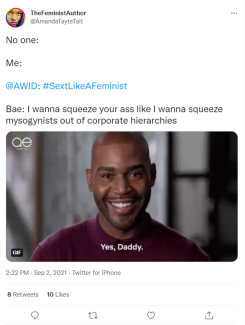
رغبتي في الانقضاض على جسدك تعادل رغبتي بالانقضاض على كراهية النساء المتجذرة في التسلسلات الهرمية للشركات
Caroline ha estado de forma periódica en AWID; en fechas anteriores, organizó los foros de 2005 y 2008 en Bangkok y Ciudad del Cabo, y cumplió otras funciones institucionales. Antes de incorporarse a AWID, impartió clases de inglés de pregrado, luego abandonó el ámbito académico para dirigir el Festival Internacional de Cine Asiático de Toronto y trabajar en otros proyectos. En fechas más recientes, se ha desempeñado como Responsable de Operaciones en Spring Strategies. Fuera del plano laboral, Caroline generalmente puede ser hallada a su jardín, en comunión con sus queridas plantas e intentando hacer las paces con los insectos y los roedores que suelen aparecer.
Moriviví es un colectivo de jóvenes artistas mujeres que trabajan en arte público desde abril de 2013. Con sede en Puerto Rico, hemos obtenido reconocimiento por la creación de murales y de arte comunitario.
Alexandra est une féministe anglo-colombienne qui dispose de plus de 20 ans d'expérience dans les programmes locaux, nationaux et internationaux en matière de VIH et de santé et droits sexuels et reproductifs. Elle possède une vaste expérience dans la mobilisation de ressources et les relations donateur·rice·s avec des fondations philanthropiques privées et des agences multilatérales pour le compte d'ONG internationales, nationales et locales, principalement situées en Amérique latine et dans les Caraïbes. Avant de rejoindre l'AWID, Alexandra a travaillé à la Fundación Si Mujer, une prestataire féministe d’accès à l’avortement et éducatrice en Colombie, à RedTraSex et à l'Alliance internationale contre le VIH/SIDA.
Alexandra est titulaire d'une licence en relations internationales et en études de développement de l'Université du Sussex et d'un master en santé publique de la London School of Hygiene and Tropical Medicine. Dans les rares moments qui ne sont pas dédiés à son travail ou sa parentalité, elle adore nager, manger et a récemment commencé à jouer à Zelda: Breath of the Wild avec son fils.
En collaboration avec l'artiste Naadira Patel, nous avons créé un album qui met en lumière une sélection de moments marquants, représentatifs des quatre décennies de soutien de AWID aux mouvements féministes.
Jemutai se passionne pour les plantes et puise son inspiration dans la nature et dans toutes les interconnexions qui la composent. Cette fascination pour l’interdépendance des éléments se reflète dans son approche du travail, de la construction communautaire, des soins et du soutien. Iel croit en la présence vibrante de ses ancêtres au fond d’iel et vit pour expérimenter, se souvenir, défendre, apprécier et célébrer leurs luttes, leurs triomphes et leurs valeurs.
En tant que féministe queer intersectionnel·le et défenseur·euse des droits humains, Jemutai a consacré sa carrière à l’équité et à l’inclusion. Passionné·e par le développement organisationnel, iel dispose d’une formation en administration et en octroi de subventions. Iel œuvre désormais à la création de rassemblements pertinents, en fournissant un soutien et un leadership opérationnels et en veillant à ce que les espaces soient inclusifs, sûrs et élaborés avec soin et précision.
Jemutai croit profondément en la philosophie de l’Ubuntu, l’idée que « je suis parce que nous sommes ». Cette croyance en notre humanité partagée et en notre interdépendance mutuelle inspire son approche, basée sur la collaboration, ainsi que son engagement à créer un environnement favorable et inclusif pour tous·tes, en particulier pour les personnes structurellement réduites au silence et marginalisées.
Please refer to the Call for Activities for this information, including the section “What you need to know”.
AWID’s work is made possible through the financial support of a wide range of donors including multilateral and bilateral agencies, private foundations and women’s funds.
Contarás con todos los materiales estándar para talleres y presentaciones: rotafolios, marcadores, notas autoadhesivas, así como proyectores y equipos audiovisuales. Cualquier material adicional será responsabilidad de lxs organizadorxs de la actividad. El equipo de logística de AWID estará disponible para responder preguntas y aconsejar.
Felogene Anumo, AWID
Dr. Vandana Shiva, India
Dr. Dilar Dirik, Kurdistan
Nana Akosua Hanson, Ghana
Varios hombres que comparten nuestro compromiso con el feminismo y los derechos humanos de las mujeres están afiliados a AWID.
كل ثلاث إلى أربع سنوات، تستضيف جمعية حقوق المرأة في التنمية حدثها الدولي الرئيسي. إنه أكبر حدث في العالم يركز بكل طاقته على الحركات النسوية والعدالة الجندرية بكل تنوعها. إنه تجمع عالمي للناشطين/ات النسويين/ات والحركات المتحالفة والباحثين/ات والممولين/ات وصانعي/ات السياسات. ويتنقل المنتدى بين مناطق وبلدان مختلفة في الجنوب العالمي.
Coumba Toure
Cindy Clark, AWID
DJ Miss Ray
DJ Luana Flores
Phoenix Inana