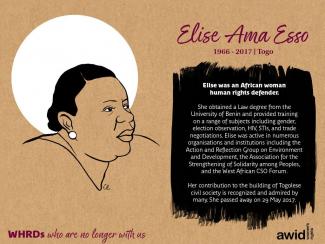
Elise Ama Esso
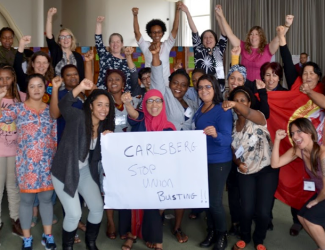
Women human rights defenders (WHRDs) worldwide defend their lands, livelihoods and communities from extractive industries and corporate power. They stand against powerful economic and political interests driving land theft, displacement of communities, loss of livelihoods, and environmental degradation.
Extractivism is an economic and political model of development that commodifies nature and prioritizes profit over human rights and the environment. Rooted in colonial history, it reinforces social and economic inequalities locally and globally. Often, Black, rural and Indigenous women are the most affected by extractivism, and are largely excluded from decision-making. Defying these patriarchal and neo-colonial forces, women rise in defense of rights, lands, people and nature.
WHRDs confronting extractive industries experience a range of risks, threats and violations, including criminalization, stigmatization, violence and intimidation. Their stories reveal a strong aspect of gendered and sexualized violence. Perpetrators include state and local authorities, corporations, police, military, paramilitary and private security forces, and at times their own communities.
AWID and the Women Human Rights Defenders International Coalition (WHRD-IC) are pleased to announce “Women Human Rights Defenders Confronting Extractivism and Corporate Power”; a cross-regional research project documenting the lived experiences of WHRDs from Asia, Africa and Latin America.
"Women Human Rights Defenders confronting extractive industries: an overview of critical risks and Human Rights obligations" is a policy report with a gender perspective. It analyses forms of violations and types of perpetrators, quotes relevant human rights obligations and includes policy recommendations to states, corporations, civil society and donors.
"Weaving resistance through action: Strategies of Women Human Rights Defenders confronting extractive industries" is a practical guide outlining creative and deliberate forms of action, successful tactics and inspiring stories of resistance.
The video “Defending people and planet: Women confronting extractive industries” puts courageous WHRDs from Africa, Asia, and Latin America in the spotlight. They share their struggles for land and life, and speak to the risks and challenges they face in their activism.
Challenging corporate power: Struggles for women’s rights, economic and gender justice is a research paper outlining the impacts of corporate power and offering insights into strategies of resistance.
AWID acknowledges with gratitude the invaluable input of every Woman Human Rights Defender who participated in this project. This project was made possible thanks to your willingness to generously and openly share your experiences and learnings. Your courage, creativity and resilience is an inspiration for us all. Thank you!
No, we are asking for just one completed survey per group.
A framework for your research will guide throughout your research process, and the framing document you develop can also serve as a concept note to advisors and partners, and a funding proposal to potential donors.
Before conducting any research:
- Set the goals of your research
- List the key questions you want your research to answer
- Write out the type of data you will need to obtain and review to answer your key questions
- Define the final products you will produce with your research
Your research framing may evolve over time as you refine your questions and gather new information. However, building an initial research framing will allow you to work from a solid foundation.
To create a strong foundation for your WITM research, it is important to clarify what you hope to accomplish.
For example, one goal of AWID’s WITM global research was to provide rigorous data to prove what we already knew anecdotally: that women’s rights organizations are discrepantly underfunded. With this data, we felt we would be better positioned to influence funders in their decision-making.
Your goals could be to:
Frame your research process with key questions that only your research can answer and limit those questions to a specific time frame (e.g. past five years, past year, etc.).
Consider the following points:
Choosing a specific timeframe for your research can result in more precise findings than working with an open-ended timeframe. Also, deciding whether you will repeat this research at regular intervals will allow you to set up data collection benchmarks for easy replication and comparison over time.
These were the key questions that guided AWID’s WITM research process:
Now that you determined your key questions, you can determine what kind of data will help you answer your key questions. This will allow you to plan the rest of your schedule for your WITM research.
For example, will you conduct a survey that covers an extensive portion of your priority population? Will you analyze the applications that funders are receiving from a certain region? Will you also conduct interviews (recommended)? By determining the types of data you need, you can reach out to external parties who will provide this data early on, and plot out your full schedule accordingly. Some suggested sources of data could be:
Diverse data sets are a great way to create robust and rich analysis.
The data from AWID’s 2011 Global Survey formed the backbone of our analysis in Watering the Leaves, Starving the Roots report. However, we also collected data from interviews and interactions with several actors in the field, ranging from donors to activists and women’s rights organizations.
In addition to allowing you to set your schedule, creating an initial plan of what products you will develop will also allow you to work out what resources you need.
For example, will you only produce a long research report or will you also create infographics, brochures and presentations? Depending on your products, you may need to hire a design firm, plan events and so on.
These products will also be the tools you use to achieve your goals, so it is important to keep those goals in mind. For example, is your WITM research exclusively intended as an advocacy tool to influence funders? In that case, your products should allow you to engage with funders at a deep level.
Some sample products:
Framing your research to cover goals, key questions, types of data, and final products will allow you to create a well-planned schedule, prepare your resources in advance, and plan a realistic budget.
This will make interactions with external partners easier and allow you to be nimble when unexpected setbacks occur.

• 1 month
• 1 or more Research person(s)
• AWID Research Framing: sample 1
• AWID Research Framing: sample 2

Salvo que existan cuestiones de accesibilidad o que respondas la encuesta en otro idioma, alentamos encarecidamente a usar KOBO a los efectos de contar con una recopilación y un análisis de datos estandarizados para la investigación ¿Dónde está el dinero?
L'Argentine a une longue histoire d’autogestion et de coopérativisme, avec des lieux de travail dirigés par et pour les travailleur·euses.
En 2001, le pays a connu l'une des pires crises économiques de son histoire.
En réponse à la récession et comme forme de résistance et de résilience, les travailleur·euses de tout le pays ont commencé à occuper leurs lieux de travail.
La Coopérative Textile Nadia Echazú a été la première coopérative créée par et pour les personnes trans et travesti en quête d'autonomie économique et de conditions de vie dignes.
Elle offre des opportunités d'emploi, l’accès à la sécurité sociale, des revenus durables et des droits économiques aux communautés qu'elle sert.
Desk research can be done throughout your research. It can assist you with framing, help you to choose survey questions and provide insights to your results.
In this section
- Giving context
- Building on existing knowledge
- Potential sources for desk research
1. Donors’ websites and annual reports
2. Online sources of information
Conducting desk research throughout your research process can assist you with framing, help you to choose survey questions and provide contextual clarity or interesting insights to your survey results, such as comparing similarities and differences between your survey results and information produced by civil society and donors.
Perhaps you notice trends in your survey data and want to understand them.
For example, your survey data may reveal that organization budgets are shrinking, but it cannot tell you why this is happening. Reviewing publications can give you context on potential reasons behind such trends.
Desk research also ensures you are building your research on the existing knowledge regarding your topic, confirming the validity and relevance of your findings.
They may be complimentary or contradictory to existing knowledge, but they must speak to existing data on the topic.
To ensure comprehensive research of the entire funding landscape related to your topic, look at a diverse set of funding sectors.
You can consider:
- Women’s Funds
- Private and Public Foundations
- International Non-Governmental Organizations (INGOs)
- Bilateral and Multilateral Agencies
- Private Sector Actors
- Individual Philanthropists
- Crowdfunders
Include any other relevant sectors to this research.
For example, you may decide that it is also important to research local non-governmental organizations (NGOs).
These are direct sources of information about what funders are actually doing and generally contain information on policies and budgets. Researching this before interviewing donors can result in more focused questions and a stronger interview.

• 1-2 months
• 1 or more research person(s)
7. Synthesize your research findings

Il y a 47 questions au total, dont 27 obligatoires* et 20 autres facultatives. La plupart sont des questions à choix multiple. Nous vous invitons à répondre à toutes les questions.
One of the founding leaders of the cooperative was Lohana Berkins, an activist, defender and promoter of transgender identity. Lohana played a crucial role in the struggle for the rights of trans and travesti people.
This brought about, among many other things, the passing of the Gender Identity Law. It is one of the most progressive legislations in the world, guaranteeing fundamental rights to trans and travesti people. Now, people can change their names and genders only with an affidavit, and have access to comprehensive healthcare without judicial or medical intervention/approval (Outright International, 2012).
Pensamos que la economía, el mercado, el sistema financiero y las premisas sobre las que se basan son todas áreas fundamentales para la lucha feminista.
Por eso, nuestra visión de una economía justa va más allá de promover los derechos y el empoderamiento de las mujeres en una economía de mercado, sino que busca evaluar el rol que juegan las opresiones de género en dar forma al modelo económico y ver como podemos transformarlo para garantizar la justicia de género y económica.
No estamos comenzando de cero ni estamos solas en nuestro intento de presentar propuestas feministas para una economía justa. Muchas de nuestras propuestas ya han sido presentadas o existen en la práctica de las diversas comunidades que confrontan y desafían a los sistemas económicos dominantes basados en el mercado y el crecimiento.
También somos concientes de las limitaciones que algunas alternativas presentan para abordar las injusticias del actual sistema capitalista a escala global. No siempre las propuestas a nivel micro son la respuesta a los problemas macro, si bien representan espacios importantes de resistencia y construcción de movimientos.
Sin embargo, las alternativas feministas para una economía justa son fundamentales para socavar el sistema y para aprender a generar cambios transformadores y sistémicos. No podemos presumir de ofrecer un relato exhaustivo ni completo acerca de cómo crear un modelo económico feminista justo, o varios modelos de esa clase. Lo que sí podemos hacer es recoger elementos de diálogos con otros movimientos (sindicales, ambientales, rurales y de campesinxs) para formular propuestas que nos permitan acercanos a esa visión.
El modelo neoliberal que dirige la economía global ha demostrado una y otra vez su incapacidad para hacer frente a las causas estructurales de la pobreza, las desigualdades y la exclusión. Lo que en realidad ha hecho el neoliberalismo ha sido contribuir a crear y exacerbar esas injusticias.
En estas últimas tres décadas, las políticas dominantes para el desarrollo se han caracterizado por la globalización, liberalización, privatizaciones, financialización y ayudas condicionadas, y han destrozado los medios de vida de la población. El recorrido de estas políticas también ha estado marcado por la profundización de desigualdades, las injusticias con marca de género y la destrucción ambiental que el mundo ya no puede continuar soportando.
Hay quienes no dudan en sostener que el crecimiento económico, que debe ser facilitado dando plena libertad a las grandes corporaciones y empresas, puede generar y sostener una una marea alta que (con el tiempo) levante todos los barcos.
Sin embargo, la noción de desarrollo que ha prevalecido durante las últimas décadas, construida sobre la premisa de un crecimiento económico ilimitado, está atravesando una crisis ideológica.
El mito del crecimiento económico como panacea para todos nuestros problemas está perdiendo cada vez más prestigio.
Prior to her retirement, she held many high profile positions including member of the Court of Appeal of Uganda and Deputy Chief Justice of Uganda. She was the first Ugandan woman to hold the position of Chief Magistrate between 1973 and 1986 and the first woman to be appointed High court judge in 1986.
She was one of the first ever women papal knights in the history of the Catholic Church in Africa. She died of a heart attack.

The data will be processed for statistical purposes to shed light on the state of resourcing for feminist movements globally and will only be displayed in an aggregate form. AWID will not publish information about a particular organization or display information that would allow an organization to be identified by its location or characteristics, without their prior consent.