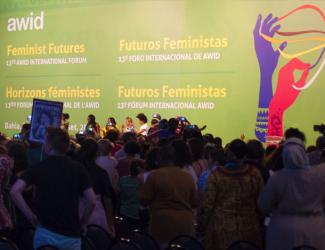
AWID Forum: Co-creating Feminist Futures

In September 2016, the 13th AWID international Forum brought together in Brazil over 1800 feminists and women’s rights advocates in a spirit of resistance and resilience.

This section highlights the gains, learnings and resources that came out of our rich conversations. We invite you to explore, share and comment!


What has happened since 2016?

One of the key takeaways from the 2016 Forum was the need to broaden and deepen our cross-movement work to address rising fascisms, fundamentalisms, corporate greed and climate change.

With this in mind, we have been working with multiple allies to grow these seeds of resistance:

And through our next strategic plan and Forum process, we are committed to keep developing ideas and deepen the learnings ignited at the 2016 Forum.

What happens now?

The world is a much different place than it was a year ago, and it will continue to change.

The next AWID Forum will take place in the Asia Pacific region (exact location and dates to be announced in 2018).

We look forward to you joining us!

About the AWID Forum

AWID Forums started in 1983, in Washington DC. Since then, the event has grown to become many things to many peoples: an iterative process of sharpening our analyses, vision and actions; a watershed moment that reinvigorates participants’ feminisms and energizes their organizing; and a political home for women human rights defenders to find sanctuary and solidarity.
Learn more about previous Forums

Related Content

Is my participation confidential?

Absolutely. Your responses will be deleted at the end of data processing and analysis, and used for research purposes only. Data will NEVER be shared outside of AWID and will be only processed by AWID staff and consultants working on the WITM project. We prioritize your privacy and security. Our detailed privacy policy is available here.

إلى مجموعتي النسوية،

إلى مجموعتي النسوية، 

تحذير: عنف ضد المرأة و البنت (لانو في فرق بيناتهم) ، اعتداء.


 لطالما كنت جزء منك. لما كنت صغيرة لم أكن أعرف أن كلمة - نسوية - مقصودة لنا نحن ، الي نطمح إلى التغلب على النظام الأبوي وتفكيكه ، الي نلتمس اللجوء في أحضان الشمول والنسوية التقاطعية ، الي يعاملو الناس على قدم المساواة بغض النظر عن جنسهم ، عرقهم،  توجهاتهم الجنسية أو دينهم ، الي يحبو يكونوا أفضل ويستخدموا صلاحياتهم لرفع مستوى الآخرين.

 كان عمري 14 سنة ،لما اعتدى مدرس اللغة الفرنسية في المدرسة الإعدادية على طالبة في صفي ، رجل يبلغ طوله ستة أقدام و عمره ثلاثين عامًا. ذهبت مع الطالبة ، التي كانت صديقة طفولتي ، والعديد من الفتيات في صفي إلى مدير المدرسة للإبلاغ عنه ، وشهد الفصل بأكمله المكون من 30 طالبًا عن الاعتداء. لكن كل محاولاتنا لمحاسبته باءت بالفشل ، وغطت الإدارة قصة الفتاة ولم يُطرد مدرس الفرنسية. أنا والفتيات في صفي شعرنا بغضب كبير، لذلك فعلنا ما  كانت ستفعله كل ناشطة نسوية في مراهقته:رمينا بيض علي سيارته! وعلى الرغم من أن البيض بيتغسل بسهولة ، إلا أن الطلاء الذي استخدمناه في كتابة "خنزير" و "خماج" بقى. لن أنسى أبدًا كيف شعرنا بهداك الوقت. متحررات ، غاضبات ، سعيدات ، متماسكات ، وجبارات.منذ ذلك الحين، نفس الشعور يتكرر في كل بيئة نسوية كان لي الشرف ان احضر فيها. نشأت الناشطة النسوية في داخلي لتنضم إلى Women Deliver ، و AWID ، و Unootha ، ولتنسق ورش نسوية في الجامعة ، بل وتتعرض للاضطهاد بسبب انتمائي النسوي في سن التاسعة عشرة ، لكن هذه قصة أخرى لرسالة أخرى.

توفر لي المساحات النسوية الأمان والتمكين. تلك المساحات هن الأمهات اللواتي تمنينهم والرابط الذي كنا بحاجة إليه للتواصل مع بعضنا وتنظيم أنفسنا على الرغم من خلافاتنا ضد عدو مشترك، الباترياركية. من خلالك تعلمت أن أجمع نقاط قوتي ومهاراتي وأوجههم نحو النهوض بالآخرين وإبراز المهمشين وإعطاء صوت لمن لا صوت لهم.

أكثر ما أحبه فيك ، هو أنك تخطئين أحيانًا ، وتتجاهلين وتهمشين أيضًا ، ولديك تحيزات كما لدى كل حركة أخرى ، لكن ما يجعلك مختلفًتن هو أنكي تسعين دائمًا إلى أن تكوني أفضل. المساءلة ليست شيئًا يرعبكي وأنت حركة دائمة التغير تعكسين كيف يتغير العالم والعمل الخيري في جهود المساواة مع مرور الوقت.
أتمنى أن تنمي دائمًا ، أن تفعلي ما هو أفضل ، وأن تغضبي دائمًا ، وأن تزأري دائمًا ، وأن تحبي دائمًا ،  أن تتحدثي بلغات مختلفة ، وأن تكوني دائمًا في السلطة.

 كل حبي ونوري وغضبي لكي ،

لينة

Snippet FEA This is the story of the Nadia Echazú (EN)

A workplace does not have to operate on competition and profit. It does not have to exploit people for the benefit of the owner and a small elite either.

Instead, communities on the margins of formal economies are building cooperative models based on autonomy, cooperation, shared responsibility, self-management and solidarity.

Worker-controlled cooperatives and workplaces have always offered alternative ways of generating employment opportunities, income, social security and savings - while distributing revenues in more communal, sustainable and safer ways.

But it is more than an employment opportunity: it is the making of dreams into a reality, and the building of feminist economies based on solidarity and care for each other. It is about creating a world where our lives, our labor and our communities matter.

This is the story of the Nadia Echazú Textile Cooperative, the first social enterprise managed by and for travesti and trans people in Argentina.

¿Cuántas respuestas a la encuesta desean recoger?

Nuestra meta es alcanzar un total de 200 respuestas, prácticamente el doble de la cifra registrada en la última encuesta ¿Dónde está el dinero? de 2011.

Lettre d’amour aux mouvements féministes #8

Mes très chers mouvements féministes adorés,

Bonjour encore, et encore, et encore. Je vous connais et je vous aime depuis le début de ma vie d’adulte, depuis que je vous ai réellement rencontrés, dès la fin de mes études universitaires. Je ne vous avais vus qu’à une seule reprise avant cela. Cette fois où vous êtes apparus en tant que Betty Friedan dans une émission de télé locale dans le Midwest, à la fin des années 1960. À l’époque, Mme Wells, mon autre mère, et moi-même avions commenté les idées folles et tirées par les cheveux de cette femme qui essayait de nous convaincre. Depuis, des décennies et des décennies après, je continue à tomber éperdument en amour avec vous, mes adorés, et je comprends et j’assiste à votre érudition théorique, votre autorité éthique et morale, votre créativité, votre joie, et votre amour, avant tout. Près de 60 ans plus tard, je sais que nous sommes ensemble pour l’éternité.

Les premières années de notre relation étaient pas mal. J’étais plutôt tournée vers moi-même – j’essayais de comprendre mon identité raciale, de genre et sexuelle; j’essayais de définir mes opinions politiques, mes valeurs essentielles et mon éthique; et de terminer mes études universitaires – et vous m’apportiez plusieurs contextes, des lieux de réflexion intellectuelle où l’on pouvait passer, et des environnements réconfortants et accueillants où, et grâce auxquels j’ai pu façonner les fondations de l’être humain et féministe que j’allais devenir.

Love letter to feminist movements from Your dramatically cloaked jungle nymph.

Le mouvement de femmes principalement blanches de Cambridge et de Boston, et notamment les Filles de Bilitis, a été mon point de départ. Ça me convenait à l’époque mais j’ai rapidement pris conscience que je désirais quelque chose de plus. Pouf! Comme par magie (heureux hasard), je suis entrée en contact avec un petit groupe de femmes lesbiennes radicales, anti-impérialistes, noires et socialistes, et nous allions rapidement devenir le Combahee River Collective.

Cette première expérience du Collectif, combinée aux dures leçons de vie et particulièrement les politiques raciales d’immigration afro-américaines/coréennes du début des années 1990 aux États-Unis, m’ont préparée à une trajectoire au bout de laquelle je me suis identifiée et je travaille en tant que féministe transnationale contre le militarisme, et par laquelle je m’efforce d’imaginer d’autres mondes dans lesquels tous les êtres humains s’épanouiront.

Les deux moments cruciaux de mouvement de femmes suivants sont venus pour moi des décennies après mes années avec le collectif, mais étaient néanmoins profondément liés. Le premier a été de rencontrer et d’être invitée au mouvement féministe coréen qui s’organisait contre les bases militaires américaines et qui soutenait les « femmes kijichon », les femmes coréennes dont les vies, y compris pour certaines avec des enfants métis, tournaient de diverses manières autour du service au personnel militaire américain dans les villages et les villes adjacentes aux bases. Des féministes coréennes adorées, et particulièrement Kim Yon-Ja et Ahn Il-Soon, les premières sœurs que j’ai rencontrées et avec qui j’ai travaillé, m’ont fait voir et comprendre l’importance essentielle de la nation en tant que principe d’analyse et d’organisation. Le point culminant a été de vivre et de travailler en Palestine occupée. La regrettée Maha Abu-Dayyeh m’a présentée au mouvement des femmes palestiniennes, avec un commentaire profond : « tu peux quitter la Palestine, mais la Palestine ne quittera jamais ». C’est tellement vrai. Et ensuite, tout mon travail et mes expériences par-delà de nombreuses frontières m’ont portée jusqu’à l’AWID - ma deuxième maison.

Comme vous le savez, mes adorés, être avec vous n’a pas été facile ni simple. En effet, vous êtes exigeants, constamment pleins de contradictions, et parfois même blessants. Néanmoins, vous continuez à vous développer et à croître, à mesure que vous soutenez mon développement et ma croissance politiques, émotionnels et spirituels. Je suppose qu’on se fait croître mutuellement - un processus très profond auquel je dédierai le reste de mon temps sous ma forme actuelle.

La constante d’avoir été avec vous toutes ces décennies est celle-ci :

Des féministes qui mobilisent collectivement les têtes, les cœurs, les mains et les esprits pour transformer nos mondes

C'est un tableau avec 7 cercles consécutifs disposés en circonférence. Chacun est séparé par une flèche qui fait du graphique une boucle. En commençant par le haut et en suivant de gauche à droite, les cercles disent : #1 réfléchir aux expériences individuelles, #2 raconter collectivement, #3 théoriser, #4 visualiser, #5 agir et réfléchir, #6 re-visualiser, # 7 éthique d'humilité, d'attention, de joie, d'amour.

Avec tout mon amour et plus, mouvements féministes!

Votre Margo
AKA DJ MOR Move and Joy

Wellfleet, Massachusetts, États-Unis

Snippet FEA 1 of 3 trans and travesti people (ES)

This is an illustration that depicts a burgundy building next to a duck blue building

1 de cada 3 personas trans y travesti en Argentina vive en un hogar de bajos ingresos.

Love letter to Feminist Movements #9

The body is a powerful entity. As women, our bodies are controlled, oppressed and policed from the womb. The way we look, move, dress, walk, speak, gesture, laugh. I often wondered at what drives patriarchal fears around the power of female bodies. Where I come from sex work and sex workers were whispered of with simultaneous contempt, disgust, fascination, pity and condemnation.

Where I come from sex work and sex workers were whispered of with simultaneous contempt, disgust, fascination, pity and condemnation.

Love letter to feminist movements from Khin Khin.

I first encountered sex work and sex workers at age 22. Simple conversations, sitting in circles, chatting over coffee and tea, we explored each other’s lives, experiences, thoughts and feelings.

For sex workers, sex work was the most worthwhile choice out of all other options to pay bills, to support family, to have more flexible working hours, to have sex. Just as I chose my job as the most worthwhile, to pay bills, to support family, to have more flexible working hours. 

These individuals, women and men, taught me that I made my own decisions about my body… where I focus its life and energy, whether I use it for pleasure or pain, whether I trade it in or give it freely, and how I want to feel about my body. The awareness was as exciting as it was empowering.

Crear | Résister | Transform: a festival for feminist movements – 2021… you accompanied me through a series of life-changing moments (!!!) 
We call these ‘events,’ though in truth, to me, your feminist learning spaces are, where I take a little of what’s inside me, a little of what your speakers say and some from the discussions to go deeper into our understanding.

Sharing… Partaking… Immersing…
in strength, in vulnerability, in pleasure.

Simply being the transformative feminist that I am, without pretentions, without misgivings… 

Welcoming the transformative feminist that I have always been, without even knowing the term or acknowledging it in such a manner or in such terms… 

Finding home for the fiercely transformative feminist living within me… 

Despite the anger, rage and frustration of not being treated as equals and being treated with ‘less __ than,’ 

I did not always consider myself a feminist nor did I recognise myself within the feminist movement or discourse… Truly, I appreciate doors being held open, chairs being pulled out to be seated, acknowledgement as a woman, of my femininity.

At times I dismissed the patriarchy with annoyance, at times, I responded with frustration and anger but I did not address it… I did not notice its sinister, insidious toxicity… I was privileged enough to be able to work through it, to survive it, to overcome it, to excel in spite of it… I did not question enough, challenge enough, push my boundaries enough… I did not do enough…
connecting with sex workers, exploring sexuality, and the women for peace and security...

Until I became fully aware and understood the implications of both privilege and oppression that was intersectional.

Until I realised what it meant to fight for gender justice and not simply ‘equality for all.’

Practitioner and facilitator no longer, I am a transformative feminist practitioner and facilitator.
Being a feminist means that I will act 

  • – through my daily activities: the way I live, the work that I do, the processes that I am invited to lead, the workshops and lectures that I am invited to give – 
  • to push back against patriarchal toxicity, to dismantle patriarchal structures and systems, 
  • to work to decolonise values, beliefs, thoughts, to smash the myths of gender norms and expectations, 
  • to address power imbalances imposed by patriarchal beliefs and socialisation, 
  • to foster relationships built on inclusion, holism, equity, care, reciprocity, accountability and justice, 
  • to stand and act in solidarity in the frontlines of the fight towards inclusion, equity and justice.

Plunging into uncertain, fragile, complex (and possibly quite violent) future…

  • I want to discover myself and be myself more intimately, authentically and deeply through the movement… 
  • I want to be more actively involved in and interconnected through this love relationship. 

I am deeply grateful for you and I promise to remain fierce in addressing and redressing problematic issues around gender, race, ethnicity, social class, sexual orientation and ability, and remain present and faithful to the struggle for inclusion, equity and justice.

Khin Khin

Snippet FEA What Challenges Story 3 (FR)

À quels défis les personnes Trans et Travesti sont-elles confrontées en Argentine ?

Snippet - WITM To build - AR

لبناء وقائع نسوية ترتكز على الأدلة عن كيف يتحرك المال ولمن يصل

El mundo en mi casa: La historia de Tidinha

Imagen de Portada: El mundo en mi casa: La historia de Tidinha

¿Cómo reaccionas cuando parece que el mundo desciende sobre ti? Tidinha se encontró en una situación en la que logró ser escuchada al cuestionar la elección de la sede, y al mismo tiempo descubrió visiones y sueños compartidos y se dio cuenta de que no está sola.

Descarga esta historia


En su propia voz: mira la entrevista con Sara Abu Ghazal


Conoce todas las historias Descarga el reporte completo

Snippet FEA Brisa Escobar Quote (EN)

"My dreams and objectives have always been the same as those of Lohana Berkins: for the cooperative to continue standing and not to close. To continue to give this place to our travesti comrades, to give them work and a place of support"

Brisa Escobar,
president of the Cooperative

Snippet - WITM Why now_col 1 - AR

لماذا الآن؟

A monochromatic orange illustration of a woman with curly hair with her hand on her chin. She seems to inquisitive or posing a question.

تتواجد الحركات النسوية، حركات حقوق النساء، حركات العدالة الجندرية، حركات مجتمع الميم - عين وحلفاءها/ يفاتها في مفترق شديد الأهمية وتواجه هجمات عصيبة على حقوق وحريات حصلت عليها. فتصاعد الاستبداد في الأعوام الأخيرة، وكذلك القمع العنيف للمجتمع المدني وتجريم النساء والأشخاص المتنوعين/ات جندرياً المدافعين عن حقوق الإنسان، تصاعد الحروب والأزمات في الكثير من أنحاء العالم، استمرار الظلم الاقتصادي والتقاطع بين الصحة، البيئة والأزمة المناخية.