Parvin Paidar
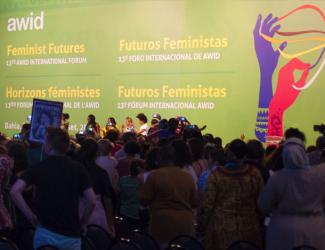
In September 2016, the 13th AWID international Forum brought together in Brazil over 1800 feminists and women’s rights advocates in a spirit of resistance and resilience.
This section highlights the gains, learnings and resources that came out of our rich conversations. We invite you to explore, share and comment!
One of the key takeaways from the 2016 Forum was the need to broaden and deepen our cross-movement work to address rising fascisms, fundamentalisms, corporate greed and climate change.
With this in mind, we have been working with multiple allies to grow these seeds of resistance:
And through our next strategic plan and Forum process, we are committed to keep developing ideas and deepen the learnings ignited at the 2016 Forum.
AWID Forums started in 1983, in Washington DC. Since then, the event has grown to become many things to many peoples: an iterative process of sharpening our analyses, vision and actions; a watershed moment that reinvigorates participants’ feminisms and energizes their organizing; and a political home for women human rights defenders to find sanctuary and solidarity.
Le cinquième Dialogue de haut niveau sur le financement du développement, organisé les 7 et 8 décembre 2011, a marqué le début des discussions relatives au programme de développement de l’après-2015 et aux liens entre ce programme et le financement du développement. La conférence a accordé une attention particulière à la question de l’accroissement de l’aide au financement des OMD. Dans ses observations finales, le Secrétaire général a appelé les membres à commencer à réfléchir sur le cadre de développement de l’après-2015.
As the WITM survey is focused on resourcing realities for feminist organizations, most questions ask about your group’s funding between 2021–2023. You will need to have this information with you to fill out the survey (e.g., your annual budgets and key sources of funding).
One of the founding leaders of the cooperative was Lohana Berkins, an activist, defender and promoter of transgender identity. Lohana played a crucial role in the struggle for the rights of trans and travesti people.
This brought about, among many other things, the passing of the Gender Identity Law. It is one of the most progressive legislations in the world, guaranteeing fundamental rights to trans and travesti people. Now, people can change their names and genders only with an affidavit, and have access to comprehensive healthcare without judicial or medical intervention/approval (Outright International, 2012).
Additional consultation sessions on the Draft Outcome Document
Sí, es absolutamente confidencial. Tus respuestas se borrarán al término del procesamiento y el análisis de los datos, y se utilizarán únicamente a los fines de la investigación. Los datos NUNCA se compartirán fuera de AWID y solo los procesarán el personal y consultorxs de AWID abocadxs al proyecto ¿Dónde está el dinero?
Damos prioridad a tu privacidad y anonimato. Los detalles de nuestra política de privacidad se encuentran disponibles aquí.
LA EXCLUSIÓN, ESTIGMA Y ABUSO INSTITUCIONAL
que las personas trans y travesti siguen enfrentando diariamente
Súmate al Women’s Working Group on Financing for Development [Grupo de Trabajo de Mujeres sobre Financiación para el Desarrollo, WWG on FfD en inglés] y entérate de cuáles son sus aportes al proceso de la FpD (también puedes enviar un mensaje electrónico a: wwgonffd@gmail.com).
Únete al Grupo de las OSC en la Conferencia Internacional sobre la FpD (en inglés) o envía un mensaje electrónico a addiscoordinatinggroup@gmail.com pidiendo sumarte: https://groups.google.com/forum/#!forum/global-social-economy).
Otros enlaces importantes para mantenerse informada/o:
Notre objectif est de recueillir 2 000 réponses à l’enquête, soit près du double de la dernière enquête WITM de 2011.
Écoutez l'histoire ici :
Related content
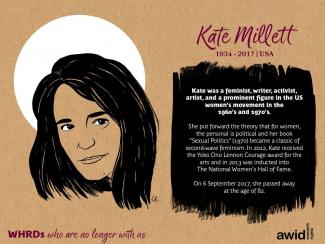
The Guardian: Kate Millett Obituary
New York Times: Kate Millett, Ground-Breaking Feminist Writer, Is Dead at 82
The New Yorker: A Last Interview with Kate Millett
對於與“論壇活動徵集”有關的任何問題,請與我們聯繫,請使用“論壇活動徵集”作為您電子郵件的主題。

Основываясь на 20-летней истории привлечения более объемного и качественного финансирования для достижения социальных изменений под руководством феминисток(-ов), AWID приглашает вас принять участие в новом опросе:
(далее – «Где деньги?»)
Пожалуйста выберите язык, на котором вы хотите отвечать на вопросы в правом верхнем углу страницыGeorgia's minimum wage is in the bottom percent of all countries in the world. This reality affects mostly women.
The country not only has a significant gender pay gap, but women also work longer, more unregulated hours before going home to take care of housework and their families. There is no maternity pay, no wage increase for overtime work, no unemployment insurance, and no pay for sick leave or other social protection. Pressured by Western organizations, Georgian oligarchic political parties have been implementing reforms that are destroying the welfare state, increasing austerity measures, and worsening worker exploitation - all for the benefits of big corporations which are applauding the country for its “ease of doing business”. Mass media, coerced by private and corporate interests, either remain silent or biased on these issues. Union organizing remains one of the very few options to fight for basic human rights, and for holding the State and corporations accountable in the face of daily, pervasive violations and persecutions, especially against women.
Sources: Minimum-Wage and Interview with Sopo Japaridze to OpenDemocracy
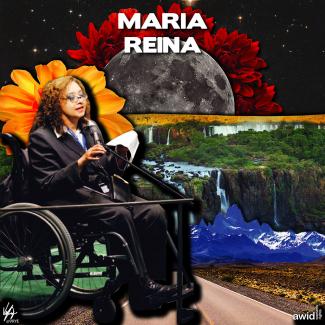
Representó al Consorcio Internacional sobre Discapacidad y Desarrollo (IDDC por su sigla en inglés) durante la negociación de la Convención sobre los Derechos de las Personas con Discapacidad (2001-2006). Su trabajo estaba dedicado a la implementación del objetivo de la Convención: el goce pleno de los derechos humanos universales por, para y con las personas con discapacidades, en pos de un mundo inclusivo, accesible y sostenible.
En sus propias palabras, su liderazgo consistía en «servir a la comunidad de personas con discapacidad, comenzando por aquellas pequeñas tareas que otrxs pueden no querer realizar».
Falleció el 27 de octubre de 2017 en su ciudad natal de Rosario, Argentina.
En esta nota puede leerse más sobre María Verónica Reina, en sus propias palabras.