AWID Forum: Co-creating Feminist Futures
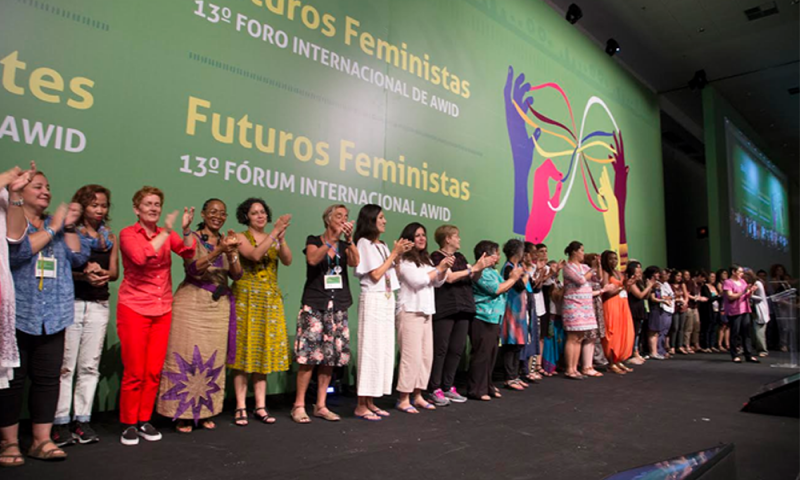
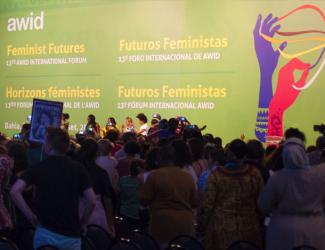
In September 2016, the 13th AWID international Forum brought together in Brazil over 1800 feminists and women’s rights advocates in a spirit of resistance and resilience.
This section highlights the gains, learnings and resources that came out of our rich conversations. We invite you to explore, share and comment!
What has happened since 2016?
One of the key takeaways from the 2016 Forum was the need to broaden and deepen our cross-movement work to address rising fascisms, fundamentalisms, corporate greed and climate change.
With this in mind, we have been working with multiple allies to grow these seeds of resistance:
- Our Seed Initiatives, has helped 20 ideas that emerged at the Forum to grow into concrete actions
- The video “Defending people and planet” and guide “Weaving resistance through action” put courageous WHRDs in the spotlight and present concrete strategies they use to confront corporate power.
- With our animations about the State of Our Feminist Movements and Climate and Environmental Justice, movements now have creative tools to support their advocacy work.
- The compiling artistic expressions of our #MovementsMatter series continues to inspire stronger and more creative organizing around the world.
- Movements can also benefit from new methodologies on Visioning Feminist Futures (Coming up soon!)
And through our next strategic plan and Forum process, we are committed to keep developing ideas and deepen the learnings ignited at the 2016 Forum.
What happens now?
The next AWID Forum will take place in the Asia Pacific region (exact location and dates to be announced in 2018).
We look forward to you joining us!
About the AWID Forum
AWID Forums started in 1983, in Washington DC. Since then, the event has grown to become many things to many peoples: an iterative process of sharpening our analyses, vision and actions; a watershed moment that reinvigorates participants’ feminisms and energizes their organizing; and a political home for women human rights defenders to find sanctuary and solidarity.
Related Content
Lettre d’amour aux mouvements féministes #7
Ma très chère communauté féministe,
Je suis ravie de te faire part d’un de mes rendez-vous les plus remarquables en tant que féministe en situation de handicap. C’était le 30 mai 2014. L’Organisation nationale des puissantes dames porteuses d’un handicap visuel (NOVEL) participait aux festivités de la Fashion Week 2014 des Philippines, au profit de notre campagne de plaidoyer pour les cannes blanches. Deux dames aveugles défilaient sur le podium pour promouvoir la canne blanche comme symbole de l’égalité des genres, de l’autonomisation, de l’inclusion totale et de la participation égale des femmes et des filles porteuses de handicap visuel au sein de la société.
J’étais extrêmement nerveuse au moment de leur passage devant la foule, en tant que porte-parole de notre projet auprès des productions Runway (j’avais douloureusement attendu cette approbation pendant une année entière), sachant qu’elles n’étaient pas des mannequins, elles avaient été nommées Madame Philippines Vision et la première dauphine 2013 de Madame Philippines sur Roues, Signe et Vision par Tahanang Walang Hagdanan, Inc. (« Maison sans marches »). Elles n’avaient pas pu participer à leur séance d’orientation et s’étaient entraînées la veille au soir sans pouvoir le faire avec des mannequins professionnelles. Avant que ne commence le spectacle, je les avais appelées pour booster leur confiance et prier ensemble que Dieu les guide. Lorsqu’elles ont quitté le podium, j’ai pris une grande respiration alors que les larmes coulaient sur mes joues. Je me sentais euphorique parce que nous y étions parvenues malgré toutes les difficultés! Notre message au monde disant que les femmes et les filles en situation de handicap visuel pouvaient marcher en toute dignité, liberté et indépendance sur la même base d’égalité que les autres, grâce à notre appareil d’aide – les cannes blanches – qui était passé! On a parlé de nous sur les réseaux sociaux ainsi que sur les chaînes de télévision.

Ma vie de féministe en situation de handicap a débutcé comme un moyen de réparer mon manque de confiance et de trouver une autre trajectoire de réussite pour ma vie après avoir survécu à une vicieuse attaque à l’acide en 2007, alors que j’attendais le véhicule qui devait me ramener chez moi depuis le bureau. Mes yeux ont été fortement touchés, au point où je suis devenue une femme malvoyante.
Ce progrès n’est pas sans coût, tout comme il n’est pas parfait. Les activistes féministes, les groupes et les activistes se retrouvent face aux difficultés typiques rencontrées dans les contextes conservateurs et affectés par des conflits. Mais l’impact du mouvement des jeunes féministes au Soudan mérite d’être encensé. Dépasser les obstacles internes des différences de culture, de religion et des conflits historiques est un défi en soi, que les jeunes féministes au Soudan semblent relever activement. La création d’écoles féministes au Darfour et dans le Kordofan révèle la trajectoire unique du travail des jeunes féministes au Soudan, dont nous pouvons tirer des enseignements.
Je n’avais jamais pensé que ma vie pourrait être aussi joyeuse et pleine de sens avant de rencontrer les femmes leaders du mouvement pour le genre et le handicap, qui n’ont cessé depuis d’exercer une influence positive sur moi. Leurs mots d’encouragement m’ont plu et sont devenus la musique la plus douce à mes oreilles. Mon cœur brisé bondit comme un oiseau qui prend son envol à chaque fois que je pense à elles et au féminisme qui m’a encouragée à contribuer pour que les choses changent pour nos sœurs en situation de handicap qui sont invisibles et pour celles qui continuent à être discriminées. Jusqu’à ce jour, je suis consumée par le désir d’être avec le mouvement. Je ne peux cacher mon excitation chaque fois que je soumets des propositions de projets à différentes parties prenantes pour l’autonomisation, le développement et la promotion de nos sœurs en situation de handicap. Ou à chaque fois que j’interviens dans des conversations locales, nationales et internationales pour faire entendre nos voix, même lorsque cela est à mes dépens.
De manière inattendue, j’ai été choisie pour représenter notre pays à l’assemblée générale de l’Union mondiale des aveugles (UMA) en 2012 en Thaïlande, bien que je venais d’arriver dans le mouvement en faveur du handicap. Cette même année, j’ai été la seule femme élue au comité de l’Union philippine des aveugles (UPA). J’ai eu envie de me rapprocher de nos sœurs ayant un handicap visuel et de les informer sur leurs droits et afin qu’elles connaissent les questions transversales. En 2013, nous avons officiellement lancé NOVEL pour soutenir l’autonomisation de nos sœurs en situation de handicap, constituer des coalitions de mouvements de plurihandicap et de mouvements de femmes et promouvoir le développement inclusif du genre du handicap.
Ma participation en tant que copersonne pour les ressources des femmes en situation de handicap dans notre soumission au rapport alternatif à la CEDAW en 2016 avec les groupes de femmes marginalisées, coordonné par Women’s Legal and Human Rights Bureau (WLB), m’a ouvert de nombreuses portes et également permis de travailler avec différentes organisations de femmes et de participer aux Journées internationales de l’inclusion de Berlin en 2017, aux côtés de trois leaders philippines en situation de handicap; journées au cours desquelles nous avons fait part de nos bonnes pratiques, et principalement de notre engagement auprès de mouvements des femmes d’autres pays.
Ma trajectoire en tant que féministe en situation de handicap a été une véritable montagne russe émotionnelle pour moi. J’en ai retiré beaucoup de joie et un sentiment de valeur lors du travail pour la promotion de nos sœurs en situation de handicap pour une participation totalement inclusive, égale et efficace dans la société, mais je me suis également sentie frustrée et en colère lorsque j’ai tout donné et que j’ai essuyé des remarques négatives. Malgré tout, c’est ce que je ressens parce que je suis amoureuse du mouvement.
Je vois mon avenir dans le travail en solidarité avec le mouvement afin de veiller à ce que nos sœurs, en situation de handicap ou non, puissent profiter de, et participer également et entièrement dans la société.
Plein d’amour,
Gina Rose P. Balanlay
Féministe en situation de handicap
Philippines
¿Qué hay de la justicia climática? ¿Es realmente el momento adecuado para tantos vuelos internacionales?
Nos hemos hecho la misma pregunta y creemos que no hay respuestas simples. Para muchas personas, el Foro de AWID puede ser uno de los pocos viajes internacionales que realicen en su vida. La pandemia nos enseñó las posibilidades pero también las limitaciones de los espacios virtuales para la construcción de movimientos: no hay nada como la conexión en persona. Los movimientos necesitan conexiones transfronterizas para construir nuestro poder colectivo frente a las amenazas que enfrentamos, especialmente la crisis climática. Creemos que el próximo Foro de AWID puede ser un espacio estratégico para abordar estas cuestiones y explorar alternativas al viaje internacional. El formato híbrido del Foro es una parte importante de esta exploración.
Ghiwa Sayegh Snippet

Ghiwa Sayegh est une écrivaine anarcho-queer, éditrice indépendante et archiviste. Elle est la rédactrice fondatrice de Kohl : la Revue de Recherche sur les Corps et le Genre et la cofondatrice d’Intersectional Knowledge Publishers. Elle a une maîtrise en études de genre de l’Université Paris 8 Vincennes – Saint-Denis. Elle est passionnée par la théorie queer, les circulations transnationales et les histoires imaginaires ou inconnues. Ses influences sont Audre Lorde et Sara Ahmed.
Barbara Allimadi
Barbara Allimadi fue una activista política y defensora de los derechos humanos de Uganda. En 2012, co-organizó una protesta contra la agresión policial a Ingrid Turinawe, una figura política de la oposición, que fue televisada y muestra cómo un policía le aprieta el pecho. Durante la protesta, Barbara, junto con otras compañeras activistas, se quitaron la ropa hasta quedarse en sujetador frente a la Estación Central de Policía de Kampala. Este hecho pasó a conocerse en Uganda como la infame "protesta de los sujetadores".
"Nos decidimos por la protesta de los sujetadores. Pensamos que sería lo más apropiado para lo que había sucedido. Con esta acción, no es que estuviésemos diciendo que no nos respetásemos a nosotras mismas. Estábamos indignadas con lo que había sucedido." - Barbara Allimadi, 2013 (Daily Monitor, en inglés)
Barbara se licenció en Ingeniería Electrónica y de Comunicaciones en la Universidad Metropolitana de Londres, y ejerció como ingeniera de redes en el Reino Unido. Era,además, una fan entusiasta de la música reggae. Regresó a Uganda en 2007, cuando su madre falleció.
En 2019, fue nombrada Coordinadora de Asuntos Internacionales y de la Diáspora de la Alianza para la Transformación Nacional (ANT, por sus siglas en inglés), un partido político lanzado ese año por un líder de la oposición.
"Queremos garantizar la seguridad de la vida y la propiedad, no el dolor, las lesiones o incluso la muerte a manos de unas fuerzas de seguridad que se supone deberían protegernos. Y lo más importante, queremos un entorno estable y propicio donde podamos realizar nuestros sueños y aspiraciones". - Barbara Allimadi, video de ANT (en inglés)
Barbara falleció el 27 de abril de 2020.
Tributos:
"Estaba muy orgullosa de mi hermana por muchas razones, pero, en particular, por su intrépida búsqueda de la paz, la democracia, la justicia y la igualdad en Uganda. En los momentos más álgidos de su activismo, Barbara lideró muchas marchas por las calles de Kampala, hacia las comisarías de policía y el Parlamento". - Doris Allimadi, hermana de Barbara
"Nos enteramos con profunda tristeza del prematuro fallecimiento de Barbara Allimadi. Ella ha sido una fuerza valiente, implacable y valerosa para el movimiento de liberación de Uganda. Queremos dar nuestro más sentido pésame a su familia. La echaremos mucho de menos". - Akina Mama wa Afrika (tweet, 28 April 2020)
"El fallecimiento de Barbara es una noticia muy triste para nosotrxs y para toda su familia. Barbara dedicó su vida a luchar por la justicia, la libertad y los derechos de las personas desde la sociedad civil, hasta que se unió, recientemente, al partido." Maj Gen Mugisha Muntu, coordinador nacional de la ANT (por sus siglas en inglés)
"Una hermana hermosa, encantadora, divertida, carismática e inspiradora. Mis hijxs han perdido a su tía. Uganda ha perdido a una audaz y valiente defensora de la libertad. Barbara dijo una vez: "Mientras siga habiendo aliento en ti, sigue trabajando por conseguir tus sueños". - Doris Allimadi, hermana de Barbara.
The 2023 Feminist Calendar

AWID is a part of an incredible ecosystem of feminist movements working to achieve gender justice and social justice worldwide. With our 40th anniversary, we are celebrating all that we’ve built over these last 40 years. As a global feminist movement support organization we know that working with fierce feminisms is our way forward, acknowledging both the multiplicity of feminisms and the value of fierce and unapologetic drive for justice. The state of the world and of feminist movements calls for brave conversations and action. We look forward to working together with our members, partners and funders in creating the worlds we believe in, celebrating the wins and speaking truth to power in service of feminist movements globally.
The 2023 Feminist Calendar is our gift to movements. It features the artwork of some of our amazing AWID members.

Use it. Print it. Share it.
Get it in your preferred language! |
Select image quality |
| English | Print Quality | Digital Version |
| Français | Print Quality | Digital Version |
| Español | Print Quality | Digital Version |
| Português | Print Quality | Digital Version |
| عربي | Print Quality | Digital Version |
| Русский | Print Quality | Digital Version |
Diana Sacayan
Snippet - COP30 - Social Media
Follow Updates on Social Media
CFA 2023 - breadcrumbs Menu _ awid-forum-es
Snippet Kohl - Plenary | Organizing to Win

with Nazik Abylgaziva, Amaranta Gomez Regalado, Cindy Weisner, and Lucineia Freitas.
Cookies
We’re committed to protecting your privacy, so here we explain how we use cookies on our website.
If you have any questions, please get in touch via the form on our contact page.
What are cookies?
A cookie is a small data file downloaded by your web browser (for example Chrome or Internet Explorer) and stored on your computer. They are downloaded automatically when you visit websites. Cookies are used to perform essential tasks on a website, to record how people use a website and to gather data for marketing.
How we use cookies
We provide essential information on our website to millions of people every year. To do this, we have to manage our website effectively and to reach out to more people who need our support and information. Cookies are a small, but essential way to make all this happen. We use cookies to:
- To measure how people use our website. This helps us understand how well different sections of our website are performing. It also helps us track numbers of visitors and helps us ensure our website is robust and works well for every single one of the millions of people who use it.
- To record actions so that the website will work well for you. For example, our online shop uses cookies to record items that you place in your shopping basket. We also use cookies in our online donations process and in other tools such as our online breath test.
- We also record actions so we can reach people more effectively. This works by using a cookie to remember what pages you have visited so we can tailor our marketing messages based on your interests.
Change your cookie settings
You can update your cookie preferences by clicking on the button below.
In addition, most browsers allow you to manage cookies saved on your device – just go to the help section of your browser. To learn more about cookies and how to manage them, visit the ICO website.
Your rights
Cookies never record your credit card details or easily identifiable personal data such as your name and address. You have every right to refuse to accept cookies from our website.
If you disable cookies you will still be able to access nearly all the information on our website. But please remember that this may affect some functionality.
How to disable cookies
You can disable cookies by changing your settings in your web browser or you can use the incognito option on Google Chrome. To find out more about your browser settings, visit the relevant support page below:
- Google Chrome – how to disable cookies
- Internet Explorer – delete and manage cookies
- Firefox – how to enable or disable cookies
- Safari – how to disable cookies
Cookies used by this site
Berta Cáceres Flores
Snippet - COP30 - Ecozine card - EN
📰 Feminist Transnational Solidarity: an Antidote to Ecocide
This collaborative zine originated from a series of sharing circles that brought together feminists from around the world throughout 2022. The purpose was to exchange ideas and mutually learn how communities are responding to the climate crisis in various local contexts.
CFA 2023 - Who, where, when - EN
Where: Bangkok, Thailand; and online
Who: Approximately 2,500 feminists from all over the world participating in- person, and 3,000 participating virtually
Sexting Like a Feminist: Humor in the Digital Feminist Revolution | Title Snippet
Sexting Like a Feminist: Humor in the Digital Feminist Revolution
by Chinelo Onwualu
Privacy and cookies - before 25 Apr 2023
AWID Privacy Policy, Your rights to privacy and cookies
This policy governs all pages hosted at www.awid.org, and any other websites under the control of the AWID (the “Website”) and registrations for these sites. It does not apply to pages hosted by organisations other than AWID, to which we may link and whose privacy policies may differ. Please read the following policy to understand our privacy policy regarding nature, purpose, using and sharing of your personal identifiable information that is collected via this website.
1. Types of information collected on this site
Generally, you can browse this website without submitting your personal information to us. However, in some circumstances, we will ask for your personal information.
1.1 Information you provide to us
When you are on the website and are asked for personal information, you are sharing that information only with AWID.
1.1.1 The information you provide to get updates from AWID:
When you register to use the website – for example, subscribe to receive emails from us or apply to become a member - you provide us with the mandatory information about you like Name, country, language to receive email updates and email address. This information is provided by you through secure forms and is stored on secure servers.
1.1.2 The payment information you provide to become member or registering for a paid event:
Also, while becoming a member or registering for events, you may need to provide payment information. AWID doesn’t store any credit card information on its servers and uses payment gateway to process the payment information.
1.1.3 The optional information you chose to give us as AWID member (with consent)
When you communicate with AWID, provide optional information through forms on the website or use the site to communicate with other members, we collect information about your communication and any information you choose to provide.
1.1.4 Information you provide us through contact forms or when you directly communicate with us
When you communicate with us, we collect your communication and any other information you choose to provide us.
1.2 Information that is automatically collected (third party cookies)
In addition, when you interact with the Website, our servers may keep an activity log that does not identify you individually (“Non-Personal Information”). Generally, we collect the following categories of Non-Personal Information:
- We may collect certain demographic data such as age and gender as part of collecting personal information;
- We collect and store certain device information about your computer, mobile device, or other device that you use to access the Website. This information may include IP address, geolocation information, unique device identifiers, browser type, browser language, and other transactional information;
- We automatically log certain usage information about your use of the Website. This information includes a reading history of the pages you view. We use this information to provide you with a more customized experience on the Website;
- We collect and store additional “traffic data” such as time of access, date of access, software crash reports, session identification number, access times, and referring website addresses; and
- We collect and store your search terms and search results.
- We also collect and store certain other information regarding our users’ use of the Website so that third parties may provide us with reports and analysis regarding usage and browsing patterns of the Website.
For more information about cookies, please see www.allaboutcookies.org.
If you do not wish to receive cookies you can easily modify your web browser to refuse cookies, or to notify you when you receive a new cookie, see how here.
2. Use of information collected on this website
AWID uses the information we collect about you to:
- Better understand how you are using our website and what we could do to improve your experience.
- Communicate with you via email to share resources and analysis in the field of women's rights, connect with you and provide opportunities to engage with our work, keep you updated about developments at AWID and with our partners.
- Comply with our legal obligations to:
- Detect and prevent fraud, spam, abuse, security incidents, and other harmful activity.
- Conduct security investigations and risk assessments.
- Verify or authenticate information provided by you (such as to verify your authorization to act as an agent on behalf of a nonprofit organization).
- Conduct checks against databases and other information sources, to the extent permitted by applicable laws.
- Resolve any disputes with any of our users or customers and enforce our agreements with third parties.
- Enforce our Terms of Use and other policies.
3. Distribution of information
If you have subscribed to AWID´s e-newsletters or email updates or you have become a member, we will send you regular communications as specified in the relevant area of the website. You are able to unsubscribe from any of the e-newsletters or email updates at any time by using the unsubscribe information provided in our emails.
4. Accessing, changing and removing information
The accuracy of your individual identifying information is important to AWID. We are always looking for ways to make it easier for you to review and correct the information that AWID maintains about you through our website. If you change your email address, or if any of the other information we hold is inaccurate or out of date, please write to us here.
- Where you have provided AWID with consent to use your personal data, you can withdraw it any time by sending us a communication and specifying which consent you are withdrawing. Please note that the withdrawal of your consent does not affect the lawfulness of any processing activities based on such consent before its withdrawal.
- Where applicable, you may also have a right to receive a machine-readable copy of your personal data. If you would like to have a copy of the personal data we hold on you or if you think that we hold incorrect personal data about you, please write to us.
- You also have the right to ask us to delete your personal data or restrict how it is used. There may be exceptions to the right to erasure for specific legal reasons which, if applicable, we will set out for you in response to your request.
- At any time, regardless of applicable law, you may object to us processing your personal information for direct marketing purposes. You may, at any time, ask AWID to cease processing your data for these direct marketing purposes by Contacting Us.
5. Sharing information
Except as explained below, AWID will not disclose any of your personally identifiable information, and will not sell or rent lists containing your information to third parties. AWID may disclose information when it has your permission to do so or under special circumstances, such as when it believes in good faith that the law requires it.
6. Information security
We are continuously implementing and updating administrative, technical, and physical security measures to help protect your information against unauthorized access, loss, destruction, or alteration. Some of the safeguards we use to protect your information are firewalls and data encryption, and information access controls. If you know or have reason to believe that your AWID membership credentials have been lost, stolen, misappropriated, or otherwise compromised or in case of any actual or suspected unauthorized use of your AWID membership account, please contact us through on Contact Us.
7. Changes to this policy & Contacting us
This policy may change from time to time. The changed policy will be posted on this website and Last updated date at the end of the policy will be updated. There will be an email update sent to you for the revised policy and if you do not agree with the revised policy, you will have the option to cancel you registration(s) with us. You can also write to us here. We welcome your feedback!
Last updated: May 2019