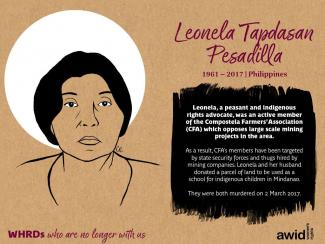
Leonela Tapdasan Pesadilla
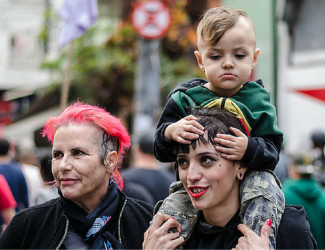
Over the past few years, a troubling new trend at the international human rights level is being observed, where discourses on ‘protecting the family’ are being employed to defend violations committed against family members, to bolster and justify impunity, and to restrict equal rights within and to family life.
The campaign to "Protect the Family" is driven by ultra-conservative efforts to impose "traditional" and patriarchal interpretations of the family, and to move rights out of the hands of family members and into the institution of ‘the family’.
Since 2014, a group of states have been operating as a bloc in human rights spaces under the name “Group of Friends of the Family”, and resolutions on “Protection of the Family” have been successfully passed every year since 2014.
This agenda has spread beyond the Human Rights Council. We have seen regressive language on “the family” being introduced at the Commission on the Status of Women, and attempts made to introduce it in negotiations on the Sustainable Development Goals.
AWID works with partners and allies to jointly resist “Protection of the Family” and other regressive agendas, and to uphold the universality of human rights.
In response to the increased influence of regressive actors in human rights spaces, AWID joined allies to form the Observatory on the Universality of Rights (OURs). OURs is a collaborative project that monitors, analyzes, and shares information on anti-rights initiatives like “Protection of the Family”.
Rights at Risk, the first OURs report, charts a map of the actors making up the global anti-rights lobby, identifies their key discourses and strategies, and the effect they are having on our human rights.
The report outlines “Protection of the Family” as an agenda that has fostered collaboration across a broad range of regressive actors at the UN. It describes it as: “a strategic framework that houses “multiple patriarchal and anti-rights positions, where the framework, in turn, aims to justify and institutionalize these positions.”
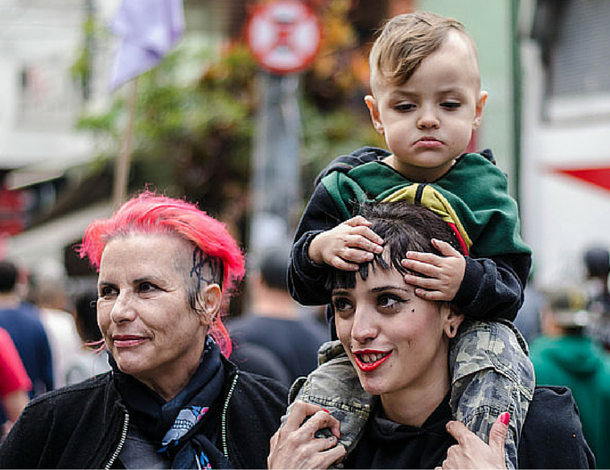
La encuesta está orientada a agrupaciones, organizaciones y movimientos que trabajan específica o primordialmente por los derechos de las mujeres, las personas LBTQI+ y la justicia de género, en todos los contextos, en todos los ámbitos y en todas las regiones. Si alguno de estos es el pilar fundamental de tu agrupación, colectivo, red o cualquier otro tipo de organización —ya sea que esté registrada, sea de reciente creación o de larga data—, te invitamos a responder la encuesta.

*En esta oportunidad, no estamos solicitando respuestas de individuos ni de fondos feministas o de mujeres.
Obtén más información sobre la encuesta:
Consultar las preguntas frecuentes
Dans le cadre de notre engagement en faveur de l’accessibilité dans tous les aspects du Forum de l’AWID, nous acceptons les formats audio/vidéo pour tous les individus/organisations/groupes qui ne peuvent soumettre de candidature écrite. Si vous décidez d’envoyer votre proposition sous format audio/vidéo, nous vous prions de bien vouloir répondre aux questions dans le même ordre, telles que détaillées dans le Formulaire de proposition d’activité.
Pour soumettre un fichier audio/vidéo, merci de nous contacter via notre formulaire de contact en choisissant « Proposition d'activité » comme sujet de votre message.
To claim your power as an expert on the state of resourcing for feminist movements
Les frais d’inscription au Forum de l’AWID pour tou-te-s les participant-e-s couvrent :
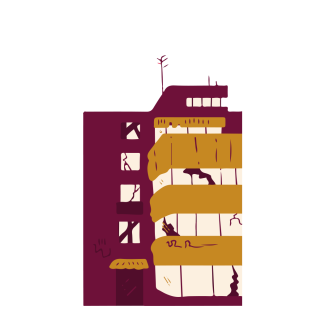
Source: Centro de população de rua da cidade de São Paulo
 |
Abandoned / Unoccupied Buildings |
 |
||
Population living in the streets |
||||
|
31,000 |
40.000 |
 While funders committed significantly more money to gender equality over the last decade, still only 1% of philanthropic and development funding has actually been moved to directly resource feminist-led social change.
In solidarity with movements that continue to be invisibilized, marginalized and without access to core, long-term, flexible and trust-based funding, the WITM survey highlights the actual state of resourcing, challenges false solutions, and points to how funding models must change for movements to thrive and meet the complex challenges of our times.
Plus qu’un simple évènement, le Forum de l’AWID s’inscrit dans notre voyage d’exploration des réalités féministes, qui offre de nombreux espaces où se réunir, en ligne et hors ligne, afin d’échanger, discuter, élaborer des stratégies et co-créer des réalités féministes.
Apprenez-en plus sur l’aventure des réalités féministes et sur tout ce qui se passera en amont du Forum. Et restez à l'écoute pour ne pas manquer les annonces post-Forum !
Nous explorons actuellement les possibilités de participer virtuellement au Forum et veillerons à vous partager l'information lorsque nous saurons ce que nous sommes en mesure de vous proposer.
 |
 |
 |
 |
 |
 |
 |
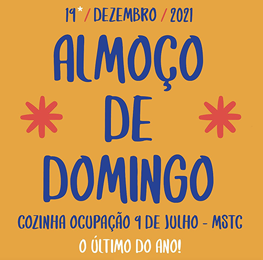 |
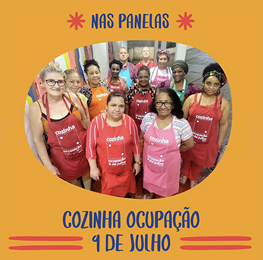
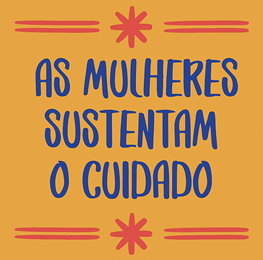
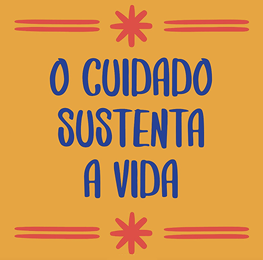
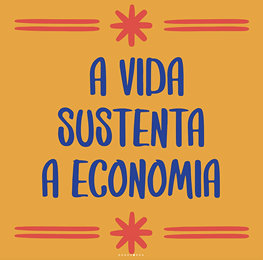
Las Mujeres Sostienen el Cuidado | El Cuidado Sostiene la Vida | La vida Sostiene la Economía | ¿Quién Cuida a las Mujeres? | Ni Una Menos1 | Juntas, Juntos, Juntes | Almuerzo de Domingo
1Nenhuna a menos se traduce literalmente como "ni una menos" en español, un eslogan feminista famoso en América Latina que surgió en Argentina como respuesta a la creciente violencia de género.
Provide AWID members, movement partners and funders with an updated, powerful, evidence-based, and action-oriented analysis of the resourcing realities of feminist movements and current state of the feminist funding ecosystem.
Identify and demonstrate opportunities to shift more and better funding for feminist organizing, expose false solutions and disrupt trends that make funding miss and/or move against gender justice and intersectional feminist agendas.
Articulate feminist visions, proposals and agendas for resourcing justice.
L’AWID examine avec attention la situation mondiale liée au COVID-19, et considère à ce jour pouvoir poursuivre la planification initialement prévue pour le Forum.
Si la situation exige un changement, nous vous en informerons immédiatement..
Le 14ème Forum international de l’AWID devrait ainsi se tenir du 20 au 23 septembre 2021, à Taipei.
 |
Droits humains et ethno-territoriaux Assurer la défense des droits humains et des droits de la Nature par la construction d'alliances avec des acteur·rices et organisations locales, nationales, régionales et mondiales. |
 |
Développement Durable Garantir que toutes les activités économiques, culturelles et environnementales contribuent au développement durable, à la sécurité alimentaire et à la génération de revenus, dans le respect de l'autodétermination et de l'autonomie gouvernementale des communautés afro-descendantes. |
 |
Education and training Former les femmes et leur donner les moyens d'exercer la défense de leurs droits dans différents espaces politiques, sociaux et économiques. Pour plus d'informations, cliquez ici! |
Related content
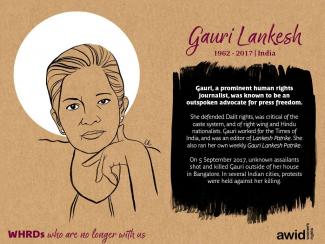
Reporters without Borders: India: Prominent woman journalist gunned down in Bangalore
BBC: Gauri Lankesh: Indian journalist shot dead in Bangalore
Committee to Protect Journalists: Gauri Lankesh Killed
BBC: Gauri Lankesh: Murdered Indian journalist in her own words
The Guardian: The murder of journalist Gauri Lankesh shows India descending into violence
Financial Times - Gauri Lankesh, journalist and activist, 1962-2017
The New York Times: Why was Gauri Lankesh killed?
El Foro Internacional de AWID es un evento de la comunidad global y, al mismo tiempo, un espacio para una transformación personal radical. Es un encuentro único: el Foro reúne a los movimientos feministas, por los derechos de las mujeres, por la justicia de género, LBTQI+ y aliados, en toda nuestra diversidad y humanidad, para conectarnos, sanar y florecer.
El tema del Foro –Rebelándonos Juntes– es una invitación a vincularnos con todo nuestro ser, a conectarnos entre nosotrxs de forma focalizada, afectuosa y valiente, para que podamos sentir el latido de los movimientos globales y rebelarnos juntxs para enfrentar los desafíos de esta época.
Por primera vez, el Foro de AWID ofrece tres modos de participación:
 |
 |
 |
|
Presencial En el Queen Sirikit National Convention Centre en Bangkok, Tailandia |
En línea a través del espacio virtual (capacidad: 3000 participantes) |
Nodos conectades en el espacio a través de las fronteras |
Con más de 4.000 participantes, el 15º Foro Internacional de AWID en 2024 fue una fuerza colectiva arrolladora de resistencia frente a la opresión, apostando a la sanación y la liberación compartida. Mantente atente a este espacio para más historias del foro y futuras actualizaciones.
El Consejo Directivo de AWID tomó la difícil decisión de cancelar el 14° Foro Internacional que estaba programado para realizarse del 20 al 23 de septiembre de 2021 en la ciudad de Taipei.
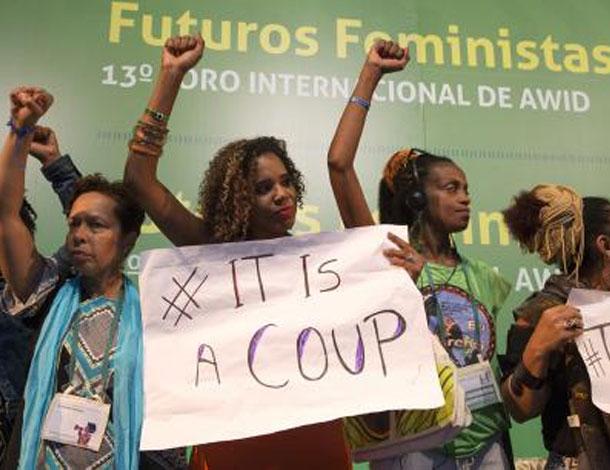
Dado el complejo mundo que enfrentamos hoy, el Foro de AWID 2016 no se centró en un ‘tema’ en particular, sino en la creación de formas más efectivas de trabajar juntxs.
Pese a las dificultades del contexto en el que se celebró este Foro (la epidemia del virus del Zika, una huelga de lxs trabajadorxs del servicio exterior brasileño, el juicio político a la presidenta Dilma Rousseff y la crisis que le siguió), se logró congregar a más de 1800 participantes de 120 países y territorios de todas las regiones del mundo.
Para el 96% de lxs participantes que respondieron a la encuesta de evaluación posterior al Foro, el evento fue una importante fuente de inspiración y energía.
El 98% de lxs participantes lo consideraron un importante espacio de convocatoria para los movimientos feministas, y manifestaron su esperanza de que AWID continúe organizado estos foros.
El 59% de quienes respondieron a la encuesta de evaluación del Foro declaró estar muy satisfechx con el Foro y el 34% algo satisfechx.
Se realizaron más de 150 sesiones en distintos formatos sobre diversos temas, desde la integridad y la libertad corporal, pasando por la violencia de género en el ámbito laboral, hasta estrategias de construcción de poder colectivo.
El primer Foro de Feminismos Negros, se celebró justo antes del Foro de AWID, y reunió a 250 feministas negrxs de todo el mundo, para crear colectivamente un espacio de poder desde donde construir y fortalecer las conexiones intergeneracionales y transnacionales.
Descargar el informe de evaluación del foro
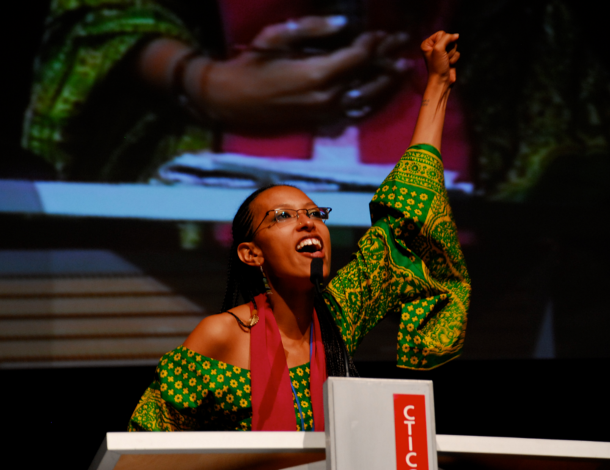
El 12° Foro de AWID se llevó a cabo en el año 2012 en Estambul, Turquía, bajo el título “Transformando el Poder Económico para Avanzar los Derechos de las Mujeres y la Justicia”. El Foro 2012 fue el más grande y diverso que hemos organizado hasta la fecha, con la participación de 2239 activistas por los derechos de las mujeres, de 141 países. El 65% provenía del sur global y casi el 15% eran mujeres jóvenes menores de 30 años, mientras que el 75% de las personas asistían a un Foro de AWID por primera vez.
El programa del Foro se enfocó en la transformación del poder económico para promover los derechos de las mujeres y la justicia. Se ofrecieron más de 170 sesiones de lo más diversas, incluyendo las sesiones de la caja de herramientas económicas feministas para forjar habilidades, sesiones interactivas que representaron los 10 temas del Foro, discusiones en profundidad y las mesas redondas de solidaridad.
Aprovechando el impulso del Foro, hemos transformado la página web en un centro de recursos y aprendizaje que se basa en el contenido generado por las participantes mediante recursos multimedia sobre todos los componentes del Foro.
Visita el archivo web del Foro 2012