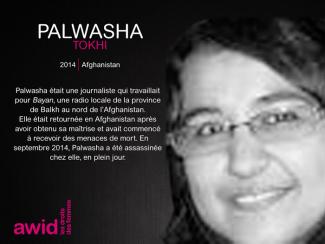
Farida Afridi

Young feminist activists play a critical role in women’s rights organizations and movements worldwide by bringing up new issues that feminists face today. Their strength, creativity and adaptability are vital to the sustainability of feminist organizing.
At the same time, they face specific impediments to their activism such as limited access to funding and support, lack of capacity-building opportunities, and a significant increase of attacks on young women human rights defenders. This creates a lack of visibility that makes more difficult their inclusion and effective participation within women’s rights movements.
AWID’s young feminist activism program was created to make sure the voices of young women are heard and reflected in feminist discourse. We want to ensure that young feminists have better access to funding, capacity-building opportunities and international processes. In addition to supporting young feminists directly, we are also working with women’s rights activists of all ages on practical models and strategies for effective multigenerational organizing.
We want young feminist activists to play a role in decision-making affecting their rights by:
Fostering community and sharing information through the Young Feminist Wire. Recognizing the importance of online media for the work of young feminists, our team launched the Young Feminist Wire in May 2010 to share information, build capacity through online webinars and e-discussions, and encourage community building.
Researching and building knowledge on young feminist activism, to increase the visibility and impact of young feminist activism within and across women’s rights movements and other key actors such as donors.
Promoting more effective multigenerational organizing, exploring better ways to work together.
Supporting young feminists to engage in global development processes such as those within the United Nations
Collaboration across all of AWID’s priority areas, including the Forum, to ensure young feminists’ key contributions, perspectives, needs and activism are reflected in debates, policies and programs affecting them.
By joining AWID, you are becoming part of worldwide feminist organizing, a collective power that is rooted in working across movements and is based on solidarity.
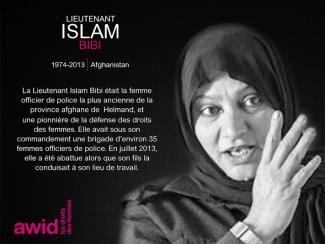
7 Women Human Rights Defenders from across the South and Southeast Asian region are honored in this year’s Online Tribute. These defenders have made key contributions to advancing human and women’s rights, indigenous people’s rights, and the right to education. These WHRDs were lawyers, women’s rights activists, scholars, and politicians. Please join AWID in commemorating t their work and legacy by sharing the memes below with your colleagues, networks and friends and by using the hashtags #WHRDTribute and #16Days.
Please click on each image below to see a larger version and download as a file


Luchar contra viento y marea: la historia de la victoria sin precedentes de la Red de Solidaridad
En enero de 2022, la Red de Solidaridad organizó una huelga con 400 trabajadorxs. ¿Su principal demanda? Aumentar los salarios. La huelga fue convocada después de meses de conversaciones fracasadas con el Ministerio de Asuntos Sociales de Georgia como parte de un conflicto laboral.
Después de semanas de protestar, negociar, hablar con la prensa, resistir represalias y soportar el frío del invierno georgiano, lxs trabajadorxs obtuvieron concesiones sin precedentes del gobierno: aumento de los salarios, prestaciones por maternidad, cobertura de los costos de transporte, el cese de despidos, la compensación por los días de huelga, y más.
La huelga no solo resultó en ganancias materiales, sino que también hizo que lxs trabajadorxs se sintieran unidxs y empoderadxs para defenderse y luchar por condiciones de trabajo dignas ahora y en el futuro. Se convirtieron en una fuente de inspiración para todxs lxs trabajadorxs del país.
Puedes leer más sobre su victoria aquí.
Да. Ваши ответы будут удалены по окончании обработки и анализа данных и будут использованы исключительно в исследовательских целях. Данные НИКОГДА не будут переданы за пределы AWID и будут обрабатываться только сотрудниками AWID и консультантками(-тами), работающими с нами над проектом «Где деньги?». Для нас ваша конфиденциальность и безопасность– приоритет. С нашей политикой конфиденциальности можно подробно ознакомиться здесь.
Su’ad was a strong advocate of women’s and children’s rights, and was the head of Al-Weed Al-Alaiami - an Iraqi human rights organisation.
She participated in the July 2018 demonstrations that took place in Basra and several other Iraqi cities protesting unemployment and demanding jobs and proper public services for citizens, as well as calling for the elimination of rampant corruption.
On 25 September 2018, Su’ad was assassinated in the Al-Abbasiyah district in downtown Basra. A video of the incident showed a person approaching her as she was getting into her car, firing a bullet at the back of her head and pointing another bullet at her driver Hussain Hassan, who was injured in the shoulder. Al-Ali was 46 and the mother of four children.

Expande tus fronteras. Lxs afiliadxs de AWID representan de forma creciente una intersección diversa y vibrante de feministas que trabajan, entre otras cosas, en temáticas asociadas a la tierra, los derechos de lxs trabajadorxs, los derechos sexuales y la autonomía corporal. Al afiliarte, puedes conectar tus luchas con las de otros movimientos.
Before starting the WITM research methodology, it is important you prepare the background and know what to expect.
With AWID’s WITM research methodology, we recommend that you first review the entire toolkit.
While this toolkit is designed to democratize WITM research, there are capacity constraints related to resources and research experience that may affect your organization’s ability use this methodology.
Use the “Ready to Go?” Worksheet to assess your readiness to begin your own WITM research. The more questions you can answer on this worksheet, the more prepared you are to undertake your research.
Before beginning any research, we recommend that you assess your organization’s connections and trust within your community.
In many contexts, organizations may be hesitant to openly share financial data with others for reasons ranging from concerns about how the information will be used, to fear of funding competition and anxiety over increasing government restrictions on civil society organizations.
As you build relationships and conduct soft outreach in the lead-up to launching your research, ensuring that your objectives are clear will be useful in creating trust. Transparency will allow participants to understand why you are collecting the data and how it will benefit the entire community.
We highly recommend that you ensure data is collected confidentially and shared anonymously. By doing so, participants will be more comfortable sharing sensitive information with you.
We also recommend referring to our “Ready to Go?” Worksheet to assess your own progress.
L’Organisation Sindicale des Travailleur·euses du Sexe (Organización Sindical de Trabajadoras del Sexo, OTRAS) est le premier syndicat de travailleur·euses du sexe de l'histoire de l'Espagne. Le syndicat est née de la nécessité de garantir les droits sociaux, juridiques et politiques des travailleur·euses du sexe dans un pays où les mouvements d'extrême droite se renforcent au jour le jour.
Après des années de lutte contre le système juridique espagnol et les groupes abolitionnistes du travail du sexe qui ont appelé à sa fermeture, OTRAS a finalement obtenu son statut légal de syndicat en 2021.
Son objectif? Décriminaliser le travail du sexe et garantir des conditions et des environnements de travail décents pour tous·tes les travailleur·euses du sexe.
Le syndicat représente plus de 600 travailleur·euses du sexe, dont beaucoup de personnes immigrantes, racialisées, trans, queer, ou de genre non-conforme.
O nosso objetivo é alcançar um total de 2000 respostas, quase o dobro do último questionário WITM em 2011.
“Afterwards
After love the first time,
Our naked bodies and minds
A hall of mirrors,
Wholly unarmed, utterly fragile,
We lie in one another's arms
Breathing with care,
Afraid to break
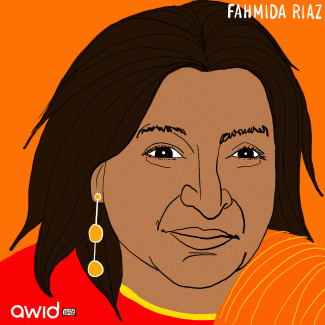
These crystal figurines.” - Fahmida Riaz
Her work faced harsh criticism from conservatives, who accused her of using erotic and “pornographic” expressions in her poetic language.
Fahimida was eventually blacklisted and charged with sedition under Section 124A of the Pakistan Penal Code) during the dictatorship of Zia Ul Haq. Forced into exile in 1981, she spent almost seven years in India before returning to Pakistan.
As part of the preface to “Badan Dareeda” ('The Torn-Bodied'), a collection of poetry published in 1974, she wrote:
The brilliance of Fahmida was in defying any singular logic or categories of gender, nation, religion or culture. She refused to be put in the role of a ‘woman poet’, breaking with traditional definitions of feminine poetry and concepts and themes (ranging from political consciousness, body, culture, desire, religion, home) and knocking down inhibitions put on her gender.
“You have to understand that culture can have no essence. Cultures move, flowing into one another, forming new cultures. Culture is born this way. There is no clash of cultures.”
Fahmida authored more than 15 books on poetry and fiction including her poem ‘Taaziyati Qaraardaaden’ (‘Condolence Resolutions’) that might serve as an appropriate tribute to her life and legacy and a collection of poems (Apna Jurm To Saabit He ‘My Crime Stands Proven’) published in 1988 during her time in exile.
Fahmida Riaz was born in Meerut, India on 28 July 1946 and passed away on 21 November 2018 in Lahore, Pakistan.
Nous célébrons le droit de chacun·e à choisir son identité, ses relations, ses objectifs, son travail, ses rêves et ses plaisirs, et ce qu'iel fait de son esprit, de son corps et de son âme. Nous croyons qu'il est nécessaire de travailler à l'accès aux ressources, aux informations et à des environnements sûrs et favorables qui permettent d'atteindre cet objectif.
This section will guide you on how to ensure your research findings are representative and reliable.
In this section:
- Collect your data
1. Before launch
2. Launch
3. During launch- Prepare your data for analysis
1. Clean your data
2. Code open-ended responses
3. Remove unecessary data
4. Make it safe- Create your topline report
- Analyze your data
1. Statistical programs
2. Suggested points for analysis
If you also plan to collect data from applications sent to grant-making institutions, this is a good time to reach out them.
When collecting this data, consider what type of applications you would like to review. Your research framing will guide you in determining this.
Also, it may be unnecessary to see every application sent to the organization – instead, it will be more useful and efficient to review only eligible applications (regardless of whether they were funded).
You can also ask grant-making institutions to share their data with you.
Your survey has closed and now you have all this information! Now you need to ensure your data is as accurate as possible.
Depending on your sample size and amount of completed surveys, this step can be lengthy. Tapping into a strong pool of detail-oriented staff will speed up the process and ensure greater accuracy at this stage.
Also, along with your surveys, you may have collected data from applications sent to grant-making institutions. Use these same steps to sort that data as well. Do not get discouraged if you cannot compare the two data sets! Funders collect different information from what you collected in the surveys. In your final research report and products, you can analyze and present the datasets (survey versus grant-making institution data) separately.
There are two styles of open-ended responses that require coding.
Questions with open-ended responses
For these questions, you will need to code responses in order to track trends.
Some challenges you will face with this is:
If using more than one staff member to review and code, you will need to ensure consistency of coding. Thus, this is why we recommend limiting your open-ended questions and as specific as possible for open-ended questions you do ask.
For example, if you had the open-ended question “What specific challenges did you face in fundraising this year?” and some common responses cite “lack of staff,” or “economic recession,” you will need to code each of those responses so you can analyze how many participants are responding in a similar way.
For closed-end questions
If you provided the participant with the option of elaborating on their response, you will also need to “up-code” these responses.
For several questions in the survey, you may have offered the option of selecting the category “Other” With “Other” options, it is common to offer a field in which the participant can elaborate.
You will need to “up-code” such responses by either:
Analyze the frequency of the results
For each quantitative question, you can decide whether you should remove the top or bottom 5% or 1% to prevent outliers* from skewing your results. You can also address the skewing effect of outliers by using median average rather than the mean average. Calculate the median by sorting responses in order, and selecting the number in the middle. However, keep in mind that you may still find outlier data useful. It will give you an idea of the range and diversity of your survey participants and you may want to do case studies on the outliers.
* An outlier is a data point that is much bigger or much smaller than the majority of data points. For example, imagine you live in a middle-class neighborhood with one billionaire. You decide that you want to learn what the range of income is for middle-class families in your neighborhood. In order to do so, you must remove the billionaire income from your dataset, as it is an outlier. Otherwise, your mean middle-class income will seem much higher than it really is.
Remove the entire survey for participants who do not fit your target population. Generally you can recognize this by the organizations’ names or through their responses to qualitative questions.
To ensure confidentiality of the information shared by respondents, at this stage you can replace organization names with a new set of ID numbers and save the coding, matching names with IDs in a separate file.
With your team, determine how the coding file and data should be stored and protected.
For example, will all data be stored on a password-protected computer or server that only the research team can access?
A topline report will list every question that was asked in your survey, with the response percentages listed under each question. This presents the collective results of all individual responses.
Tips:
- Consistency is important: the same rules should be applied to every outlier when determining if it should stay or be removed from the dataset.
- For all open (“other”) responses that are up-coded, ensure the coding matches. Appoint a dedicated point person to randomly check codes for consistency and reliability and recode if necessary.
- If possible, try to ensure that you can work at least in a team of two, so that there is always someone to check your work.
Now that your data is clean and sorted, what does it all mean? This is the fun part where you begin to analyze for trends.
Are there prominent types of funders (government versus corporate)? Are there regions that receive more funding? Your data will reveal some interesting information.
Smaller samples (under 150 responses) may be done in-house using an Excel spreadsheet.
Larger samples (above 150 responses) may be done in-house using Excel if your analysis will be limited to tallying overall responses, simple averages or other simple analysis.
If you plan to do more advanced analysis, such as multivariate analysis, then we recommend using statistical software such as SPSS, Stata or R.
NOTE: SPSS and Stata are expensive whereas R is free.
All three types of software require staff knowledge and are not easy to learn quickly.
Try searching for interns or temporary staff from local universities. Many students must learn statistical analysis as part of their coursework and may have free access to SPSS or Stata software through their university. They may also be knowledgeable in R, which is free to download and use.

• 2 - 3 months
• 1 or more research person(s)
• Translator(s), if offering survey in multiple languages
• 1 or more person(s) to assist with publicizing survey to target population
• 1 or more data analysis person(s)
• List of desired advisors: organizations, donors, and activists
• Optional: an incentive prize to persuade people to complete your survey
• Optional: an incentive for your advisors
Survey platforms:
• Survey Monkey
• Survey Gizmo (Converts to SPSS for analysis very easily)
Examples:
• 2011 WITM Global Survey
• Sample of WITM Global Survey
• Sample letter to grantmakers requesting access to databases
Visualising Information for Advocacy:
• Cleaning Data Tools
• Tools to present your data in compelling ways
• Tutorial: Gentle Introduction to Cleaning Data