Young Feminist Activism
Organizing creatively, facing an increasing threat
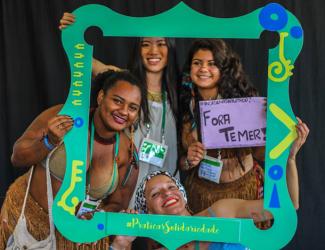
Young feminist activists play a critical role in women’s rights organizations and movements worldwide by bringing up new issues that feminists face today. Their strength, creativity and adaptability are vital to the sustainability of feminist organizing.
At the same time, they face specific impediments to their activism such as limited access to funding and support, lack of capacity-building opportunities, and a significant increase of attacks on young women human rights defenders. This creates a lack of visibility that makes more difficult their inclusion and effective participation within women’s rights movements.
A multigenerational approach
AWID’s young feminist activism program was created to make sure the voices of young women are heard and reflected in feminist discourse. We want to ensure that young feminists have better access to funding, capacity-building opportunities and international processes. In addition to supporting young feminists directly, we are also working with women’s rights activists of all ages on practical models and strategies for effective multigenerational organizing.
Our Actions
We want young feminist activists to play a role in decision-making affecting their rights by:
-
Fostering community and sharing information through the Young Feminist Wire. Recognizing the importance of online media for the work of young feminists, our team launched the Young Feminist Wire in May 2010 to share information, build capacity through online webinars and e-discussions, and encourage community building.
-
Researching and building knowledge on young feminist activism, to increase the visibility and impact of young feminist activism within and across women’s rights movements and other key actors such as donors.
-
Promoting more effective multigenerational organizing, exploring better ways to work together.
-
Supporting young feminists to engage in global development processes such as those within the United Nations
-
Collaboration across all of AWID’s priority areas, including the Forum, to ensure young feminists’ key contributions, perspectives, needs and activism are reflected in debates, policies and programs affecting them.
Related Content
Snippet FEA collaborator and allies Photo 1 (EN)

Ursula K Le Guin
Ursula was an American novelist who worked mainly in the genres of fantasy and science fiction.
She found fame with The Left Hand Of Darkness, which imagines a future society where people are ambisexual – they have no fixed sex. It explores the effects of gender and sex in society, and was one of the first major feminist science fiction books. Ursula was inspiring in her subversive and original writing, and also for the themes of feminism and freedom she held so dearly.
In a 1983 address at Mills College in California, she told graduates: “Why should a free woman with a college education either fight Macho-man or serve him? Why should she live her life on his terms? I hope you live without the need to dominate, and without the need to be dominated.”
أنا ناشط/ة فردي/ة ولا أعمل مع أي مجموعة، منظمة و\ أو حركة في الوقت الحالي. هل عليّ تعبئة الاستطلاع؟
كلا. نقدّر عملك لكننا لا نطلب من الأفراد تعبئة الاستطلاع في الوقت الحالي.
Merci d'avoir téléchargé la Boîte à outils des réalités féministes
En savoir plus sur les réalités féministes
Des questions ou commentaires ?
N'hésitez pas à nous contacter.
What languages will be included in the Forum?
English, French, Spanish and Mandarin.
Snippet FEA Workers demonstrations in Georgia 2 (ES)

Susana Chavez
Liliana Bodoc
Liliana fue una maestra argentina, una tejedora y una escritora muy reconocida.
Su trilogía La saga de los confines recibió varios premios y es única en el género fantástico por su uso y reimaginación de la mitología de los pueblos indígenas de América del Sur.
El compromiso de Liliana con el feminismo se expresaba en las diversas, ricas y fuertes voces de mujeres en su escritura y especialmente en su extensa obra para lectorxs jóvenes. También tomó posición públicamente en favor del aborto, la justicia económica y la equidad de género.
Могу ли я заполнить опрос не на платформе KOBO, а поделиться с вами ответами по электронной почте?
Если у вас нет проблем с доступом к платформе, и/или вы не заполняете анкету на других языках, мы настоятельно рекомендуем вам использовать KOBO для стандартизированного сбора и анализа данных.
Disclaimer: Communications with AWID staff
If you have received emails from any staff members at AWID, we would like you to understand the following:
-
The information contained in this communication is confidential and is intended solely for the addressee.
-
This communication may contain information proprietary to the Association for Women’s Rights in Development (AWID), and may not be reproduced or disseminated in whole or in part without AWID's written consent.
-
AWID does not warrant that any information contained herein is complete or correct. This communication is not an offer to enter into any agreement and is not a confirmation of any agreement described herein unless the context clearly indicates the contrary.
-
AWID is not acting as your adviser in any agreement that may be proposed herein, and this communication does not constitute a recommendation, guidance or proposal to enter into any agreement.
-
AWID does not guarantee or otherwise assure the expected results of any agreement. This communication may contain views or opinions that are not necessarily those of AWID.
-
You shall not be entitled to place any reliance on the information contained in this communication for the purposes of entering into any proposed agreement or otherwise.
What happens to the activity proposals submitted through the CfA?
- Activity proposals will initially be screened by AWID staff.
- Organizers of shortlisted proposals will then be invited to participate in a voting process, to choose among the shortlisted activities. Those with the most votes will be included in the Forum program. AWID may make a few adjustments to the final selection to ensure our program has an adequate balance across regions, constituencies, issues and methodologies.
- Our Forum Content and Methodology Committee will reach out to the organizers of selected proposals to support them in further developing their activities.
We will update the outcomes of this process in the website in due time.
Snippet FEA Workers Persecution S4 (FR)

LA PERSÉCUTION DES TRAVAILLEUR·EUSES
Le magazine des Réalités féministes
Nous vous présentons une sélection motivante de puissantes histoires et d’images de transformations et de résistances créées par des activistes, des écrivain·e·s et des artistes du monde entier.
Rhonda Copelon
Anna Campbell (şehid Hêlîn Qerecox)
Anna a grandi à Lewes, dans le Sussex (Royaume-Uni). Après avoir décidé de ne pas poursuivre sa licence d’anglais à l'Université de Sheffield, elle a déménagé à Bristol et est devenue plombière.
Elle a passé une grande partie de son temps à défendre les personnes marginalisées et défavorisées, à assister à des rassemblements antifascistes et à offrir son soutien aux femmes de la Dale Farm lorsqu'elles furent menacées d'expulsion. Végétalienne et amie des animaux, elle a participé à des missions de sabotage de chasses et son nom est honoré sur le monument commémoratif « Arbre de vie » de l’organisation PETA. Anna s'est rendue à Rojava en mai 2017 pour lutter en faveur du renforcement du pouvoir des femmes, de la pleine représentation de toutes les ethnies et de la protection de l'environnement.
Anna est décédée le 15 mars 2018, après avoir été atteinte par une frappe aérienne turque dans la ville d'Afrin, dans le nord de la Syrie. Anna se battait auprès des forces de protection des femmes (YPJ) quand elle a été tuée.
O inquérito tem quantas perguntas?
Um total de 47 perguntas, das quais 27 são obrigatórias* e 20 são opcionais. A maioria das perguntas no inquérito é de escolha múltipla. Encorajamo-lo a responder a todas as perguntas.
Calling all artists & creative activists to come together in a new Slack community!
Our thoughts are with the many people all around the world who are most affected by the repercussions of the global COVID-19 pandemic, especially marginalised communities that are historically oppressed.
This is an invitation for artists and creative activists to join a virtual space to connect, build community, and support each other through these challenging times. For this we have created a new Slack community to safely share insights, learnings, life-hacks, resources, advice, fears and anxieties, hopeful and joyful reminders, and in general chat about how we’re doing.
Join us on Slack
After filling out the form, we will send you a personal invitation to the community.

About this community:
For those who are new to Slack, we’ll have orientation sessions and materials available after you sign up.
Since we are working in three languages (English, Spanish, French) we invite you to write in the language you are the most comfortable with and use online translation tools (Google Translate or others) to participate in discussions.
Co-creating welcoming and safe spaces:
Please refer to the Community Guidelines
The co-creation of our feminist realities starts with ourselves and how we treat each other. We are dedicated to creating and protecting safe and supportive spaces for our communities both online and in person. We also consider that safe and welcoming spaces are co-owned and co-created. We expect our members to act in a manner that is ethical, responsible and consistent with the values of AWID and assume collective responsibility to ensure an atmosphere of mutual respect and solidarity.
Weekly Prompts:
As part of our ongoing discussions, we will offer weekly prompts in Slack with the intention to gently facilitate dialogue and inspire art-making processes. This can be an introspective process, but to make the most out of this community, we welcome you to interact with other community members and share thoughts as part of our discussions. The intention is to invite folks to respond freely and gradually by writing or making art in whatever way feels best.
We hope to have relevant and timely discussions with you, so we invite your suggestions and feedback. In general, the themes will center the experiences and perspectives of artists, writers, and creators -- and they will make space for folks to vision into and beyond the current global climate through the lens of feminist realities.
Do I need a visa to attend the Forum in Taipei?
You DO NOT need a visa to attend the Forum in Taipei if you hold a passport from one of the following countries (the allowed length of your stay varies from one country to another):
Andorra, Australia, Austria, Belgium, Bulgaria, Brunei, Canada, Chile, Croatia, Cyprus, Czech Republic, Denmark, Estonia, Eswatini, Finland, France, Germany, Greece, Guatemala, Haiti, Honduras, Hungary, Iceland, Ireland, Israel, Italy, Japan*, Republic of Korea, Latvia, Liechtenstein, Lithuania, Luxembourg, Malta, Marshall Island, Monaco, Netherlands, New Zealand, Nicaragua, Norway, Palau, Paraguay, Philippines, Poland, Portugal, Romania, Russia, San Marino, Slovakia, Slovenia, Spain, Sweden, Switzerland, Tuvalu, the United Kingdom, the United States of America,and Vatican City State, Belize, Dominican Republic, Malaysia, Nauru, St. Kitts and Nevis, Saint Lucia, Saint Vincent and the Grenadines, Singapore.
People with any other passport WILL NEED A VISA to come to Taipei.
Please note:
It is likely that, once you have registered to attend the Forum, you will get an event-related code that will allow you to apply for your visa electronically regardless of your citizenship.
We will let you know more about this when the Registration opens.
Snippet FEA Sopo Japaridze (EN)
Meet Sopo Japaridze, fierce feminist, union leader and chair of the independent service trade union at the Solidarity Network.
She left the country when she was very young to go to the United States where she first became very politically active as a labor organizer. She kept Georgia in the back of her mind all that time, until one day, two decades later, she decided to return.
The existing Georgian union confederation back then was less than ideal. So, equipped with her skills, knowledge and labor organizing experience, Sopo went back to Georgia and built her own union.
Sopo is a passionate researcher and writer. She studies labor and social relations, writes for various publications and is the contributing editor of LeftEast, an Eastern European analytical platform. She also co-founded the political history initiative and podcast, Reimagining Soviet Georgia, where she explores the complexities and nuances of the country's experiences under the Soviet Union, to better understand its past in order to shed light on how to build a better future.