Young Feminist Activism
Organizing creatively, facing an increasing threat
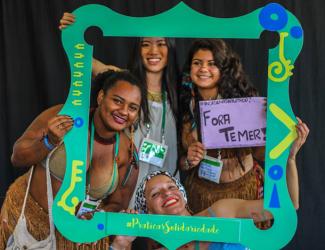
Young feminist activists play a critical role in women’s rights organizations and movements worldwide by bringing up new issues that feminists face today. Their strength, creativity and adaptability are vital to the sustainability of feminist organizing.
At the same time, they face specific impediments to their activism such as limited access to funding and support, lack of capacity-building opportunities, and a significant increase of attacks on young women human rights defenders. This creates a lack of visibility that makes more difficult their inclusion and effective participation within women’s rights movements.
A multigenerational approach
AWID’s young feminist activism program was created to make sure the voices of young women are heard and reflected in feminist discourse. We want to ensure that young feminists have better access to funding, capacity-building opportunities and international processes. In addition to supporting young feminists directly, we are also working with women’s rights activists of all ages on practical models and strategies for effective multigenerational organizing.
Our Actions
We want young feminist activists to play a role in decision-making affecting their rights by:
-
Fostering community and sharing information through the Young Feminist Wire. Recognizing the importance of online media for the work of young feminists, our team launched the Young Feminist Wire in May 2010 to share information, build capacity through online webinars and e-discussions, and encourage community building.
-
Researching and building knowledge on young feminist activism, to increase the visibility and impact of young feminist activism within and across women’s rights movements and other key actors such as donors.
-
Promoting more effective multigenerational organizing, exploring better ways to work together.
-
Supporting young feminists to engage in global development processes such as those within the United Nations
-
Collaboration across all of AWID’s priority areas, including the Forum, to ensure young feminists’ key contributions, perspectives, needs and activism are reflected in debates, policies and programs affecting them.
Related Content
Snippet FEA Georgia's minimum wage (ES)
El salario mínimo de Georgia se encuentra en un porcentaje inferior al de todos los países del mundo. Esta realidad afecta mayoritariamente a las mujeres.
El país no solo tiene una brecha salarial de género significativa, sino que las mujeres también trabajan más horas y más horas no reguladas antes de irse a casa para ocuparse de las tareas domésticas y de sus familias. No hay licencia por maternidad, no hay aumentos de salario por horas extras, no hay seguro de desempleo, y no hay licencias por enfermedad u otra protección social. Presionados por organizaciones occidentales, los partidos políticos oligárquicos georgianos han estado implementando reformas que están destruyendo el estado de bienestar, aumentando las medidas de austeridad y empeorando la explotación de lxs trabajadorxs, todo para los beneficios de grandes corporaciones que aplauden al país por su "facilidad para hacer negocios". Los medios de comunicación, cooptados por intereses privados y corporativos, están sesgados sobre estos temas o los silencian. La organización sindical sigue siendo una de las pocas opciones para luchar por los derechos humanos básicos y para hacer que el Estado y las empresas rindan cuentas ante las violaciones y persecuciones diarias y generalizadas contra lxs trabajadorxs, especialmente contra las mujeres.
Fuentes: Minimum-Wage y entrevista con Sopo Japaridze en Democracia Abierta
Defending our land and ourselves from corporate power

These industries 'extract' raw materials from the Earth: mining, timber, gas, oil are some examples
This economical model exploits nature and as it intensifies, so does the inequality between global North with their large corporations, and the global South, where resources are extracted.
Land contamination, water pollution, environmental damage, communities displaced are only some of the consequences.
Find more on our report on EXTRACTIVE INDUSTRIES
There are sustainable alternatives for the environment and women's rights.
Razan Al-Najar
Razan était une infirmière palestinienne bénévole âgée de 21 ans.
Elle a été tuée par balle à l'est de la ville de Khan Younis, au sud de Gaza, alors qu'elle courait vers une clôture de la frontière fortifiée dans le but de porter secours à une victime.
Dans son tout dernier post sur Facebook, Razan avait déclaré : « J’y retourne et ne reculerai pas », ajoutant: « Frappez-moi de vos balles. Je n'ai pas peur ».
Snippet - WITM RESOURCES - PT
Recursos
(Disponível em inglês)
Snippet FEA collaborator and allies Photo 4 (FR)

Voici votre guide pratique et les infographies «Vers un écosystème de financement féministe»
Téléchargez le guide complet
Cliquez sur l'image pour ouvrir le rapport complet en PDF
|
Téléchargez le rapport PDF «Vers un écosystème de financement féminist» |
Téléchargez les infographies individuelles
Où en sommes -nous aujourd'hui ? |
Où nous voulons être |
Financement actuel, par secteur |
Magdalena Reyes Salazar
Jacqueline Coulibaly Ki-Zerbo
Jacqueline was a pioneering Malian/Burkinabe feminist, nationalist and educator.
She taught English in Senegal, before being recruited in 1961 as an English teacher at the Lycée Philippe Zinda Kaboré in Ouagadougou, Burkina Faso. Through her activism, she was involved in the popular uprising of January 3, 1966. Between 1961 and 1966, Jacqueline was also responsible for the trade union press, Voices of the Teachers. She was appointed as the head of the Normal Course for Young Girls (now known as Nelson Mandela High School) until 1974, and dedicated herself to girls’ education and advancing women’s rights.
In 1984 she was awarded the Paul G. Hoffmann Award for outstanding work in national and international development.
Наша группа, организация и/или движение не зарегистрированы – можем ли мы принять участие в опросе?
Безусловно, мы хотим услышать ваше мнение и о вашем опыте привлечения ресурсов.
Snippet FEA lines of work Against (EN)

LABOR RIGHT VIOLATIONS
The AWID Forum Access Fund
We strive to make the AWID Forum a truly global gathering with participation from a diverse array of movements, regions and generations. To this end, AWID mobilizes resources for a limited Access Fund (AF) to assist some participants with the costs of attending the Forum.
The 14th AWID International Forum will take place 11-14 January 2021, in Taipei, Taiwan.
How will the Access Fund be allocated?
For this AWID Forum, there will be no application process.
Access Fund grants will be allocated by invitation only to:
- Two persons per activity selected for the Forum program (decided by those organizations, groups or individuals organizing the activity)
- Participants who identify as part of Priority Forum Constituencies (PFCs) recommended by the organizations, networks and groups who are co-creating the Forum with AWID.
- PFCs are those which we consider would strengthen our collective power as movements, are not centered in mainstream feminist movements, and whose Feminist Realities we would like to honor, celebrate and visibilize:
- Black feminists
- Indigenous feminists
- Trans, gender non-conforming and intersex feminists
- Feminists with disabilities
- Feminist sex workers and informal workers, including migrant workers
- Feminists affected by migration
- Women affected by drug policy
- Feminists from the Forum regions (with a focus on the Pacific and mainland China)

In addition, AWID will fund approximately 100 participants from the Forum’s location. Forum Committee Members (Content and Methodology, Access and Host) as well as those in the Artists Working Group [link] are also granted Access Fund support.
What does the Access Fund cover?
For selected participants, the Access Fund will cover the cost of their:
- Flight
- Accommodation
- Visa
- Local transportation in Taipei
- Travel medical insurance
The Access Fund will NOT cover their:
- Forum registration fee
- Transportation to and from the airport in their city of departure
- Other incidental costs
Apart from the Access Fund, how can I fund my participation at the Forum?
We have listed other ideas on how to fund your participation at the AWID Forum on the Funding Ideas page.
Sandra Viviana Cuellar Gallego
Lara Kruger
Lara fue una muy conocida y querida DJ de radio en la FM Motsweding, en Sudáfrica.
Fue una de las primeras conductoras abiertamente transgénero en una estación de radio comercial. Trabajó mucho para echar luz sobre los temas LGTBI.
El activismo de Lara comenzó a temprana edad, cuando defendía vivamente su derecho a vestirse y comportarse de una forma que le resultara cómoda y lo hacía frente a integrantes de su comunidad que todavía no entendían qué significaba ser transgénero.
Qual é a definição de financiamento externo?
Financiamento externo inclui subsídios e outras formas de financiamento de fundações filantrópicas, governos, financiadores bilaterais, multilaterais ou empresariais, e doadores individuais, tanto a nível nacional como internacional. Não inclui recursos gerados autonomamente por grupos, organizações e/ou movimentos, como, por exemplo, quotas de membres, contribuições voluntárias de colaboradores, membres e/ou apoiantes, angariações de fundos comunitários, aluguer de espaços ou venda de serviços. Para facilitar a consulta, estão incluídas no inquérito definições dos diferentes tipos de financiamento e descrições resumidas de diferentes doadores.
Snippet FEA Wage Parity (ES)