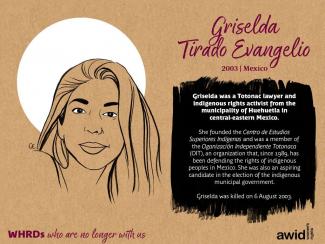
Griselda Tirado Evangelio
WHRDs are self-identified women and lesbian, bisexual, transgender, queer and intersex (LBTQI) people and others who defend rights and are subject to gender-specific risks and threats due to their human rights work and/or as a direct consequence of their gender identity or sexual orientation.
WHRDs are subject to systematic violence and discrimination due to their identities and unyielding struggles for rights, equality and justice.
The WHRD Program collaborates with international and regional partners as well as the AWID membership to raise awareness about these risks and threats, advocate for feminist and holistic measures of protection and safety, and actively promote a culture of self-care and collective well being in our movements.
WHRDs are exposed to the same types of risks that all other defenders who defend human rights, communities, and the environment face. However, they are also exposed to gender-based violence and gender-specific risks because they challenge existing gender norms within their communities and societies.
We work collaboratively with international and regional networks and our membership
We aim to contribute to a safer world for WHRDs, their families and communities. We believe that action for rights and justice should not put WHRDs at risk; it should be appreciated and celebrated.
Promoting collaboration and coordination among human rights and women’s rights organizations at the international level to strengthen responses concerning safety and wellbeing of WHRDs.
Supporting regional networks of WHRDs and their organizations, such as the Mesoamerican Initiative for WHRDs and the WHRD Middle East and North Africa Coalition, in promoting and strengthening collective action for protection - emphasizing the establishment of solidarity and protection networks, the promotion of self-care, and advocacy and mobilization for the safety of WHRDs;
Increasing the visibility and recognition of WHRDs and their struggles, as well as the risks that they encounter by documenting the attacks that they face, and researching, producing, and disseminating information on their struggles, strategies, and challenges:
Mobilizing urgent responses of international solidarity for WHRDs at risk through our international and regional networks, and our active membership.

¡Sí! Reconocemos y valoramos las distintas razones por las que los feminismos en sus contextos respectivos no cuentan con financiamiento externo, ya sea por no reunir los requisitos para solicitar donaciones o para recibir dinero del exterior, o bien porque se financian con recursos generados de manera autónoma como estrategia política en sí misma. Deseamos saber de ustedes con independencia de su experiencia de financiamiento externo.
“Nous Sommes la Solution tiene una visión de una África donde, en solidaridad, las mujeres rurales involucradas en la toma de decisiones puedan cultivar, procesar, vender y consumir productos de la agricultura familiar preservando el medio ambiente, para un desarrollo sostenible, armonioso y duradero”.
À l’heure actuelle, l’enquête est disponible sur KOBO en français, anglais, arabe, espagnol, portugais et russe. Vous pouvez choisir votre langue au début du questionnaire.
Yes, we still want to hear from you regardless of whether you received funding in all three, two or only one of the years between 2021 and 2023.

Solicitamos estos datos para facilitar el análisis de las respuestas, para evitar duplicaciones y para contactar a su organización en caso de que no hayan podido completar el cuestionario o de que tengan dudas u otras preguntas. Puedes consultar más detalles acerca de cómo utilizamos la información personal que recolectamos a través de nuestro trabajo aquí.
Argentina tiene una larga historia de cooperativas autogestionadas y lugares de trabajo controlados por lxs trabajadorxs.
En 2001, el país vivió una de las peores crisis económicas de su historia.
Como respuesta a la recesión y como forma de resistencia y resiliencia, lxs trabajadorxs de todo el país comenzaron a ocupar sus lugares de trabajo.
La Cooperativa Textil Nadia Echazú fue la primera cooperativa creada por y para personas trans y travesti en busca de autonomía económica y condiciones de vida dignas.
Proporciona oportunidades de trabajo, acceso a la seguridad social, ingresos sostenibles y derechos económicos para las comunidades a las que sirve.
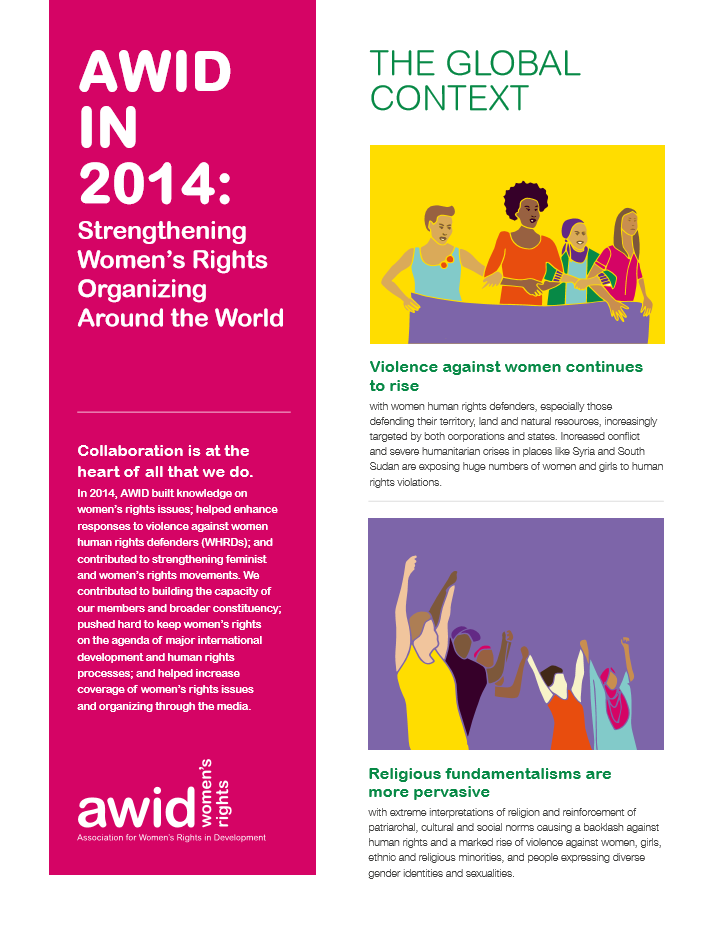
AWID is very pleased to share our 2014 Annual Report.
From building knowledge on women’s rights issues to amplifying responses to violence against women human rights defenders (WHRDs), our work last year continued to strengthen feminist and women’s rights movements across the world.
Get learn how we built the capacity of our members and broader constituency, pushed hard to keep women’s rights on the agenda of major international development and human rights processes, and helped increase coverage of women’s rights issues and organizing through the media. You'll find a panoramic sampling of our projects and some concrete numbers demonstrating our impact.
Collaboration is at the heart of all that we do, and we look forward to another year of working together to take our movements to the next level.
Despite an increasingly challenging panorama, there are important signs of hope for advancing women’s rights agendas. Women’s rights activists remain crucial in creating openings to demand structural change, sustaining their communities, opposing violence and holding the line on key achievements. And there are important opportunities to influence new actors and to mobilize greater resources to support women’s rights organizations.
In this context, strong collective action and organizing among women’s rights activists remains essential.
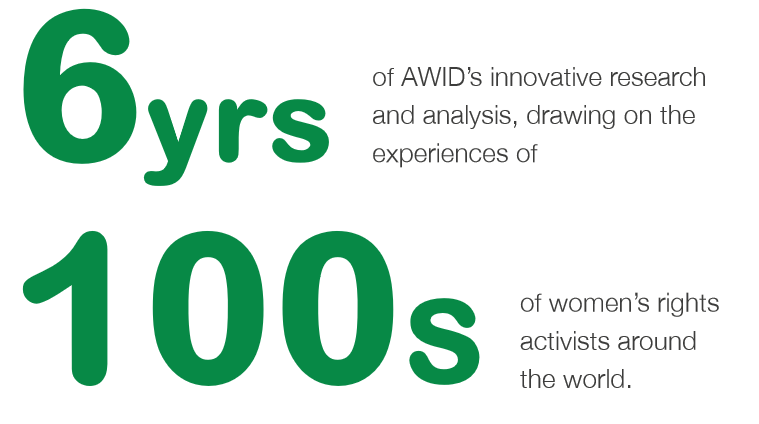
I am sincerely thrilled by AWID’s accomplishments since 1982 and hope to be able to pay at least a modest contribution to its hard work for the benefit of women and situation of gender equality.” — Aleksandra Miletic-Santic, Bosnia Herzegovina