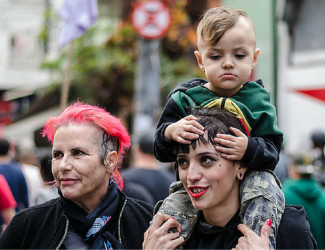
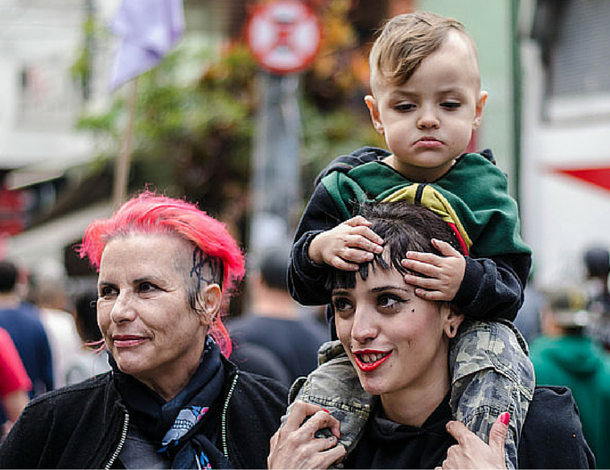
Flickr/Leonardo Veras (CC BY 2.0)

Special Focus

AWID is an international, feminist, membership organisation committed to achieving gender equality, sustainable development and women’s human rights

Protection of the Family

The Issue

Over the past few years, a troubling new trend at the international human rights level is being observed, where discourses on ‘protecting the family’ are being employed to defend violations committed against family members, to bolster and justify impunity, and to restrict equal rights within and to family life.

The campaign to "Protect the Family" is driven by ultra-conservative efforts to impose "traditional" and patriarchal interpretations of the family, and to move rights out of the hands of family members and into the institution of ‘the family’.

“Protection of the Family” efforts stem from:

  • rising traditionalism,
  • rising cultural, social and religious conservatism and
  • sentiment hostile to women’s human rights, sexual rights, child rights and the rights of persons with non-normative gender identities and sexual orientations.

Since 2014, a group of states have been operating as a bloc in human rights spaces under the name “Group of Friends of the Family”, and resolutions on “Protection of the Family” have been successfully passed every year since 2014.

This agenda has spread beyond the Human Rights Council. We have seen regressive language on “the family” being introduced at the Commission on the Status of Women, and attempts made to introduce it in negotiations on the Sustainable Development Goals.


Our Approach

AWID works with partners and allies to jointly resist “Protection of the Family” and other regressive agendas, and to uphold the universality of human rights.

In response to the increased influence of regressive actors in human rights spaces, AWID joined allies to form the Observatory on the Universality of Rights (OURs).  OURs is a collaborative project that monitors, analyzes, and shares information on anti-rights initiatives like  “Protection of the Family”.

Rights at Risk, the first OURs report, charts a map of the actors making up the global anti-rights lobby, identifies their key discourses and strategies, and the effect they are having on our human rights.   

The report outlines “Protection of the Family” as an agenda that has fostered collaboration across a broad range of regressive actors at the UN.  It describes it as: “a strategic framework that houses “multiple patriarchal and anti-rights positions, where the framework, in turn, aims to justify and institutionalize these positions.”
 

Related Content

L’activisme au Moyen-Orient et en Afrique du Nord

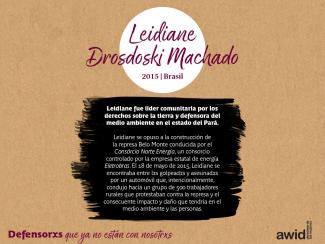
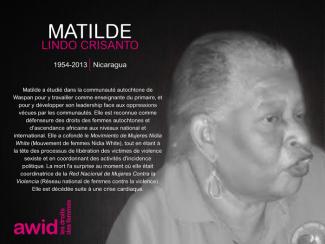
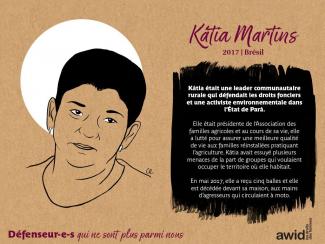
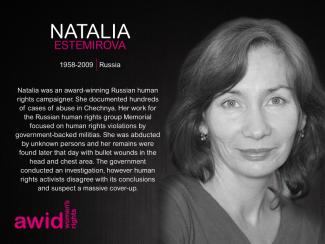
Notre hommage en ligne met à l’honneur cinq défenseuses des droits humains assassinées au Moyen-Orient ou en Afrique du Nord. Ces défenseuses étaient avocates ou militantes et ont œuvré pour les droits des femmes ou pour les droits civils. Leur mort met en évidence les conditions de travail souvent difficiles et dangereuses dans leurs pays respectifs. Nous vous invitons à vous joindre à nous pour commémorer la vie, le travail et l’activisme de ces femmes. Faites circuler ces mèmes auprès de vos collègues et amis ainsi que dans vos réseaux et twittez en utilisant les hashtags #WHRDTribute et #16Jours.


S'il vous plaît cliquez sur chaque image ci-dessous pour voir une version plus grande et pour télécharger comme un fichier 

[scald=2457:sdl_editor_representation]


Snippet - WITM To Strengthen - ES

Para fortalecer nuestra voz y poder colectivos para obtener más y mejor financiamiento para las organizaciones feministas, por los derechos de las mujeres y de las personas LBTQI+ y demás organizaciones aliadas de todo el mundo.

Snippet FEA Introducing Carmen Silva Ferreira (EN)

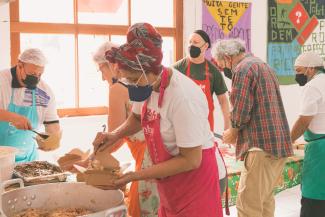
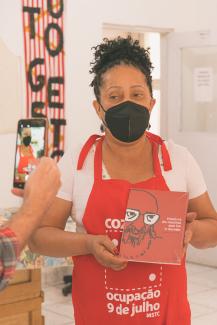
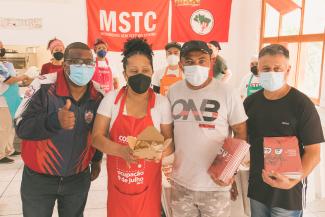
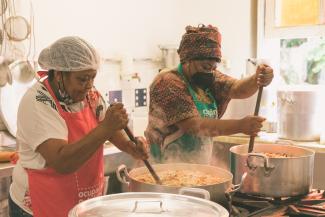
We have the pleasure to introduce you to Carmen Silva Ferreira.

She was born in Bahia, the Northeastern part of Brazil. She is an immigrant, a social activist and a mother of 8 children.

Carmen experienced homelessness at the age of 35, after migrating to Sao Paulo on her own. This led her to become a fierce advocate for vulnerable, marginalized and invisibilized communities most affected by the housing crisis. She eventually became one of the founders of MSTC in 2000.

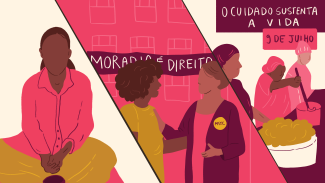
As a visionary political organizer and the current leader of the MSTC, Carmen’s work has laid bare the city's housing crisis and provided inspiration to others on different ways to organize and manage occupations. She stood strong on the forefront of several occupations. One of them is the 9 de Julho Occupation, which now serves as a stage for direct democracy, and a space where everyone can be heard, seen, appreciated and work together.

Carmen has been long celebrated for her boldness in giving life back to abandoned buildings in the heart of São Paulo.

To know more about her life, you can follow her on Instagram!

2009: l´ONU organise une conférence sur l´impact de la crise économique

La Conférence des Nations Unies de 2009 sur la crise financière et économique mondiale et son incidence sur le développement

  • La  conférence  de 2009  était l’aboutissement de celle de Doha en 2008. La Déclaration de Doha avait  mandaté  les Nations Unies  pour organiser, sous l’égide du Président de l’Assemblée générale, une conférence consacrée à la crise financière et économique mondiale et à son incidence sur le développement.
  • Pendant la conférence, les groupes de femmes, par le biais du WWG ont souligné l’impact de la crise financière mondiale sur les groupes les plus vulnérables. Dans sa déclaration aux membres (en anglais), le WWG a  proposé une liste d’actions nécessaires que les États membres devraient mettre en œuvre pour pallier  aux conséquences de la crise sur les femmes. Le groupe de travail a également déclaré que la prise en compte des autres groupes sociaux touchés par la crise était essentielle pour apporter une réponse qui soit en accord avec les normes et les engagements internationaux relatifs à l’égalité des genres, aux droits des femmes, aux droits humains et à l’autonomisation. 

WHRDs from Sub-Saharan Africa

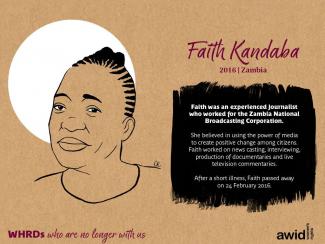
In our 2015 Online Tribute to Women Human Rights Defenders No Longer With Us we are commemorating four women from Sub-Saharan Africa, three of whom were murdered due to their work and/or who they were in their gender identity and sexual orientation. Their deaths highlight the violence LGBT persons often face in the region and across the globe. Please join AWID in honoring these women, their activism and legacy by sharing the memes below with your colleagues, networks and friends and by using the hashtags #WHRDTribute and #16Days. 


Please click on each image below to see a larger version and download as a file


Snippet - WITM Survey will remain open - FR

Regardez le webinaire « Où est l'argent?» maintenant !

Le 11 juillet 2024, nous avons eu une conversation étonnante avec de grandes féministes sur l'état de l'écosystème du financement et le pouvoir du recherche « Où est l'argent ? ».

Un merci spécial à Cindy Clark (Thousand Currents), Sachini Perera (RESURJ), Vanessa Thomas (Black Feminist Fund), Lisa Mossberg (SIDA) et Althea Anderson (Fondation Hewlett).

N'oubliez pas que l'enquête restera ouverte jusqu'au 31 août 2024 !

Regardez le webinaire

Gauri Lankesh

Snippet FEA ASOM Challenges Story 1 (ES)

DESAFÍOS

  • Cambio Climático
  • Acesso a créditos
  • Intermediários

March 2015: The Zero-Draft Outcome Document is released

Release of the Zero-Draft Outcome Document, March 2015

  • The zero-draft outcome document (dated 16 March), prepared by the Co-facilitators, was released for discussion at the 2nd drafting session from 13-17 April 2015
  • During the opening session, the WWG on FfD called for dedicated resources for gender equality and women’s empowerment as stated in both the Monterrey Consensus and Doha Declaration,to be added into the Zero draft. 

Research methology

Over eight years, we did four global surveys and built a research methodology.

In 2013, we published three global reports. These reports confirm that women’s rights organizations are doing the heavy lifting to advance women’s rights and gender equality by using diverse, creative and long-term strategies, all while being underfunded.

Our 2010 global survey showed that the collective income of 740 women’s organizations around the world totaled only USD 104 million. Compare this with Greenpeace International, one organization with a 2010 budget of USD 310 million1. Imagine the impact these groups could have if they were able to access all the financial resources they need and more?

AWID’s WITM research has catalyzed increased funding for women’s rights organizing. WITM research was a driving force behind the Catapult crowdfunding platform, which has raised USD 6.5 million for women’s rights. The Dutch Government cited WITM research as a reason for its unprecedented MDG 3 Fund of EU 82 million. WITM research has also led to the creation of several new funds: FRIDA – The Young Feminist Fund, the Indigenous Women’s Fund, Fundo Elas, the Mediterranean Women’s Fund and the Rita Fund.

Funding trends analyses

While the WITM research has shed important light on the global funding landscape, AWID and partners have identified the need to dig deeper, to analyze funding trends by region, population and issue. In response, organizations are now using AWID’s WITM research methodology to do their own funding trends analyses. For example, in November 2013, Kosova Women’s Network and Alter Habitus – Institute for Studies in Society and Culture published Where is the Money for Women’s Rights? A Kosovo Case Study.

At the same time, AWID continues to collaborate with partners in Where is the Money for Indigenous Women’s Rights (with International Indigenous Women’s Forum and International Funders for Indigenous Peoples) and our upcoming Where is the Money for Women’s Rights in Brazil? (with Fundo Elas).

Several organizations have also conducted their own independent funding trends research, deepening their understanding of the funding landscape and politics behind it. For example, the South Asian Women’s Fund was inspired by AWID’s WITM research to conduct funding trends reports for each country in South Asia, as well as a regional overview. Other examples of research outside of AWID include the collaboration between Open Society Foundations, Mama Cash, and the Red Umbrella Fund to produce the report Funding for Sex Workers Rights, and the first-ever survey on trans* and intersex funding by Global Action for Trans* Equality and American Jewish World Service.


Snippet - WITM RESOURCES - ES

Recursos

Snippet FEA Barcelona, Spain (FR)

Barcelone, Espagne

Metzineres


Les Gens se Droguent.

ET ALORS?

¿Qué es el Proceso de la Financiación para el Desarrollo de Naciones Unidas?

El proceso de la Financiación para el Desarrollo (FpD) de Naciones Unidas (ONU) se propone abordar distintas formas de financiación y cooperación para el desarrollo. Según lo acordado en el Consenso de Monterrey, se centra en seis áreas prioritarias:

  • Movilización de recursos financieros nacionales para el desarrollo;
  • Movilización de recursos internacionales para el desarrollo: la inversión extranjera directa y otras corrientes de capitales privados;
  • El comercio internacional como promotor del desarrollo;
  • Aumento de la cooperación financiera y técnica internacional para el desarrollo;
  • La deuda externa;
  • Tratamiento de cuestiones sistémicas: fomento de la coherencia y la cohesión de los sistemas monetarios, financieros y comerciales internacionales en apoyo al desarrollo.

7. Synthesize your research findings

Now that you have analyzed all your data – from your survey, interviews, desk research and potentially other sources – you can create your final product.

In this section:

Create your final product

Your final product will be the document that will summarize, analyze and criticize your data. That will be the piece that you will share with your community to present and explain your research to your audience.

At AWID, we often write a comprehensive written report that analyzes each set of data and synthesizes all of our findings, then later create smaller products, such as infographics and summaries (explained in the subsequent section “Finalize and format”).

1. Write clearly

  • Organize your data as you would like to tell a story. You can follow the order of your survey. Or you can regroup some questions to lead to your conclusion in a smooth and progressive way.
  • Adapt your language to your audience. Use universal language and avoid jargon or too technical terms.

Importance of the editor

An editor will proofread, ensure concise writing, conduct fact-checking, point out inconsistencies that need to be resolved, arrange the flow of the document and possibly suggest titles.

Your editor should preferably be someone who understands and knows your WITM work but who was not directly involved in the research. This will bring in a fresh perspective.

2. Make it pretty

  • Use the data collected to create graphs and tables. These type of visuals are a compelling way to highlight the main findings of your research and validate your analysis.

  • Source relevant images that can illustrate your report.

  • Highlight key-numbers and/or powerful testimonials.

Remember: The more accessible your product is, the more people will want to read (and share!) it.

Back to top


Gather review & inputs

At this point, you have collected all your data, analyzed it and transformed it into your final product, likely in a long report.

1. Polish your results

Before moving on to the next steps – you should share your final research product with your advisor organizations, activists, and donors.

This is a great moment to check the following points:

  • Are there any key points missing in your analysis of the present funding landscape and trends?
  • Are there any key points missing in your conclusions?
  • Are there any inaccuracies in the data that need to be corrected?
  • General suggestions on strengthening the report to achieve your goals as listed in your research framing.

Once you have inputted all feedback from your advisors, be sure to run it by your editor once more.

This will now be the final, completed version of your report.  If you intend to publish the final report in other languages, now is the time to send it for translation.

2. Facilitate the feedback

  • Your advisors are likely busy with their regular responsibilities. Be sure to request feedback within a reasonable deadline.
  • Keep your request for feedback brief and specific, so it is easy for them to respond. If you like, you can simply copy and paste the bullet points we have provided.
  • If you are publishing in multiple languages, ensure you have advisors who can also review the final translated versions of your product(s).

This is a significant contribution from your advisors. Consider offering them some form of recognition.

Back to top


Previous step

6. Conduct desk research

Next step

8. Finalize and format


Estimated time:

• 2 - 5 months

People needed:

• 1 or more research person(s)
• 1 Editor (or web-editor if you create an online product)
• Translator(s), if done in more than one language

Resource needed:

• List of advisor organizations, activists, and donors.
• Concept note (from “Frame your research” section)
• Survey topline results
• Prepared interview questions
• Interview results
• Desk research data
• All other data used in report


Previous step

6. Conduct desk research

Next step

8. Finalize and format


Ready to Go? Worksheet

Download the toolkit in PDF