Magalie Marcelin
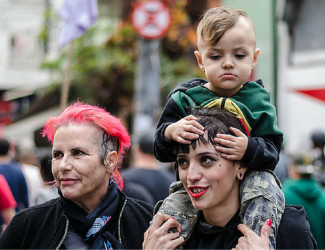
Over the past few years, a troubling new trend at the international human rights level is being observed, where discourses on ‘protecting the family’ are being employed to defend violations committed against family members, to bolster and justify impunity, and to restrict equal rights within and to family life.
The campaign to "Protect the Family" is driven by ultra-conservative efforts to impose "traditional" and patriarchal interpretations of the family, and to move rights out of the hands of family members and into the institution of ‘the family’.
Since 2014, a group of states have been operating as a bloc in human rights spaces under the name “Group of Friends of the Family”, and resolutions on “Protection of the Family” have been successfully passed every year since 2014.
This agenda has spread beyond the Human Rights Council. We have seen regressive language on “the family” being introduced at the Commission on the Status of Women, and attempts made to introduce it in negotiations on the Sustainable Development Goals.
AWID works with partners and allies to jointly resist “Protection of the Family” and other regressive agendas, and to uphold the universality of human rights.
In response to the increased influence of regressive actors in human rights spaces, AWID joined allies to form the Observatory on the Universality of Rights (OURs). OURs is a collaborative project that monitors, analyzes, and shares information on anti-rights initiatives like “Protection of the Family”.
Rights at Risk, the first OURs report, charts a map of the actors making up the global anti-rights lobby, identifies their key discourses and strategies, and the effect they are having on our human rights.
The report outlines “Protection of the Family” as an agenda that has fostered collaboration across a broad range of regressive actors at the UN. It describes it as: “a strategic framework that houses “multiple patriarchal and anti-rights positions, where the framework, in turn, aims to justify and institutionalize these positions.”
Articulate feminist visions, proposals and agendas for resourcing justice.
We have been contacted by global and regional partners about some ideas for pre-Forum convenings and we will share more information about these ideas soon.
Many beautiful things emerged from the 2016 Black Feminisms Forum (BFF) that was organized by an Advisory Group and funded by AWID. Some of the independent organizing that arose from the BFF include Black feminist organizing in Brazil. While we won’t have another BFF this year, we remain committed to sharing some key learnings with anyone interested in continuing work around Black feminist organizing.
Les groupes, organisations et mouvements qui travaillent spécifiquement, ou principalement, à la défense des droits des femmes et des filles, pour la justice de genre, pour la défense des droits des personnes LBTQI+ et des allié·es dans toutes les régions et à tous les niveaux, que ces structures soient récentes ou non.

The 14th AWID International Forum will take place 20-23 September 2021 in Taipei, Taiwan.
Una comunidad en línea desarrollada para y por las jóvenes feministas que trabajan por los derechos humanos de las mujeres, la igualdad de género y la justicia social en todo el mundo.
FRIDA: proporciona financiamiento a iniciativas lideradas por jóvenes feministas. Busca fortalecer la capacidad de las organizaciones de jóvenes feministas para obtener recursos para su trabajo e incrementar los compromisos de donantes y aliados con la dotación de fondos para el activismo joven feminista.
En esta plataforma podrás encontrar información y recursos sobre cómo proteger la universalidad de los derechos en espacios internacionales y regionales de derechos humanos.
Visita la página (en inglés)
Sitio obligado para conocer las respuestas urgentes emprendidas para proteger a las defensoras de los derechos humanos y encontrar herramientas y recursos en apoyo del trabajo y el bienestar de las defensoras.
La Iniciativa Mesoamericana de Mujeres Defensoras de Derechos Humanos es una iniciativa regional creada para prevenir, responder, documentar y dar a conocer todos los casos de violencia ejercida contra las defensoras de los derechos humanos en la región mesoamericana.
La Coalición es una red de recursos y promoción para la protección y el apoyo a las mujeres defensoras de los derechos humanos en todo el mundo.
Visita la página (en inglés)
Una coalición de organizaciones feministas, por los derechos de las mujeres, por las mujeres y el desarrollo, y de organizaciones de base y por la justicia social que trabajan para interpelar y dar nuevo marco la agenda global para el desarrollo.
Visita la página (en inglés)
El rol del Grupo consiste en garantizar una participación pública efectiva de los grupos no gubernamentales de mujeres en los procesos normativos de la ONU sobre el desarrollo sostenible, la agenda posterior a 2015 y los asuntos ambientales.
Visita la página (en inglés)
Una alianza de organizaciones y redes de mujeres que promueve el avance de la igualdad de género, el empoderamiento de las mujeres y sus derechos humanos en los procesos de la ONU referidos al financiamiento para el desarrollo.
Visita la página (en inglés)
NOUS SOMMES LA SOLUTION
Somos la Solución
External funding includes grants and other forms of funding from philanthropic foundations, governments, bilateral, multilateral or corporate funders and individual donors – from both within your country or abroad. It excludes resources that groups, organizations and/or movements generate autonomously such as, for example, membership fees, the voluntary contributions of staff, members and/or supporters, community fundraisers, venue hires or sale of services. For ease and clarity, definitions of the different types of funding as well as short descriptions of different donors are included in the survey.
Related content
AfriCOG's security forum: Eva Ayiera on key drivers of Kenya's security threats (Video)
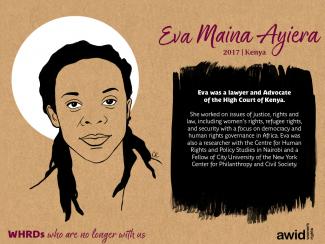
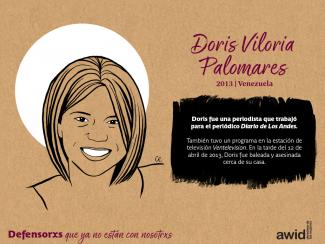
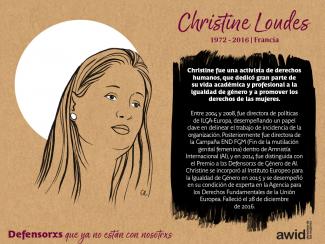
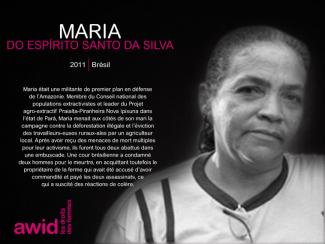
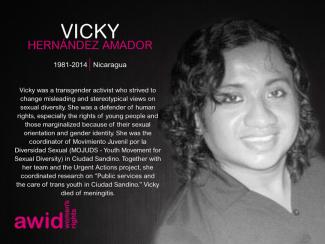
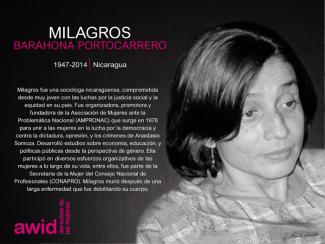
These 21 Women Human Rights Defenders (WHRDs) worked as journalists and more widely in the media sector in Mexico, Colombia, Fiji, Libya, Nepal, United States, Nicaragua, Philippines, Russia, Germany, France, Afghanistan, and the United Kingdom. 17 of them were murdered and in one case the cause of death is still unclear. On this World Press Freedom Day, please join us in commemorating the life and work of these women by sharing the images below with your colleagues, friends and networks using the hashtags #WPFD2016 and #WHRDs.
The contributions of these women were celebrated and honoured in our Tribute to Women Human Rights Defenders (WHRDs) Who Are No Longer With Us.
Please click on each image below to see a larger version and download as a file


Tenemos el placer de presentarte a Mariama Sonko, inspiradora ecofeminista, campesina y defensora de los derechos humanos y de las mujeres, que vive actualmente en Niaguis, en el suroeste de Senegal.
Al crecer en una familia y comunidad campesina rural, fue testigo del papel esencial de la mujer en la producción de alimentos y el almacenamiento de semillas desde la infancia, mientras estaba inmersa en el trabajo y ritmos de la tierra.
Mariama ha defendido el conocimiento agrícola local y las prácticas campesinas desde los años 1990. Como madre de 5 hijos, los alimentos que ella misma cultiva son la principal fuente de sustento de su familia.
Actualmente es presidenta de Nous Sommes la Solution y está comprometida con la promoción de las prácticas agroecológicas y la agricultura familiar, con el fomento de la soberanía alimentaria, la biodiversidad y la preservación de las semillas campesinas, y con la exigencia del acceso equitativo a los recursos y a la tierra en África Occidenta para las mujeres.
Fuente: AWID’s Feminist Realities Festival Crear | Résister | Transform - 2º día
AWID tiene un compromiso con la justicia lingüística y, en este punto, lamentamos no poder contar con más idiomas para la encuesta ¿Dónde está el dinero? Sin embargo, en caso de que necesites asistencia con la traducción o desees responder la encuesta en otro idioma, te pedimos que nos contactes al email witm@awid.org.