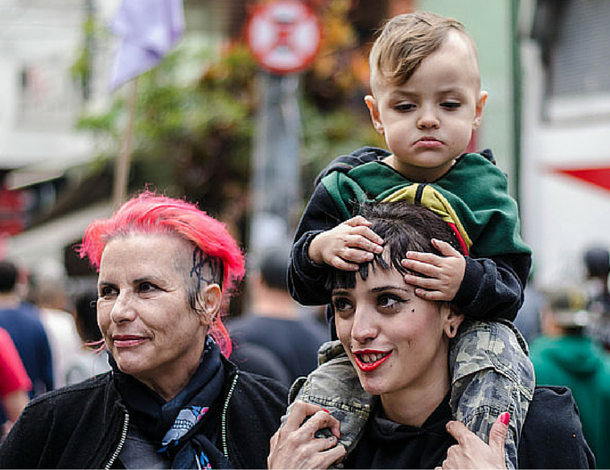
Flickr/Leonardo Veras (CC BY 2.0)

Special Focus

AWID is an international, feminist, membership organisation committed to achieving gender equality, sustainable development and women’s human rights

Protection of the Family

The Issue

Over the past few years, a troubling new trend at the international human rights level is being observed, where discourses on ‘protecting the family’ are being employed to defend violations committed against family members, to bolster and justify impunity, and to restrict equal rights within and to family life.

The campaign to "Protect the Family" is driven by ultra-conservative efforts to impose "traditional" and patriarchal interpretations of the family, and to move rights out of the hands of family members and into the institution of ‘the family’.

“Protection of the Family” efforts stem from:

  • rising traditionalism,
  • rising cultural, social and religious conservatism and
  • sentiment hostile to women’s human rights, sexual rights, child rights and the rights of persons with non-normative gender identities and sexual orientations.

Since 2014, a group of states have been operating as a bloc in human rights spaces under the name “Group of Friends of the Family”, and resolutions on “Protection of the Family” have been successfully passed every year since 2014.

This agenda has spread beyond the Human Rights Council. We have seen regressive language on “the family” being introduced at the Commission on the Status of Women, and attempts made to introduce it in negotiations on the Sustainable Development Goals.


Our Approach

AWID works with partners and allies to jointly resist “Protection of the Family” and other regressive agendas, and to uphold the universality of human rights.

In response to the increased influence of regressive actors in human rights spaces, AWID joined allies to form the Observatory on the Universality of Rights (OURs).  OURs is a collaborative project that monitors, analyzes, and shares information on anti-rights initiatives like  “Protection of the Family”.

Rights at Risk, the first OURs report, charts a map of the actors making up the global anti-rights lobby, identifies their key discourses and strategies, and the effect they are having on our human rights.   

The report outlines “Protection of the Family” as an agenda that has fostered collaboration across a broad range of regressive actors at the UN.  It describes it as: “a strategic framework that houses “multiple patriarchal and anti-rights positions, where the framework, in turn, aims to justify and institutionalize these positions.”


Related Content

Snippet FEA Get Involved Story 2 (EN)

GET INVOLVED!

You can follow Nous Sommes la Solution
on Facebook and support their work by donating here.

Sara AbuGhazal

Biography

Sara AbuGhazal es una feminista palestina que vive en Beirut. Es cofundadora de Sawt al-Niswa, un colectivo que produce conocimiento en Beirut. Es codirectora de The Knowledge Workshop [«Taller del conocimiento»], una organización feminista con sede en Beirut que trabaja en la historia oral y el archivo feminista. Sara es actualmente la Coordinadora Regional de la Coalición Regional para Defensoras de los Derechos Humanos en el Medio Oriente y África del Norte.

Sara lucha para ayudar a crear espacios de transformación feminista y solidaridad. Su trabajo se centra principalmente en la construcción de movimientos sostenibles en la región del MOAN. Sara se empeña en temas de la Palestina, la producción de conocimiento y la transformación feminista. Publica regularmente en sawtalniswa.org y su obra de ficción también aparece en la revista electrónica Romman


Add to stories
Off

Nadine Ramaroson

Son soutien aux femmes et aux personnes les plus vulnérables de sa communauté a fait que Nadine était un modèle pour beaucoup. Elle était déterminée à aider les pauvres et les sans-abri en particulier.

Bien que sa mort ait été déclarée comme étant accidentelle, la famille Ramaroson, sur l’initiative de son père André Ramaroson, a mené une enquête qui a mis en évidence des preuves de son assassinat. Elle serait décédée dans un accident mortel survenu entre Soanierano - Ivongo et Ste Marie - une histoire qui a été réfutée par sa famille. Elle avait reçu de nombreuses menaces de mort pour ses positions politiques résolues. L’affaire est toujours en cours auprès des tribunaux à Antananarivo (la capitale de Madagascar).


Nadine Ramaroson, Madagascar

Snippet - CSW69 - Feminist Solidarity Space - EN

Feminist Solidarity Space

✉️ By registration for larger groups. Drop-ins for smaller groups. Register here

📅 Tuesday, March 11, 2025
🕒 12.00-2.00pm and 4.00-6.00pm EST

🏢 Chef's Kitchen Loft with Terrace, 216 East 45th St 13th Floor New York

Organizer: AWID

Snippet FEA argentina history cooperatives (ES)

Argentina tiene una larga historia de cooperativas autogestionadas y lugares de trabajo controlados por lxs trabajadorxs.

En 2001, el país vivió una de las peores crisis económicas de su historia.

Como respuesta a la recesión y como forma de resistencia y resiliencia, lxs trabajadorxs de todo el país comenzaron a ocupar sus lugares de trabajo.

La Cooperativa Textil Nadia Echazú fue la primera cooperativa creada por y para personas trans y travesti en busca de autonomía económica y condiciones de vida dignas.

Proporciona oportunidades de trabajo, acceso a la seguridad social, ingresos sostenibles y derechos económicos para las comunidades a las que sirve.

Salome Chagelishvili

Biography

Salome est une activiste féministe originaire de Tbilisi, Géorgie, qui se consacre à la justice de genre et sociale. Titulaire d’une Maîtrise en études sur le genre, elle s’est impliquée auprès de mouvements féministes, queers et écologiques au cours des neuf dernières années, travaillant entre autres sur les questions de la violence liée au genre, la violence domestique, la santé sexuelle et reproductive et les droits afférents, les droits LGBTIQ et la sécurité et les droits holistiques et numériques.

Depuis 2014, elle travaille activement sur les questions de sécurité et de sûreté des activistes et des femmes défenseures des droits humains, organisant des ateliers sur la sécurité intégrée et la sécurité numérique spécialement pour les activistes de groupes défavorisés (personnes homosexuelles, minorités ethniques et religieuses, femmes et filles rurales, etc.) ainsi que pour de grandes organisations féministes. Salome est membre de l’Independent Group of Feminists (Groupe indépendant de féministes)- une initiative non-formelle, non hiérarchique et non enregistrée qui réunit des féministes géorgiennes ayant différents parcours. Elle travaille actuellement avec le Fonds pour les femmes de Géorgie, où elle est pleinement impliquée dans la construction de mouvements de femmes/féministes, tout en offrant un financement féministe et encourageant la philanthropie féministe locale.


Add to stories
Off

Sainimili Naivalu

« J’ai constaté la discrimination dans la rue, que ce soit par des taquineries ou des agressions verbales qui y ont lieu. Je me suis aussi faite plein d’ami·e·s et j’y ai rencontré plusieurs personnes. Il se peut que ce soit dangereux là-bas, mais je suis une survivante, et pour le moment, c’est là où je suis. » -  Sainimili Naival

Sainimili Naivalu était une activiste féministe des droits des personnes handicapées issue du village de Dakuibeqa, sur l’île de Beqa aux Fidji.

Elle a demandé aux responsables et acteurs politiques de fournir des politiques et des services adaptés au handicap, comme la construction de rampes dans les villes et les villages afin d'accroître leur accessibilité. Les barrières physiques n’étaient pas les seules qu’elle aspirait à modifier. Sur la base de sa propre expérience, elle savait que des changements plus difficiles devaient être menés dans les sphères économiques et sociales. Bon nombre des défis avec lesquels sont aux prises les personnes handicapées trouvent leurs racines dans les attitudes discriminantes et stigmatisantes. 

Survivante et combattante, Sainimili a contribué à co-créer des réalités féministes qui renforcent l’inclusion et font évoluer les attitudes par rapport à l’égalité des personnes handicapées. Elle a été membre de la Spinal Injury Association of Fiji (SIA) ainsi que participé à la formation « Démarrez votre entreprise » de l’Organisation internationale du Travail à Suva via le projet « Pacific Enable » (le Pacifique rend possible) du Forum Asie-Pacifique sur le handicap. Elle a ainsi pu transformer ses idées en une entreprise qui lui était propre. Elle était commerçante sur l’étal de marché 7 de Suva, offrant des services de manucure, tout en gérant un stand au marché des femmes SIA pour y vendre de l’artisanat, des suls et des objets historiques. Sainimili planifiait d’élargir son commerce et de devenir une employeuse majeure de personnes handicapées. 

Outre son activisme, elle était également médaillée de tennis de table et une récente championne.

Avec sa personnalité vive, Sainimili était unique. On savait toujours lorsqu’elle était dans la pièce car ses rires et ses histoires étaient la première chose qu’on pouvait remarquer. -  Michelle  Reddy

Sainmili est décédée en 2019.
 

Snippet - Resources to rally - EN

Resources to rally through CSW69 with

Snippet FEA Life expectancy of a trans and travesti (FR)

This illustration depicts a faceless person with long dark hair and a burgundy shirt, with the number 37 written across the image (37 being the life expectancy of a trans and travesti person in Argentina)

L'espérance de vie d'une personne trans et travesti en Argentine est de 37 ans - l'âge moyen de la population générale est de 77 ans.

Patience Chabururuka

Biography

Patience is a global human resources professional with over a decade of experience in human resources (HR) management in the not-for-profit sector. Patience previously worked at Mercy Corps as the Global HR Officer for Africa supporting the full employee life cycle for expatriates in the Eastern and Southern African region and provided HR technical guidance to Human Resources leaders in country offices within the African region. Before joining the global people team, she was the Country Human Resources and Safeguarding Focal Point, she was part of the senior management team leading on all human resources and safeguarding matters. Prior to Mercy Corps she led the HR and Operations department at SNV Netherlands Development Organization and was a member of the country management team. She also has HR Consultancy experience which she gained while she was still studying for her BSc Honors degree in Human Resource Management. She has a passion for HR, loves working with people and she takes wellbeing and safeguarding as her core values and in her professional work. As someone who loves sports, you can also find Patience at the basketball court, the tennis court or on the soccer field.

Position
Human Resources Coordinator
Add to stories
Off

Molara Ogundipe

“But when was the master
ever seduced from power?
When was a system ever broken
by acceptance?
when will the BOSS hand you power with love?
At Jo’Burg, at Cancun or the U.N?
– Molara Ogundipe

In an interview at the 2010 Ghana International Book Fair, Molara Ogundipe introduced herself with the words: “...I’m a Nigerian. I’ve lived possibly all over the world except for the Soviet Union and China.”

Across the different continents and countries, Professor Ogundipe taught comparative literature, writing, gender, and English studies using literature as a vehicle for social transformation and re-thinking gender relations. 

A feminist thinker, writer, editor, social critic, poet, and activist Molara Ogundipe succeeded in combining theoretical work with creativity and practical action. She is considered to be one of the leading critical voices on African feminism(s), gender studies and literary theory.

Molara famously coined the concept of “stiwanism’ from the acronym STIWA – Social Transformations in Africa Including Women recognizing the need to move “away from defining feminism and feminisms in relation to Euro-America or elsewhere, and from declaiming loyalties or disloyalties.”

In her seminal work ‘Re-creating Ourselves’ in 1994, Molara Ogundipe (published under Molara Ogundipe-Leslie) left behind an immense body of knowledge that decolonized feminist discourse and “re-centered African women in their full, complex narratives...guided by an exploration of economic, political and social liberation of African women and restoration of female agency across different cultures in Africa.”

In speaking about the challenges she faced as a young academic she said: 

”When I began talking and writing feminism in the late sixties and seventies, I was seen as a good and admirable girl who had gone astray, a woman whose head has been spoilt by too much learning".

Molara Ogundipe stood out for her leadership in combining activism and academia; in 1977 she was among the founding members of AAWORD, the Association of Women in Research and Development. In 1982 she founded WIN (Women In Nigeria) to advocate for full “economic, social and political rights” for Nigerian women. She then went on to establish and direct the Foundation for International Education and Monitoring and spent many years on the editorial board of The Guardian.

Growing up with the Yoruba people, their traditions, culture, and language she once said :

“I think the celebration of life, of people who pass away after an achieved life is one of the beautiful aspects of Yoruba culture.” 

Molara’s Yoruba ‘Oiki’ praise name was Ayike. She was born on 27 December 1940 and at the age of 78, Molara passed away on 18 June 2019 in Ijebu-Igbo, Ogun State, Nigeria.

Snippet - Homepage CSW69_ES

AWID en la CSW69 Beijing+30 | #CongelarFascismos

Nuestra presencia colectiva trastorna las prácticas institucionales de exclusión en dichos espacios y, a la vez, apoya los procesos de organización de los movimientos en torno a las alternativas feministas a los sistemas de opresión.

Súmate a las conversaciones desde el 10 al 21 de marzo de 2025, mientras transformamos de forma colectiva la CSW69 en espacios para y sobre la resistencia y la solidaridad.

Conoce más

Snippet FEA Exclusion and Stigma (EN)

An illustration of a megaphone in navy blue. Lines representing sound waves are coming out the speaker end, in burgundy.

THE EXCLUSION, STIGMA AND INSTITUTIONAL ABUSE
that trans and travesti people continue to face on a daily basis

Debbie Stothard

Biography

Durante sus 38 años de carrera, Debbie Stothard ha trabajado con diferentes comunidades y activistas para involucrar en los derechos humanos y la justicia a los Estados, organizaciones intergubernamentales y otras partes interesadas a lo largo de Asia, África, Europa y las Américas. Su trabajo está enfocado en las prioridades temáticas de las empresas y en los derechos humanos, en la prevención de las atrocidades y en el liderazgo de las mujeres. Por ello, ha sido facilitadora o persona de referencia en casi 300 eventos de capacitación durante los últimos 15 años. La mayoría fueron talleres orientados a las bases, desarrollados en el terreno, centrados en la incidencia en derechos humanos, alfabetización económica, en empresas y derechos humanos, y en justicia transicional y prevención de las atrocidades. Su trabajo en justicia transicional y prevención de las atrocidades ha estado enfocado principalmente en Burma/Myanmar, aunque también ha proveído asesoramiento para responder a situaciones de otros países alrededor del mundo.

Entre 1981 y 1996, Debbie trabajó como periodista especializada en crímenes, activista estudiantil, analista política, académica, consejera de gobierno y proveedora de comida en Malasia y Australia, mientras era voluntaria en causas de derechos humanos. En 1996, fundó ALTSEAN-Burma, que encabezó una variedad de programas de innovación y empoderamiento en derechos humanos. Entre ellos, el programa intensivo permanente de liderazgo de ALTSEAN para diferentes mujeres jóvenes de Burma, que, durante los últimos 22 años, ha ayudado a fortalecer y ampliar el liderazgo de las mujeres en las zonas afectadas por el conflicto. Se desempeñó como integrante de la Junta de la Federación Internacional de Derechos Humanos (FIDH) durante 9 años como secretaria general adjunta (2010-2013) y secretaria general (2013-2019), durante los cuales promovió la misión y el perfil de la FIDH en, aproximadamente, 100 reuniones y conferencias por año.

Add to stories
Off

Yamile Guerra

Yamile Guerra fue una conocida abogada, líder comunitaria y activista política de la región colombiana de Santander.

Trabajó activamente para resolver las disputas entre comunidades locales y empresas promotoras, y abogó contra la apropiación ilegal de las tierras. Yamile ocupó varios cargos políticos, entre ellos la Secretaría General del Gobierno de Santander en Bogotá, y se presentó también a la Alcaldía de Bucaramanga. En los últimos años de su vida, Yamile se volvió cada vez más activa en las causas medioambientales contra los desarrollos urbanos, particularmente, en la defensa de los humedales biodiversos de Santurbán contra los desarrollos urbanos, una región que abastece de agua dulce a casi 2 millones de personas .

Según su familia y amigxs, Yamile recibía amenazas de muerte a diario y había pedido protección a las autoridades.

"Ella era muy consciente de este problema [litigio de tierras] y manifestó repetidamente que se sentía insegura". - Alixon Navarro Muñoz, periodista y amigo de la familia Guerra.
El 20 de julio de 2019, Yamile fue asesinada a tiros por dos hombres en Floridablanca, Santander. Acababa de terminar de discutir con ellos por una disputa de tierras. Un sospechoso fue arrestado más tarde por su asesinato y admitió haber recibido un pago por llevar a cabo su asesinato. Según varios informes, o Yamile fue la tercera integrante de su familia en ser asesinada a causa de las disputas por tierras. El padre de Yamile, Hernando Guerra, había sido  asesinado también varios años antes.

El asesinato de Yamile forma parte de una ola de violencia y asesinatos sistemáticos contra cientos de activistas sociales y defensorxs de los derechos humanos en Colombia. Según el Instituto de Estudios para el Desarrollo y la Paz (INDEPAZ), en el momento de la muerte de Yamile, más de 700 líderes comunitarios y activistas de derechos humanos habían sido asesinadxs desde que el país firmó un acuerdo de paz en agosto de 2016. La mayoría de ellxs fueron asesinadxs por enfrentar el tráfico ilegal de drogas y las operaciones mineras. Las personas  indígenas, afrocolombianas y las mujeres defensoras de derechos humanos son lxs activistas que corren mayor riesgo.

Menos de una semana después de la muerte de Yamile, miles de colombianxs marcharon por pueblos y ciudades sosteniendo fotos en blanco y negro de activistas que habían sido asesinadxs, en las pancartas se podía leer: "Sin líderes no puede haber paz" y "No más derramamientos de sangre".

Yamile Guerra tenía solo 42 años en el momento de su asesinato.

Snippet - WCFM Database blurb - En

AWID’s Who Can Fund Me?  Database

Regularly updated and searchable directory of 200+ funders across different sectors and regions that support vital gender justice work. 

Search and mobilize