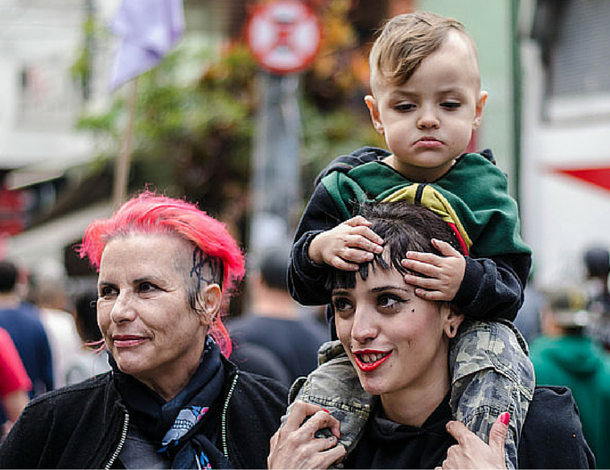
Over the past few years, a troubling new trend at the international human rights level is being observed, where discourses on ‘protecting the family’ are being employed to defend violations committed against family members, to bolster and justify impunity, and to restrict equal rights within and to family life.
The campaign to "Protect the Family" is driven by ultra-conservative efforts to impose "traditional" and patriarchal interpretations of the family, and to move rights out of the hands of family members and into the institution of ‘the family’.
“Protection of the Family” efforts stem from:
rising traditionalism,
rising cultural, social and religious conservatism and
sentiment hostile to women’s human rights, sexual rights, child rights and the rights of persons with non-normative gender identities and sexual orientations.
Since 2014, a group of states have been operating as a bloc in human rights spaces under the name “Group of Friends of the Family”, and resolutions on “Protection of the Family” have been successfully passed every year since 2014.
This agenda has spread beyond the Human Rights Council. We have seen regressive language on “the family” being introduced at the Commission on the Status of Women, and attempts made to introduce it in negotiations on the Sustainable Development Goals.
Our Approach
AWID works with partners and allies to jointly resist “Protection of the Family” and other regressive agendas, and to uphold the universality of human rights.
In response to the increased influence of regressive actors in human rights spaces, AWID joined allies to form the Observatory on the Universality of Rights (OURs). OURs is a collaborative project that monitors, analyzes, and shares information on anti-rights initiatives like “Protection of the Family”.
Rights at Risk, the first OURs report, charts a map of the actors making up the global anti-rights lobby, identifies their key discourses and strategies, and the effect they are having on our human rights.
The report outlines “Protection of the Family” as an agenda that has fostered collaboration across a broad range of regressive actors at the UN. It describes it as: “a strategic framework that houses “multiple patriarchal and anti-rights positions, where the framework, in turn, aims to justify and institutionalize these positions.”
Diana Isabel Hernández Juárez fue una maestra guatemalteca, defensora de los derechos humanos y activista comunitaria y del medioambiente. Fue la coordinadora del programa ambiental de la parroquia de Nuestra Señora de Guadalupe, en la costa sur del país.
Diana dedicó su vida a co-crear conciencia ambiental, y trabajó de modo particularmente estrecho con comunidades locales para abordar problemas ambientales y proteger los recursos naturales. Inició proyectos tales como viveros forestales, granjas municipales, huertas familiares y campañas de limpieza. Participó activamente en programas de reforestación, tratando de recuperar especies nativas y paliar la falta de agua, en más de 32 comunidades rurales.
El 7 de septiembre de 2019, Diana recibió disparos y fue asesinada por dos hombres armados desconocidos mientras se encontraba participando de una procesión en su comunidad. Diana tenía solamente 35 años en el momento de su muerte.
Body
Snippet FEA Trans and Travesti people (ES)
EL CUPO LABORAL TRANS
no está siendo respetado por las empresas
AWID Members Engaging at CSW61
Member states and women's rights advocates and organisations are gathering at the United Nations Headquarters in New York from 13 - 24 March for the 61st Commission on the Status of Women to address ‘women’s economic empowerment’ in the context of Sustainable Development Goal 5.
Whilst AWID is looking forward to physically meeting those of you who will be in New York, we want to engage with all those who cannot attend CSW, and as much as possible, amplify your voices in relevant spaces.
Continue reading to find out how to engage with AWID around CSW, whether you are attending physically or not.
Participate in an artistic takeover!
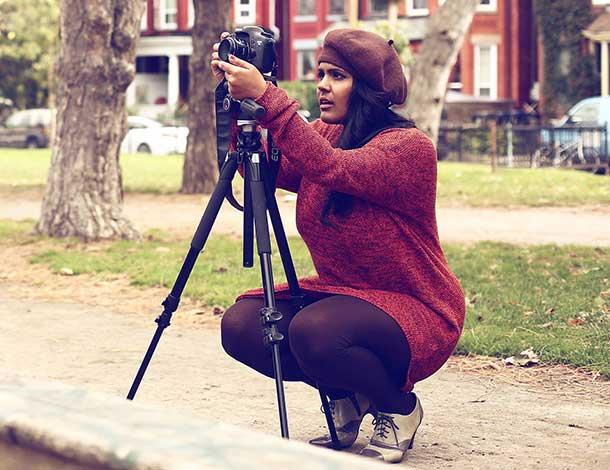
We are thrilled that AWID member Nayani Thiyagarajah is attending CSW this year and will take over the AWID Instagram. She will be available onsite to connect with other members for a possible feature on our Instagram. She will also explore possibilities of including some AWID members in a short film on the theme, ‘The personal is political’, a story of Nayani’s participation in this year’s CSW.
Nayani Thiyagarajah
Who is Nayani?
Nayani Thiyagarajah is a director, producer, and writer, dedicated to stories for the screen. A daughter of the Tamil diaspora, she calls Toronto home. For over 10 years, Nayani has worked in the arts and cultural industries. Her first independent feature documentary Shadeism: Digging Deeper (2015) had its World Premiere at the 2015 Zanzibar International Film Festival, where it won a Special Jury Prize. Nayani recently launched [RE]FRAME, with her producing partner Camaro West, a production company based out of Atlanta and Toronto, focused on re-framing the narratives around Black, Indigenous, and other people of colour through storytelling on screen.
On a more serious note, it should be noted that Nayani has a strange laugh, she's quite awkward, and her head is always in the clouds. She feels blessed beyond belief to create stories for the screen and play make believe for a living. Above all else, she believes in love.
Interested in meeting Nayani and being considered for inclusion in the film?
Send an email to membership@awid.org with the subject line “CSW Artistic Takeover”
By 13 March 2017
Please include your full name and country information.
Can't attend? Voice it!
If you are not able to attend CSW61 because of a travel ban, either due to the one imposed by the Trump administration or one you are facing from your own government, please share your story with us.
Send us messages you want heard in the United Nations spaces concerning funding, the impact of the reinstatement of the Global Gag Rule, and the need to push back against all types of religious fundamentalisms. You can send these in the following formats:
Video: no longer than two minutes and sent through a file sharing folder (for example dropbox, google drive)
Audio: no longer than two minutes and sent through a file sharing folder (for example dropbox, google drive)
Image: you can share a photo or a poster of your message
Text: no longer than 200 words and sent in the body of an email or in a word document
AWID members tell us that connecting with other members at CSW is valuable. In such a huge advocacy space, it is useful to connect with others including activists working on similar issues, or originating from the same country or region. Recognising the importance of connecting for movement building, we invite you to:
Interested in connecting with other members @CSW61?
If you are attending the CSW, we’d love to see what’s going on through your eyes!
Show us by capturing a moment you find speaks to the energy in the CSW space, be it on or off site. We hope to publish some of your ‘images’ on our social media channels and share on awid.org.
You can send us:
colour and/ or black and white photographs with a title (if you wish) and
a caption (no longer than 100 words) about the story your image tells.
Please also include:
your full name and country of origin and
let us know if we can publish the information you shared (in part or in full).
If the positions advertised have closed, or just don’t match your area of interest and expertise, we suggest the following resources for your job search.
Jaitun, souvent appelée « Amma », œuvrait à la protection des droits reproductifs des femmes et des filles en Inde. Son travail s’est particulièrement centré sur la défense des personnes pauvres et marginalisées, dont les filles et femmes dalits et musulmanes.
Jaitun était la force vitale derrière l’affaire Jaitun contre Janpura Maternity Home & Ors. Sa persévérance à obtenir justice a permis d’aboutir à un jugement sans précédent rendu par la Cour Suprême de Delhi. Le gouvernement indien a ainsi été tenu responsable de n’avoir pas rempli plusieurs de ses obligations juridiques, telles que les soins de santé reproductive et le droit à l’alimentation.
Sa fille Fatema, qui vivait sous le seuil de pauvreté, s’était vu refuser l’accès à des services de santé reproductive et avait dû accoucher en public, sous un arbre. Jaitun et Fatema étaient à cette époque sans domicile, car le gouvernement avait démoli leur maison dans le cadre d’un projet de réaménagement et de gentrification à New Delhi.
« Depuis, le jugement a fait jurisprudence pour de nombreux·euses avocat·e·s et activistes du monde entier, et notamment l’ancien Rapporteur spécial des Nations Unies sur le droit à la santé, non seulement comme source d’inspiration, mais comme solide tremplin pour obtenir la justice. » - Jameen Kaur
Jaitun a inspiré de très nombreuses autres femmes vivant dans la pauvreté à réclamer leurs droits. Elle s’est éteinte en 2017.
« Avec le décès de Jaitun, nous venons de perdre une inimitable guerrière pour la justice, mais son esprit de résistance perdure. » - Jameen Kaur
« Je n’ai, au cours de mes 18 années de plaidoyer pour les droits humains, jamais rencontré de femme qui m’ait tant inspirée et émue qu’Amma. Son courage féroce, son humour inimitable - nous la comparions à l’actrice de Bollywood Hema Malini -, ses colères lorsque l’on passait trop de temps sans venir la voir : elle nous disait, une étincelle dans le regard, « Tu as oublié Amma, Amma ne te parle plus », puis faisait volte-face de manière mélodramatique, pour se retourner en riant et tendre les bras pour une embrassade. Sa gentillesse, et en fin de compte son amour, sa joie d’aimer et sa volonté que chacun·e ait le droit de vivre dignement en faisaient un être à part . Elle me manque terriblement. » - Jameen Kaur
Snippet FEA Brisa Escobar Quote (FR)
« Mes rêves et mes objectifs ont toujours été les mêmes que ceux de Lohana Berkins : que la coopérative continue à exister et non à fermer. Continuez à offrir cet endroit à nos collègues travesti, à leur donner du travail et un lieu de soutien»
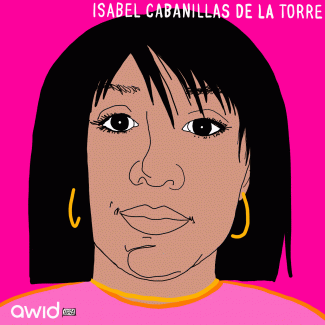
Isabel Cabanillas de la Torre was a much loved young feminist artist and activist from Ciudad Juárez, Mexico, known for her beautiful and evocative hand-painted clothing with eyes being an emblematic feature in her work. Her murals transformed the run down and vacant buildings in Ciudad Juarez’s downtown, bringing life and political commentary to their walls.
Through her art and political activism Isabel sought to draw attention to thegender based violence pervasive in her hometown. She volunteered with the women’s network Mesa de Mujeres on the Citizen Observatory on Gender to monitor the performance of judges, prosecutors and public defenders on cases of femicides and other gender based violations. She was also a member of Hijas de su Maquilera Madre, a feminist collective whose name makes reference to the daughters of mothers who are maquila workers. Some of these mothers were among the first victims of femicide in the city.
Isabel’s latest project, still in progress, was an art installation to protest a Canadian company that was looking to mine copper in the Samalayuca Desert.
On 18 January, 2020 Isabel was shot while riding her bike back home in Downtown Juárez, in what appeared to be a targeted killing, her body found beside her bike.
Isabel’s murder, sparked a new wave of outrage against femicides in the region, hundreds marched to the US-Mexico border bridge, blocking it for hours and chanting “Ni una mas” (Not one more) as feminist collectives continue to protest the murders of women throughout Mexico. In 2019 alone, 3142 women and girls were killed in Mexico, many of whom were targeted specifically because of their gender.
She loved riding her bike.
"The bike for her was a symbol of freedom. A symbol of being free in the streets." - Marisol (a friend of Isabel’s)
Snippet FEA Map of Georgia (EN)
Derechos en riesgo
Cómo se organizan las fuerzas anti-derechos en América Latina y nuestra resistencia colectiva
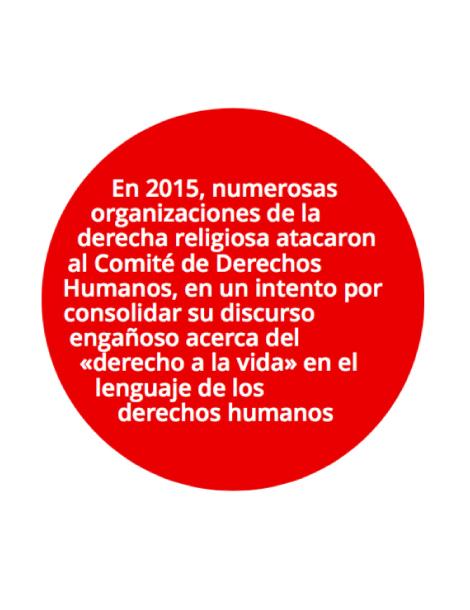
Lxs fundamentalistas religiosos están cada vez más presentes y coordinados en políticas locales, nacionales y regionales. Su incursión arremete contra la vida y la salud de niñas, adolescentes y mujeres, los derechos de la niñez, la libertad de religión y los derechos de las personas LGBTI entre otros.
“No te Metas Con Mis Hijos” o “Menos Estado, Más Familia”
Lxs fundamentalistas buscan posicionar sus intereses. En el informe Derechos en riesgo puedes comprobar cómo actúan y cómo identificarlos
Este informe es el primero de una serie sobre las tendencias en derechos humanos, producido por la iniciativa Observatorio sobre la Universalidad de los Derechos (OURs en inglés), un proyecto colaborativo que reúne a varias organizaciones y tiene como objetivo monitorear, analizar y compartir información sobre iniciativas anti-derechos.
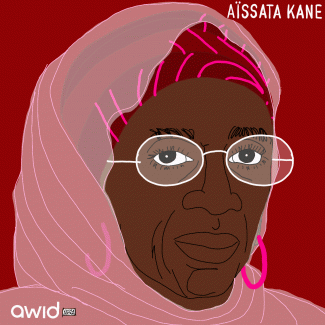
Aïssata Kane, también conocida afectuosamente como «Yaye Kadia»” [«Madre Kadia»], fue una feminista comprometida, durante toda su vida, con la defensa de los derechos de las mujeres africanas y, en especial, mauritanas.
En 1975 fue la primera mujer en ocupar el cargo de Ministra de Protección Familiar y Asuntos Sociales, puesto desde el cual Aïssata trabajó fervientemente para mejorar el estatus de las mujeres de su país.
Este trabajo incluyó el fomento de la educación de niñas y mujeres, la lucha contra la práctica de alimentación forzada de mujeres jóvenes, la incidencia para la inclusión de una legislación sobre derechos maritales, y la promoción de la creación de un cupo de representación femenino en el Parlamento.
«[Aïssata] materializaba todas sus pasiones con humildad, valentía y determinación. No quería molestar a nadie con su lucha en todos estos frentes simultáneos.» - Ball Halimata Dem, sobrina de Aïssata
Fundó la Unión Nacional de Mujeres de Mauritania (UNFM), creando y publicando con otras activistas Marienou, una revista dedicada a la emancipación de las mujeres mauritanas. Aïssata también dirigió varias organizaciones subregionales y locales, por ejemplo, como Presidenta de la Asociación Internacional de Mujeres Francófonas (AIFF) y, como firme ecologista, fue Presidenta de la Asociación para la Protección del Medio Ambiente de Mauritania (APEM).
En 2018, recibió el Premio a la Mujer Pionera, en honor a su trabajo para la promoción del estatus de las mujeres de Mauritania y como reconocimiento de su fuerte liderazgo y su sentido de la innovación.