Over the past few years, a troubling new trend at the international human rights level is being observed, where discourses on ‘protecting the family’ are being employed to defend violations committed against family members, to bolster and justify impunity, and to restrict equal rights within and to family life.
The campaign to "Protect the Family" is driven by ultra-conservative efforts to impose "traditional" and patriarchal interpretations of the family, and to move rights out of the hands of family members and into the institution of ‘the family’.
“Protection of the Family” efforts stem from:
rising traditionalism,
rising cultural, social and religious conservatism and
sentiment hostile to women’s human rights, sexual rights, child rights and the rights of persons with non-normative gender identities and sexual orientations.
Since 2014, a group of states have been operating as a bloc in human rights spaces under the name “Group of Friends of the Family”, and resolutions on “Protection of the Family” have been successfully passed every year since 2014.
This agenda has spread beyond the Human Rights Council. We have seen regressive language on “the family” being introduced at the Commission on the Status of Women, and attempts made to introduce it in negotiations on the Sustainable Development Goals.
Our Approach
AWID works with partners and allies to jointly resist “Protection of the Family” and other regressive agendas, and to uphold the universality of human rights.
In response to the increased influence of regressive actors in human rights spaces, AWID joined allies to form the Observatory on the Universality of Rights (OURs). OURs is a collaborative project that monitors, analyzes, and shares information on anti-rights initiatives like “Protection of the Family”.
Rights at Risk, the first OURs report, charts a map of the actors making up the global anti-rights lobby, identifies their key discourses and strategies, and the effect they are having on our human rights.
The report outlines “Protection of the Family” as an agenda that has fostered collaboration across a broad range of regressive actors at the UN. It describes it as: “a strategic framework that houses “multiple patriarchal and anti-rights positions, where the framework, in turn, aims to justify and institutionalize these positions.”
Defensoras que demostraron su valentía en los medios
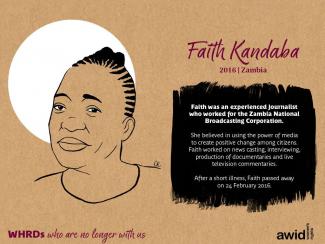
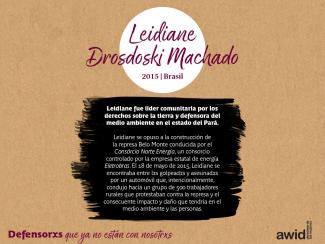
Estas 20 Defensoras de derechos humanos (WHRDs, por las siglas en inglés) trabajaron como periodistas, y de manera más amplia, en los medios comunicación de México, Colombia, Fiji, Libia, Nepal, Estados Unidos de Norteamérica, Nicaragua, Filipinas, Rusia, Alemania, Francia, Afganistán, y el Reino Unido. De ellas, 16 han sido asesinadas, y la causa de muerte en uno de los casos sigue sin ser esclarecida. Por esto, en este Día Mundial de la Libertad de Prensa, por favor únete a nosotrxs para conmemorar la vida y el trabajo de estas mujeres, compartiendo las memes aquí incluidas con tus colegas, amistades y redes, utilizando los hashtags #LibertadDePrensa y #WHRDs.
¿Tendré oportunidad de compartir mi opinión sobre cuestiones que no se hayan incluido en la encuesta?
Sí, invitamos a compartir más impresiones acerca de alguna cuestión que sea de importancia para ti respondiendo a las preguntas abiertas al término de la encuesta.
Snippet FEA Mariama Sonko (FR)
Nous avons le plaisir de vous présenter Mariama Sonko, agricultrice rurale, éco-féministe et défenseuse des droits humains, vivant actuellement à Niaguis, une ville du sud-ouest du Sénégal.
Ayant grandi dans une famille et une communauté rurale d’agriculteur·rices, elle a été témoin du rôle essentiel des femmes dans la production alimentaire et la conservation des semences depuis son plus jeune âge, tout en étant immergée dans le travail de la terre.
Mariama défend les savoirs agricoles locaux et les pratiques paysannes depuis les années 90. En tant que mère de 5 enfants, la nourriture qu'elle cultive elle-même est la principale source de subsistance de sa famille.
Elle est actuellement présidente de Nous Sommes la Solution et s'engage à promouvoir les pratiques agroécologiques et l'agriculture familiale, à encourager la souveraineté alimentaire, la biodiversité et la préservation des semences paysannes, et à exiger un accès équitable aux ressources et à la terre à travers l'Afrique de l'Ouest.
Source: AWID’s Feminist Realities Festival Crear | Résister | Transform - Day 2/ 2ème jour/ 2º día
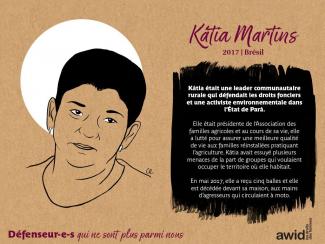
Les données que nous avons recueillies pour élaborer notre hommage montrent à quel point le Mexique est un pays dangereux pour les défenseuses. Sur les 12 femmes mexicaines défenseuses des droits humains que nous commémorons cette année, 11 ont été assassinées. Elles étaient des journalistes ou des activistes, des défenseuses des droits des femmes ou de ceux des personnes trans*. Nous vous invitons à vous joindre à nous pour rendre hommage à ces défenseuses, à leur travail et à l’héritage qu’elles nous ont laissé. Faites circuler ces mèmes auprès de vos collègues et amis ainsi que dans vos réseaux et twittez en utilisant les hashtags #WHRDTribute et #16Jours.
S'il vous plaît cliquez sur chaque image ci-dessous pour voir une version plus grande et pour télécharger comme un fichier
Comment présenterez-vous et traiterez-vous les données collectées pendant l’enquête?
Les données seront traitées à des fins statistiques, pour mettre en lumière l’état du financement de l’organisation des mouvements féministes dans le monde entier, et ne seront présentées que sous forme agrégée. L’AWID ne publiera pas d’informations relatives à une organisation donnée ni ne divulguera d’informations qui permettraient d’identifier une organisation par le biais de son emplacement ou de caractéristiques qui lui sont propres, sans son accord explicite.
Match up your favourite messages below with these images for Facebook. These messages may also be used on Twitter via private Direct Messages, which don’t have character limits.
Facebook messages for your personal profile
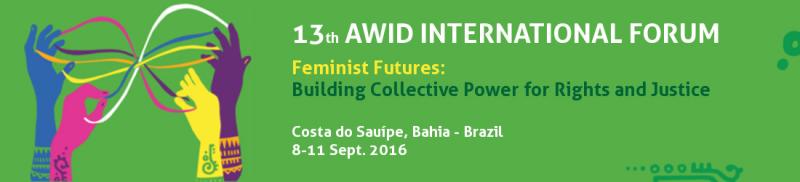
The wait is over! We can all register for the 2016 AWID Forum. So excited to reconnect with fellow activists and re-imagine our feminist futures. See you there, in Brazil!http://forum.awid.org/forum16/
Loving the thought of re-imagining feminist futures with 2,000 people from lots of amazing women's rights and social justice movements at the AWID Forum. Register and meet me in Brazil!http://forum.awid.org/forum16/
Facebook messages for your organization’s page
Registration is now open for the 2016 AWID Forum in Costa do Sauípe, Brazil! This is not just any event - it’s a key space for women’s rights and social justice activists to come together and re-imagine our feminist futures. You won’t want to miss it!http://forum.awid.org/forum16/
Join us at the 2016 AWID Forum in Brazil! Activists and movements from all over the world will come together to celebrate, strategize, inspire and renew ourselves and our collective struggles. Register now!http://forum.awid.org/forum16/
The 2016 AWID Forum will be a historic global gathering of women’s rights and social justice activists and movements. Join us there to break the silos, strengthen solidarity and leverage our collective power. Register now!http://forum.awid.org/forum16/
The 2016 AWID Forum will be a historic global gathering of women’s rights and social justice activists and movements. Join us to celebrate, strategize, inspire and renew ourselves and leverage our collective power. Registration is now open!http://forum.awid.org/forum16/
Pourquoi et comment renouveler votre adhésion de l'AWID
Rencontrez d'autres membres
Nos membres individuel-le-s et institutionnels viennent de 163 pays situés dans TOUTES les régions du monde. Les dernier-ère-s membres à avoir rejoint notre association viennent de l’Inde, du Royaume-Uni, du Sri Lanka et du Kirghizistan. Nos membres contribuent un éventail riche et diversifié de perspectives, d’expériences, de connaissances, d’énergie et d’inspiration !
Connaissez-vous nos profils hebdomadaires de membres ?
En tant que membre de l’AWID, vous pourrez, entre autres avantages, voir votre propre histoire figurer dans la newsletter que nous envoyons à 35,000 abonné-e-s et que nous diffusons par le biais des médias sociaux auprès de 60,000 personnes.
Récemment en vedette :
Rencontrez Angila Ashitua, une jeune femme du comté de Vihiga, situé dans l’ouest du Kenya.
en entrant en contact avec d’autres membres par le biais de notre forum des membres et de notre annuaire en ligne.
en en apprenant davantage sur le travail de l’AWID et sur les questions relatives aux droits des femmes et à la justice sociale grâce à nos publications et ressources, et notamment grâce à notre dernière vidéo en date “Changing Systems, Changing Lives“.(uniquement disponible en anglais).
en prenant part à nos sessions de formation en ligne. Vous pouvez consulter ici les points principaux de notre webinaire sur la Puissance des entreprises et la justice de genre. (uniquement disponible en anglais)
Et bien plus encore !
Vous pouvez renouveler votre adhésion pour une période d’1, 2 ou 3 ans. Nous offrons la possibilité d’une adhésion individuelle ou institutionnelle gratuite à ceux et celles dont les revenus ou budgets sont restreints.
Si vous rencontrez des difficultés lors de votre identification en ligne et avez besoin d’aide, n’hésitez pas à me contacter à l’adresse suivante : membership@awid.org
Les témoignages de nos membre
«Nous trouvons que l’AWID est un réseau particulièrement stimulant et nous nous impliquons dans beaucoup de ses plateformes. » – Engabu Za Tooro (membre institutionnel de l’AWID)
« Je me réjouis d’entamer une collaboration fructueuse avec l’équipe. J’en suis très heureuse. Merci de m’avoir acceptée parmi vos membres. » – R. Chakraborty (membre individuelle de l’AWID)
« Je tiens à remercier infiniment l’AWID ! Vous accomplissez un travail gigantesque. Vos efforts sont grandement appréciés. » – E. Khan (membre individuelle de l’AWID)