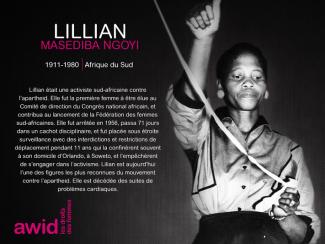
Lillian Masediba Ngoyi
Over the past few years, a troubling new trend at the international human rights level is being observed, where discourses on ‘protecting the family’ are being employed to defend violations committed against family members, to bolster and justify impunity, and to restrict equal rights within and to family life.
The campaign to "Protect the Family" is driven by ultra-conservative efforts to impose "traditional" and patriarchal interpretations of the family, and to move rights out of the hands of family members and into the institution of ‘the family’.
Since 2014, a group of states have been operating as a bloc in human rights spaces under the name “Group of Friends of the Family”, and resolutions on “Protection of the Family” have been successfully passed every year since 2014.
This agenda has spread beyond the Human Rights Council. We have seen regressive language on “the family” being introduced at the Commission on the Status of Women, and attempts made to introduce it in negotiations on the Sustainable Development Goals.
AWID works with partners and allies to jointly resist “Protection of the Family” and other regressive agendas, and to uphold the universality of human rights.
In response to the increased influence of regressive actors in human rights spaces, AWID joined allies to form the Observatory on the Universality of Rights (OURs). OURs is a collaborative project that monitors, analyzes, and shares information on anti-rights initiatives like “Protection of the Family”.
Rights at Risk, the first OURs report, charts a map of the actors making up the global anti-rights lobby, identifies their key discourses and strategies, and the effect they are having on our human rights.
The report outlines “Protection of the Family” as an agenda that has fostered collaboration across a broad range of regressive actors at the UN. It describes it as: “a strategic framework that houses “multiple patriarchal and anti-rights positions, where the framework, in turn, aims to justify and institutionalize these positions.”
Asociación de Mujeres Afrodescendientes del Norte del Cauca
 La dotación de recursos de los movimientos feministas es fundamental para garantizar una presencia más justa y pacífica y un futuro en libertad. En las últimas décadas, los donantes comprometieron una cantidad más considerable de dinero para la igualdad de género; sin embargo, apenas el 1% del financiamiento filantrópico y para el desarrollo se ha destinado real y directamente a dotar de recursos al cambio social encabezado por los feminismos.
Para luchar por la abundancia y acabar con esta escasez crónica, la encuesta ¿Dónde está el dinero? es una invitación a lxs promotorxs feministas y por la justicia de género a sumarse al proceso de la construcción colectiva de razones fundadas y evidencias para movilizar más y mejores fondos y recobrar el poder en el ecosistema de financiamiento de hoy. En solidaridad con los movimientos que continúan invisibilizados, marginados y sin acceso a financiamiento básico, a largo plazo, flexible y fiduciario, la encuesta ¿Dónde está el dinero? pone de relieve el estado real de la dotación de recursos, impugna las falsas soluciones y señala cómo los modelos de financiamiento necesitan modificarse para que los movimientos prosperen y puedan hacer frente a los complejos desafíos de nuestro tiempo.
全球和區域的合作夥伴已就論壇會前會的一些想法與我們聯繫,我們將很快分享有關這些想法的更多信息。
由諮詢小組組織,AWID資助的2016年黑人女權主義論壇(BFF)湧現出許多美好的事物。BFF產生了一些獨立組織包括巴西的黑人女權組織。儘管今年我們不會再舉辦BFF,但我們仍致力於與有興趣繼續圍繞黑人女權主義組織開展工作的任何人分享一些重要的經驗。
 |
 |
 |
 |
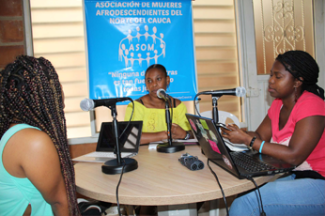 |
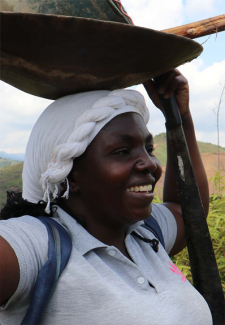
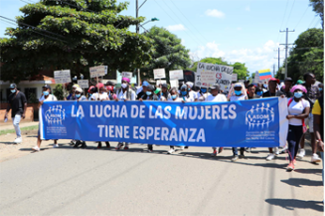
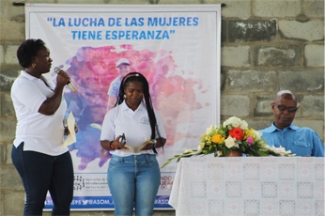
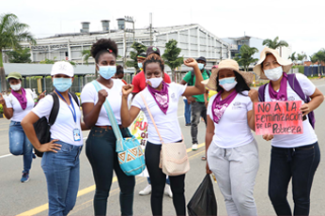
Activistas de ASOM en encuentros, desfiles y eventos
Identify and demonstrate opportunities to shift more and better funding for feminist organizing, expose false solutions and disrupt trends that make funding miss and/or move against gender justice and intersectional feminist agendas.
第十四屆AWID國際論壇將於西元2021年9月20日至23日在台北举行。
Venez rencontrer Aura Roig, militante féministe visionaire, anthropologue, directrice et fondatrice de la coopérative Metzineres.
Elle a consacré les deux dernières décennies à la recherche, à la conception et à la mise en place de politiques de soutien aux personnes qui se droguent, basées sur la réduction des méfaits, les droits humains et le féminisme intersectionnel.
Après avoir expérimenté et appris des communautés qui consomment des drogues dans le monde entier, elle est retournée à Barcelone pour créer la Xarxa de Dones que Usen Drogues (le Réseau des Femmes qui Consomment des Drogues, XADUD). XADUD était un espace d'entraide et de solidarité avec la lutte pour les droits des groupes marginalisés, qui plus tard deviendra la coopérative Metzineres.
Aujourd'hui, Aura travaille à étendre le modèle Metzineres pour prendre en charge des groupes plus grands, tout en documentant de manière approfondie son parcours et son apprentissage prolifiques.
Agrupaciones, organizaciones y movimientos que trabajan específica o primordialmente por los derechos de las mujeres, las niñas, la justicia de género, las personas LBTQI+ y demás personas aliadas en todas las regiones y en todos los ámbitos, ya sean estas de nueva creación o de larga data.
Women sustain Care | Care Sustains Life | Life Sustains Economy | Who takes care of women? | Not one less1 | Together | Sunday lunch
1Nenhuna a menos literally translates as “not one woman less” or “ni una menos” in Spanish - a famous feminist slogan in Latin America that emerged in Argentina as a response to increasing gender-based violence.
.
Oui, tout à fait! Nous reconnaissons et comprenons les différentes raisons pour lesquelles les féministes de tous contextes ne recourent pas au financement extérieur, pouvant aller de ne pas être éligibles à demander des subventions et/ou recevoir de l’argent de l’étranger, à compter sur des ressources générées de manière autonome (ressource en anglais) en tant que stratégie politique à part entière. Nous vous invitons à participer, peu importe votre expérience du financement extérieur.