
Ola AbuElShalashel
- Category
- Droits civils et politiques
- Date of death / disappearance
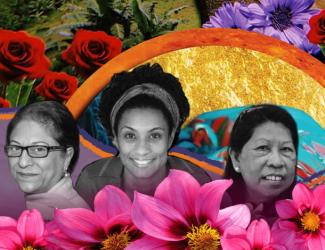
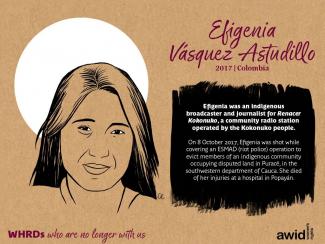
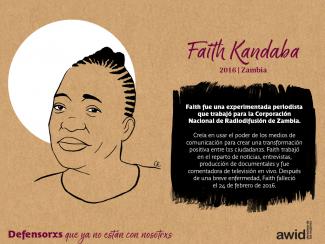
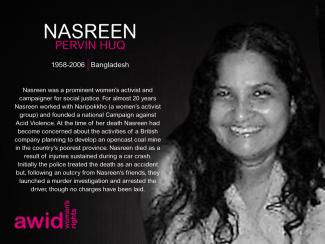
AWID’s Tribute is an art exhibition honouring feminists, women’s rights and social justice activists from around the world who are no longer with us.
This year’s tribute tells stories and shares narratives about those who co-created feminist realities, have offered visions of alternatives to systems and actors that oppress us, and have proposed new ways of organising, mobilising, fighting, working, living, and learning.
49 new portraits of feminists and Women Human Rights Defenders (WHRDs) are added to the gallery. While many of those we honour have passed away due to old age or illness, too many have been killed as a result of their work and who they are.
This increasing violence (by states, corporations, organized crime, unknown gunmen...) is not only aimed at individual activists but at our joint work and feminist realities.
The portraits of the 2020 edition are designed by award winning illustrator and animator, Louisa Bertman.
AWID would like to thank the families and organizations who shared their personal stories and contributed to this memorial. We join them in continuing the remarkable work of these activists and WHRDs and forging efforts to ensure justice is achieved in cases that remain in impunity.
“They tried to bury us. They didn’t know we were seeds.” - Mexican Proverb
It took shape with a physical exhibit of portraits and biographies of feminists and activists who passed away at AWID’s 12th International Forum, in Turkey. It now lives as an online gallery, updated every year.
To date, 467 feminists and WHRDs are featured.
Si vous êtes de passage à Sao Paulo, au Brésil, visitez l'Occupation 9 de Julho et prenez un repas collaboratif. Vous pouvez aussi acheter leurs produits dans leur boutique en ligne depuis l'étranger.
Visitez la boutique en ligne de l'Association des Femmes Afro-Descendantes du Cauca du Nord où vous pouvez trouver de superbes produits faits à la main.
Il existe plusieurs façons de soutenir Metzineres : vous pouvez faire un don financier, offrir du matériel et des services, proposer une formation, un atelier ou une activité (pour plus d'informations, cliquez ici).



Non, nous reconnaissons l’importance de votre travail, mais nous ne collectons pas les réponses fournies à titre individuel à l’heure actuelle.
We are living in a world where the destruction of Nature fuels our current global economy. |
Even in times of climate crisis, governments continue to encourage large-scale agriculture industries to expand. These activities poison the land, threaten biodiversity, and destroy local food production and livelihoods. Meanwhile, while women produce the majority of our food in the world, they own almost none of the land. |
|
What if we perceived land and Nature not as private property to exploit, but as a whole to live in, learn from, and harmoniously coexist with? What if we repaired our relationships with the land and embraced more sustainable alternatives that nurture both the planet and its communities? Nous Sommes la Solution (We Are the Solution, NSS) is one of many women-led movements striving to do this. This is their story. |
|
Unless there are accessibility issues and/or you are filling the survey in other languages, we strongly encourage you to use KOBO for WITM standardized data collection and analysis.
AGROECOLOGY AND FOOD SOVEREIGNTY AS RESISTANCE |
Today, large-scale industrial food production uses single-crop plantations, genetically modified organisms and other pesticides that destroy the land and knowledge of local communities. |
Agroecology is a resistance to corporate-driven agriculture. It prioritizes smaller scale agriculture, multiple crops and diversified food production, and the centering of local knowledge and practices. Agroecology goes hand-in-hand with demands for food sovereignty, or the “right of peoples to healthy and culturally appropriate food produced through ecologically sound and sustainable methods, and their right to define their own food and agriculture systems”(Via Campesina, Declaration of Nyéléni).
The role of women, indigenous and rural communities and people of color from the Global South is absolutely essential when it comes to food systems. Feminist agroecologists are working to dismantle oppressive gender roles and systems of patriarchy embedded within food production. As shown by the heroines of NSS, they are generating a liberatory agroecology by strengthening community resilience, empowering women peasants and farmers, and preserving local traditions, territories, and knowledge of food-producing communities.
La encuesta contiene 47 preguntas en total, de las cuales 27 son de respuesta obligatoria* y las 20 restantes son opcionales. La mayoría de las preguntas de la encuesta son de opción múltiple. Invitamos a responder la totalidad de las preguntas.