Left
Half
Left

Special Focus

AWID is an international, feminist, membership organisation committed to achieving gender equality, sustainable development and women’s human rights

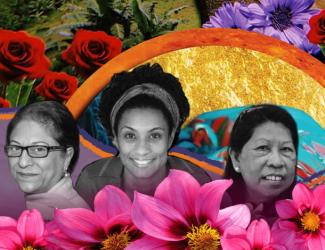
Memory as Resistance: A Tribute to WHRDs no longer with us

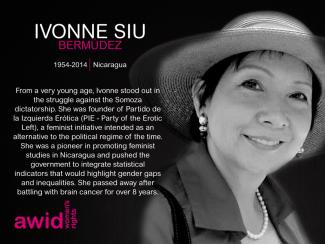
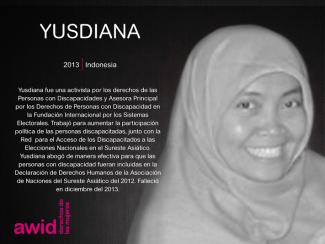
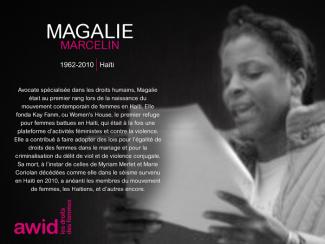
AWID’s Tribute is an art exhibition honouring feminists, women’s rights and social justice activists from around the world who are no longer with us. 


In 2020, we are taking a turn

This year’s tribute tells stories and shares narratives about those who co-created feminist realities, have offered visions of alternatives to systems and actors that oppress us, and have proposed new ways of organising, mobilising, fighting, working, living, and learning.

49 new portraits of feminists and Women Human Rights Defenders (WHRDs) are added to the gallery. While many of those we honour have passed away due to old age or illness, too many have been killed as a result of their work and who they are.

This increasing violence (by states, corporations, organized crime, unknown gunmen...) is not only aimed at individual activists but at our joint work and feminist realities.

The stories of activists we honour keep their legacy alive and carry their inspiration forward into our movements’ future work.

Visit the online exhibit

The portraits of the 2020 edition are designed by award winning illustrator and animator, Louisa Bertman

AWID would like to thank the families and organizations who shared their personal stories and contributed to this memorial. We join them in continuing the remarkable work of these activists and WHRDs and forging efforts to ensure justice is achieved in cases that remain in impunity.

“They tried to bury us. They didn’t know we were seeds.” - Mexican Proverb 


The Tribute was first launched in 2012

It took shape with a physical exhibit of portraits and biographies of feminists and activists who passed away at AWID’s 12th International Forum, in Turkey. It now lives as an online gallery, updated every year.

To date, 467 feminists and WHRDs are featured.

Visit the online exhibit

Related Content

Snippet - Intro WITM - EN

Where is the Money for Feminist Organizing? Survey Results

Thanks to our global feminist community! From May to August 2024, nearly 1,200 organizations working for Women's rights, gender justice, and LBTQI+ equality shared their experiences in the WITM survey. The results offer a unique picture of how feminist movements are resourced and where gaps remain.

Stay tuned for the upcoming report for more analysis!
 

Learn more about the insights

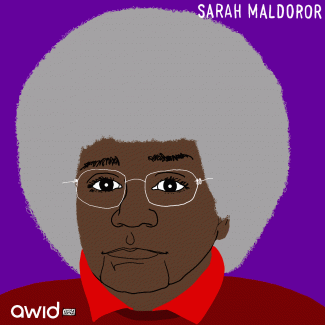
Sarah Maldoror

“I’m no adherent to the concept of the ‘Third World’. I make films so that people - no matter what race or color they are - can understand them. For me there are only exploiters and the exploited, that’s all. To make a film means to take a position.” - Sarah Maldoror 

Sarah Maldoror, a French filmmaker of West Indies descent, was a pioneer of Pan-African cinema. At the core of her work, she placed political concerns along with her longstanding involvement in decolonization movements.

Her groundbreaking film and “revolutionary picture” Sambizanga (1972) follows Angolan militants’ anti-colonial liberation struggle, as well as captures a woman’s perspective in a historical moment she finds herself in. 

“For many African filmmakers, cinema is a revolutionary tool, a political education to raise consciousness. It is inscribed in the evolution of a Third Cinema striving to decolonize thought and advocate radical changes in society.” - Sarah Maldoror

Throughout her career, Sarah - together with a number of African and Caribbean artists - co-founded (1956) the first Black theatre troupe in France. She made around 40 films, comprising important documentaries that amplify the lives and work of black artists, including her friend and poet Aimé Césaire who wrote to her: 

“To Sarah Maldo
who, a camera in hand,
fights oppression, alienation
and flies in the face
of human bullshit.”

Sarah was also committed to giving African women more ownership of the filmmaking process. In an interview, she pointed out: 

"African women must be everywhere. They must be in the images, behind the camera, in the editing room and involved in every stage of the making of a film. They must be the ones to talk about their problems." 

Sarah left an incredibly powerful legacy to be carried forward. 

Born 19 July 1929, Sarah passed away on 13 April 2020 from complications of the coronavirus.


Watch Sambizanga and read a film review in a 1973 New York Times article
 

Mai 2015: les consultations sur la version préliminaire du document final ont lieu

Sessions de consultation complémentaires sur la version préliminaire du document final

  • Le 7 mai, les co-facilitateurs ont publié la version révisée du document final de la troisième Conférence sur FdD (en anglais).
  •  Pour permettre d’améliorer le document final, des sessions complémentaires ad hoc portant sur cette version révisée du document final ont été organisées du 12 au 15 mai 2015, puis du 26 au 29 mai 2015, au siège de l’ONU à New York.

Snippet FEA Get Involved 1 (EN)

GET INVOLVED!

Follow the work of these organizations on their social media accounts and websites:

Snippet - WITM To make - ES

Para darle visibilidad a la complejidad de la dotación de recursos para las diversas formas de organización feministas.

María Digna Montero

María Digna Montero fue una garífuna (afrodescendiente e indígena) defensora de la tierra e integrante de la Organización Fraternal Negra Hondureña (OFRANEH), una organización de base que trabaja para proteger a las comunidades garífunas, sus derechos ancestrales, su cultura, sus recursos y su territorio.

María también enseñaba en la escuela local, e integraba el grupo de trabajo de Educación Bilingüe Intercultural de OFRANEH.

El 12 de octubre (Día de la Resistencia Indígena) de 2019, sujetos desconocidos le dispararon a María varias veces en el patio de su casa.

Fue una de las seis defensoras garífunas asesinadas entre septiembre y octubre de 2019 y, según OFRANEH, no hubo ninguna investigación de estos crímenes por parte de las autoridades. En un comunicado oficial, la organización también subrayó la conexión entre la violencia contra líderes garífunas y el incremento de las industrias extractivas que explotan los recursos naturales en sus comunidades, y definieron esta violencia como «parte de una estrategia de intimidación y de expulsión sistemática por parte del Estado de Honduras.»

«El recrudecimiento de la tensión y de los riesgos crecientes para la seguridad y derechos humanos de las lideresas en las comunidades y territorios ancestrales es producto del despojo, desplazamiento y criminalización hacia las comunidades, y de los mega proyectos extractivos que impulsa el Estado junto con las corporaciones nacionales e internacionales.» - Pronunciamiento de OFRANEH, 13 de octubre de 2019

What are some of the debates and conflict areas?

Snippet FEA EoS The Powerful (EN)

Illustration of a pink human in white underwear doing a power pose

The Powerful
Self-protection and strengthening

Snippet - WITM About the survey - EN

ABOUT THE SURVEY

  • GLOBAL & DIVERSE: Reflecting on resourcing realities of feminist organizing at a global scale and disaggregated by region
  • CONTEXTUALIZED: Centering voices, perspectives and lived experiences of feminist movements in all their richness, boldness and diversity in their respective contexts
  • CO-CREATED: Developed and piloted in close consultations with AWID members and movement partners
  • COMPLEMENTARY: Contributing to and amplifying existing evidence on the state of resourcing for feminist, women’s rights and gender justice organizing by activists, feminist funders and allies
  • MULTI-LINGUAL: Accessible in Arabic, English, French, Portuguese, Russian and Spanish.
  • PRIORITIZING PRIVACY & SECURITY: We are committed to maintaining the confidentiality and integrity of your data. Read our Privacy Policy to learn more about the measures we take to ensure the protection of your information
  • ACCESSIBLE: Accessible to people with a diverse range of hearing, movement, sight, and cognitive abilities, taking approximately 30 minutes to complete
  • REPLICABLE: Replicable by movements in their respective contexts; WITM survey tools and datasets will be publicly available to support more feminist research and collective advocacy.

Nilcéa Freire

Nilcéa Freire était une activiste, politicienne et universitaire brésilienne. Ardente défenseuse des droits des femmes et des minorités sous-représentées dans le pays, sa vie et son travail ont été marqués par une longue histoire de luttes et de victoires.

"Nous devons, tout en résistant, continuer à chercher à progresser, et ce que nous pouvons accomplir actuellement, je pense que nous le devons à la fantastique organisation des jeunes femmes blanches, et surtout des femmes noires, dans toutes les capitales d’États et les grandes villes brésiliennes.” - Nilcéa Freire

En 1999, elle est devenue la première femme à occuper le poste de doyenne de l'université d'État de Rio de Janeiro. Elle y a dirigé la mise en œuvre de la première politique d'action positive pour les étudiant·e·s des écoles publiques, demandant au sein d’une école publique que des places soient spécifiquement réservées aux étudiant·e·s noir·e·s à faible revenu. Ce système a été adopté dans des dizaines d'autres universités publiques. 

Quelques années plus tard, Nilcéa dirigea le Secrétariat spécial des politiques pour les femmes sous le gouvernement de l'ancien président Luiz Inácio Lula da Silva. C’est à ce titre qu’elle conduisit la première Conférence nationale des femmes. Plus de 12 000 femmes de tout le pays y participèrent et le résultat de ce travail collectif fut incorporé dans le Plan national des politiques pour les femmes. 

Son engagement envers les femmes, les Afro-Brésilien·ne·s et les populations autochtones se reflète aussi fortement dans son travail de défense de leurs droits, qu’elle a mené dans le cadre des initiatives du bureau de la Fondation Ford du Brésil, dont elle était la directrice régionale. 

L’activiste féministe Manoela Miklos a dit de Nilcéa qu'elle était "une femme sans égal·e".

Nilcéa s’est éteinte à Rio de Janeiro à l'âge de 66 ans, le 29 décembre 2019, des suites d’un cancer.


"Je n’ai pas de mots face à l’annonce de la mort de notre chère Nilcéa Freire. Il m’est trop triste de savoir qu’elle est partie si tôt. Elle s’est toujours rangée du côté de celleux qui ne tolèrent pas les injustices de ce monde. Elle était la ministre des femmes, sans cesse engagée dans la cause féministe. Elle nous manquera beaucoup!” - Jandira Feghali, Federal Deputy

Retrouvez sur YouTube la féministe brésilienne Nilcea Freire et pourquoi il importe de se montrer solidaires avec le Brésil

No puedo presentar una propuesta escrita, ¿aceptan otros formatos?

Como expresión de nuestro compromiso con hacer que todos los aspectos del Foro AWID sean accesibles, aceptaremos propuestas en forma de audio/video cuando se trate de personas/organizaciones/grupos que no puedan enviarlas por escrito. Si decides enviar tu propuesta en formato de audio/video, por favor responde las preguntas en el mismo orden en que aparecen en el Formulario para Presentar Actividades.

Para presentar un archivo de audio/video, por favor escríbenos utilizando nuestro formulario de contacto. Seleccione «propuesta de actividad» como asunto de mensaje.

Contactanos

Snippet FEA Land and Agroecology (ES)

AGROECOLOGÍA Y

SOBERANÍA ALIMENTARIA

Mujeres Rurales Cuidando la Naturaleza y las Comunidades

Snippet - WITM Acknowledgements - EN

Acknowledgements

AWID gratefully acknowledges the many people whose ideas, analysis and contributions have shaped the “Where is the Money for Feminist Organizing?” research and advocacy over the years.

First and foremost, our deepest thanks goes to the AWID members and activists who engaged in WITM consultations and piloted this survey with us, sharing so generously of their time, analysis and hearts.

Our appreciation to feminist movements, allies and feminist funds, including but not limited to: Black Feminist Fund, Pacific Feminist Fund, ASTRAEA Lesbian Foundation for Justice, FRIDA Young Feminist Fund, Purposeful, Kosovo Women’s Network, Human Rights Funders Network, Dalan Fund and PROSPERA International Network of Women's Funds - for your rigorous research on the state of resourcing, sharp analysis and continued advocacy for more and better funding and power for feminist and gender justice organizing in all contexts.

Join the global community of feminists speaking up about the state of resourcing, demanding more and better funding and power for feminists everywhere

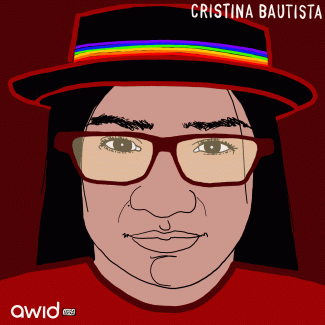
Cristina Bautista

“If we stay quiet they kill us and if we talk [they kill us] too. So, let’s talk.” -  Cristina Bautista, 2019

Cristina Bautista was a member of the Nasa Indigenous people’s community whose home is situated in the region of Northern Cauca, Colombia. She was part of their resistance as a leader, land rights defender, social worker, and governor of the Nasa Tacueyó Indigenous reserve. 

A tireless defender of the rights of Nasa people, Cristina spoke strongly and loudly against the violence directed at her community. In a speech before the United Nations, she called for the protection of Indigenous women’s lives and their involvement in different spheres of life. In 2017, Cristina was a UN Human Rights Office Indigenous fellow and she was awarded a grant from the UN Voluntary Fund for Indigenous Peoples in 2019. 

“I would like to bring to light the current situation of the Indigenous people in Colombia, the killing of Indigenous leaders, the repression of social protest. Instead of helping, the peace deal has increased war and the exploitation of sacred territories in Colombia… In the current situation, in almost all Indigenous nations as women we have been working to find a better future for our families. I don’t want more women from the countryside to continue living under these circumstances. We need opportunities for Indigenous women to participate in politics, in the economy, in society and in culture. Today gives me true strength, to see all these women here and that I am not alone.” - Cristina Bautista, 2019

On 29 October 2019, Cristina was murdered along with four unarmed Indigenous guards in an attack which was allegedly carried out by armed members of “Dagoberto Ramos”, a FARC dissident group. 

According to Global Witness, “the murder of community and social leaders has risen dramatically in Colombia in recent years.” 

“The Nasa community has repeatedly raised the alarm with the authorities about threats to their safety. Despite efforts by successive Colombian Governments, indigenous peoples continue to face great risks, especially religious or community leaders like Cristina Bautista.” - UN press briefing, 1 November 2019


Watch a speech by Cristina Bautista in August 2019 in which she denounced previous murders of Indigenous guards (Spanish only)

¿Qué incluye el costo de inscripción?

El costo de inscripción para el Foro de AWID cubre, para todxs lxs participantes:

  •  Pleno acceso a los cuatro días del Foro
  • Almuerzos y pausas para café/té durante los días del Foro
  • Materiales de consulta
  • Interpretación simultánea durante las plenarias y algunas sesiones/actividades subsidiarias determinadas (inglés, francés, español e idioma local)
  • Participación en la cena/fiesta de celebración
  • Aplicación móvil con programa definitivo y función de chat
  • Servicio de wi-fi gratuito dentro del área de Foro
  • Traslados desde/al aeropuerto y transporte hotel-sede-hotel.

Snippet FEA Audio Land and Agroecology (EN)

Escucha esta historia aquí: