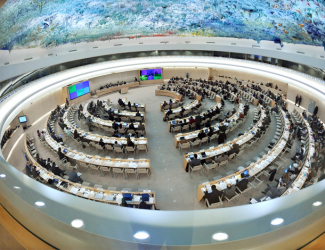


Jean-Marc Ferré | Flickr (CC BY-NC-ND 2.0)
A general view of participants at the 16th session of the Human Rights Council in Geneva, Switzerland.

Special Focus

AWID is an international, feminist, membership organisation committed to achieving gender equality, sustainable development and women’s human rights

Human Rights Council (HRC)

The Human Rights Council (HRC) is the key intergovernmental body within the United Nations system responsible for the promotion and protection of all human rights around the globe. It holds three regular sessions a year: in March, June and September. The Office of the UN High Commissioner for Human Rights (OHCHR) is the secretariat for the HRC.

The HRC works by:

  • Debating and passing resolutions on global human rights issues and human rights situations in particular countries

  • Examining complaints from victims of human rights violations or activist organizations on behalf of victims of human rights violations

  • Appointing independent experts (known as “Special Procedures”) to review human rights violations in specific countries and examine and further global human rights issues

  • Engaging in discussions with experts and governments on human rights issues

  • Assessing the human rights records of all UN Member States every four and a half years through the Universal Periodic Review

Learn more about the HRC


AWID works with feminist, progressive and human rights partners to share key knowledge, convene civil society dialogues and events, and influence negotiations and outcomes of the session.

With our partners, our work will:

◾️ Monitor, track and analyze anti-rights actors, discourses and strategies and their impact on resolutions

◾️ Raise awareness of the findings of the 2017 and 2021 OURs Trends Reports.

◾️Support the work of feminist UN experts in the face of backlash and pressure

◾️Advocate for state accountability
 
◾️ Work with feminist movements and civil society organizations to advance rights related to gender and sexuality.
 

Related Content

Snippet FEA WE ARE LEGAL AND ALWAYS WERE (ES)

España

Sindicato OTRAS


SOMOS LEGALES Y

SIEMPRE LO FUIMOS

Florence Adong-Ewoo

Florence fue una activista por los derechos de las personas con discapacidad que trabajó con varias organizaciones de mujeres con discapacidad en Uganda.

También ocupó la Dirección del Distrito de Lira de la Asociación de Mujeres con Discapacidad, así como del foro de Consejeras Mujeres del Distrito de Lira. Formada como consejera para personas con discapacidad y para madres y padres de niñxs con discapacidad, apoyó muchos proyectos que reclamaban mayor representación de las personas con discapacidad.

Murió en un accidente de motocicleta.


Florence Adong-Ewoo, Uganda

Values - intersectionality

Interseccionalidad

Creemos que para que los movimientos feministas sean transformadores y sólidos debemos seguir trabajando en nuestras similitudes y diferencias. También debemos cuestionar el poder y los privilegios, tanto dentro como fuera de nuestros movimientos.

Upasana Agarwal

Forgotten Song
Forgotten Song (Chanson Oubliée)
Ode to the Moon
Ode to the Moon (Ode à la Lune)
Vapour and Fire
Vapour and Fire (Vapeur et Feu)

À propos d’Upasana Agarwal

Upasana Agarwal
Upasana est un·e illustrateurice et artiste non binaire basé·e à Kolkata, en Inde. Son travail explore l'identité et les récits personnels en partant d’un vestige visuel ou d’une preuve des contextes avec lesquels iel travaille. Iel est particulièrement attiré·e par les motifs qui, selon Upasana, communiquent des vérités complexes sur le passé, le présent et l'avenir.  Quand Upasana n'est pas en train de dessiner, iel organise et dirige un centre d'art communautaire queer et trans dans la ville.

Как вы будете представлять и обрабатывать данные, собранные в ходе опроса?

Данные будут обработаны в статистических целях, чтобы осветить состояние ресурсного обеспечения феминистских движений во всем мире, и представлены будут только в обобщенном виде. AWID не будет публиковать информацию о конкретных организациях или отображать информацию, которая позволила бы идентифицировать организации по их местоположению или характеристикам, без их согласия.

Snippet FEA Unio Otras Photo 2 (FR)

Photo de Sabrina Sanchez agitant un drapeau et menant une manifestation. Elle marche en portant un ensemble de lingerie et des talons. Il y a des gens avec des affiches derrière elle.

Nadine Ramaroson

Son soutien aux femmes et aux personnes les plus vulnérables de sa communauté a fait que Nadine était un modèle pour beaucoup. Elle était déterminée à aider les pauvres et les sans-abri en particulier.

Bien que sa mort ait été déclarée comme étant accidentelle, la famille Ramaroson, sur l’initiative de son père André Ramaroson, a mené une enquête qui a mis en évidence des preuves de son assassinat. Elle serait décédée dans un accident mortel survenu entre Soanierano - Ivongo et Ste Marie - une histoire qui a été réfutée par sa famille. Elle avait reçu de nombreuses menaces de mort pour ses positions politiques résolues. L’affaire est toujours en cours auprès des tribunaux à Antananarivo (la capitale de Madagascar).


Nadine Ramaroson, Madagascar

Membership why page page - to join as a member block

Comment adhérer - étape par étape

  1. Lisez et acceptez les valeurs et la charte communautaire de l’AWID.
  2. Remplissez votre formulaire d'adhésion et indiquez votre contribution à au moins un type d'action proposé.
  3. Consultez vos courriels et vérifiez que vous avez bien reçu votre dossier de bienvenue numérique confirmant votre inscription.
  4. Effectuez les actions pour lesquelles vous vous êtes engagé·e lors de votre inscription.

Anti-Rights Tactics, Strategies, and Impacts

Chapter 5

Anti-rights actors adopt a double strategy. As well as launching outright attacks on the multilateral system, anti-rights actors also undermine human rights from within. Anti-rights actors engage with the aim of co-opting processes, entrenching regressive norms, and undermining accountability.

Photo-OP // the first anniversary of the EU signature to the Council of Europe Convention to prevent and combat gender-based violence and domestic violence, the so-called Istanbul Convention
© ALDE Group/Flickr
Photo-OP // the first anniversary of the EU signature to the Council of Europe Convention to prevent and combat gender-based violence and domestic violence, the so-called Istanbul Convention

Anti-rights actors’ engagement in international human rights spaces has a principal purpose: to undermine the system and its ability to respect, protect and fulfill human rights for all people, and to hold member states accountable for violations. Some anti-rights tactics operate from outside the UN and include delegitimization and political pressure to defund the UN, or to withdraw from international human rights agreements.  In recent years, anti-rights actors have also gained increasing influence inside the UN. Their inside tactics include training of delegates, distortion of human rights frameworks, watering down human rights agreements, infiltrating NGO committees, applying for ECOSOC status under neutral names, infiltrating youth spaces, and lobbying to place anti-rights actors in key positions.

Table of Contents

  • Institutionalization of Anti-rights Actors in UN Mechanisms
  • Opting-out and Delegitimization
  • Lowering HR Standards
  • Co-optation - Building a Parallel HR Framework
  • Exercise: Yes, they are strong, but so are we!
  • Exercise: Holding Governments Accountable
     

Read Full Chapter >

As realidades de financiamento para movimentos feministas mudam rapidamente. Este questionário é um ocorrência única?

Não. Tem por base a história de 20 anos da AWID de mobilizar mais financiamento de maior qualidade para mudanças sociais lideradas por feministas e é a terceira edição do nosso inquérito “Onde está o dinheiro para organização feminista?”. O nosso objetivo é repetir o inquérito WITM a cada 3 anos.

Snippet FEA Linda Porn Bio (EN)

Linda Porn is yet another heroine of feminist union organizing and sex worker activism nationally (in Spain) and transnationally.

Originally from Mexico, she has been living in Spain since the 2000s. She is a sex worker, an activist, a single mother and a multidisciplinary artist. Drawing from these different identities, she uses performance, video art and theater to vizibilize struggles at the intersections of transfeminism, sex work, migration, colonialism and motherhood.

She combines art and sex work while caring for her daughter as a single mother.

Linda also belongs to sex workers collectives that fight for their rights, such as the OTRAS union and CATS Murcia. She also co-founded the group 'Madrecitas' - that visibilises and denounces racist institutional violence against migrant families. Violence to which she and her daughter were subjected as a sex worker and migrant single mother.

You can follow her art work here.

Sainimili Naivalu

« J’ai constaté la discrimination dans la rue, que ce soit par des taquineries ou des agressions verbales qui y ont lieu. Je me suis aussi faite plein d’ami·e·s et j’y ai rencontré plusieurs personnes. Il se peut que ce soit dangereux là-bas, mais je suis une survivante, et pour le moment, c’est là où je suis. » -  Sainimili Naival

Sainimili Naivalu était une activiste féministe des droits des personnes handicapées issue du village de Dakuibeqa, sur l’île de Beqa aux Fidji.

Elle a demandé aux responsables et acteurs politiques de fournir des politiques et des services adaptés au handicap, comme la construction de rampes dans les villes et les villages afin d'accroître leur accessibilité. Les barrières physiques n’étaient pas les seules qu’elle aspirait à modifier. Sur la base de sa propre expérience, elle savait que des changements plus difficiles devaient être menés dans les sphères économiques et sociales. Bon nombre des défis avec lesquels sont aux prises les personnes handicapées trouvent leurs racines dans les attitudes discriminantes et stigmatisantes. 

Survivante et combattante, Sainimili a contribué à co-créer des réalités féministes qui renforcent l’inclusion et font évoluer les attitudes par rapport à l’égalité des personnes handicapées. Elle a été membre de la Spinal Injury Association of Fiji (SIA) ainsi que participé à la formation « Démarrez votre entreprise » de l’Organisation internationale du Travail à Suva via le projet « Pacific Enable » (le Pacifique rend possible) du Forum Asie-Pacifique sur le handicap. Elle a ainsi pu transformer ses idées en une entreprise qui lui était propre. Elle était commerçante sur l’étal de marché 7 de Suva, offrant des services de manucure, tout en gérant un stand au marché des femmes SIA pour y vendre de l’artisanat, des suls et des objets historiques. Sainimili planifiait d’élargir son commerce et de devenir une employeuse majeure de personnes handicapées. 

Outre son activisme, elle était également médaillée de tennis de table et une récente championne.

Avec sa personnalité vive, Sainimili était unique. On savait toujours lorsqu’elle était dans la pièce car ses rires et ses histoires étaient la première chose qu’on pouvait remarquer. -  Michelle  Reddy

Sainmili est décédée en 2019.
 

Forum anchors (Forum page)

Forum Anchors

The AWID Forum will be organized around 6 interconnected topics. These ‘anchors’ center feminist realities.

Explore

La historia de Crear, Résister, Transform por Coumba Toure

Una experiencia mágica de narración feminista conducida por la feminista panafricana Coumba Toure, quien actuará en la antigua tradición de lxs griots de África Occidental.

Y nos reunimos nuevamente
Juntamos nuestras historias, nuestra fuerza
nuestras canciones
nuestras lágrimas
nuestra ira
nuestros sueños
nuestro éxito
nuestros fracasos
Y lo colocamos todo junto
en un gran cuenco para compartir
durante una luna de pensamientos
Y nos mantenemos en contacto
nos sacudimos las mentes unas a otras
nos acariciamos las almas 
mientras nuestras manos siguen atadas
y nuestros besos y abrazos están prohibidos
Sin embargo, nos hacemos más fuertes cada hora
entretejiendo juntas nuestras voces
cruzando las barreras del sonido
mientras hablamos en lenguas
 
Nuestras voces son cada vez más altas
Sabemos lo que nos diferencia de otras personas
y entre nosotras, de modo que
estamos bordando nuestras bellezas en un mosaico de pensamientos
desde nuestros aprendizajes más profundos, desde nuestros poderes
A veces nos rodea el terror
la confusión, la deshonestidad
pero nos lavamos en el océano de amor
Somos tejedoras de sueños
para vestir nuestro nuevo mundo
hilo por hilo
tan pequeñas como somos
como pequeñas hormigas construyendo nuestro movimiento
comopequeñas gotas construyendo nuestros ríos
Damos pasos hacia adelante y pasos hacia atrás
bailando nuestro camino de vuelta a la cordura
Sostenemos el ritmo de nuestros corazones: sigan
latiendo, por favor, no se detengan
Y aquí estamos, transmisoras de generosidad olvidada
gota tras gota creciendo como el océano
creciendo como el río que fluye de nuestras almas
mostrando nuestra fuerza para ser el agua
que limpiará este mundo
y nos estamos reuniendo nuevamente ¿pueden sentirnos?
Mentiría si dijera que para mí
está bien no verlas, extraño a mi gente
Extraño su contacto y
sus voces sin filtro y sin registro
Extraño nuestros susurros y nuestros alaridos
nuestros gritos de la revolución abortada
Solo queremos parir nuevos mundos
Entonces luchemos para borrar las fronteras entre nosotras
Por favor, no se detengan

هل يمكنني التواصل مع أي أحد إن كانت لدي أسئلة أو أمور تثير قلقي؟

إن كانت لديكم/ن أسئلة أو أمور تثير قلقكم/ن، الرجاء التوجه الينا عن طريق هذا النموذج وكتابة "استطلاع أين المال" في العنوان أو راسلنا على witm@awid.org

Snippet FEA Principles of work Human Rights (ES)

Una persona hablando por un altavoz.

DERECHOS HUMANOS

Molara Ogundipe

“But when was the master
ever seduced from power?
When was a system ever broken
by acceptance?
when will the BOSS hand you power with love?
At Jo’Burg, at Cancun or the U.N?
– Molara Ogundipe

In an interview at the 2010 Ghana International Book Fair, Molara Ogundipe introduced herself with the words: “...I’m a Nigerian. I’ve lived possibly all over the world except for the Soviet Union and China.”

Across the different continents and countries, Professor Ogundipe taught comparative literature, writing, gender, and English studies using literature as a vehicle for social transformation and re-thinking gender relations. 

A feminist thinker, writer, editor, social critic, poet, and activist Molara Ogundipe succeeded in combining theoretical work with creativity and practical action. She is considered to be one of the leading critical voices on African feminism(s), gender studies and literary theory.

Molara famously coined the concept of “stiwanism’ from the acronym STIWA – Social Transformations in Africa Including Women recognizing the need to move “away from defining feminism and feminisms in relation to Euro-America or elsewhere, and from declaiming loyalties or disloyalties.”

In her seminal work ‘Re-creating Ourselves’ in 1994, Molara Ogundipe (published under Molara Ogundipe-Leslie) left behind an immense body of knowledge that decolonized feminist discourse and “re-centered African women in their full, complex narratives...guided by an exploration of economic, political and social liberation of African women and restoration of female agency across different cultures in Africa.”

In speaking about the challenges she faced as a young academic she said: 

”When I began talking and writing feminism in the late sixties and seventies, I was seen as a good and admirable girl who had gone astray, a woman whose head has been spoilt by too much learning".

Molara Ogundipe stood out for her leadership in combining activism and academia; in 1977 she was among the founding members of AAWORD, the Association of Women in Research and Development. In 1982 she founded WIN (Women In Nigeria) to advocate for full “economic, social and political rights” for Nigerian women. She then went on to establish and direct the Foundation for International Education and Monitoring and spent many years on the editorial board of The Guardian.

Growing up with the Yoruba people, their traditions, culture, and language she once said :

“I think the celebration of life, of people who pass away after an achieved life is one of the beautiful aspects of Yoruba culture.” 

Molara’s Yoruba ‘Oiki’ praise name was Ayike. She was born on 27 December 1940 and at the age of 78, Molara passed away on 18 June 2019 in Ijebu-Igbo, Ogun State, Nigeria.