Carole Seymour-Jones
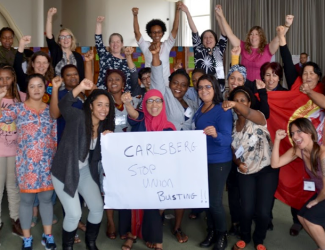
Women human rights defenders (WHRDs) worldwide defend their lands, livelihoods and communities from extractive industries and corporate power. They stand against powerful economic and political interests driving land theft, displacement of communities, loss of livelihoods, and environmental degradation.
Extractivism is an economic and political model of development that commodifies nature and prioritizes profit over human rights and the environment. Rooted in colonial history, it reinforces social and economic inequalities locally and globally. Often, Black, rural and Indigenous women are the most affected by extractivism, and are largely excluded from decision-making. Defying these patriarchal and neo-colonial forces, women rise in defense of rights, lands, people and nature.
WHRDs confronting extractive industries experience a range of risks, threats and violations, including criminalization, stigmatization, violence and intimidation. Their stories reveal a strong aspect of gendered and sexualized violence. Perpetrators include state and local authorities, corporations, police, military, paramilitary and private security forces, and at times their own communities.
AWID and the Women Human Rights Defenders International Coalition (WHRD-IC) are pleased to announce “Women Human Rights Defenders Confronting Extractivism and Corporate Power”; a cross-regional research project documenting the lived experiences of WHRDs from Asia, Africa and Latin America.
"Women Human Rights Defenders confronting extractive industries: an overview of critical risks and Human Rights obligations" is a policy report with a gender perspective. It analyses forms of violations and types of perpetrators, quotes relevant human rights obligations and includes policy recommendations to states, corporations, civil society and donors.
"Weaving resistance through action: Strategies of Women Human Rights Defenders confronting extractive industries" is a practical guide outlining creative and deliberate forms of action, successful tactics and inspiring stories of resistance.
The video “Defending people and planet: Women confronting extractive industries” puts courageous WHRDs from Africa, Asia, and Latin America in the spotlight. They share their struggles for land and life, and speak to the risks and challenges they face in their activism.
Challenging corporate power: Struggles for women’s rights, economic and gender justice is a research paper outlining the impacts of corporate power and offering insights into strategies of resistance.
AWID acknowledges with gratitude the invaluable input of every Woman Human Rights Defender who participated in this project. This project was made possible thanks to your willingness to generously and openly share your experiences and learnings. Your courage, creativity and resilience is an inspiration for us all. Thank you!
ÉCONOMIES DES SOINS AGROÉCOLOGIE ET SOUVERAINETÉ ALIMENTAIRECOOPÉRATIVISME FÉMINISTESYNDICALISME FÉMINISTE
We will reconnect with past partners, to ensure past efforts are honored. If your contact information has changed since the last Forum process, please update us so that we may reach you.
Suivez notre super-héroïne alors qu'elle se lance dans une quête pour récupérer le récit des acteurs anti-droits à travers le monde.
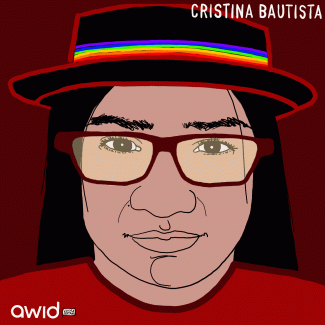
“If we stay quiet they kill us and if we talk [they kill us] too. So, let’s talk.” - Cristina Bautista, 2019
A tireless defender of the rights of Nasa people, Cristina spoke strongly and loudly against the violence directed at her community. In a speech before the United Nations, she called for the protection of Indigenous women’s lives and their involvement in different spheres of life. In 2017, Cristina was a UN Human Rights Office Indigenous fellow and she was awarded a grant from the UN Voluntary Fund for Indigenous Peoples in 2019.
“I would like to bring to light the current situation of the Indigenous people in Colombia, the killing of Indigenous leaders, the repression of social protest. Instead of helping, the peace deal has increased war and the exploitation of sacred territories in Colombia… In the current situation, in almost all Indigenous nations as women we have been working to find a better future for our families. I don’t want more women from the countryside to continue living under these circumstances. We need opportunities for Indigenous women to participate in politics, in the economy, in society and in culture. Today gives me true strength, to see all these women here and that I am not alone.” - Cristina Bautista, 2019
On 29 October 2019, Cristina was murdered along with four unarmed Indigenous guards in an attack which was allegedly carried out by armed members of “Dagoberto Ramos”, a FARC dissident group.
According to Global Witness, “the murder of community and social leaders has risen dramatically in Colombia in recent years.”
“The Nasa community has repeatedly raised the alarm with the authorities about threats to their safety. Despite efforts by successive Colombian Governments, indigenous peoples continue to face great risks, especially religious or community leaders like Cristina Bautista.” - UN press briefing, 1 November 2019
Watch a speech by Cristina Bautista in August 2019 in which she denounced previous murders of Indigenous guards (Spanish only)
We know feminists still need and deserve more and better resources! We have revised our funder database.
The Who Can Fund Me? Database is an easy-to-use, practical tool for movements looking for funders from philanthropic foundations, multilateral funders to women’s and feminist funds to support vital lifesaving efforts.
En 2023, le budget annuel médian des organisations féministes et de défense des droits des femmes était de 22 000 USD. Cette médiane masque de profondes inégalités : quelques groupes accèdent à des ressources considérables, tandis que la grande majorité survit avec des budgets très limités.
Un examen plus attentif des budgets réels révèle une immense diversité et une grande disparité dans les revenus.
Explorez les données relatives à la taille des budgets féministes
Para preguntas adicionales, por favor utiliza nuestro formulario de contacto. ¡Continuaremos actualizando este documento en base a las consultas que vayamos recibiendo de ustedes!
Avec Lindiwe Rasekoala, Lizzie Kiama, Jovana Drodevic et Malaka Grant.
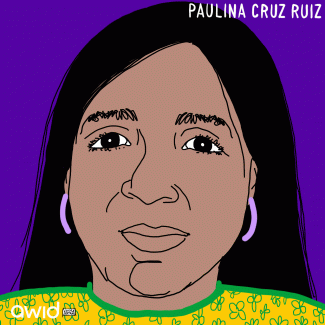
Paulina Cruz Ruiz, de la región de Rabinal, Baja Verapaz, en Guatemala, fue una autoridad ancestral Maya Achí (Indígena) y una defensora de los derechos humanos. Paulina se involucró activamente en la organización comunitaria y la resistencia, lo cual incluyó la adopción de medidas legales contra los proyectos mineros en territorios Indígenas, proyectos que afectarían y perjudicarían severamente el tejido socio ambiental.
"El modelo de industria extractiva promovido por el gobierno guatemalteco y la construcción de proyectos de desarrollo a gran escala en tierras indígenas, sin el consentimiento de la comunidad afectada, ha sido una fuente de disputas permanentes con los movimientos de resistencia". - Minority Rights Group International
Paulina también formó parte de la Marcha por la Dignidad, la Vida y la Justicia, del 1º de mayo de 2019, en la cual miles de guatemaltecxs iniciaron una marcha de ocho días contra la corrupción y la impunidad en la persecución y el asesinato de dirigentes de derechos humanos, líderes campesinxs e indígenas y defensorxs de la tierra.
Paulina fue asesinada el 14 de septiembre de 2019 cerca de su casa en la aldea de Xococ.
Según el Grupo Internacional de Derechos de las Minorías: "actualmente, uno de los principales problemas que afectan a las comunidades mayas es la creciente actividad de la industria minera".
Para leer más sobre la comunidad Maya en Guatemala
Para leer más sobre la Marcha por la Dignidad, la Vida y la Justicia
Le Forum a été un espace clé pour le Mouvement des femmes autochtones (Indigenous Women’s Movement, IWM) dans son rapport au féminisme. Aux Forums de l’AWID, elles ont appliqué la même stratégie que celle utilisée pour les Nations Unies. Au cours de ce processus, les deux mouvements ont été transformés : de nouvelles voix et questions ont émergé au sein de l’IWM, et les féministes ont commencé à changer leurs discours et leurs pratiques autour des droits fonciers et de la spiritualité, elles ont mieux compris les droits collectifs et ont inclus l’IWM dans leurs événements et leurs programmes. Mónica Alemán et María Manuela Sequeira, de l’IWM, nous ont raconté cette histoire.
Get started with these resources.
COP30 Political Education Toolbox Play the Climate Justice Organizing Deckgame
Read the Feminist Economic Alternatives Brief Download the Climate Justice Zine
New
As an online participant, you can facilitate activities, connect and converse with others, and experience first-hand the creativity, art and celebration of the AWID Forum. Participants connecting online will enjoy a rich and diverse program, from workshops and discussions to healing activities and musical performances. Some activities will focus on connection among online participants, and others will be truly hybrid, focusing on connection and interaction among online participants and those in Bangkok.

Feminists have long asserted that the personal is political. Crear, Resister, Transform Festival created spaces for feminists to discuss issues around body, gender and sexualities, and explored the interconnections of how these issues are both deeply embodied experiences, and simultaneously a terrain where rights are constantly disputed and at risk in society.
The power of feminist movements lie in how we organise and take coordinated action, not only amongst our own communities and movements, but with allied social justice causes and groups. This space provided opportunities for movements to share and strengthen organizing and tactical strategies with each other.
The COVID-19 global health pandemic has made the failures of neo-liberal capitalism even more apparent than ever before, exposed the cracks in our systems, and highlighted the need and opportunities to build new realities. A feminist economic and social recovery requires all of us to make it together. This journal edition in partnership with Kohl: a Journal for Body and Gender Research, will explore feminist solutions, proposals and realities for transforming our current world, our bodies and our sexualities.
Explore the articles online or
Download PDF
Les agradecemos su interés por visitar el sitio web de AWID. Para obtener más información sobre nuestro trabajo, visiten https://www.awid.org/es
Movements marching globally for climate justice.
📅 Saturday, November 15, 2025
📍 Multiple Locations

We welcome applications across the full range of thematic areas and intersections important to feminist and gender justice movements. In the application form, you will be able to mark more than one theme that fits your activity.
by Chinelo Onwualu
On September 2nd, 2021, the amazing feminist and social justice activists of AWID’s Crear | Résister | Transform festival came together not only to share resistance strategies, co-create, and transform the world, but also to talk dirty on Twitter.