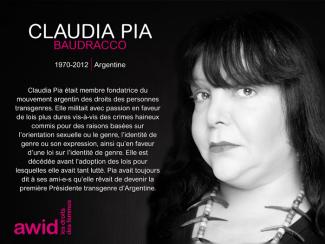
Claudia Pia Baudracco
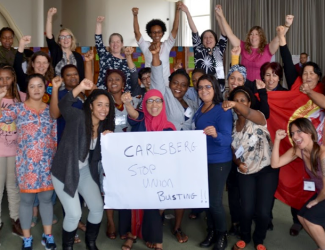
Women human rights defenders (WHRDs) worldwide defend their lands, livelihoods and communities from extractive industries and corporate power. They stand against powerful economic and political interests driving land theft, displacement of communities, loss of livelihoods, and environmental degradation.
Extractivism is an economic and political model of development that commodifies nature and prioritizes profit over human rights and the environment. Rooted in colonial history, it reinforces social and economic inequalities locally and globally. Often, Black, rural and Indigenous women are the most affected by extractivism, and are largely excluded from decision-making. Defying these patriarchal and neo-colonial forces, women rise in defense of rights, lands, people and nature.
WHRDs confronting extractive industries experience a range of risks, threats and violations, including criminalization, stigmatization, violence and intimidation. Their stories reveal a strong aspect of gendered and sexualized violence. Perpetrators include state and local authorities, corporations, police, military, paramilitary and private security forces, and at times their own communities.
AWID and the Women Human Rights Defenders International Coalition (WHRD-IC) are pleased to announce “Women Human Rights Defenders Confronting Extractivism and Corporate Power”; a cross-regional research project documenting the lived experiences of WHRDs from Asia, Africa and Latin America.
"Women Human Rights Defenders confronting extractive industries: an overview of critical risks and Human Rights obligations" is a policy report with a gender perspective. It analyses forms of violations and types of perpetrators, quotes relevant human rights obligations and includes policy recommendations to states, corporations, civil society and donors.
"Weaving resistance through action: Strategies of Women Human Rights Defenders confronting extractive industries" is a practical guide outlining creative and deliberate forms of action, successful tactics and inspiring stories of resistance.
The video “Defending people and planet: Women confronting extractive industries” puts courageous WHRDs from Africa, Asia, and Latin America in the spotlight. They share their struggles for land and life, and speak to the risks and challenges they face in their activism.
Challenging corporate power: Struggles for women’s rights, economic and gender justice is a research paper outlining the impacts of corporate power and offering insights into strategies of resistance.
AWID acknowledges with gratitude the invaluable input of every Woman Human Rights Defender who participated in this project. This project was made possible thanks to your willingness to generously and openly share your experiences and learnings. Your courage, creativity and resilience is an inspiration for us all. Thank you!

Contenido relacionado
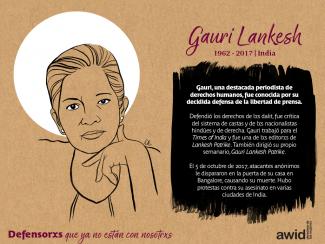
Reporteros sin Fronteras: India: Asesinada la periodista Gauri Lankesh
Global Voices: Asesinan a Gauri Lankesh, periodista crítica con la derecha india, a la entrada de su casa
AWID began in 1982 and has grown and transformed since then into a truly global organization.
Read From WID to GAD to Women's Rights: The First 20 Years of AWID
The growing dominance of international financial markets and institutions in defining global economic policies has resulted in the capture of people’s power in the interest of global elites and big corporations.
Our policy brief on Illicit Financial Flows explores their disproportional gender impact and unveils the current legal and political frameworks that allow multinational corporations to benefit from tax abuse to the detriment of people and planet.
The brief concludes with these seven feminist policy recommendations to demand transparency and corporate accountability in order to curb illicit financial flows.
Illicit financial flows are gaining unprecedented attention: whether in development negotiations, like those leading to Agenda 2030 and the Addis Ababa Financing for Development Conference in 2015; or making headlines in mainstream media with the release of leaked documents on offshore finance known as the ‘Panama Papers’. In another example, the Ecuadorean people voted to bar politicians and civil servants from having assets, companies or capital in tax havens, in a referendum in February 2017. The Ecuadorian government is now a leading voice within the group of G77, in the United Nations, to create a UN global tax body to end tax havens.
This public attention potentially builds momentum for feminists, social movements and tax justice advocates to pressure for the transformation of the global financial system, which entrenches global inequalities, including gendered inequalities.
We offer below a set of seven policy asks as a contribution to growing advocacy efforts from social justice, feminist, women’s rights and gender equality actors:

Чтобы поделиться опытом финансирования в вашей организации

Contenu lié
Rolling Stone Magazine: Décès d’Edith Windsor: la communauté LGBT pleure une icône
Le Monde: L’Américaine Edith Windsor, figure LGBT, est morte

Trabajamos para fortalecer las voces y el impacto de lxs activistas, organizaciones y movimientos por los derechos de las mujeres.
Las áreas prioritarias de AWID se relacionan con temas estrechamente vinculados con tendencias globales dominantes. Estos temas reflejan los crecientes desafíos que afectan negativamente a los derechos de las mujeres en todo el mundo.

O inquérito está disponível em árabe, inglês, francês, português, russo e espanhol!
Tous nos rapports annuels sont accessibles sur notre site web.
En planifiant l’activité que vous voulez présenter au Forum, pensez aussi à la façon dont vous financerez votre participation. Prenez en compte : l’hébergement, le voyage, le visa, les frais d’inscription au forum, etc.
Veuillez noter que ce Forum offrira de nombreux « espaces ouverts » et moments d’apprentissage et d’échange entre mouvements, mais aussi moins de sessions formelles. (Consultez la section « Comment décrire le Forum pour votre levée de fonds » ci-dessous concernant le langage à adopter dans votre demande).
Votre meilleure option sera toujours de faire appel à vos bailleurs de fonds actuels : Si votre groupe bénéficie de l'appui d'organismes donateurs, dites-leur que vous souhaitez participer au Forum de l’AWID pour apprendre, expérimenter, échanger et travailler en réseau, et ce même si votre activité n'est pas sélectionnée dans le programme final.
Pour soutenir votre participation, vos bailleurs de fonds devront en être informés longtemps à l'avance, alors n’attendez pas pour leur en parler déjà tout de suite ! (Ils sont déjà en train de décider des fonds qu’ils vont distribuer en 2020. Nous vous recommandons de les contacter au plus tard début 2020.) Bon nombre de donateurs qui soutiennent les organisations féministes disposent de budgets alloués au déplacement pour le Forum.
D’autres pourraient les inclure dans des renouvellements de subventions ou dans d’autres financements permettant de couvrir les frais de déplacements.
Si vous ne disposez pas actuellement d’un soutien financier, ou que vous ne pouvez garantir de subventions dédiées au déplacement pour le Forum, vous pouvez envisager de contacter de nouveaux donateurs.
Les délais et exigences varient d’un donateur à l’autre, et la procédure d’octroi de financement peut prendre plusieurs mois. Si vous envisagez d’effectuer de nouvelles demandes de financement, nous vous encourageons à le faire au plus tôt.
Les mouvements féministes ont depuis longtemps fait preuve de créativité lorsque s’agissait de financer leur propre militantisme. Voici quelques idées que nous avons été en mesure de rassembler afin d’inspirer des modes alternatifs de financement.
Pour plus d’inspiration, vous pouvez consulter les informations continues de l’AWID sur le financement autonome, comprenant des idées spécifiques sur le financement de la participation aux conférences.
Le Fonds d’accès de l’AWID : l’AWID s'efforce de faire du Forum un véritable rassemblement mondial avec la participation de divers mouvements, régions et générations. A cette fin, l'AWID mobilise des ressources pour constituer un Fonds d'accès limité (AF, selon son sigle anglais) afin d'aider les participant-e-s à couvrir leurs frais de participation.
Vous pouvez indiquer dans votre candidature si vous souhaitez soumettre une demande de financement au Fonds d'accès de l’AWID.
N'oubliez pas que ces ressources sont très limitées et que nous ne serons pas en mesure de soutenir tou.te.s les candidat.e.s. Même si vous faites une demande pour le Fonds d'accès de l’AWID, nous vous encourageons à continuer à explorer d'autres options pour financer votre participation au Forum. Les décisions relatives au Fonds d'accès seront confirmées d'ici la fin du mois de juin 2020.
Voici quelques extraits de messages qui peuvent vous aider à prendre contact avec vos donateurs ou votre réseau. N’hésitez pas à les adapter de la façon que vous jugerez la plus utile à vos yeux !
Le Forum de l’AWID est un espace cocréé par des mouvements féministes qui stimule les participant·e·s dans leur propre activisme, et renforce les connexions entre divers mouvements de droits et de justice. Les participant·e·s en tirent des sources d’espoir, d’énergie et d’imagination débridée, tout en approfondissant leurs analyses partagées et leurs apprentissages. C’est aussi un lieu de renforcement de la solidarité entre mouvements qui permet de développer des programmes d’action intégrés et de faire avancer des stratégies communes.
Notre organisation est à la recherche de fonds pour participer à ce Forum afin de se connecter à d’autres activistes et mouvements du monde entier, de consolider nos stratégies et de partager notre travail. Les participant·e·s des années précédentes nous inspirent, notamment lorsque ces personnes décrivent le pouvoir de ce rassemblement mondial féministe :
« Pendant quelques jours… les voix se sont tissées en une perspective mondiale sur l’état de l’égalité de genre. Et lorsque je dis mondiale, je fais référence à des traductions simultanées en sept langues… »
« Nous nous sommes rappelé·e·s que nous n’étions pas seul·e·s. Le Forum est un moyen pour traduire le collectif dans nos mouvements. En dépit des idéologies, des identités ou des frontières, notre force réside dans notre vision et notre soutien les un·e·s pour les autres. »
Veuillez noter que ce Forum offrira de nombreux « espaces ouverts » et moments d’apprentissage et d’échange entre mouvements, mais aussi moins de sessions formelles.
Même si beaucoup de participant·e·s ne feront pas de présentation aux sessions formelles, le Forum offrira cependant un espace précieux d’apprentissage, de réflexion stratégique et d’expérimentation du pouvoir collectif en action des mouvements féministes.
Lors du calcul de vos coûts et du montant nécessaire à financer, il est important de prendre en compte certaines dépenses qui peuvent survenir. Voici des exemples d’éléments clés à considérer :
Le 14ème Forum de l'AWID aura lieu du 11 au 14 janvier 2021 à Taipei, Taiwan.
C'est bien plus qu’un événement de quatre jours. C’est un arrêt de plus dans un parcours de renforcement de mouvement autour des réalités féministes, lequel a déjà commencé et continuera bien au-delà des dates du Forum.
استطلاع "اين المال" (أين التمويل للتنظيمات النسوية) هو ركيزة أساسية للنسخة الثالثة لأبحاثنا الموجهة نحو العمل. سيتم بحث وتوسيع نتائج الاستطلاع من خلال المحادثات العميقة مع النشطاء/ الناشطات والممولين/ات وسيتم مقارنة النتائج مع تحليلات وبحوث أخرى عن وضع التمويل للحركات النسوية وحركات العدالة الجندرية.
سيتم نشر تقرير أين المال للتنظيمات النسوية في العام  2026.
2026.
لمعرفة المزيد عن كيف تسلّط جمعية حقوق المرأة في التنمية الضوء على على تمويل التنظيمات النسوية أو ضدها، انظروا إلى قصة "أين المال" وتقارير سابقة هنا