Special Focus

AWID is an international, feminist, membership organisation committed to achieving gender equality, sustainable development and women’s human rights

Confronting Extractivism & Corporate Power

Women human rights defenders (WHRDs) worldwide defend their lands, livelihoods and communities from extractive industries and corporate power. They stand against powerful economic and political interests driving land theft, displacement of communities, loss of livelihoods, and environmental degradation.


Why resist extractive industries?

Extractivism is an economic and political model of development that commodifies nature and prioritizes profit over human rights and the environment. Rooted in colonial history, it reinforces social and economic inequalities locally and globally. Often, Black, rural and Indigenous women are the most affected by extractivism, and are largely excluded from decision-making. Defying these patriarchal and neo-colonial forces, women rise in defense of rights, lands, people and nature.

Critical risks and gender-specific violence

WHRDs confronting extractive industries experience a range of risks, threats and violations, including criminalization, stigmatization, violence and intimidation.  Their stories reveal a strong aspect of gendered and sexualized violence. Perpetrators include state and local authorities, corporations, police, military, paramilitary and private security forces, and at times their own communities.

Acting together

AWID and the Women Human Rights Defenders International Coalition (WHRD-IC) are pleased to announce “Women Human Rights Defenders Confronting Extractivism and Corporate Power”; a cross-regional research project documenting the lived experiences of WHRDs from Asia, Africa and Latin America.

We encourage activists, members of social movements, organized civil society, donors and policy makers to read and use these products for advocacy, education and inspiration.

Share your experience and questions!

Tell us how you are using the resources on WHRDs Confronting extractivism and corporate power.

◾️ How can these resources support your activism and advocacy?

◾️ What additional information or knowledge do you need to make the best use of these resources?

Share your feedback


Thank you!

AWID acknowledges with gratitude the invaluable input of every Woman Human Rights Defender who participated in this project. This project was made possible thanks to your willingness to generously and openly share your experiences and learnings. Your courage, creativity and resilience is an inspiration for us all. Thank you!

Related Content

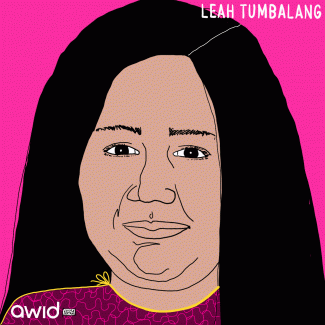
Leah Tumbalang

Leah Tumbalang was a Lumad woman of Mindanao in the Philippines. The story of Lumad Indigenous peoples encompasses generations of resistance to large-scale corporate mining, protection of ancestral domains, resources, culture, and the fight for the right to self-determination. 

Leah was a Lumad  leader as well as a leader of Kaugalingong Sistema Igpasasindog to Lumadnong Ogpaan (Kasilo), a Lumad and peasant organization advocating against the arrival of mining corporations in Bukidnon, Mindanao province. She was unwavering in her anti-mining activism, fervently campaigning against the devastating effects of mineral extraction on the environment and Indigenous peoples’ lands. Leah was also an organizer of the Bayan Muna party-list, a member of the leftist political party Makabayan.

For almost a decade, Leah (along with other members of Kasilo) had been receiving threats for co-leading opposition against the deployment of paramilitary groups believed to be supported by mining interests. 

“Being a Lumad leader in their community, she is at the forefront in fighting for their rights to ancestral land and self-determination.” - Kalumbay Regional Lumad Organization

Being at the forefront of resistance also often means being a target of violence and impunity and Leah not only received numerous death threats, but was murdered on 23 August 2019 in Valencia City, Bukidnon. 

According to a Global Witness report, “the Philippines was the worst-affected country in sheer numbers” when it comes to murdered environmental activists in 2018. 


Read the Global Witness report, published July 2019
Find out more about Lumad women in the Philippines and their inter-generational struggle for self-determination
 

Je suis une jeune féministe. Comment m’impliquer au sein de l’AWID ?

Les jeunes féministes sont au cœur de l’action de l’AWID.

De fait, 38 % de nos membres sont ont moins de 30 ans.

Nous estimons que les jeunes féministes représentent le présent et l’avenir de la lutte pour les droits des femmes. Nous encourageons les jeunes femmes à devenir des leaders du mouvement et notre programme « Activisme des jeunes féministes » est transversal à tous les autres aspects de notre travail.

Dans le même temps, en définissant les jeunes féministes comme l'un de nos domaines prioritaires, nous apportons de nouvelles perspectives aux débats actuels et veillons à ce que les jeunes activistes puissent exprimer clairement leurs priorités et leurs inquiétudes.

En savoir plus sur le programme Activisme des jeunes féministes

Snippet - COP30 - International Eco-Socialist Encounter - EN

International Eco-Socialist Encounter

Panels, workshops, plenaries and spaces for exchange between collectives, activists and organizations in struggle to collectively walk the path towards an agenda and a program of struggle for ecosocialism.

📅 November 8 - November 11, 2025
📍 Buenos Aires, Argentina

Register here

Snippet FEA FIGHT LIKE SOMEONE WHO CARES (FR)

São Paulo, Brésil

COZINHA OCUPAÇÃO 9 DE JULHO

Lutte comme quelqu'un·e qui

PREND SOIN

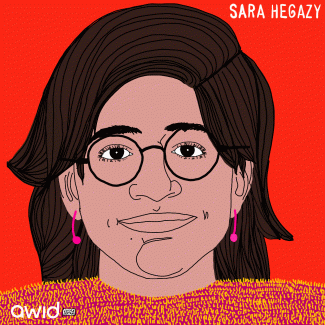
Sara Hegazy

Sarah Hegazy, una audaz activista egipcia por los derechos LGBTQI+, vivía en una sociedad en la que lxs integrantes de su comunidad, sus cuerpos y sus vidas, enfrentan prejuicios letales a menudo. La resistencia de Sarah estaba arraigada en la deconstrucción del sistema dominante, opresor y patriarcal, y de sus actores antiderechos.

«[En Egipto], toda persona que no sea varón, musulmán, suní, heterosexual y partidario del sistema, es rechazada, reprimida, estigmatizada, arrestada, exiliada o asesinada. Este problema se relaciona con el sistema patriarcal en su conjunto, ya que el Estado no podría ejercer su represión contra lxs ciudadanxs, si no hubiera una opresión preexistente desde la infancia», escribió Sarah Hegazy el 6 de marzo de 2020

La supresión de la voz de Sarah por parte del gobierno egipcio alcanzó su pico más violento en 2017, cuando fue arrestada por alzar una bandera arcoíris en el recital de Mashrou’ Leila (una banda libanesa cuyo cantante principal es abiertamente gay) en El Cairo. Fue acusada de pertenecer a un grupo ilegal, y de «promover la desviación sexual y el libertinaje».

«Fue un acto de apoyo y solidaridad, no solamente con el cantante [de Mashrou’ Leila] sino con todas las personas oprimidas... Nos enorgulleció alzar la bandera. Nunca nos imaginamos la reacción de la sociedad y del Estado egipcio. Para ellos, yo era una criminal: alguien que buscaba destruir la estructura moral de la sociedad.» - Sarah Hegazy

Sarah estuvo encarcelada por tres meses, durante los cuales fue torturada y agredida sexualmente. En enero de 2018, después de ser liberada bajo fianza, pidió asilo en Canadá, donde estaba segura, pero seguía prisionera de los recuerdos del abuso y la violencia que su cuerpo y su alma habían sufrido.

«Salí de esta experiencia después de tres meses con un caso muy intenso y serio de TEPT [trastorno por estrés postraumático]. La prisión me mató. Me destruyó», dijo Sarah Hegazy a NPR.

Sarah se quitó la vida el 14 de junio de 2020, luego de dejar una nota escrita a mano en árabe:

«A mis hermanxs: traté de encontrar redención y fallé, perdónenme.
A mis amigxs: la experiencia [el viaje] fue muy dura y soy demasiado débil como para resistir, perdónenme.
Al mundo: has sido tremendamente cruel, pero perdono.»

Su legado y su coraje continuarán, llevados adelante por quienes la aman y creen en aquello por lo que Sarah luchó.

Tributos:

«A Sarah: Descansa, solo descansa, libre de esta violencia implacable, de este patriarcado letal impulsado por el Estado. Con rabia, con dolor, con extenuación, resistimos.» - Rasha Younes, investigadora sobre derechos LGBT de Human Rights Watch. Lee el texto completo

El vocalista de Mashrou’ Leila canta un tributo a Sarah Hegazy

Tributos en Twitter

Documental sobre la vida de Sarah Hegazy

Sitio web dedicado a Sarah Hegazy y a quienes (en especial voces LGBTQI) no pueden hacer su duelo en público

I am experiencing violence in one or more of my relationships. Can AWID advocate on my behalf?

Unfortunately, no. AWID is not a direct service or individual advocacy organization.

It would be better for you to seek legal advice and contact a women’s shelter or referral centre in your area.

The HotPeachPages is an online resource that offers links to women’s shelters around the world. AWID cannot vouch for the accuracy or quality of its listings, but it may be a good place to start if you don’t know of organizations in your area.

Snippet - COP30 - Resistance Hubs Section Column 2 - ES

La organización de los nodos para la COP30 está a cargo de los siguientes aliados:

  1. Caribbean Feminist Climate Justice Movement, Barbados
  2. Gender Interactive Alliance (GIA)*, Pakistán
  3. Women’s Initiative for Sustainable Environment (WISE)*, Nigeria
  4. Réseau des Acteurs du Développement Durable (RADD)**, Camerún
  5. MASIPAG*, Filipinas

*Sitios web en inglés
**Sitio web en francés

Snippet FEA Introducing Carmen Silva Ferreira (EN)

We have the pleasure to introduce you to Carmen Silva Ferreira.

She was born in Bahia, the Northeastern part of Brazil. She is an immigrant, a social activist and a mother of 8 children.

Carmen experienced homelessness at the age of 35, after migrating to Sao Paulo on her own. This led her to become a fierce advocate for vulnerable, marginalized and invisibilized communities most affected by the housing crisis. She eventually became one of the founders of MSTC in 2000.

As a visionary political organizer and the current leader of the MSTC, Carmen’s work has laid bare the city's housing crisis and provided inspiration to others on different ways to organize and manage occupations. She stood strong on the forefront of several occupations. One of them is the 9 de Julho Occupation, which now serves as a stage for direct democracy, and a space where everyone can be heard, seen, appreciated and work together.

Carmen has been long celebrated for her boldness in giving life back to abandoned buildings in the heart of São Paulo.

To know more about her life, you can follow her on Instagram!

2007: se intensifica la participación de la sociedad civil con la creación del WWG sobre FpD

En octubre de 2007 se creó el Women’s Working Group on Financing for Development [Grupo de Trabajo de Mujeres sobre Financiación para el Desarrollo, WWG on FfD en inglés], una alianza entre organizaciones y redes por los derechos de las mujeres cuyo objetivo es defender y promover avances en cuanto a igualdad de género, empoderamiento de las mujeres y derechos humanos en los procesos de la ONU relacionados con la FpD.

Tercer Diálogo de Alto Nivel sobre la Financiación para el Desarrollo, 23 al 25 de octubre de 2007

  • En el tercer panel de alto nivel, la participación de la sociedad civil se incrementó exponencialmente. Además de las seis mesas redondas, hubo audiencias para la sociedad civil y el sector empresarial.
  • AWID leyó en plenaria la declaración de la sociedad civil que pedía a los gobiernos prestar una mayor atención a la importancia de las organizaciones por los derechos de las mujeres como agentes del desarrollo y a la necesidad de promover nuevos mecanismos de financiación para las mujeres en los países en desarrollo y los menos desarrollados. Esta declaración exhortó a los gobiernos a brindar un mayor apoyo a la arquitectura de género de la ONU para que el sistema en su conjunto pudiera avanzar en sus compromisos en materia de igualdad de género, empoderamiento de las mujeres y derechos humanos, incluyendo los derechos económicos, sociales, culturales y ambientales de todas las personas.

Snippet - COP30 - Deckgame card - ES

🎯 Juego: Organizar. Elaborar estrategias. Movilizarse.

Un juego práctico con el que los colectivos pueden analizar las alternativas económicas feministas y los sistemas de cuidados como respuesta a las crisis. Destinado a todos los movimientos que trabajan en torno a la crisis climática mundial mediante una estrategia basada en escenarios de la vida real. Una vía creativa para elaborar estrategias en reuniones, talleres y encuentros comunitarios.

Próximamente

Snippet FEA ASOM Challenges Story 1 (ES)

DESAFÍOS

  • Cambio Climático
  • Acesso a créditos
  • Intermediários

2013: le sixième Dialogue de haut niveau examine les progrès des OMD

WITM - Refreshed Intro Text (FR)

Où est l’argent ? Un plaidoyer documenté pour soutenir les organisations féministe

Ce rapport révèle la réalité du financement des organisations féministes et de défense des droits des femmes dans un contexte de bouleversements politiques et financiers. S’appuyant sur plus de dix ans d’analyse depuis la dernière étude Où est l’argent ? de l’AWID (Arroser les feuilles, affamer les racines), il dresse un bilan des progrès réalisés, des lacunes persistantes et des menaces croissantes dans le domaine du financement féministe.

Le rapport salue le pouvoir des initiatives menées par les mouvements pour façonner le financement selon leurs propres conditions, tout en alertant sur les coupes massives dans l’aide au développement, le recul de la philanthropie et l’escalade des offensives anti-droits. 

Il appelle les bailleurs de fonds à investir massivement dans l’organisation féministe, infrastructure essentielle pour la justice et la libération, et invite les mouvements à réimaginer des modèles de financement audacieux et autodéterminés, fondés sur le soin, la solidarité et le pouvoir collectif.

Le rapport sera bientôt disponible

Snippet FEA Barcelona, Spain (FR)

Barcelone, Espagne

Metzineres


Les Gens se Droguent.

ET ALORS?

June 2015

Further drafting sessions on the Addis Ababa outcome document

Learn more from the CSO Hitchhiker’s Guide