Special Focus

AWID is an international, feminist, membership organisation committed to achieving gender equality, sustainable development and women’s human rights

Confronting Extractivism & Corporate Power

Women human rights defenders (WHRDs) worldwide defend their lands, livelihoods and communities from extractive industries and corporate power. They stand against powerful economic and political interests driving land theft, displacement of communities, loss of livelihoods, and environmental degradation.


Why resist extractive industries?

Extractivism is an economic and political model of development that commodifies nature and prioritizes profit over human rights and the environment. Rooted in colonial history, it reinforces social and economic inequalities locally and globally. Often, Black, rural and Indigenous women are the most affected by extractivism, and are largely excluded from decision-making. Defying these patriarchal and neo-colonial forces, women rise in defense of rights, lands, people and nature.

Critical risks and gender-specific violence

WHRDs confronting extractive industries experience a range of risks, threats and violations, including criminalization, stigmatization, violence and intimidation.  Their stories reveal a strong aspect of gendered and sexualized violence. Perpetrators include state and local authorities, corporations, police, military, paramilitary and private security forces, and at times their own communities.

Acting together

AWID and the Women Human Rights Defenders International Coalition (WHRD-IC) are pleased to announce “Women Human Rights Defenders Confronting Extractivism and Corporate Power”; a cross-regional research project documenting the lived experiences of WHRDs from Asia, Africa and Latin America.

We encourage activists, members of social movements, organized civil society, donors and policy makers to read and use these products for advocacy, education and inspiration.

Share your experience and questions!

Tell us how you are using the resources on WHRDs Confronting extractivism and corporate power.

◾️ How can these resources support your activism and advocacy?

◾️ What additional information or knowledge do you need to make the best use of these resources?

Share your feedback


Thank you!

AWID acknowledges with gratitude the invaluable input of every Woman Human Rights Defender who participated in this project. This project was made possible thanks to your willingness to generously and openly share your experiences and learnings. Your courage, creativity and resilience is an inspiration for us all. Thank you!

Related Content

Snippet - Feminist Mixer - ES

Encuentro feminista: Citas rápidas para feministas

✉️ Requiere inscripción previa. Regístrate aquí

📅 Martes 11 de marzo de 2025
🕒 De 06:00 a 08:00 p. m.,

🏢 Chef's Kitchen Loft with Terrace, 216 East 45th St 13th Floor New York

Organiza: AWID

FRMag - Anatomy of a survivor's story

Anatomía de la historia de una sobreviviente

por Maryum Saifee

Cuando se hace una búsqueda en Internet sobre «mutilación genital femenina» o «MGF», junto a la entrada de Wikipedia, aparece una imagen de cuatro dibujos lineales de la anatomía femenina, que ilustran cuatro tipos de violencia. (...)

Leer

arte:  «Dreams» [Sueños], Neesa Sunar >

Hevrin Khalaf

Hevrin Khalaf fue una destacada líder política siria-kurda de la región autónoma de Rojava, donde las mujeres kurdas están arriesgando sus vidas para resistir la ofensiva turca y construir un sistema feminista.

Hevrin fue Secretaria General del Future Syria Party [Partido de la Futura Siria] (FSP, por sus siglas en inglés), un grupo que tenía como objetivo la construcción de puentes, la reconciliación entre diferentes grupos étnicos y el trabajo hacia una "Siria democrática, pluralista y descentralizada".

Hevrin fue un símbolo de este esfuerzo de reconciliación. También trabajó para promover la igualdad entre mujeres y hombres y fue una representante para periodistas, trabajadorxs de ayuda humanitaria y diplomáticxs que visitaban la región.

Hevrin era también una ingeniera civil de Derik, y fue una de las fundadoras de Foundation for Science and Free Though [(Fundación para la Ciencia y el Libre Pensamiento] en 2012.

El 12 de octubre de 2019 fue torturada y asesinada por la milicia Ahrar al-Sharqiya, sustentada por Turquía, durante una operación militar contra las Fuerzas Democráticas Sirias en Rojava.

"El asesinato de Khalaf es un punto de inflexión en la historia moderna de Siria. Demuestra una vez más el viejo proverbio kurdo "no hay amigxs sino montañas". Siempre seré amigo[NC1]  de Khalaf y su visión de un mundo mejor." - Ahed Al Hendi
Qu’est-ce que le processus des Nations Unies sur le financement du développement ?

Le processus de l’Organisation des Nations Unies (ONU) sur le financement du développement (FdD) vise à traiter  différentes formes de financement du développement et de coopération pour le développement. Selon le Consensus de Monterrey, ce processus comporte six axes clés :

  • La mobilisation des ressources financières nationales au service du développement.
  • La mobilisation des ressources internationales au service du développement : investissements étrangers directs et autres flux financiers privés.
  • Le commerce international, comme moteur  du développement.
  • L’accroissement de la coopération financière et technique internationale pour le développement.
  • La dette extérieure.
  • L’examen des questions systémiques : amélioration de la cohérence et de la constance des systèmes monétaires, financiers et commerciaux internationaux en faveur du développement. 

Snippet FEA Intro Acknowledgments (FR)

Nous tenons à remercier le collectif Amar.ela de femmes féministes militantes et créatives qui ont rendu cette série possible, et tout particulièrement Natalia Mallo (le poulpe de l'équipe) pour son soutien et son accompagnement dans ce voyage.

Nous exprimons également notre profonde gratitude et notre admiration à tous les groupes et personnes qui ont participé à ce projet, et nous les remercions d'avoir partagé leur temps, leur sagesse, leurs rêves et leurs illusions avec nous. Nous les remercions de faire de ce monde un monde plus juste, féministe et durable.

Nous espérons que leurs histoires inspireront le reste du monde autant qu’elles nous ont inspirés.

Snippet - CSW69 On feminist resourcing today - FR

Sur le financement féministe aujourd’hui

FRMag - Esmeralda takes over the Internet

Esmeralda aux contrôles d’Internet : comment les réseaux sociaux aident les femmes roms à gagner en visibilité

par Émilie Herbert-Pontonnier 

Vous vous souvenez d’Esmeralda? Cette héroïne « gitane » et exotique née sous la plume de Victor Hugo, géant de la littérature française, et rendue célèbre par les studios Disney et leur Bossu de Notre-Dame.  (...)

Lire

< illustration : « Si les Marronas le permettent » Nayare Soledad Otorongx Montes Gavilan 

Diana Isabel Hernández Juárez

Diana Isabel Hernández Juárez était une enseignante, défenseure des droits humains et activiste pour l’environnement et les communautés guatémaltèque. Elle coordonnait le programme environnemental de la paroisse de Nuestra Señora de Guadalupe, sur la côte sud du Guatemala. 

Diana a dévoué sa vie à co-créer des actions de sensibilisation à l’environnement, en étroite collaboration avec les communautés locales, dans le but de résoudre les problèmes environnementaux et protéger les ressources naturelles. Elle a été à l’initiative de projets de pépinières forestières, de fermes municipales, de jardins familiaux et de campagnes de nettoyage. Active dans les programmes de reboisement, elle s’est efforçée de récupérer des espèces locales et de remédier aux pénuries d’eau dans plus de 32 communautés rurales.

Le 7 septembre 2019, Diana a été assassinée par balle par deux hommes armés inconnus alors qu’elle participait à une procession dans sa localité. Diana n’avait que 35 ans au moment de son décès.

Puis-je soumettre une proposition de session ?

L'appel à propositions est maintenant fermé.

Nous avons lancé un Appel à activités le 19 novembre 2019 et la date limite de réception des propositions était le14 février 2020.  

Trouvez d'autres moyens de vous engager sur le chemin du Forum

Snippet - GII Download (ES)

Snippet - Jobs and opportunities intro

If you’re looking to have an impact through your work in feminist, social justice and other non-profit organizations, we hope this page provides a start.

Here you will find open vacancies and call for applications from AWID and the Alliance for Feminist Movements, when available. Follow us on social media to be in the loop.

Instagram LinkedIn Facebook X (Twitter) BlueSky

FRMag - Looking at me Looking at Safe Spaces

Looking at me Looking at Safe Spaces

by Judyannet Muchiri

October last year I left for Kenya to begin what I have come to think of as my most important work yet. (...)

Read

artwork: “Healing Together” by Upasana Agarwal >

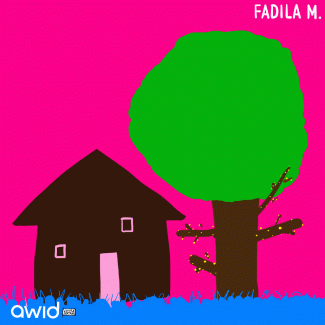
Fadila M.

Fadila M. was a Soulaliyate tribal activist from Azrou, the Ifrane region of Morocco. She fought against a specific form of land discrimination directed against tribal women.

As part of the Soulaliyate Women’s Land-Use Rights Movement, she worked towards overhauling the framework legislation relating to the management of community property through the 2019 adoption of three projects of laws guaranteeing the equality of women and men.

According to the customary laws in force, women had no right to benefit from the land, especially those who were single, widowed or divorced. The rights to collective land in Morocco were transmitted traditionally between male members of a family of over 16 years of age. Since 2007, Fadila M. had been part of the women’s movement, the first grassroots nationwide mobilization for land rights. Some of the achievements included that in 2012 for the first time Soulaliyate women were able to register on the lists of beneficiaries and to benefit from compensation relating to land cession. The movement also managed to get the 1919 dahir (Moroccan King's decree) amended to guarantee women the right to equality.

Fadila M. died on 27 September 2018. The circumstances of her death are unclear. She was part of a protest march connected to the issue of collective land and while authorities reported her death as being accidental, and her having a cardiac arrest on the way to the hospital, the local section of the Moroccan Association of Human Rights (AMDH) pointed out that Fadila was suffocated by a member of the police force using a Moroccan flag. Her family requested investigation but the results of the autopsy were not known.

Find out more about the Soulaliyate Women’s Land-Use Rights Movement


Please note: As there was no photograph/image of Fadila M. available to us, the artwork (instead of a portrait) aims to represent what she fought and worked for; land and rights to live and have access to that land and what grows on it.

Quand pourrai-je m’inscrire au Forum ?

Nous vous fournirons cette information sous peu. Restez à l’écoute ! 


Snippet Watch Stories (EN)

Learn more about the impact of the forum through these stories

Snippet - WCFM With smart filtering - EN

With smart filtering for Who Can Fund Me?  Database, you can search for funders based on:

FRMag - Resistance Series

Serie Resistencia Feminista

Ver la serie fotográfica