Special Focus

AWID is an international, feminist, membership organisation committed to achieving gender equality, sustainable development and women’s human rights

AWID Forum: Co-creating Feminist Futures

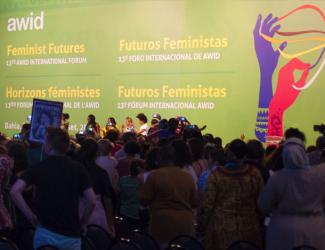
In September 2016, the 13th AWID international Forum brought together in Brazil over 1800 feminists and women’s rights advocates in a spirit of resistance and resilience.

This section highlights the gains, learnings and resources that came out of our rich conversations. We invite you to explore, share and comment!


What has happened since 2016?

One of the key takeaways from the 2016 Forum was the need to broaden and deepen our cross-movement work to address rising fascisms, fundamentalisms, corporate greed and climate change.

With this in mind, we have been working with multiple allies to grow these seeds of resistance:

And through our next strategic plan and Forum process, we are committed to keep developing ideas and deepen the learnings ignited at the 2016 Forum.

What happens now?

The world is a much different place than it was a year ago, and it will continue to change.

The next AWID Forum will take place in the Asia Pacific region (exact location and dates to be announced in 2018).

We look forward to you joining us!

About the AWID Forum

AWID Forums started in 1983, in Washington DC. Since then, the event has grown to become many things to many peoples: an iterative process of sharpening our analyses, vision and actions; a watershed moment that reinvigorates participants’ feminisms and energizes their organizing; and a political home for women human rights defenders to find sanctuary and solidarity.

Learn more about previous Forums

Related Content

“Where is the Money for Women’s Rights?" AWID’s WITM Toolkit (landing page intro) ES

Una nueva edición de la investigación "¿Dónde está el dinero?" está actualmente en marcha.

Obtén más información

Manual «¿Dónde está el dinero?» (WITM)

Una metodología de investigación que puedes aplicar tú mismx

Women leaders
© UN Women/Ashutosh Negi (CC BY-NC-ND 2.0) [https://creativecommons.org/licenses/by-nc-nd/2.0/]

AWID presenta este Manual WITM para apoyar a personas y organizaciones que quieran investigar por su cuenta las tendencias en el financiamiento para una región, temática o población en particular, adaptando las metodologías de investigación de AWID.


El Manual WITM de AWID es producto de diez años de experiencia. Las investigaciones de WITM y este Manual son una demostración política y práctica de los recursos y pasos necesarios para realizar investigaciones en acción de buena calidad.

Más información sobre el contexto de la metodología de la investigación WITM

El equipo WITM también ofrece apoyo técnico y político antes y durante el proceso de investigación. Te invitamos a leer el Manual y a ponerte en contacto con nosotras en fundher@awid.org si necesitas más información.

Является ли мое участие конфиденциальным?

Да. Ваши ответы будут удалены по окончании обработки и анализа данных и будут использованы исключительно в исследовательских целях. Данные НИКОГДА не будут переданы за пределы AWID и будут обрабатываться только сотрудниками AWID и консультантками(-тами), работающими с нами над проектом «Где деньги?». Для нас ваша конфиденциальность и безопасность– приоритет. С нашей политикой конфиденциальности можно подробно ознакомиться здесь.

Marceline Loridan-Ivens

Née en 1928, Marceline était actrice, scénariste et réalisatrice.

En 2003, elle avait réalisé « La petite prairie aux bouleaux », mettant en vedette Anouk Aimée, ainsi que plusieurs autres documentaires. Survivante de l'holocauste, elle n'avait que quinze ans lorsque son père et elle furent arrêtés et envoyés dans des camps de concentration nazis. Les trois kilomètres qui la séparaient de son père à Auschwitz alors qu’elle-même était à Birkenau furent une distance insurmontable, décrite dans l’un de ses romans majeurs « Et tu n’es pas revenu ».

En parlant de son travail, elle a un jour déclaré: « Tout ce que je peux dire c’est que tout ce que je peux écrire, tout ce que je peux dévoiler, c’est à moi de le faire. »


Marceline Loridan-Ivens, France

Snippet FEA No feminist economies without feminist unions (FR)

Pas d’économies féministes sans syndicats féministes!

Par le biais de l'organisation syndicale, Sopo, Sabrina et Linda se battent non seulement pour les droits des femmes, des travailleur·euses essentiel·les, des travailleur·euses migrant·e·s et des travailleur·euses du sexe, mais pour les droits de tous·tes les travailleur·euses .

La lutte pour mettre fin à l'exploitation des travailleur·euses est une lutte féministe. C’est pourquoi il n’y a pas d’économies féministes sans syndicats féministes.

How much does registration cost?

This information will only be available when registration opens. 

FRMag - The Triple (FR)

Les invalides en triple : parlons sexe, chéri !

par Nandini Tanya Lallmon 

Olajumoke « Jay » Abdullahi et Kym Oliver sont des féministes révolutionnaires à plus d'un titre. (...)

Lire

illustration : « Éclose » de Titash Sen >

Desejam recolher quantas respostas ao questionário?

O nosso objetivo é alcançar um total de 2000 respostas, quase o dobro do último questionário WITM em 2011.

Dilma Ferreira Silva

Dilma Ferreira Silva était une activiste de premier plan des droits amazoniens qui s’est battue durant plusieurs décennies pour les droits des personnes affectées par les barrages.

Elle faisait elle-même partie des 32 000 personnes déplacées par Tucuruí, un imposant barrage hydroélectrique, construit au Brésil sous la dictature militaire de 1964-1985. 

En 2005, Dilma a été invitée à rejoindre le Mouvement des personnes affectées par les barrages (MAB) au Brésil et, en 2006, elle y a formé un collectif de femmes pour finir ensuite par devenir coordonatrice régionale du mouvement.

Évoquant son activisme, ses collègues racontent :

« Elle se distinguait très rapidement car elle n’avait jamais peur dans la lutte. » 

Dilma vivait dans la localité rurale de Salvador Allenda, à 50 kilomètres de Tucuru. Elle a dédié sa vie à mieux protéger les communautés et les territoires affectés par la construction d’énormes projets. Elle était particulièrement préoccupée par l’impact de genre de ce type de projets et plaidait pour les droits des femmes.

Lors d’une réunion d’ordre national du MAB en 2011, Dilma évoqua les femmes affectées par les barrages, soulignant :

« Nous sommes les réelles Marias, guerrières, combattantes ici, nous nous confrontons au défi de la lutte quotidienne. »    

Au cours des années suivantes, Dilma a organisé des groupes de terrain du MAB et travaillé avec les communautés pour former des coopératives paysannes qui permirent de mieux distribuer la nourriture au sein des communautés. Ensemble, elles ont amélioré la commercialisation de la pêche et développé un projet de citerne pour un accès à l’eau potable. Elle défendait aussi les agriculteurs·rices dont les terres étaient convoitées par les « grileiros » (personnes qui s’approprient les terres).

Le 22 mars 2019, à l’âge de 48 ans, Dilma, son mari et leur ami·e furent violemment assassiné·e·s. Ces trois meurtres s’inscrivirent dans une vague de violences en Amazonie contre les Movimento dos Trabalhadores Sem (mouvements des travailleurs·ses sans terre) et les activistes écologistes et autochtones.


Snippet FEA We are living in a world right (EN)

Even in times of climate crisis, governments continue to encourage large-scale agriculture industries to expand. These activities poison the land, threaten biodiversity, and destroy local food production and livelihoods. Meanwhile, while women produce the majority of our food in the world, they own almost none of the land.

What if we perceived land and Nature not as private property to exploit, but as a whole to live in, learn from, and harmoniously coexist with? What if we repaired our relationships with the land and embraced more sustainable alternatives that nurture both the planet and its communities?

Nous Sommes la Solution (We Are the Solution, NSS) is one of many women-led movements striving to do this. This is their story.

What languages will be included in the Forum?

English, French, Spanish and Mandarin.

FRMag - Resistance from the Kitchen

Our arepa: Resistance from the Kitchen

by Alejandra Laprea

I live in a country of the impossible, where there are no bombs yet we are living in a war. (...)

Read

artwork: “Entretejidas” [Interwoven women] by Surmercé >

Snippet - WITM Languages - EN

Carol Thomas

Carol Thomas was a trailblazer for women’s sexual and reproductive rights in South Africa. A gifted gynecologist and founder of the WomenSpace, she practiced and advocated for non-traditional ways of delivering healthcare to women, offering services that were high quality, empathetic and accessible.

“She entered into not only the joy of pregnancies and new babies, but the anxieties of infertility and premature deliveries and female cancers, the heartbreak of miscarriages and stillbirths.” Helen Moffett

Carol thought in new paradigms that centered the needs of women with the least access to services and rights in society:

“The prevailing socio-economic environment that we find ourselves in means that women bear a disproportionate burden of disease and unemployment…As a black, previously disadvantaged woman I have a good sense of what is happening in our communities.” - Carol Thomas

Carol’s innovative and multi-award-winning social venture “iMobiMaMa” used mobile kiosks and interactive technology to connect women directly with antenatal and reproductive health services, information and support in communities all over South Africa.

Carol supported women both in wanted and unwanted pregnancies, mentoring many nurses and doctors during her lifetime.

She was also described as the go-to gynecologist “for trans folks who could have affirming care. She got it right when so many did not have the language or pronouns. Her warm blankets, listening and saying just what you needed to hear was so comforting.” -Marion Lynn Stevens

Carol Thomas was described as being at the height of her professional career when she died on 12 April 2019 of complications following a double lung transplant.

The tributes that poured in following her unexpected death referred to her as many things:

“a role model, warrior woman, innovator, dynamic leader, mould-breaker, dynamo, brilliant scientist, compassionate doctor.”

Undoubtedly, Carol Thomas will be remembered and honored for being all of this and much more.

Snippet - That Feminist Fire Podcast Trailer (FR)

What happens to the activity proposals submitted through the CfA?

  1. Activity proposals will initially be screened by AWID staff.
  2. Organizers of shortlisted proposals will then be invited to participate in a voting process, to choose among the shortlisted activities. Those with the most votes will be included in the Forum program. AWID may make a few adjustments to the final selection to ensure our program has an adequate balance across regions, constituencies, issues and methodologies.  
  3. Our Forum Content and Methodology Committee will reach out to the organizers of selected proposals to support them in further developing their activities.

We will update the outcomes of this process in the website in due time.

FRMag - Armenians

Armenixs: el feminismo es nuestro pasado y nuestro futuro

por Sophia Armen

Guste o no, lxs férrexs ungerhouis han sido parte esencial de nuestras historias de resistencia y están aquí para quedarse. (...)

Leer

What Our Members Say - En

What Our Members Say