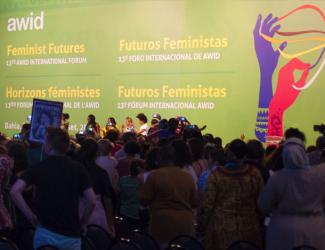
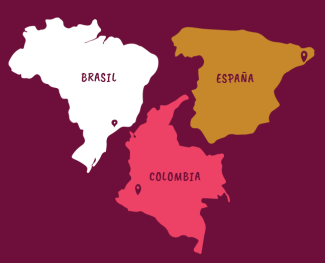
In September 2016, the 13th AWID international Forum brought together in Brazil over 1800 feminists and women’s rights advocates in a spirit of resistance and resilience.
This section highlights the gains, learnings and resources that came out of our rich conversations. We invite you to explore, share and comment!
What has happened since 2016?
One of the key takeaways from the 2016 Forum was the need to broaden and deepen our cross-movement work to address rising fascisms, fundamentalisms, corporate greed and climate change.
With this in mind, we have been working with multiple allies to grow these seeds of resistance:
Movements can also benefit from new methodologies on Visioning Feminist Futures (Coming up soon!)
And through our next strategic plan and Forum process, we are committed to keep developing ideas and deepen the learnings ignited at the 2016 Forum.
What happens now?
The world is a much different place than it was a year ago, and it will continue to change.
The next AWID Forum will take place in the Asia Pacific region (exact location and dates to be announced in 2018).
We look forward to you joining us!
About the AWID Forum
AWID Forums started in 1983, in Washington DC. Since then, the event has grown to become many things to many peoples: an iterative process of sharpening our analyses, vision and actions; a watershed moment that reinvigorates participants’ feminisms and energizes their organizing; and a political home for women human rights defenders to find sanctuary and solidarity.
Feminist Realities is a warm and caring invitation, a kind of en masse-care (versus self-care) act of preservation, an invitation to archive, to take stock of all the work lest it disappear. (...)
When people come together on a global scale, as individuals and movements, we generate a sweeping force. Join us in Bangkok, Thailand and online in December 2024.
Tshegofatso Senne est un·e féministe noir·e atteint·e d’une maladie chronique et genderqueer qui fait le maximum. Une grande partie de son travail est axée sur le plaisir, la communauté et le rêve et s’alimente de l’abolitionnisme somatique et du handicap, de la guérison et des justices transformatives. Tshegofatso écrit, fait des recherches et s’exprime sur des questions concernant le féminisme, la communauté, la justice sexuelle et reproductive, le consentement, la culture du viol et la justice, et élabore depuis 8 ans des théories sur la façon dont le plaisir recoupe ces différents thèmes. Tandis qu’iel dirige sa propre entreprise, Thembekile Stationery, sa plateforme communautaire Hedone rassemble les gens pour explorer et comprendre le pouvoir du plaisir et de la prise de conscience de traumatismes dans leur vie quotidienne.
Le corps. Notre maison la plus permanente.
C’est dans notre corps, et non dans notre cerveau pensant, que nous expérimentons la plupart de nos douleurs, nos plaisirs, nos joies, et là où nous traitons la majeure partie de ce qui nous arrive. C’est également là que nous faisons la plupart de notre travail de guérison, et notamment notre guérison émotionnelle et psychologique. Et c’est là où nous faisons l’expérience de la résilience et d’une sorte de flux.
Ces mots, ceux de Resmaa Menakem dans son roman My Grandmother’s Hands résonnent toujours en moi
Le corps contient nos expériences. Nos mémoires. Notre résilience. Et comme l’a écrit Menakem, le corps contient également nos traumatismes. Il emploie des mécanismes spontanés de protection pour arrêter ou prévenir les dommages supplémentaires. Le pouvoir du corps. Le traumatisme, ce n’est pas l’événement, c’est la manière dont nos corps répondent aux événements qui nous semblent dangereux. Et le trauma reste souvent coincé dans notre corps, jusqu’à ce que nous l’abordions. Il n’est pas possible de faire autrement – c’est ainsi que notre corps l’entend.
En utilisant l’appli Digital Superpower de Ling Tan, j’ai observé les réactions de mon corps alors que je me promenais dans différents quartiers de ma ville, Johannesburg, en Afrique du Sud. L’appli est une plateforme en ligne pilotée par le mouvement qui permet de suivre nos perceptions pendant que l’on se déplace dans un lieu, en saisissant et en enregistrant les données. Je m’en suis servie pour faire le suivi de mes symptômes psychosomatiques – les réactions physiques connectées à une cause psychologique. Il pouvait s’agir de flash-backs. D’attaques de panique. De serrement de poitrine. L’accélération du rythme cardiaque. De maux de tête dus à la tension. De douleurs musculaires. D’insomnie. De difficulté à respirer. J’ai suivi ces symptômes tout en marchant et en me déplaçant dans différents coins de Johannesburg. Et je me suis demandé.e :
Où pouvons-nous être en sécurité? Peut-on être en sécurité?
Les réponses psychosomatiques peuvent avoir plusieurs causes, certaines moins sévères que d’autres. Lorsque l’on a vécu un traumatisme, on peut être dans une détresse très intense lors d’événements ou de situations similaires. J’ai fait le relevé de mes sensations, sur une échelle de 1 à 5, où 1 correspond aux cas où je n’ai ressenti presque aucun de ces symptômes – plutôt à l’aise que sur mes gardes et à fleur de peau, ma respiration et mon rythme cardiaque étaient stables, je ne regardais pas par-dessus mon épaule – et 5 à l’opposé : des symptômes qui me rapprochaient de l’attaque de panique.
En tant que personne noire. En tant que personne queer. En tant que personne de genre queer qui pouvait être perçue comme une femme, selon mon expression de genre ce jour-là.
Je me suis demandé.e : Où pouvons-nous être en sécurité?
Même dans les quartiers que l’on pourrait considérer comme « sûrs », je me sentais constamment en panique. Je regardais autour de moi pour vérifier que je n’étais pas suivie, ajustant la manière dont mon T-shirt tombait pour que mes seins ne soient pas trop moulés, regardant autour de moi pour m’assurer que je connaissais plusieurs sorties, si je sentais tout à coup un danger là où j’étais. Une route sans personne fait monter l’anxiété. Une route bondée aussi. Prendre un Uber aussi. Marcher dans une rue publique également. Et être dans mon appartement aussi. Tout comme de récupérer une livraison au pied de mon immeuble.
Peut-on être en sécurité?
Pumla Dineo Gqola parle de l’usine de peurs féminines. Vous en avez peut-être une vague idée, mais si vous êtes une personne socialisée en tant que femme, vous connaîtrez très bien ce sentiment. Ce sentiment d’avoir à planifier chaque pas que vous faites, que vous vous rendiez au travail, à l’école, ou fassiez simplement une course. Ce sentiment d’avoir à surveiller la manière dont on s’habille, on parle, on s’exprime en public et dans les espaces privés. Ce sentiment au creux de l’estomac si on doit se déplacer la nuit, aller chercher une livraison, ou avoir affaire à toute personne qui continue à se socialiser en tant qu’homme cis. Harcelées dans la rue, toujours sous la menace de la violence. Exister pour nous, quel que soit l’espace, s’accompagne d’une peur innée.
La peur est un phénomène à la fois individuel et sociopolitique. Au niveau individuel, la peur peut faire partie d’un système d’avertissement sain qui se développe bien […] Lorsque l’on pense à la peur, il est important de prendre en compte à la fois les notions d’expérience émotive individuelle et les modalités politiques par lesquelles la peur a été utilisée à des fins de contrôle à diverses époques. - Pumla Dineo Gqola, dans son ouvrage Rape: A South African Nightmare
En Afrique du Sud, les femmes cis, les femmes et les queers savent que chaque pas que nous faisons à l’extérieur – des pas pour faire des choses ordinaires comme se rendre dans un magasin, prendre un taxi jusqu’au travail, un Uber pour rentrer d’une fête – toutes ces actions sont une négociation avec la violence. Cette peur, elle fait partie du traumatisme. Pour s’adapter au traumatisme que l’on porte dans nos corps, nous élaborons des réponses à la détection du danger – on examine les réactions émotives des personnes autour de nous, à la recherche d’« amabilité ». Nous sommes constamment sur nos gardes.
Jour après jour. Année après année. Vie après vie. Génération après génération.
L’auteur de The Body Keeps the Score, Bessel van der Kolk, explique à propos de la difficulté supplémentaire que pose ce système de défense acquis, que
Elle perturbe la capacité à correctement lire les autres, ce qui rend les survivant·e·s de traumatisme moins à même de détecter le danger, ou plus à même de croire avoir perçu un danger là où il n’y en a pas. Il faut une énergie considérable pour continuer à fonctionner tout en portant la mémoire de la terreur, et la honte d’une faiblesse et d’une vulnérabilité infinie.
Comme le dit Resmaa Menakem, le traumatisme est partout; il s’infiltre dans l’air que nous respirons, l’eau que nous buvons, la nourriture que nous ingérons. Il est présent dans les systèmes qui nous gouvernent, l’institution qui nous enseigne et qui nous traumatise aussi, et au sein des contrats sociaux que nous concluons les un·e·s avec les autres. Plus important encore, nous prenons le traumatisme avec nous partout où nous allons, dans nos corps, nous épuisant et sapant notre santé et notre bonheur. Nous portons cette vérité dans nos corps. Des générations d’entre nous l’ont fait.
Alors, pendant que je marche dans ma ville, que ce soit dans un quartier considéré « sûr » ou non, je porte les traumatismes de générations dont les réactions sont intégrées dans mon corps. Mon cœur palpite, je commence à avoir du mal à respirer, ma poitrine se resserre – parce que mon corps a l’impression que le traumatisme a lieu exactement à ce moment-là. Je vis avec une hypervigilance. Au point où l’on est soit trop sur ses gardes pour profiter de la vie sans souci, soit trop engourdi·e pour absorber de nouvelles expériences.
Pour que nous commencions à guérir, nous devons reconnaître cette vérité.
Ces vérités qui vivent dans nos corps.
Ce traumatisme est ce qui empêche nombre d’entre nous de vivre les vies que nous voulons. Demandez à n’importe quelle femme ou personne queer à quoi ressemble la sécurité pour elle, et elle vous donnera principalement des exemples de tâches très simples – pouvoir simplement vivre une vie joyeuse, sans la menace constante de la violence.
Les sentiments de sécurité, de confort et d’aise sont spatiaux. Incarner nos traumatismes influence la manière dont nous percevons notre propre sécurité, affecte les manières dont nous interagissons avec le monde et modifie les possibilités pour nous de vivre et d’incarner toute chose plaisante ou joyeuse.
Nous devons refuser cette encombrante responsabilité et nous battre pour un monde sûr pour nous toutes et tous. Nous, qui nous déplaçons avec nos blessures, sommes des battantes. Le patriarcat peut nous terroriser et nous brutaliser, nous ne cesserons pas le combat. Alors que nous continuons à descendre dans la rue, en défiant la peur de manière spectaculaire et apparemment insignifiante, nous nous défendons et parlons en notre propre nom. - Pumla Dineo Gqola, dans son ouvrage Rape: A South African Nightmare
Où pouvons-nous être en sécurité? Comment commencer à se défendre, pas simplement physiquement mais également émotionnellement, psychologiquement et spirituellement?
« Le traumatisme nous transforme en armes » déclarait Adrienne Maree Brown dans un entretien mené par Justin Scott Campbell. Et son ouvrage, Pleasure Activism, propose plusieurs méthodes pour guérir ce traumatisme et nous ancrer dans la compréhension que la guérison, la justice et la libération peuvent également être des expériences plaisantes. Et particulièrement pour celles d’entre nous qui sont les plus marginalisées, qui ont peut-être été éduquées à faire rimer souffrance avec « ce travail ». Ce travail que tant d’entre nous ont entamé en tant qu’activistes, bâtisseuses communautaires et travailleuses, celles qui sont au service des plus marginalisées, ce travail que nous souffrons à réaliser, nous épuisant et ne prenant que rarement soin de nos esprits et de nos corps. L’alternative est d’être mieux informées à propos de nos traumatismes, capables d’identifier nos propres besoins et de devenir profondément incarnées. Cette incarnation signifie que nous sommes tout simplement plus à même de faire l’expérience du monde à travers les sens et les sensations de notre corps, en reconnaissant ce qu’ils nous disent plutôt qu’en supprimant et en ignorant l’information qu’ils nous communiquent.
Être en conversation continue avec notre corps vivant et pratiquer ces conversations avec intention nous connecte plus profondément à l’incarnation. Cela nous permet de rendre tangibles les émotions que nous ressentons lorsque nous interagissons avec le monde, que nous apprenons à apprivoiser notre corps et que nous comprenons tout ce qu’il essaie de nous enseigner. En comprenant le traumatisme et l’incarnation de pair, nous pouvons commencer à débuter la guérison et à accéder au plaisir de manière plus holistique, sainement et dans notre vie de tous les jours sans honte ou culpabilité. Nous pouvons commencer à accéder au plaisir en tant qu’outil de changement individuel et social, en puisant dans le pouvoir de l’érotique, comme le décrivait Audre Lorde. Un pouvoir qui nous permet de partager la joie à laquelle nous accédons et dont nous faisons l’expérience, élargissant notre capacité à être heureuses et à comprendre que nous le méritons, même avec notre traumatisme.
Puiser dans le plaisir et incarner l’érotique nous gratifie de la possibilité d’être délibérément vivantes, de nous sentir ancrées et stables et de comprendre notre système nerveux. Cela nous permet de comprendre et de nous défaire des bagages générationnels que nous portions sans le réaliser; nous pouvons acquérir du pouvoir grâce à la connaissance que même aussi traumatisées que nous le sommes, aussi traumatisées que nous pourrions potentiellement l’être à l’avenir, nous méritons tout de même des vies plaisantes et joyeuses, et que nous pouvons partager ce pouvoir avec nos gens. C’est l’aspect communautaire qui manque aux manières dont nous prenons soin de nous-mêmes; l’autosoin ne peut exister sans soin communautaire. Nous sommes en mesure de sentir une confiance interne plus profonde, une sécurité et un pouvoir en nous-mêmes, particulièrement face à des traumatismes ultérieurs qui déclencheraient des réactions en nous, car nous savons comment nous apaiser et nous stabiliser. Toute cette compréhension nous mène à un pouvoir interne profond et nourri, qui nous permet de relever tous les défis qui se présentent à nous.
Comme celles qui vivent avec des traumatismes générationnels profonds, nous en sommes venues à perdre confiance, voire à penser que nous sommes incapables de contenir et d’accéder au pouvoir que nous avons. Dans « Uses of the Erotic: The Erotic as Power », Lorde nous enseigne que l’érotique offre une source de régénération, une manière d’exiger mieux pour nous-mêmes et pour nos vies.
Car l’érotique n’est pas simplement une question de ce que nous faisons; c’est de savoir dans quelle mesure nous pouvons précisément et entièrement ressentir le faire. Dès lors que nous connaissons la mesure dans laquelle nous sommes capables de ressentir ce sens de satisfaction et de complétude, nous pouvons alors observer quelle activité dans notre vie nous rapproche le plus de cette complétude.
Je ne dis rien de tout ça à la légère – je sais que c’est plus facile à dire qu’à faire. Je sais que nombre d’entre nous sont empêchées de comprendre ces réalités, de les internaliser, voire de les guérir. La résistance s’accompagne d’actes où l’on se sent en insécurité, mais elle n’est pas impossible. Résister à des structures de pouvoir qui maintiennent les plus puissants en sécurité mettra toujours en danger celles d’entre nous qui sont poussées dans la marge. Reconnaître les traumatismes que vous avez affrontés, c’est réclamer vos expériences vécues, celles qui sont passées et celles qui suivront; c’est la résistance qui incarne cette connaissance que nous méritons, plutôt que les miettes que ces systèmes nous ont obligées à avaler. C’est une résistance qui comprend que le plaisir est compliqué par le traumatisme, mais que l’on peut y accéder de manière arbitraire et puissante. C’est une résistance qui reconnaît que notre traumatisme est une ressource qui nous connecte les unes aux autres et qui peut nous permettre de nous sentir mutuellement en sécurité. C’est une résistance qui comprend que même avec le plaisir et la joie, ce n’est pas une utopie; nous blesserons encore et serons de nouveau blessées, mais nous serons mieux outillées pour survivre et nous épanouir dans une communauté de soins et de gentillesse diversifiés. Une résistance qui fait de la place à la guérison et à la connexion à notre être humain en entier. La guérison ne sera jamais une balade agréable, mais elle commence avec la reconnaissance de la possibilité. Lorsque l’oppression nous fait croire que le plaisir est quelque chose auquel tout le monde a un accès égal, une des manières par lesquelles nous commençons à faire le travail de réclamation de nos êtres entiers – nos êtres entiers libérés et libres – est de réclamer notre accès au plaisir.
Leah Lakshmi Piepzna-Samarasinha a écrit dans sa contribution à Pleasure Activism,
Je sais que, pour la plupart des gens, les mots « soins » et « plaisir » ne peuvent absolument pas faire partie d’une même phrase. Nous nageons toutes dans la haine validiste de nos corps qui ont des besoins, et on nous propose un choix vraiment merdique : n’avoir aucun besoin et obtenir l’autonomie, la dignité et le contrôle de notre vie ou admettre que nous avons besoin de soins et perdre tout cela.
Le pouvoir que cela a? Nous comprenons nos traumatismes, donc nous comprenons ceux des autres; nous incarnons les sensations que nous vivons et y prêtons attention plutôt que de les négliger ou les éviter. Les manières dont nous accédons au plaisir nous donnent envie de partager cette joie dans nos communautés. En tenant compte des traumatismes, on se donne davantage de place pour faire l’expérience de tout cela et on se donne à nous-mêmes, et aux autres, la permission de guérir. Imaginez une communauté dans laquelle tout le monde a accès à des ressources et a le temps de vivre une vie plaisante, de la manière dont toutes et tous le veulent et le méritent. Dans laquelle les traumatismes spatiaux sont atténués parce que les personnes qui occupent ces espaces ont conscience des traumatismes, sont pleines d’attention bienveillante. N’est-ce pas ça, la guérison? N’est-ce pas un travail au niveau des traumatismes générationnels? N’est-ce pas la base pour un avenir plus sain et durable pour tout le monde?
Il est temps de nous reconnecter à cette sagesse ancestrale selon laquelle nous méritons de vivre des vies pleines. Nous devons reprendre contact avec notre droit naturel à la joie et à l’existence pour nous-mêmes. De ressentir du plaisir pour le simple plaisir. De ne pas vivre des vies de terreur. Cela paraît radical ; cela semble radical. Dans un monde où nous avons été socialisées et traumatisées à taire, à avoir peur, à ressentir et à rester impuissantes, à être cupides et à vivre avec ces problèmes structurels qui entraînent des maladies mentales, quel cadeau et quel émerveillement que de commencer à ressentir, d’être dans une communauté avec celles qui ressentent, dans laquelle nous sommes sainement interdépendantes, de s’aimer mutuellement et complètement. La sensation est radicale. Le plaisir est radical. La guérison est radicale.
Vous avez la permission de ressentir du plaisir. Vous avez la permission de danser, créer, faire l’amour à vous-même et à d’autres, célébrer et cultiver la joie. Vous êtes encouragées à le faire. Vous avez la permission de guérir. Ne le retenez pas à l’intérieur, n’essayez pas de traverser cela toute seule. Vous avez la permission de faire le deuil. Et vous avez la permission de vivre. - Adrienne Marre Brown « You Have Permission »
L’incarnation somatique nous permet d’explorer notre traumatisme, d’y travailler et de faire des connexions significatives avec nous-mêmes et avec le collectif. Faire cela sur la durée entretient notre guérison. Tout comme le traumatisme, la guérison n’est pas un événement à occurrence unique. Cette guérison nous aide à aller vers la libération individuelle et collective.
Dans « A Queer Politics of Pleasure », Andy Johnson parle de la manière dont le fait de rendre le plaisir queer nous apporte des sources de guérison, d’acceptation, de relâchement, de jeu, d’entièreté, de défiance, de subversion et de liberté. Quelle ouverture! En incarnant le plaisir de manière si holistique, si queer, nous sommes en mesure de reconnaître la limite.
Rendre le plaisir queer nous pose également les questions à l’intersection de nos rêves et de nos réalités vécues.
Qui est assez libre ou considéré assez méritant pour ressentir du plaisir? Quand sommes-nous autorisés à ressentir le plaisir ou à être satisfaits? Avec qui pouvons-nous faire l’expérience du plaisir? Quel type de plaisir est accessible? Qu’est-ce qui nous limite dans notre accès total à notre potentiel érotique et de satisfaction? - Andy Johnson, « A Queer Politics of Pleasure »
Lorsque nos pratiques de plaisir, qui prennent en compte le traumatisme, sont ancrées dans les soins communautaires, nous commençons à répondre à quelques-unes de ces questions. Nous commençons à en comprendre le potentiel libérateur. En tant qu’activistes du plaisir, c’est la réalité au sein de laquelle nous nous ancrons. La réalité qui dit : « mon plaisir peut-être fractal, mais il a le potentiel de guérir non seulement moi et ma communauté, mais des lignées futures ».
Je suis un système entier; nous sommes des systèmes entiers. Nous ne sommes pas que nos douleurs, que nos peurs, et que nos pensées. Nous sommes des systèmes entiers prévus pour le plaisir et nous pouvons apprendre comment dire oui depuis l’intérieur. - Prentis Hemphill, entretien mené par Shar Jossell
Il y a un monde de plaisir qui nous permet de commencer à nous comprendre de manière holistique, avec des façons qui nous donnent la place de reconstruire les réalités qui affirment que nous sommes capables et que nous méritons du plaisir quotidien. Le BDSM, un de mes plaisirs les plus profonds, me permet d’entrevoir ces réalités où je peux sentir et guérir mon traumatisme, tout en sentant les incommensurables possibilités de dire oui depuis l’intérieur. Alors que le traumatisme me bloque dans un cycle de combat ou de fuite, le bondage, l’agenouillement, l’impact et les jeux de respiration m’encouragent à rester ancrée et connectée, me reconnectant à ma restauration. Le plaisir ludique me permet de guérir, d’identifier où l’énergie traumatique est emmagasinée dans mon corps et d’y centrer mon énergie. Il me permet d’exprimer les sensations que ressent mon corps avec des cris de douleur et de satisfaction, d’exprimer mon « non » sans aucune peur et de me délecter dans le « oui, carrément ». Avec un plan de sécurité, des soins après la pratique et une compréhension approfondie du traumatisme, la perversion offre un lieu de plaisir et de guérison d’une valeur inestimable.
Donc, que votre plaisir prenne la forme de la préparation d’un repas à votre rythme, d’avoir des relations sexuelles, de rester au lit plusieurs jours avec vos partenaires, de participer à des collectifs de soins adaptés aux situations de handicap, d’avoir quelqu’un qui vous crache dans la bouche, de faire des sorties accessibles, d’avoir des rendez-vous de câlins, de participer à une soirée dansante en ligne, de passer du temps dans votre jardin, d’être étouffée dans un donjon,
J’espère que vous prenez le plaisir avec vous partout où vous allez. J’espère qu’il vous guérit, vous et celleux qui vous entourent.
Reconnaître le pouvoir de l’érotique au sein de nos vies peut nous donner l’énergie de poursuivre le véritable changement au sein de notre monde. - Audre Lorde, « Uses of the Erotic: The Erotic as Power »
Continuez à explorer Incarnations transnationales
Cette édition du journal, en partenariat avec Kohl : a Journal for Body and Gender Research (Kohl : une revue pour la recherche sur le corps et le genre) explorera les solutions, propositions et réalités féministes afin de transformer notre monde actuel, nos corps et nos sexualités.
نصدر النسخة هذه من المجلة بالشراكة مع «كحل: مجلة لأبحاث الجسد والجندر»، وسنستكشف عبرها الحلول والاقتراحات وأنواع الواقع النسوية لتغيير عالمنا الحالي وكذلك أجسادنا وجنسانياتنا.
Bessy Ferrera a défendu sans relâche les droits humains des personnes trans, travailleuses du sexe et séropositives au Honduras.
Bessy était aussi membre d’Arcoíris, une organisation qui soutient la communauté LGBTI+. Elle était en outre la personne référente de la plateforme Derechos aquí y Ahora (les droits ici et maintenant) au Honduras et plaidait fermement en faveur d’une pleine citoyenneté pour les personnes trans, ainsi que pour l’adoption d’une loi sur l’identité de genre qui permettrait aux personnes trans de changer légalement d’identité de genre.
« Depuis le début de l’année [2019], la communauté trans a été victime d’une série d’attaques, parce qu’elle a défendu et demandé des droits. » Rihanna Ferrera (sœur de Bessy)
Bessy était une travailleuse du sexe qui a été tuée par balle par deux hommes, au début du mois de juillet 2019, alors qu’elle travaillait dans les rues Comayagüela. Ses assaillants ont par la suite été arrêtés.
Bessy fait partie des nombreux·ses activistes des droits LGBTI+ du Honduras, assassiné·e·s en raison de leur identité et de leur travail, parmi qui se trouvent : Cynthia Nicole, Angy Ferreira, Estefania "Nia" Zuniga, Gloria Carolina Hernandez Vasquez, Paola Barraza, Violeta Rivas et Sherly Montoya.
Le cas de Bessy incarne l’injustice, de même qu’un problème plus large de violence systémique à laquelle se confronte la communauté LGBTI+ au Honduras, puisque l’État ne parvient pas à garantir l’offre de droits ni à fournir une protection. Cela est à l’origine d’une culture de l’impunité.
Malgré les risques auxquels sont confronté.e.s les activistes LGBTI+ au Honduras, tous et toutes continuent leur travail pour défier et résister à la violence, ainsi que pour combattre la stigmatisation et la discrimination au quotidien.
« Si je meurs, il faut que ce soit pour quelque chose de bien, pas pour une futilité. Je ne veux pas mourir en fuyant, en étant lâche. Si je meurs, je veux que les gens disent que je suis mort·e en me battant pour ce qui m’appartient » - membre d’Arcoíris
arte: «Angels go out at night too» [Los ángeles también salen de noche], Chloé Luu >
Snippet - CSW69 spaces to watch out for - ES
Espacios para tener en cuenta en la CSW69
Obtén más información sobre los próximos eventos de la CSW69 que AWID está coorganizando
40 ans de la fondation de AWID: L'album
Rassembler, semer et perturber.
L’année 2022 marque les 40 ans de la fondation de AWID. Nous profitons de ce moment pour nous pencher sur les années passées et apprendre du chemin parcouru, tout en nous préparant à l’avenir et au travail qui nous attend. À mesure de notre progression entre les cycles de progrès et de repli , nous avons appris que les luttes pour les droits des femmes et la justice de genre sont itératives et non linéaires. En collaboration avec l'artiste Naadira Patel, nous avons créé un album qui met en lumière une sélection de moments marquants, représentatifs des quatre décennies de soutien de AWID aux mouvements féministes.
Nous n’avons pas fait tout cela toutes seules. Nous vous faisons part de cela avec une profonde reconnaissance envers la myriade d’activistes et de groupes féministes qui ont rendu ce travail possible. Dans ce contexte de si nombreuses crises convergentes, nous accueillons l’occasion de célébrer le pouvoir et la résilience des mouvements féministes autour du monde…
"She was not a person. She was a power."
- a fellow activist remembering Navleen Kumar
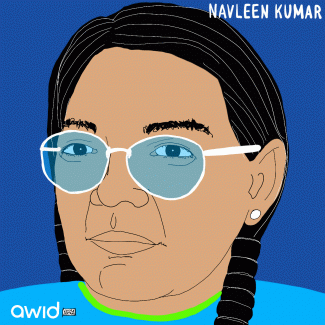
Navleen Kumar was a fervent land rights and social justice activist in India.
With commitment and integrity, she worked for more than a decade to protect and restore the lands of Indigenous people (adivasi) in Thane district, an area taken away by property and land developers using such means as coercion and intimidation. She fought this injustice and crime through legal interventions at different courts, realizing that manipulation of land records was a recurrent feature in most cases of land acquisition. In one of the cases, that of the Wartha (a tribal family), Navleen found out that the family had been cheated with the complicity of government officials.
Through her work, she helped restore the land back to the Wartha family and continued to pursue other cases of adivasi land transfers.
“Her paper on the impact of land alienation on adivasi women and children traces the history and complexities of tribal alienation from the 1970s, when middle class families began to move to the extended suburbs of Mumbai as the real estate value in the city spiralled.
Housing complexes mushroomed in these suburbs, and the illiterate tribals paid the price for this. Prime land near the railway lines fetched a high price and builders swooped down on this belt like vultures, to grab land from tribals and other local residents by illegal means.” -Jaya Menon, Justice and Peace Commission
During the course of her activism, Navleen received numerous threats and survived several attempts on her life. Despite these, she continued working on what was not only important to her but contributed to changing the lives and realities of many she supported in the struggle for social justice.
Navleen was stabbed to death on 19 June 2002 in her apartment building. Two local gangsters were arrested for her murder.
« Ashawo Work na Work » : Comment les jeunes féministes ghanéennes transforment des horizons féministes en réalité
par Fatima B. Derby
En 2017, la campagne #ManifestezVotreSolidarité a mis en évidence la manière dont les jeunes féministes pouvaient construire un avenir féministe en étant là les unes pour les autres, en participant à des conversations transrégionales, en marchant en solidarité avec d'autres activistes et en collaborant entre les mouvements. (...)
📅 Miércoles 12 de marzo de 2025
🕒 De 05:00 a 07:00 p.m., EST
🏢 Chef's Kitchen Loft with Terrace, 216 East 45th St 13th Floor New York
Organizan: Women Enabled International y AWID
Introducing AWID’s next Co-Executive Directors
Dear Feminist Movements,
On behalf of the AWID Board of Directors, I am proud to introduce AWID’s next Co-Executive Directors: Faye Macheke and Inna Michaeli!
Faye Macheke is a passionate Pan-African feminist, active in movements for women's rights, racial justice, migrant and labor rights, and environmental justice. Her activism builds on the legacy of the struggle against apartheid in South Africa and the aftermath of the apartheid era in Zimbabwe. In 2019, Faye joined AWID as the Director of Finance, Operations and Development. She brings extensive experience in feminist leadership, strategy, and all aspects of organisational development. Faye is a committed Board Member of UAF-Africa and other women's rights organizations. She is based in Cape Town, South Africa.
Inna Michaeli is a feminist lesbian queer activist and sociologist with many years of deep engagement in feminist and LGBTQI+ struggles, political education and organizing by and for migrant women, and Palestine liberation and solidarity. Inna joined AWID in 2016 and served in different roles, most recently as the Director of Programs. She brings extensive experience in research and knowledge building, policy advocacy and organizational development. Inna serves on the Board of the Jewish Voice for Peace - Germany. She is based in Berlin, Germany.
This decision is the result of a rigorous process with full participation of the Board and the staff of AWID. The Board recognised and honoured the skills and talents of AWID staff by opening an internal hiring search. As a result, we had two brilliant candidates, who embody the integrity, ethic of care, and feminist intersectional values that drive AWID’s work, apply together as a team. Faye and Inna brought forward a brave and exciting vision to meet the challenges of this moment: building a global feminist community, resisting and disrupting systems of oppression, and supporting feminist movements to thrive.
As AWID celebrates 40 years we are excited for Inna and Faye to co-lead AWID into our next strategy and a new phase of evolving, pushing boundaries, and supporting feminist movements worldwide.
Appointing and supporting AWID’s Co-Executive Directors to lead the organisation is a fiduciary responsibility we take seriously as a Board. How we engage those processes is also a reflection of AWID’s brilliant and diverse membership, which elects AWID’s Board.
As we say good-bye to Cindy and Hakima, we, the Board, unanimously and enthusiastically welcome Faye and Inna as our next Co-EDs as of September 5, 2022. Stay tuned for more updates about our leadership transition in the months ahead.
Most of all, thank you for your ongoing support!
In feminist solidarity and love, Margo Okazawa-Rey
President, AWID Board
Lo personal es político, y la apasionada y valiente Nadyn Jouny personificó este mantra feminista. Nadyn experimentó de primera mano el dolor de la violencia estructural de los sistemas legales que despojan a las mujeres de sus derechos.
Cuando Nadyn decidió solicitar el divorcio, los tribunales religiosos chiítas, bajo las Leyes de Estatuto Personal Libanesas, le negaron la custodia de su joven hijo Karam. Nadyn, como tantas otras mujeres del Líbano y de otros países, se vio atrapada entre el dolor imposible de dejar una relación no deseada y abusiva y de perder a la vez los derechos sobre su hijo. Sin embargo, Nadyn se defendió, y lo habría de hacerlo hasta el último día.
Nadyn utilizó su habilidad con los medios de comunicación para convertirse en una voz franca a favor de las mujeres que luchan contra la discriminación en la legislación familiar, en el Líbano y a nivel internacional. Nadyn cofundó el grupo autofinanciado "Protecting Lebanese Women" [Protegiendo a las Mujeres Libanesas] (PLW, por sus siglas en inglés) y se unió a muchas otras madres libanesas que se enfrentaban a problemas similares de custodia. Juntas, trabajaron para crear conciencia sobre las injusticias extremas a las que se enfrentaban, a nivel nacional, protestaron ante los tribunales religiosos por sus derechos y, a nivel internacional, llamaron la atención de los medios de comunicación.
Nadyn también trabajó con ABAAD - Resource Center for Gender Equality [Centro de Recursos para la Igualdad de Género], otra organización por los derechos de las mujeres en el Líbano, para realizar campañas en favor de los derechos de las mujeres, la igualdad en la legislación familiar y relativa a las custodias y contra los matrimonios forzados y precoces.
Para muchxs de sus colegas, Nadyn llegó a "simbolizar la lucha de una madre libanesa contra la supresión y la misoginia de todo tipo" (en inglés), al utilizar "su experiencia personal y trayectoria individual de empoderamiento, dio a otras mujeres esperanza para que ellas también pudieran ser un catalizador para el cambio positivo" - ABAAD - Centro de Recursos para la Igualdad entre los Géneros, Líbano.
El 6 de octubre de 2019, Nadyn murió trágicamente en un accidente de automóvil cuando se dirigía a protestar por los injustos aumentos de impuestos en un país que ya se enfrentaba a una espiral de crisis financiera. Nadyn Jouny tenía solo 29 años en el momento de su muerte.
Snippet Forum Stories Story 1 (EN)
Case study 1 - Three Boats, a Horse and a Taxi: Pacific Feminists at the AWID Forums
This story is about how an increasingly diverse group of feminists from the Pacific organized through the years to attend the AWID Forums and how that process changed them personally, as organizations, and as a movement through what they learned, discovered and experienced. It illustrates the importance of the Forums as a space through which a region that tends to be marginalized or ignored at the global level can build a strong presence in the feminist movement that is then replicated at other international women’s rights spaces.