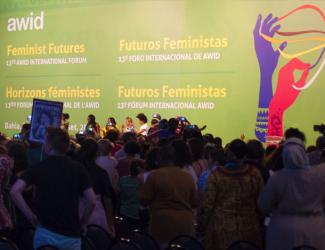
AWID Forum: Co-creating Feminist Futures
In September 2016, the 13th AWID international Forum brought together in Brazil over 1800 feminists and women’s rights advocates in a spirit of resistance and resilience.
This section highlights the gains, learnings and resources that came out of our rich conversations. We invite you to explore, share and comment!
What has happened since 2016?
One of the key takeaways from the 2016 Forum was the need to broaden and deepen our cross-movement work to address rising fascisms, fundamentalisms, corporate greed and climate change.
With this in mind, we have been working with multiple allies to grow these seeds of resistance:
- Our Seed Initiatives, has helped 20 ideas that emerged at the Forum to grow into concrete actions
- The video “Defending people and planet” and guide “Weaving resistance through action” put courageous WHRDs in the spotlight and present concrete strategies they use to confront corporate power.
- With our animations about the State of Our Feminist Movements and Climate and Environmental Justice, movements now have creative tools to support their advocacy work.
- The compiling artistic expressions of our #MovementsMatter series continues to inspire stronger and more creative organizing around the world.
- Movements can also benefit from new methodologies on Visioning Feminist Futures (Coming up soon!)
And through our next strategic plan and Forum process, we are committed to keep developing ideas and deepen the learnings ignited at the 2016 Forum.
What happens now?
The next AWID Forum will take place in the Asia Pacific region (exact location and dates to be announced in 2018).
We look forward to you joining us!
About the AWID Forum
AWID Forums started in 1983, in Washington DC. Since then, the event has grown to become many things to many peoples: an iterative process of sharpening our analyses, vision and actions; a watershed moment that reinvigorates participants’ feminisms and energizes their organizing; and a political home for women human rights defenders to find sanctuary and solidarity.
Related Content
Guadalupe Campanur Tapia
Guadalupe was an environmental activist involved in the fight against crime in Cherán, Mexico.
Guadalupe helped to overthrow the local government in April 2011 and participated in local security patrols including those in municipal forests. She was among the Indigenous leaders of Cherán, who called on people to defend their forests against illegal and merciless logging. Her work for seniors, children, and workers made her an icon in her community.
She was killed in Chilchota, Mexico about 30 kilometers north of her hometown of Cherá.
Vous demandez le nom du groupe, de l’organisation et/ou du mouvement qui répond aux questions de l’enquête, et ses coordonnées – pour quelle raison?
Nous demandons ces données pour faciliter l’examen des réponses, éviter les doublons et pouvoir vous contacter si votre groupe n’a pas pu terminer le questionnaire et/ou vous répondre si vous avez des doutes ou des questions. Des informations sur la manière dont nous utilisons les informations personnelles collectées lors de notre travail sont disponibles ici.
Snippet FEA Lohana Berkins (EN)
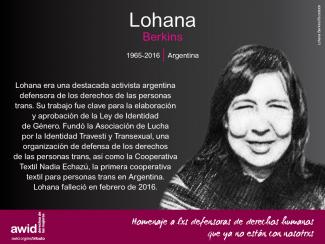
One of the founding leaders of the cooperative was Lohana Berkins, an activist, defender and promoter of transgender identity. Lohana played a crucial role in the struggle for the rights of trans and travesti people.
This brought about, among many other things, the passing of the Gender Identity Law. It is one of the most progressive legislations in the world, guaranteeing fundamental rights to trans and travesti people. Now, people can change their names and genders only with an affidavit, and have access to comprehensive healthcare without judicial or medical intervention/approval (Outright International, 2012).
6. Conduct desk research
Desk research can be done throughout your research. It can assist you with framing, help you to choose survey questions and provide insights to your results.
In this section
- Giving context
- Building on existing knowledge
- Potential sources for desk research
1. Donors’ websites and annual reports
2. Online sources of information
Giving context
Conducting desk research throughout your research process can assist you with framing, help you to choose survey questions and provide contextual clarity or interesting insights to your survey results, such as comparing similarities and differences between your survey results and information produced by civil society and donors.
Perhaps you notice trends in your survey data and want to understand them.
For example, your survey data may reveal that organization budgets are shrinking, but it cannot tell you why this is happening. Reviewing publications can give you context on potential reasons behind such trends.
Building on existing knowledge
Desk research also ensures you are building your research on the existing knowledge regarding your topic, confirming the validity and relevance of your findings.
They may be complimentary or contradictory to existing knowledge, but they must speak to existing data on the topic.
To ensure comprehensive research of the entire funding landscape related to your topic, look at a diverse set of funding sectors.
You can consider:
- Women’s Funds
- Private and Public Foundations
- International Non-Governmental Organizations (INGOs)
- Bilateral and Multilateral Agencies
- Private Sector Actors
- Individual Philanthropists
- Crowdfunders
Include any other relevant sectors to this research.
For example, you may decide that it is also important to research local non-governmental organizations (NGOs).
Potential sources for desk research (non-exhaustive)
1. Donors’ websites and annual reports
These are direct sources of information about what funders are actually doing and generally contain information on policies and budgets. Researching this before interviewing donors can result in more focused questions and a stronger interview.
2. Online sources of information
- Alliance Magazine
- Council on Foundations newsletter
- Devex blog & bulletins
- Foundation Center news
- Articles written by activists and organizations in your survey population
- AWID’s Donor list
- Philanthropy Journal
- Institute of Development Studies
Previous step
Next step

Estimated time:
• 1-2 months
People needed:
• 1 or more research person(s)
Previous step
Next step
7. Synthesize your research findings
Ready to Go? Worksheet
Agnes Torres
Winnie Madikizela- Mandela
A Winnie la han descripto como una «militante agitadora» que luchó contra el régimen del apartheid en Sudáfrica.
Fue encarcelada numerosas veces y en varias ocasiones fue encerrada en celdas de aislamiento. Ma’Winnie, como la recuerdan afectuosamente, era conocida por hablar abiertamente sobre los desafíos que las mujeres negras enfrentaron durante y después del apartheid, habiendo sido ella misma sometida a esas brutalidades como madre, esposa y activista durante la lucha. Fue más allá del concepto erróneo que sostiene que el liderazgo está basado en el género, la clase o la raza. A pesar de haber sido una figura controvertida, es recordada por muchxs por su nombre en xhosa, «Nomzamo», que significa «la que soporta las pruebas».
Ma’Winnie sigue siendo una inspiración para muchxs, especialmente las jóvenes sudafricanas.
Su muerte incentivó un creciente movimiento bajo el lema: «Ella no murió, se multiplicó».
When will survey results be available?
We will analyze the survey responses, derive insights and trends, and present the results during the 15th AWID International Forum in Bangkok, and online, in December 2024. Register to attend the Forum here!
Snippet FEA Exclusion and Stigma (ES)

LA EXCLUSIÓN, ESTIGMA Y ABUSO INSTITUCIONAL
que las personas trans y travesti siguen enfrentando diariamente
¿Cómo se originó este proyecto?
Pensamos que la economía, el mercado, el sistema financiero y las premisas sobre las que se basan son todas áreas fundamentales para la lucha feminista.
Por eso, nuestra visión de una economía justa va más allá de promover los derechos y el empoderamiento de las mujeres en una economía de mercado, sino que busca evaluar el rol que juegan las opresiones de género en dar forma al modelo económico y ver como podemos transformarlo para garantizar la justicia de género y económica.
El proceso
No estamos comenzando de cero ni estamos solas en nuestro intento de presentar propuestas feministas para una economía justa. Muchas de nuestras propuestas ya han sido presentadas o existen en la práctica de las diversas comunidades que confrontan y desafían a los sistemas económicos dominantes basados en el mercado y el crecimiento.
También somos concientes de las limitaciones que algunas alternativas presentan para abordar las injusticias del actual sistema capitalista a escala global. No siempre las propuestas a nivel micro son la respuesta a los problemas macro, si bien representan espacios importantes de resistencia y construcción de movimientos.
Metas
Sin embargo, las alternativas feministas para una economía justa son fundamentales para socavar el sistema y para aprender a generar cambios transformadores y sistémicos. No podemos presumir de ofrecer un relato exhaustivo ni completo acerca de cómo crear un modelo económico feminista justo, o varios modelos de esa clase. Lo que sí podemos hacer es recoger elementos de diálogos con otros movimientos (sindicales, ambientales, rurales y de campesinxs) para formular propuestas que nos permitan acercanos a esa visión.
¿Qué queremos cambiar?
El modelo neoliberal que dirige la economía global ha demostrado una y otra vez su incapacidad para hacer frente a las causas estructurales de la pobreza, las desigualdades y la exclusión. Lo que en realidad ha hecho el neoliberalismo ha sido contribuir a crear y exacerbar esas injusticias.
En estas últimas tres décadas, las políticas dominantes para el desarrollo se han caracterizado por la globalización, liberalización, privatizaciones, financialización y ayudas condicionadas, y han destrozado los medios de vida de la población. El recorrido de estas políticas también ha estado marcado por la profundización de desigualdades, las injusticias con marca de género y la destrucción ambiental que el mundo ya no puede continuar soportando.
Hay quienes no dudan en sostener que el crecimiento económico, que debe ser facilitado dando plena libertad a las grandes corporaciones y empresas, puede generar y sostener una una marea alta que (con el tiempo) levante todos los barcos.
Sin embargo, la noción de desarrollo que ha prevalecido durante las últimas décadas, construida sobre la premisa de un crecimiento económico ilimitado, está atravesando una crisis ideológica.
El mito del crecimiento económico como panacea para todos nuestros problemas está perdiendo cada vez más prestigio.
Ver también
Clotilde Marquez Cruz
Barin Kobane
Barin était membre de l’unité de combat exclusivement féminine des Unités de protection du peuple kurde (YPG).
Elle a été tuée alors qu’elle était en service actif.
La journaliste libanaise Hifaa Zuaiter a écrit : « Barin représente tout ce que nous avons entendu à propos du courage des femmes kurdes et sa mort représente bien plus que le meurtre d’un-e rival-e ou une perte résultant d’une lutte politique ou ethnique. L’exhibition monstrueuse de sa dépouille par un groupe de rebelles syriens provient du fait qu’en tant que femme combattant sur un champ de bataille réservé aux hommes, elle a osé menacer l’hégémonie masculine ».
Snippet - WITM Who should - AR
من يجب أن يجيب على الاستطلاع؟
الاستطلاع هذا مخصّص للمجموعات، المنظمات والحركات التي تعمل بالأساس أو فقط على حقوق النساء، أفراد مجتمع الميم - عين، والحقوق الجندرية، في جميع السياقات، على جميع المستويات، وفي جميع المناطق. إن كان واحد من هذه المبادئ اساسًا لمجموعتكم/ن، تنظيمكم/ن أو شبكتكم/ن، أو أي نوع تنظيم آخر، إن كان مسجلاً أم لا، جديداً أو طويل العمر، ندعوكم/ن للإجابة على الاستطلاع.

*في الوقت الحالي، لا نطلب من الأفراد أو الصناديق النسوية أو النسائية تعبئة الاستطلاع.
تعرف على المزيد حول الاستطلاع: راجع/ي الأسئلة الشائعة
Snippet FEA Audio Story 3 (FR)
Écoutez l'histoire ici :
Agroécologie et souveraineté alimentaire
Le contexte
La recherche de moyens alternatifs de production alimentaire fondés sur la durabilité environnementale gagne du terrain dans toutes les régions du monde. Cette quête mondiale présente une caractéristique centrale : la nécessité de mobiliser les populations rurales, en particulier les femmes, tenant compte de leurs priorités et de leurs connaissances locales par le truchement de l’agroécologie.
Définition
L’agroécologie est une façon de pratiquer l'agriculture ou de faire appel aux technologies qui ne nuit pas à l'environnement. Cette approche propose de rompre avec le modèle de développement rural hégémonique reposant sur les grandes exploitations et la monoculture qui profitent essentiellement aux entreprises agricoles et renforcent l'exclusion sociale.
Dans le contexte de l'agriculture familiale, l'agroécologie représente une forme de résistance au modèle de développement actuel et aux problèmes sociaux, culturels, environnementaux et économiques que ce modèle implique. L’agroécologie se pose en alternative face au manque d'autonomie financière des agriculteur-trice-s et symbolise une résistance face au modèle d'agroentreprises actuel.
Perspective féministe
Il se pourrait que les efforts uniquement axés sur l'agroécologie ne suffisent pas à résoudre tous les problèmes de la marginalisation et de l'invisibilité des femmes. Il est alors crucial d’adopter une perspective féministe afin d'analyser les normes associées à la notion de famille telle qu'actuellement constituée en tant qu'institution parfaite, ainsi que les normes relatives à la condition de subordination des femmes.
Plus simplement, il importe d'inclure une réflexion sur les rôles de genre socialement construits pour faire avancer le potentiel émancipateur de l'agroécologie dans ce débat.

Pour en savoir plus sur cette proposition :
- Agroecology: Exploring opportunities for women’s empowerment based on experiences from Brazil (Agroécologie : explorer les possibilités d'autonomisation des femmes à partir d’expériences menées au Brésil), AWID et ActionAid, 2011 (article en anglais).
- Semeuses de luttes et d'espoirs : Pour le féminisme et la souveraineté alimentaire! par La Via Campesina. Ce document relate des échanges de la IVe Assemblée des femmes de la Via Campesina, où l’on a discuté de la crise du capitalisme et des défis liés à la construction d’un féminisme rural et ouvrier.
Digna Ochoa
Anna Campbell (şehid Hêlîn Qerecox)
Anna grew up in Lewes, Sussex (UK) and, after deciding not to pursue her English degree at Sheffield University, she moved to Bristol and became a plumber.
She spent much of her time defending the marginalised and under-privileged, attending anti-fascist rallies, and offering support to the women of Dale Farm when they were threatened with eviction. A vegan and animal lover, she attended hunt sabotages and her name is honoured on PETA's 'Tree of Life' Memorial. Anna went to Rojava in May 2017 with a strong commitment to women's empowerment, full representation of all ethnicities and protection of the environment.
Anna died on March 15, 2018 when she was hit by a Turkish airstrike in the town of Afrin, northern Syria. Anna was fighting with the Women's Protection Forces (YPJ), when she was killed.