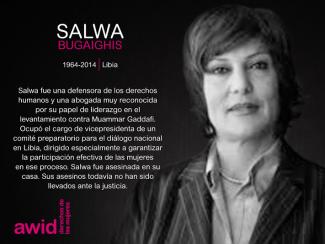
Salwa Bugaighis
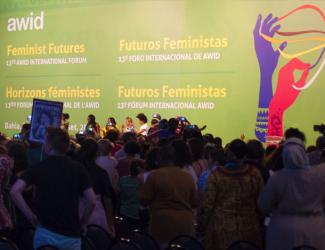
In September 2016, the 13th AWID international Forum brought together in Brazil over 1800 feminists and women’s rights advocates in a spirit of resistance and resilience.
This section highlights the gains, learnings and resources that came out of our rich conversations. We invite you to explore, share and comment!
One of the key takeaways from the 2016 Forum was the need to broaden and deepen our cross-movement work to address rising fascisms, fundamentalisms, corporate greed and climate change.
With this in mind, we have been working with multiple allies to grow these seeds of resistance:
And through our next strategic plan and Forum process, we are committed to keep developing ideas and deepen the learnings ignited at the 2016 Forum.
AWID Forums started in 1983, in Washington DC. Since then, the event has grown to become many things to many peoples: an iterative process of sharpening our analyses, vision and actions; a watershed moment that reinvigorates participants’ feminisms and energizes their organizing; and a political home for women human rights defenders to find sanctuary and solidarity.
Venez rencontrer Aura Roig, militante féministe visionaire, anthropologue, directrice et fondatrice de la coopérative Metzineres.
Elle a consacré les deux dernières décennies à la recherche, à la conception et à la mise en place de politiques de soutien aux personnes qui se droguent, basées sur la réduction des méfaits, les droits humains et le féminisme intersectionnel.
Après avoir expérimenté et appris des communautés qui consomment des drogues dans le monde entier, elle est retournée à Barcelone pour créer la Xarxa de Dones que Usen Drogues (le Réseau des Femmes qui Consomment des Drogues, XADUD). XADUD était un espace d'entraide et de solidarité avec la lutte pour les droits des groupes marginalisés, qui plus tard deviendra la coopérative Metzineres.
Aujourd'hui, Aura travaille à étendre le modèle Metzineres pour prendre en charge des groupes plus grands, tout en documentant de manière approfondie son parcours et son apprentissage prolifiques.
Women sustain Care | Care Sustains Life | Life Sustains Economy | Who takes care of women? | Not one less1 | Together | Sunday lunch
1Nenhuna a menos literally translates as “not one woman less” or “ni una menos” in Spanish - a famous feminist slogan in Latin America that emerged in Argentina as a response to increasing gender-based violence.
Ces informations sont disponibles dans notre Appel à activités, et notamment sa section intitulée « Ce qu’il faut savoir ».

If your activity is accepted, you will be contacted by the AWID team to assess and respond to interpretation and accessibility needs.
Vivimos en un mundo donde la destrucción de la naturaleza alimenta nuestra economía global actual. |
Incluso en tiempos de crisis climática, los gobiernos continúan alentando el crecimiento de las industrias agrícolas a gran escala. Estas actividades envenenan la tierra, amenazan la biodiversidad y destruyen la producción de alimentos y los medios de vida locales. Mientras tanto, aunque las mujeres producen la mayoría de nuestros alimentos en el mundo, casi no poseen tierra. |
|
¿Qué pasaría si percibiéramos la tierra y la Naturaleza no como una propiedad privada para ser explotada, sino como una totalidad con la cual aprender y coexistir en armonía? ¿Y si repararíamos nuestras relaciones con la tierra y adoptaríamos alternativas más sostenibles que nutran tanto al planeta como a sus comunidades? Nous Sommes la Solution (Somos la Solución, NSS) es uno de los muchos movimientos liderados por mujeres que se esfuerzan por lograr este objetivo. Esta es su historia. |
|
2-5 ديسمبر 2024، بانكوك، تايلاند! سنجتمع في مركز الملكة سيريكيت الوطني للمؤتمرات (QSNCC) وكذلك افتراضيا عبر
AGROECOLOGÍA Y SOBERANÍA ALIMENTARIA COMO RESISTENCIA |
Hoy en día, la producción industrial de alimentos a gran escala utiliza plantaciones de monocultivo, organismos genéticamente modificados y otros pesticidas que destruyen la tierra y el conocimiento de las comunidades locales. |
La agroecología es una resistencia a la agricultura hiper-industrializada utilizada por las multinacionales. La agroecología prioriza la agricultura a pequeña escala, los cultivos múltiples y la producción de alimentos diversificados, al tiempo que se centra en el conocimiento y las prácticas tradicionales locales. La agroecología va de la mano con los reclamos de soberanía alimentaria, o el "derecho de los pueblos a alimentos sanos y culturalmente apropiados producidos por métodos ecológicamente racionales y sostenibles, y su derecho a definir sus propios sistemas alimentarios y agrícolas" (Vía Campesina, Declaración de Nyéléni).
El papel de las mujeres, las comunidades indígenas y rurales y las personas racializadas en los países del Sur Global es fundamental para mantener los sistemas alimentarios. Lxs agroecologistxs feministas trabajan para desmantelar los roles de género opresivos y los sistemas patriarcales arraigados en la producción de alimentos. Como lo muestran las heroínas de Nous Sommes la Solution, generan una agroecología liberadora al fortalecer la resiliencia de las comunidades, empoderar a las mujeres campesinas y agricultoras mientras preservan las tradiciones locales, los territorios y los conocimientos de las comunidades productoras de alimentos.
لا تقدم جمعية حقوق المرأة في التنمية خصومات جماعية، ولكننا نقدم خصومات التسجيل للأعضاء/ العضوات. (انقر هنا لمعرفة المزيد عن كيفية الانضمام)
يرجى الرجوع إلى فتح باب التقديم للحصول على هذه المعلومات، بما في ذلك قسم "ما تحتاج/ين إلى معرفته".