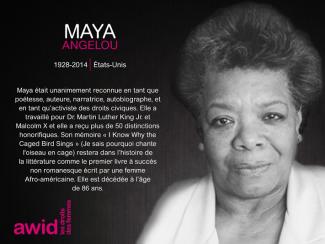
Maya Angelou
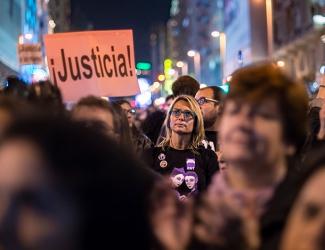
Across the globe, feminist, women’s rights and gender justice defenders are challenging the agendas of fascist and fundamentalist actors. These oppressive forces target women, persons who are non-conforming in their gender identity, expression and/or sexual orientation, and other oppressed communities.
Discriminatory ideologies are undermining and co-opting our human rights systems and standards, with the aim of making rights the preserve of only certain groups. In the face of this, the Advancing Universal Rights and Justice (AURJ) initiative promotes the universality of rights - the foundational principle that human rights belong to everyone, no matter who they are, without exception.
We create space for feminist, women’s rights and gender justice movements and allies to recognize, strategize and take collective action to counter the influence and impact of anti-rights actors. We also seek to advance women’s rights and feminist frameworks, norms and proposals, and to protect and promote the universality of rights.
Please take a look at the existing propositions for inspiration before submitting your own idea. Someone might already be thinking along the same lines! Send your proposition to contribute@awid.org.
We will review and include new propositions on this webpage as they come.
From 27 - 30 April, 2026, AWID will be at the Women Deliver 2026 Conference, co-creating a political home with feminist and gender justice movements that is rooted in transnational care and solidarity.
In a time when fascism and militarization continue to rise globally, feminist connection and solidarity across borders is what we truly need. We are organizing multiple spaces at Women Deliver and online to connect movements with each other in conversations to build feminist agendas of solidarity and action.
In September 2016, the 13th AWID international Forum brought together in Brazil over 1800 feminists and women’s rights advocates in a spirit of resistance and resilience.
This section highlights the gains, learnings and resources that came out of our rich conversations. We invite you to explore, share and comment!
One of the key takeaways from the 2016 Forum was the need to broaden and deepen our cross-movement work to address rising fascisms, fundamentalisms, corporate greed and climate change.
With this in mind, we have been working with multiple allies to grow these seeds of resistance:
And through our next strategic plan and Forum process, we are committed to keep developing ideas and deepen the learnings ignited at the 2016 Forum.
AWID Forums started in 1983, in Washington DC. Since then, the event has grown to become many things to many peoples: an iterative process of sharpening our analyses, vision and actions; a watershed moment that reinvigorates participants’ feminisms and energizes their organizing; and a political home for women human rights defenders to find sanctuary and solidarity.
Khaoula Ksiksi est une fervente défenseuse de la justice, de l’équité et de la libération. Dans son rôle de conseillère en matière de genre, d’égalité, de diversité et d’inclusion (GEDI), elle œuvre à faire de l’inclusion une réalité concrète, pas simplement un concept politique, au sein des programmes humanitaires et des interventions en situation de crise. Elle collabore avec diverses équipes pour combattre l’oppression structurelle en déployant des approches audacieuses et transformatrices qui s’appuient sur les expériences vécues.
Son activisme a débuté au cœur du mouvement antiraciste tunisien. Au sein de l’organisation Mnemty, elle a contribué à l’adoption de la première législation anti-discrimination du pays, obligeant la société tunisienne à reconnaître l’existence de l’injustice raciale. Par la suite, elle a co-fondé le collectif Voix des Femmes Tunisiennes Noires, une initiative visant à valoriser le leadership des femmes noires, à développer des réseaux de solidarité et à revendiquer une visibilité dans une société qui tend à les réduire au silence.
Khaoula est également l’une des fondatrices de Falgatna, un mouvement queer-féministe radical qui œuvre pour la défense des droits OSIGEGCS, tout en apportant son soutien aux communautés LGBTQI+ par des actions directes, des stratégies de cyberrésistance et un plaidoyer centré sur les survivant·es.
Auparavant, elle a dirigé des projets régionaux féministes et de justice climatique à la Fondation Rosa Luxemburg en Afrique du Nord et de l’Ouest.
Son travail est guidé par une conviction profonde : personne n’est libre tant que nous ne le sommes pas toustes. Son activisme est à la fois un combat et une lettre d’amour à son peuple, à ses communautés et au monde que nous méritons.
Nous œuvrons à renforcer les répercussions et l’influence des organisations, mouvements et défenseur-euse-s des droits des femmes sur la scène internationale et à amplifier leur voix collective, en vue de la pleine réalisation de la justice de genre et des droits humains des femmes.

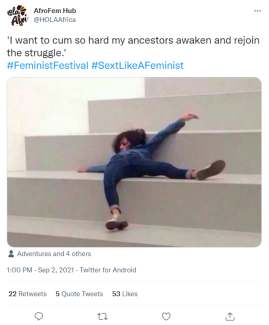
عزمي الوصول الى الذروة الجنسية، كفيلة بإيقاظ الأجداد من مثواهم الأخير وإعادتهم الى صفوف الثورة التقدميّة
AWID works towards the realization of gender justice and women’s human rights worldwide. We work to strengthen the voices and impact of women’s rights advocates, organizations and movements. Our main Priority Areas relate to themes that are closely linked to dominant global trends.
These themes reflect growing challenges that negatively impact women’s rights worldwide.
Ika Vantiani is an Indonesian artist, curator and crafter based in Jakarta. Her works explores the idea of being a woman in today’s society with the intertwined between media and consumption. Ika uses the discipline of collage and expands it into workshop, installation, and street art. Ika is the member of artist collectives including Micro Galleries, The Collage Club and It’s In Your Hands Collective.
Todos nuestros informes anuales estan disponibles en línea.
Sí, por favor. El mundo ha cambiado desde 2021, y te invitamos a proponer una actividad que refleje tus realidades y prioridades actuales.
Explora estos proyectos elaborados por los equipos de AWID para promover la defensoría de derechos y perspectivas feministas.
Hakima Abbas, AWID
"Nous utilisons les outils dont nous disposons pour partager notre résistance, nos stratégies et continuer à renforcer notre pouvoir d'agir et de créer de nouveaux mondes courageux et justes."
Second High-level Dialogue on Financing for Development

From the rising right in many countries and the flurry of funding cuts hitting hard civil society of the Global Majority, to the ongoing genocide in Gaza, the intensification of violent conflicts in Sudan, and climate crisis in many parts of our planet, we are facing real forces of fascism and a world order of impunity. This makes our opportunities to come together and build solidarity particularly valuable and imperative for our survival as a global feminist community. Of course, in 2024, the 15th AWID International Forum finally happened, and what a powerful space it was.
Download the full 2024 Annual Report
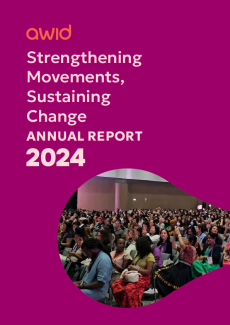
As we look ahead, we build on the powerful calls to action made by feminists at the AWID Forum; Together we can build a world where justice, liberation and care are not aspirations but realities.

Umyra Ahmad is a Malaysian feminist with a background in international and regional advocacy, and human rights education. In AWID, she works on advancing rights related to gender and sexuality at the UN. Prior to joining, she was a programme officer at IWRAW Asia Pacific, where she supported regional, national and grassroots organizations in using UN treaty body mechanisms as a tool for state accountability and access to justice. In Malaysia, she works with queer and refugee collectives and supports coordination of various mutual aid initiatives.

With over 30 years of finance experience, Christine has devoted her career to furthering nonprofit missions on a global scale. Her contributions extend to serving as Treasurer on the Board of an NGO. Christine joined AWID in 2007 as Controller and in 2023 took on the role as Director of Finance. During her spare time she enjoys traveling, gardening and hiking.
AWID’s work is made possible through the financial support of a wide range of donors including multilateral and bilateral agencies, private foundations and women’s funds.
Women's Forum on Financing for Gender Equality
The Third UN International Conference on Financing for Development
More than just an event, the AWID Forum is part of our Feminist Realities Journey, with many spaces to come together, online and offline, for sharing, discussing, strategizing and co-creating feminist realities.
Learn more about the Feminist Realities Journey and everything that will happen before the Forum. Join our mailing list to stay tuned for Post-Forum announcements!
We are exploring options to participate virtually at the Forum and we will share information when we know what we can offer.