L´AWID est une organisation féministe mondiale qui consacre ses efforts à la justice de genre, au développement durable et aux droits humains des femmes
Forum de l'AWID : Co-créer nos horizons féministes
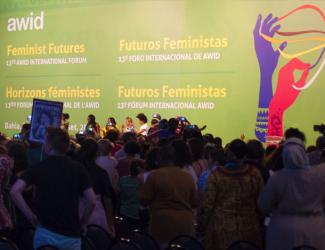
En septembre 2016, 1800 féministes et défenseur-e-s des droits des femmes venu-e-s des quatre coins de nos mouvements se réunissaient sur les côtes de Bahia à l’occasion du 13ème Forum international de l’AWID.
Cette section met l’accent sur les victoires, les enseignements et les ressources qui ont couronné nos conversations. Nous vous invitons à l’explorer, la partager et laisser vos impressions.
L’un des principaux éléments à retenir de ce Forum a été la nécessité d’élargir et d’approfondir notre travail de collaboration entre mouvements pour faire face à une montée des fascismes et des fondamentalismes, une exacerbation de la cupidité des entreprises et un changement climatique en progression.
L’AWID a donc travaillé avec plusieurs allié-e-s pour ériger ces semences de résistance :
Les mouvements peuvent aussi bénéficier d’une nouvelle méthodologie pour envisager nos horizons féministes. (à venir bientôt !)
A travers son prochain plan stratégique et le processus de son Forum, l’AWID s’engage à poursuivre et approfondir les rapports, les apprentissages et les processus amorcés lors du Forum 2016, tout en s’inspirant de l’actualité.
Et maintenant ?
Le monde est bien différent de celui qu’il était l’an dernier et il continuera à changer dans les années à venir.
Le prochain Forum de l’AWID se tiendra dans la région Asie-Pacifique (les dates et le lieu exacts seront annoncés en 2018). Nous attendons avec impatience de vous y retrouver !
A propos du Forum de l’AWID
Les Forums de l’AWID ont vu le jour en 1983, à Washington DC. Depuis, ils revêtent de nombreux aspects et incarnent, selon les personnes, tantôt un processus itératif visant à affiner nos analyses, notre vision et nos actions, un évènement clé galvanisant les féminismes des participant-e-s et leurs organisations ou un espace politique offrant refuge et solidarité aux défenseur-se-s des droits humains.
Member states and women's rights advocates and organisations are gathering at the United Nations Headquarters in New York from 13 - 24 March for the 61st Commission on the Status of Women to address ‘women’s economic empowerment’ in the context of Sustainable Development Goal 5.
Whilst AWID is looking forward to physically meeting those of you who will be in New York, we want to engage with all those who cannot attend CSW, and as much as possible, amplify your voices in relevant spaces.
Continue reading to find out how to engage with AWID around CSW, whether you are attending physically or not.
Participate in an artistic takeover!
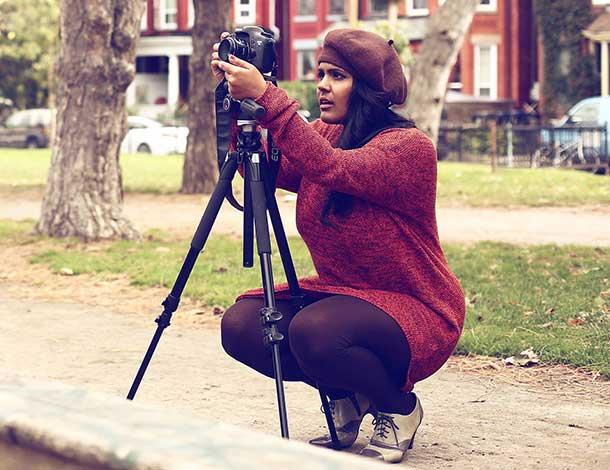
We are thrilled that AWID member Nayani Thiyagarajah is attending CSW this year and will take over the AWID Instagram. She will be available onsite to connect with other members for a possible feature on our Instagram. She will also explore possibilities of including some AWID members in a short film on the theme, ‘The personal is political’, a story of Nayani’s participation in this year’s CSW.
Nayani Thiyagarajah
Who is Nayani?
Nayani Thiyagarajah is a director, producer, and writer, dedicated to stories for the screen. A daughter of the Tamil diaspora, she calls Toronto home. For over 10 years, Nayani has worked in the arts and cultural industries. Her first independent feature documentary Shadeism: Digging Deeper (2015) had its World Premiere at the 2015 Zanzibar International Film Festival, where it won a Special Jury Prize. Nayani recently launched [RE]FRAME, with her producing partner Camaro West, a production company based out of Atlanta and Toronto, focused on re-framing the narratives around Black, Indigenous, and other people of colour through storytelling on screen.
On a more serious note, it should be noted that Nayani has a strange laugh, she's quite awkward, and her head is always in the clouds. She feels blessed beyond belief to create stories for the screen and play make believe for a living. Above all else, she believes in love.
Interested in meeting Nayani and being considered for inclusion in the film?
Send an email to membership@awid.org with the subject line “CSW Artistic Takeover”
By 13 March 2017
Please include your full name and country information.
Can't attend? Voice it!
If you are not able to attend CSW61 because of a travel ban, either due to the one imposed by the Trump administration or one you are facing from your own government, please share your story with us.
Send us messages you want heard in the United Nations spaces concerning funding, the impact of the reinstatement of the Global Gag Rule, and the need to push back against all types of religious fundamentalisms. You can send these in the following formats:
Video: no longer than two minutes and sent through a file sharing folder (for example dropbox, google drive)
Audio: no longer than two minutes and sent through a file sharing folder (for example dropbox, google drive)
Image: you can share a photo or a poster of your message
Text: no longer than 200 words and sent in the body of an email or in a word document
AWID members tell us that connecting with other members at CSW is valuable. In such a huge advocacy space, it is useful to connect with others including activists working on similar issues, or originating from the same country or region. Recognising the importance of connecting for movement building, we invite you to:
Interested in connecting with other members @CSW61?
If you are attending the CSW, we’d love to see what’s going on through your eyes!
Show us by capturing a moment you find speaks to the energy in the CSW space, be it on or off site. We hope to publish some of your ‘images’ on our social media channels and share on awid.org.
You can send us:
colour and/ or black and white photographs with a title (if you wish) and
a caption (no longer than 100 words) about the story your image tells.
Please also include:
your full name and country of origin and
let us know if we can publish the information you shared (in part or in full).
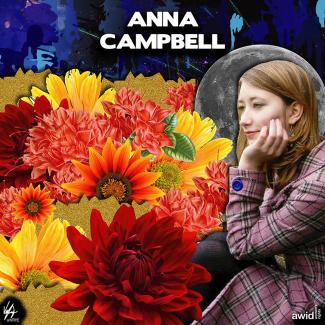
Anna a grandi à Lewes, dans le Sussex (Royaume-Uni). Après avoir décidé de ne pas poursuivre sa licence d’anglais à l'Université de Sheffield, elle a déménagé à Bristol et est devenue plombière.
Elle a passé une grande partie de son temps à défendre les personnes marginalisées et défavorisées, à assister à des rassemblements antifascistes et à offrir son soutien aux femmes de la Dale Farm lorsqu'elles furent menacées d'expulsion. Végétalienne et amie des animaux, elle a participé à des missions de sabotage de chasses et son nom est honoré sur le monument commémoratif « Arbre de vie » de l’organisation PETA. Anna s'est rendue à Rojava en mai 2017 pour lutter en faveur du renforcement du pouvoir des femmes, de la pleine représentation de toutes les ethnies et de la protection de l'environnement.
Anna est décédée le 15 mars 2018, après avoir été atteinte par une frappe aérienne turque dans la ville d'Afrin, dans le nord de la Syrie. Anna se battait auprès des forces de protection des femmes (YPJ) quand elle a été tuée.
Snippet FEA Georgia's minimum wage (FR)
Le salaire minimum en Géorgie est l’un des plus bas dans le monde. Cette réalité touche surtout les femmes.
Non seulement le pays a un écart de rémunération important entre les genres, mais les femmes travaillent également des heures plus longues et moins réglementées avant de rentrer chez elles pour s'occuper des tâches ménagères et de leur famille. Il n'y a pas de congé de maternité, pas d'augmentation de salaire pour les heures supplémentaires, pas d'assurance-chômage, et pas de congé de maladie ou d'autre protection sociale. Sous la pression d’organisations occidentales, les partis politiques oligarchiques géorgiens ont mis en œuvre des réformes qui détruisent l'État-providence, augmentent les mesures d'austérité et aggravent l'exploitation des travailleur·euses, le tout au profit des grandes entreprises qui applaudissent le pays pour sa «facilité à faire des affaires». Les médias, cooptés par des intérêts privés et corporatifs, sont partiaux sur ces questions ou les réduisent au silence. L'organisation syndicale reste l'une des rares options pour lutter pour les droits humains fondamentaux et pour tenir l'État et les entreprises responsables des violations et persécutions quotidiennes et généralisées contre les travailleur·euses, et en particulier les femmes.
الهدف الأساسي من وراء استطلاع "أين المال" هو تسليط الضوء على على وقائع التمويل المتنوّعة والمركّبة للحركات النسوية، حركات النساء، حركات العدالة الجندرية وحركات مجتمع الميم - عين والحركات الحليفة لها على المستوى العالمي. بناءاً على هذا، وبناءً على ذلك - تعزيز قضية تحويل أموال أكثر وأفضل وتحويل السلطة باتجاه الحركات النسوية.
Margarita is a feminist and LGBTIQA activist from Latin America; her passion is social transformation and collective wellbeing. She holds degrees in Psychology, Communications and Public Administration, as well as certificates in Public Policy, Leadership, Management & Decision Making. In her professional capacity, Margarita has had extensive experience with grassroots organizations, national and regional NGOs, universities and the public sector, developing facilitation, capacity building, political advocacy, communications & policy assessment.
Position
Special Projects Manager
Add to stories
Off
Background
Why this resource?
While active participants on the front lines of protests and uprisings in the Middle East and North Africa (MENA), women became invisible, absent from processes of formation of the new states, and excluded from decision-making roles, responsibilities, and positions in the aftermath of the uprisings. Except in rare cases, men dominated leadership positions in transitional structures, including the constitutional reform and electoral committees[i]. Subsequent elections brought very few women to parliamentary and ministerial positions.
Additionally, a strong and immediate backlash against women and women’s rights has clearly emerged in the aftermath. The rise of new religious fundamentalist groups with renewed patriarchal agendas aiming to obliterate previous gains of the women’s movements even in countries with longer histories of women’s rights, such as Tunisia, has been very alarming.
The varying contexts of governance and transition processes across the MENA countries presents an important opportunity for women human rights defenders to shape the future of these democracies. However, the lack of prioritization of women’s rights issues in the emerging transitions and the aforementioned backlash have posed a variety of complex challenges for the women’s movements. Faced with these enormous challenges and possibilities, women’s rights activists have been struggling to forge ahead a democratic future inclusive and only possible with women’s rights and equality. The particular historical and contextual legacies that impact women’s movements in each country continue to bear on the current capacities, strategies, and overall preparedness of the women’s movements to take on such a challenge. Burdened with daily human rights violations in one context, with lack of resources and tools in another, with organizational tensions in a third, in addition to the constant attacks on them as activists, women human rights defenders have voiced their desire to be more equipped with knowledge and tools to be effective and proactive in engaging with these fast-changing environments. Conceptual clarity and greater understanding of notions and practices of democratization, transitional justice tools and mechanisms, political governance and participation processes, international and local mechanisms, movement building strategies, constitutional reform possibilities, and secularization of public space and government are important steps to defining future strategic action.
It is clear that feminists and women’s rights activists cannot wait for women’s rights to be addressed after transitions – issues must be addressed as the new power configurations are forming. Experiences of earlier moments of transition, namely from colonial rule, have clearly demonstrated that women’s rights have to be inherently part of the transition movement towards a more just and equal society.
What is included?
This publication represents a research mapping of key resources, publications and materials on transitions to democracy and women’s rights in different countries of the world that have undergone such processes, such as: Indonesia, Chile, South Africa, Nepal, Mexico, Argentina, Poland, Ukraine, as well as within the Middle East and North Africa (MENA). It provides bibliographic information and short summaries of resources which succinctly identify the contextual changes and challenges facing women in those particular transitional moments, as well as clearly delineates the ways in which women’s rights activists sought to confront those challenges and what lessons were learned.
A key criterion in the selection process was the primacy of a women’s rights/feminist perspective; the few exceptions to this rule offer a unique and, we hope, useful, perspective on the issues that women’s rights organizations and activists face in the region. The texts have been selected to provide a wide range of information, relevant to women human rights defenders working from the grassroots to the international level, across issues (including different case studies and examples), from different perspectives (international human rights bodies, academic institutions, NGO contributions, activists’ experiences, etc.), and at a wide range of levels of complexity, in order to respond to the needs of as many readers as possible.
The mapping clusters resources under six major categories:
Transitions to Democracy
Political Participation
Movement Building
Transitional Justice
Constitutional/Legal Reform
Responses to Fundamentalisms
[i]This and other context points are drawn from the report from Pre AWID Forum meeting on Women’s Rights in Transitions to Democracy: Achieving Rights, Resisting Backlash, collaboratively organized by AWID, the Equality Without Reservation Coalition, Global Fund for Women and Women’s Learning Partnership
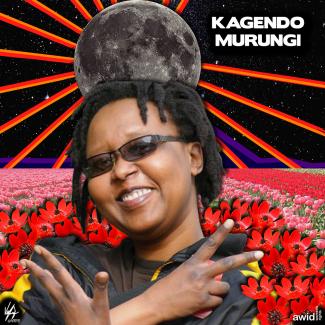
Kagendo is remembered fondly by family and friends as a fierce African feminist activist, artist, and filmmaker.
She dedicated over 20 years to advocate for the rights and dignity of African LGBTIQ and gender non conforming people.
Kagendo’s colleagues remember her as someone with a jovial personality, fierce conviction, and love for life. Kagendo died due to natural causes at her home in Harlem on December 27th, 2017.
On Kagendo’s passing Kenyan writer and activist Shailja Patel noted “Kagendo's lifelong commitment to connecting the dots between all oppressions, showing how colonialism fostered homophobia on the African continent, making Kenya a country where queer Kenyans and free women could live and thrive.”
Snippet FEA collaborator and allies Photo 5 (EN)
Мы распределяем деньги среди наших грантополучающих партнерок(-ров) и являемся феминистским и/или женским фондом – можем ли мы участвовать в опросе?
Нет, мы высоко ценим вашу работу, но в данный момент мы не просим откликов от женских и феминистских фондов. Мы будем рады, если вы поделитесь информацией об опросе со своими партнерками(-рами) и контактами внутри феминистской сети.
Sara AbuGhazal es una feminista palestina que vive en Beirut. Es cofundadora de Sawt al-Niswa, un colectivo que produce conocimiento en Beirut. Es codirectora de The Knowledge Workshop [«Taller del conocimiento»], una organización feminista con sede en Beirut que trabaja en la historia oral y el archivo feminista. Sara es actualmente la Coordinadora Regional de la Coalición Regional para Defensoras de los Derechos Humanos en el Medio Oriente y África del Norte.
Sara lucha para ayudar a crear espacios de transformación feminista y solidaridad. Su trabajo se centra principalmente en la construcción de movimientos sostenibles en la región del MOAN. Sara se empeña en temas de la Palestina, la producción de conocimiento y la transformación feminista. Publica regularmente en sawtalniswa.org y su obra de ficción también aparece en la revista electrónica Romman
Add to stories
Off
Twitter Test
@shalinikonanur sharing a comment by her colleague debbie @salco "we can talk about shattering the glass ceiling, but we have to talk about who are sweeping those broken glasses?" challenging the #G7 to truly see who's vulnerable domestically & globally #W7Canada@kramdas@AWIDpic.twitter.com/1rs0SpLYHp
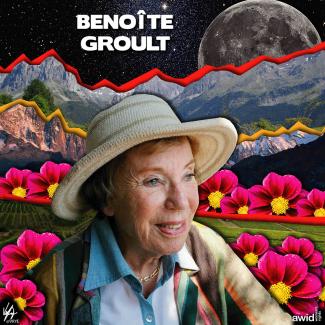
Benoîte fue una periodista, escritora y activista feminista francesa.
Benoîte publicó más de 20 novelas y numerosos ensayos sobre feminismo.
En 1975 se publicó su primer libro, Ainsi Soit-Elle (que podría traducirse «Como ella es»). En él analizaba la historia de los derechos de las mujeres, así como la misoginia y la violencia contra las mujeres.
En su último libro, Ainsi Soit Olympe de Gouges, analizaba los derechos de las mujeres durante la Revolución Francesa, centrándose en la pionera feminista francesa. Olympe de Gouges fue guillotinada en 1793 por desafiar la autoridad masculina; dos años antes había publicado una declaración sobre los derechos de las mujeres («Déclaration Des droits de la Femme et de la Citoyenne»).
Snippet FEA lines of work Against (ES)
VIOLACIONES DE DERECHOS LABORALES
Posso aceder a e realizar o inquérito no meu telemóvel?
Sim, o inquérito pode ser acedido através de um smartphone.
Salome est une activiste féministe originaire de Tbilisi, Géorgie, qui se consacre à la justice de genre et sociale. Titulaire d’une Maîtrise en études sur le genre, elle s’est impliquée auprès de mouvements féministes, queers et écologiques au cours des neuf dernières années, travaillant entre autres sur les questions de la violence liée au genre, la violence domestique, la santé sexuelle et reproductive et les droits afférents, les droits LGBTIQ et la sécurité et les droits holistiques et numériques.
Depuis 2014, elle travaille activement sur les questions de sécurité et de sûreté des activistes et des femmes défenseures des droits humains, organisant des ateliers sur la sécurité intégrée et la sécurité numérique spécialement pour les activistes de groupes défavorisés (personnes homosexuelles, minorités ethniques et religieuses, femmes et filles rurales, etc.) ainsi que pour de grandes organisations féministes. Salome est membre de l’Independent Group of Feminists (Groupe indépendant de féministes)- une initiative non-formelle, non hiérarchique et non enregistrée qui réunit des féministes géorgiennes ayant différents parcours. Elle travaille actuellement avec le Fonds pour les femmes de Géorgie, où elle est pleinement impliquée dans la construction de mouvements de femmes/féministes, tout en offrant un financement féministe et encourageant la philanthropie féministe locale.
Add to stories
Off
Funding Ideas
This page provides ideas and inspiration for how you can fund your participation at the 14th AWID International Forum.
As you plan the activity you would like to do at the Forum, please also consider how you will fund your participation. Typical Costs include: accommodation, travel, visa, forum registration fees, etc.
It is important to note that this Forum will have many ‘open spaces’ and moments for movements to learn and exchange, but fewer formal sessions. (See “Ways to describe the Forum in your fundraising” below for language to use in your outreach.)
Work with your current funders:
Reach out to your current donors first : Your best option is always a current funder that you have.
Make sure to do it in advance : We recommend contacting them by early 2020 at the latest. Many funders who support feminist organizations have some budget allocated for Forum travel. Others may be able to include it in renewal grants or through other travel funds.
If your group has funders, tell them that you want to attend the AWID Forum to learn, experience, exchange and network- even if your activity does not get selected for the final program. In order to be able to support your participation, your donors will need to know about it well in advance so tell them right away! (they are already deciding which funds they will distribute in 2020).
Seeking new funders:
If you do not currently have donor support or are not able to secure grants for Forum travel, consider reaching out to new donors.
Deadlines and requirements vary by funder, and a grant review process can take many months. If you’re considering applying for new grants, do so as soon as possible.
Creative inspiration:
Feminist movements have long gotten creative with funding our own activism. Here are some ideas that we have gathered to inspire alternative ways of fundraising:
Mobilize your community to support participation: fundraise with small contributions from members through community dinners, dance parties, and local shows, events and tours
Mobilize your networks by organizing giving circles and crowdsourcing using various online tools like gofundme, indiegogo, plumfund, or kickstarter
Cultivate local sources of income, including from individual donors and membership dues
Consider co-funding through strategic partnerships with other community and social justice groups.
For more inspiration, see AWID’s ongoing series on autonomous resourcing, including specific ideas for conference raising participation funds.
Access Fund:
AWID strives to make the Forum a truly global gathering with participation from diverse movements, regions and generations. To this end, AWID mobilizes resources for a limited Access Fund (AF) to assist Forum participants with the costs of attending the Forum.
AWID’s Access Fund will provide support to a limited number of Forum participants and session/activity facilitators. You can indicate in your application if you would like to apply to the AWID Access Fund. This is not guaranteed, and we strongly encourage you to seek alternative funding for your participation and travel to the Forum.
Even if you apply for the AWID Access Fund, we encourage you to continue to explore other options to fund your participation in the Forum. Access Fund decisions will be confirmed by the end of June 2020. Please remember that these resources are very limited, and we will be unable to support all applicants.
Ways to describe the Forum in your fundraising:
As you reach out to funders or your own networks, here is some sample messaging that may be helpful. Feel free to adapt it in whatever way is useful for you!
The AWID Forum is a co-created feminist movement space that energizes participants in their own activism, and strengthens connections with others across multiple rights and justice movements. Participants get to draw from wells of hope, energy and radical imagination, as well as deepen shared analysis, learning, and build cross-movement solidarity to develop more integrated agendas and advance joint strategies.
Our organization is seeking funds to attend the Forum in order to connect with other activists and movements from around the world, strengthen our strategies, and share our work. We are inspired by past participants, who have described the power of this global feminist gathering:
“Over four days … voices weaved together into a global perspective on the state of gender equality. And when I say global, I mean simultaneous translation into seven languages kind of global ....”
“It was reminding us that we are not alone. The Forum provided a means of translating collectivity into our movements. Whether across ideologies, identities or borders, our strength is in our vision and our support of one another.”
It is important to note that this Forum will have many ‘open spaces’ and moments for movements to learn and exchange, but fewer formal sessions. While many attendees will not be presenting in formal sessions, there will be invaluable space to learn, strategize, and experience feminist movements’ collective power in action.
Budget considerations:
When calculating your costs and how much you need to raise, it is important to factor in costs that may come up. Here’s an example of key items to consider:
Airfare
Forum registration fees (please note that even if you are granted Access Funds by AWID, you will have to cover your registration fee yourself)
Visa costs
Travel health insurance
Local travel to and from the airport (taxis or other transportation)
Layover costs, such as hotels and meals if your plane travel requires a long layover
Accommodation, including giving yourself a day to recover on either end if you have traveled far
Technology, including WiFi access or fees for international communication as needed during travel (AWID will provide WiFi during the Forum)
Materials costs for any items (visuals, reports, artwork!) you want to bring, share, or exchange at the Forum
Incidentals and/or per diems to cover food and other items that come up (all lunches and coffee/tea breaks, plus one dinner will be provided by AWID during Forum days)
Accessibility, such as any additional support that may be important to make your travel more comfortable, safe, and secure
We look forward to seeing you at the Forum!
The Forum is a collaborative process
The AWID Forum will now take place 11-14 January 2021 in Taipei .
It is more than a four-day convening. It is one more stop on a movement strengthening journey around Feminist Realities that has already begun and will continue well beyond the Forum dates.