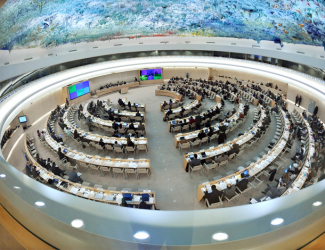
Jean-Marc Ferré | Flickr (CC BY-NC-ND 2.0)
A general view of participants at the 16th session of the Human Rights Council in Geneva, Switzerland.

Analyses Spéciales

L´AWID est une organisation féministe mondiale qui consacre ses efforts à la justice de genre, au développement durable et aux droits humains des femmes

Conseil des Droits de l'Homme (CDH)

​​​​​​Le Conseil des droits de l'homme (CDH) est un organe intergouvernemental clé du système des Nations Unies, responsable de la promotion et la protection des droits humains autour du globe. Il se réunit  trois fois par an en session ordinaire, en Mars, Juin et Septembre. Le Bureau du Haut-Commissariat des Nations Unies aux Droits de l’Homme (HCDH) constitue le secrétariat pour le CDH.

Le CDH :

  • Débat et adopte des résolutions sur les questions globales des droits humains ainsi que sur la situation des droits humains dans des pays particuliers

  • Examine les plaintes des victimes de violations des droits humains et des organisations activistes, au nom des victimes de violations des droits humains

  • Nomme des experts indépendants (que l'on connaît sous le nom de « Procédures Spéciales ») pour réviser les cas de violation des droits humains dans des pays spécifiques, ainsi que pour examiner et suivre des questions globales relatives aux droits humains

  • Prend part à des discussions avec les experts et les gouvernements sur les questions de droits humains

  • Évalue les bilans des États membres de l'ONU en matière de droits humains tous les quatre ans et demi, dans le cadre de l'examen périodique universel.

En savoir plus sur le CDH


Session actuelle: CDH 44

La prochaine session du CDH a lieu à Genève, en Suisse, du 30 juin au 17 juillet 2020.

AWID travaille avec des partenaires féministes, progressistes et du domaine des droits humains pour partager nos connaissances clé, convoquer dialogues et évènements avec la société civile, et influencer les négociations et les résultats de la session.

Avec nos partenaires, notre travail consiste à :


◾️ Suivre, surveiller et analyser les acteurs, discours et stratégies anti-droits et leur impact sur les résolutions du CDH.

◾️ Co-développer un plaidoyer collectif pour contrer les acteurs anti-droits et discuter plus en détails les résultats du Rapport de tendances 2017 du OURs

◾️ Soutenir, coordoner et développer de manière collaborative le Caucus féministe qui émerge au CDH.


Contenu lié

Snippet FEA NSS Quote (ES)

“Los saberes y prácticas indígenas siempre han apoyado la soberanía alimentaria, y ese saber está en manos de las mujeres […] El ecofeminismo para mí es el respeto por todo lo que tenemos a nuestro alrededor” -

Mariama Sonko

Snippet - Intro WITM - AR

نكمل مشوار بناء الحشد الذي بدأناه قبل 20 عاماً لموارد أفضل وأكبر لحركات التغيير الاجتماعي بقيادة نسوية، تدعوكم/ن جمعية حقوق المرأة في التنمية لاستكمال استطلاعنا

" "أين التمويل للتنظيمات النسوية" (WITM)

لتعبئة الاستطلاع Tutorial

الرجاء اختيار اللغة المفضلة للإجابة على الاستطلاع في أقصى يمين الصفحة


Maria Olivo

Biography

Maria is a graphic designer and visual communicator. Maria has worked with NGOs and Human Rights like Profamilia and OXFAM. As a woman of the Global South, she feels especially called to use her skills to work with organizations that help protect the wellbeing, as well the rights of millions of girls and women in Latin America.

Position
Digital Communications Coordinator
Add to stories
Off

Quelle est l’origine de ce projet?

Nous croyons que l'économie, le marché, le système financier et les prémisses sur lesquelles ils reposent sont des domaines critiques pour la lutte féministe.


Ainsi, notre vision pour une économie juste dépasse la promotion des droits et de l'autonomisation des femmes sur le marché. Elle propose d'évaluer le rôle des oppressions liées au genre lors de l'élaboration de mesures économiques, afin de les modifier pour favoriser l'égalité de genre et la justice économique.

Processus

Nous ne partons pas de zéro et nous ne sommes pas seules à tenter de mettre en avant des propositions féministes pour une économie juste. Beaucoup des propositions formulées dans ce document existaient déjà en théorie et aussi dans la pratique, au sein de diverses communautés qui défient et résistent face aux systèmes économiques fondés sur la croissance et le marché.
 
Il est également très important de noter qu'il y a une prise de conscience croissante du fait que les micros solutions n’apportent pas toujours de réponses aux problèmes macros, même si elles représentent des espaces importants pour la construction de la résistance et des mouvements. Certaines alternatives spécifiques peuvent ne pas être en mesure de remédier aux injustices du système capitaliste actuel à l'échelle mondiale.

Objectifs

Cela dit, les alternatives féministes pour une économie juste sont essentielles pour ouvrir des brèches dans le système et pouvoir en tirer des leçons, en faveur d’un changement systémique transformateur. Nous n’avons pas la prétention de proposer un compte-rendu complet et exhaustif sur la manière de créer un modèle économique qui soit juste d’un point de vue féministe, ou même des modèles.

À partir d’un dialogue inter-mouvements avec des syndicats, des mouvements ruraux et paysans et des mouvements environnementaux, nous pouvons néanmoins formuler une série de propositions pour cheminer vers cette vision.

Que voulons-nous changer?

Le modèle néolibéral qui domine l'économie mondiale a démontré à maintes reprises son incapacité à traiter les causes profondes de la pauvreté, des inégalités et de l'exclusion. En réalité, le néolibéralisme a même contribué à provoquer et à exacerber ces injustices.
 
Caractérisées par la mondialisation, la libéralisation, la privatisation, la financiarisation et l'aide conditionnelle, les politiques générales de développement de ces trois dernières décennies ont fait des ravages dans la vie et les moyens de subsistance de tous et toutes. Ces politiques ont également contribué sans faillir à creuser le fossé des inégalités, aux injustices de genre et à une destruction de l'environnement que le monde ne peut plus se permettre de supporter.
 
Il y a encore des personnes qui affirment qu’en donnant carte blanche aux sociétés et aux entreprises pour favoriser la croissance économique, le vent finira par atteindre les voiles de tous les navires.
 
Cependant, la notion du développement dominante au cours des dernières décennies,  qui repose en grande partie sur le principe d’une croissance économique illimitée, traverse actuellement une crise idéologique.
 
Le mythe de la croissance économique en tant que panacée capable de résoudre tous nos problèmes prend l’eau.


Voir également

Notre vision

5 menaces principales

Snippet FEA This is the story of the Nadia Echazú (FR)

Un lieu de travail n'a pas à fonctionner sur la base de la concurrence et du profit. Un lieu de travail ne devrait pas exploiter les gens au profit d’autrui. C’est pourquoi les communautés marginalisées en dehors des économies formelles construisent des modèles coopératifs alternatifs basés sur l'autonomie, la coopération, la coresponsabilité, l'autogestion et la solidarité.

Les lieux de travail et coopératives autogérés par les travailleur·euses ont toujours offert d'autres moyens de générer des opportunités d'emploi, des revenus, une sécurité sociale et des épargnes, tout en distribuant les revenus de manière plus communautaire, durable et sûre.

Mais le coopérativisme c'est bien plus qu'une opportunité d'emploi: c'est la réalisation des rêves et la construction d’économies féministes basées sur la solidarité et l'entraide. C'est la création d’un monde où nos vies, notre travail et nos communautés comptent.

Voici l'histoire de la Coopérative Textile Nadia Echazú, la première coopérative créée et dirigée par et pour les personnes travesti et trans en Argentine.

Snippet - WITM To make - RU

Сделать видимой сложность обеспечения ресурсами различных феминистских организаций

Leila Hessini

Biography

Leila es una líder, defensora y consultora feminista transnacional, con más de veinticinco años de experiencia en la promoción de los derechos humanos, la igualdad de género y la justicia sexual y reproductiva en salud, derechos y justicia a nivel local y global. Leila nació en Argelia y se educó en Estados Unidos, Francia y Marruecos; a lo largo de su carrera profesional, ha vivido y trabajado en África, Europa y Estados Unidos.

Durante más de cinco años fue Vicepresidenta de Programas en el Fondo Global de Mujeres (GFW), supervisando el otorgamiento estratégico de subvenciones, el fortalecimiento de los movimientos, la incidencia global y las colaboraciones filantrópicas. En GFW duplicó las subvenciones otorgadas a más de 17 millones USD, inauguró el trabajo sobre movimientos feministas y de género en las crisis, creó un programa para niñas adolescentes liderado por un consejo asesor de niñas, y dirigió su trabajo de incidencia filantrópica. Antes de eso, entre 2002 y 2016 se desempeñó en el equipo de dirección de Ipas, donde publicó extensamente sobre derecho al aborto y justicia, lideró tareas de incidencia globales, y se asoció con grupos feministas que trabajan sobre gestión autónoma, movilización comunitaria y reducción de estigmas respecto de la integridad corporal y de los derechos sexuales y reproductivos. Mientras vivió en África del Norte, cofundó una empresa consultora feminista interseccional, Strategic Analysis for Gender Equality (SAGE), que trabajaba en las intersecciones de los derechos económicos, de género y sexuales y reproductivos, y dirigió el trabajo nacional, regional y mundial sobre género de la oficina de El Cairo de la Fundación Ford durante cinco años.

Leila tiene una vasta experiencia en educación popular, incidencia, organizaciones sin fines de lucro, juntas de desarrollo, filantropía, y monitoreo y evaluación. Es una hábil comunicadora comprometida con la utilización del enfoque interseccional para priorizar y difundir las voces y las experiencias de las personas más marginadas. Ha recibido la beca «Op-ed Public Voices» de la Fundación Ford, y fue becaria Fulbright en Marruecos. Sus publicaciones cubren una amplia gama de tópicos, incluyendo enfoques feministas y decoloniales a la filantropía, la promoción de los derechos humanos de las mujeres en contextos mayoritariamente musulmanes, estrategias feministas para impulsar la justicia reproductiva, el fomento de los abortos autogestionados, y la lucha contra los estigmas y la discriminación.

Actualmente Leila se desempeña como Copresidenta de la Junta Directiva del Centro por los Derechos Constitucionales (CCR), e integra la Junta Directiva del Highlander Research and Education Center. Es también funcionaria del consejo de rendición de cuentas del Numun Feminist Technology Fund y del comité asesor de la African Women’s Human Rights Defenders Platform. Anteriormente ha integrado las Juntas de la SisterSong Women of Color Reproductive Justice Collective, de la Red Mundial de Mujeres por los Derechos Reproductivos (WGNRR), del Fondo Global de Mujeres (GFW), del Fondo de Acción para el Aborto Seguro (SAAF), y del Proyecto de Tecnologías para la Salud Reproductiva (RHTP). Fue elegida Tesorera e integrante del Comité Ejecutivo de la Junta Directiva de Prospera, y del Comité de Dirección de Fenomenal Funds por cuatro años. Leila tiene una Maestría en Salud Pública, y una Maestría en Estudios de Medio Oriente y Norte de África; ha estudiado derecho islámico en Marruecos, y cursó estudios doctorales en sociología en Francia. Ha estudiado árabe y alemán, habla francés e inglés en forma fluida.

Position
Tesorera
Add to stories
Off

Reclaiming the Commons

Definition

There are varied conceptualizations about the commons notes activist and scholar Soma Kishore Parthasarathy.

Conventionally, they are understood as natural resources intended for use by those who depend on their use. However, the concept of the commons has expanded to include the resources of knowledge, heritage, culture, virtual spaces, and even climate. It pre-dates the individual property regime and provided the basis for organization of society. Definitions given by government entities limit its scope to land and material resources.

The concept of the commons rests on the cultural practice of sharing livelihood spaces and resources as nature’s gift, for the common good, and for the sustainability of the common.

Context

Under increasing threat, nations and market forces continue to colonize, exploit and occupy humanity’s commons.

In some favourable contexts, the ‘commons’ have the potential to enable women, especially economically oppressed women, to have autonomy in how they are able to negotiate their multiple needs and aspirations.

Feminist perspective

Patriarchy is reinforced when women and other oppressed genders are denied access and control of the commons.

Therefore, a feminist economy seeks to restore the legitimate rights of communities to these common resources. This autonomy is enabling them to sustain themselves; while evolving more egalitarian systems of governance and use of such resources. A feminist economy acknowledges women’s roles and provides equal opportunities for decision-making, i.e. women as equal claimants to these resources.

Photo: Ana Abelenda / AWID, 2012

Learn more about this proposition

Part of our series of


  Feminist Propositions for a Just Economy

Snippet FEA Life expectancy of a trans and travesti (EN)

This illustration depicts a faceless person with long dark hair and a burgundy shirt, with the number 37 written across the image (37 being the life expectancy of a trans and travesti person in Argentina)

Life expectancy of a trans and travesti person in Argentina is 37 years old - the average age for the general population is 77.

Abby Lippman

Abby was a pioneering feminist, human-rights activist and former McGill University epidemiologist.

Abby was renowned for championing social causes and for her insightful critiques of reproductive technologies and other medical topics. Specifically, she campaigned against what she called the "geneticization" of reproductive technologies, against hormone replacement therapy and for better, longer research before the approval of discoveries such as the vaccines against the human papillomavirus.

On the news of her passing, friends and colleagues described her fondly as an “ardent advocate” for women’s health.


Abby Lipman, Canada

Snippet - WITM Survey will remain open - AR

سيبقى الاستطلاع مفتوحاً حتى 31 يوليو (تموز) 2024

لتعبئة الاستطلاع

الرجاء اختيار لغتك في الزاوية اليمنى الرجاء اختيار اللغة المفضلة للإجابة على الاستطلاع في أقصى يمين الصفحة

 ذا كنت ترغب في معرفة المزيد، انضم إلى لقاء للأعضاء/ العضوات: أين المال؟ يوم الاثنين 27 مايو (أيار) الساعة 9:00 بالتوقيت العالمي - مع ترجمة
 فورية باللغتين الفرنسية والإنجليزية.
14:00 بالتوقيت العالمي - مع ترجمة فورية باللغتين الإسبانية والإنجليزية
سنستمع إلى فريق الحركات النسوية لتوفير الموارد التابع لجمعية حقوق المرأة في التنمية (جمعية حقوق المرأة في التنمية) حول خصوصيات وعموميات تمويل التنظيمات النسوية.

انضم/ي إلينا كعضو/ة في وكن/وني جزءًا من جلسة التواصل هذه.
الرد على الدعوة هنا

(Registration only available in English)

Alexandra Lamb Guevara

Biography

Alexandra is an anglo-colombian feminist with over 20 years of experience in local, national and international HIV and sexual and reproductive health and rights programming. She has extensive experience in resource mobilization and donor relations with private philanthropic foundations and multilateral agencies on behalf of international, national and local NGOs, predominantly in Latin America and the Caribbean. Prior to AWID, Alexandra worked at Fundación Si Mujer, a feminist abortion provider and educator in Colombia, RedTraSex and the International HIV/AIDS Alliance.

Alexandra has a BA in International Relations and Development Studies from Sussex University and a MSc in Public Health from the London School of Hygiene and Tropical Medicine. In rare moments when she is not working or parenting, she loves to swim, eat and has recently begun to play Zelda: Breath of the Wild with her son.

Position
Resource Mobilization Lead
Add to stories
Off

Key opposition strategies and tactics

Despite their rigidity in matters of doctrine and worldview, anti-rights actors have demonstrated an openness to building new kinds of strategic alliances, to new organizing techniques, and to new forms of rhetoric. As a result, their power in international spaces has increased.


There has been a notable evolution in the strategies of ultra conservative actors operating at this level. They do not only attempt to tinker at the edges of agreements and block certain language, but to transform the framework conceptually and develop alternative standards and norms, and avenues for influence.

Strategy 1: Training of UN delegates

Ultra conservative actors work to create and sustain their relationships with State delegates through regular training opportunities - such as the yearly Global Family Policy Forum - and targeted training materials.

These regular trainings and resources systematically brief delegates on talking points and negotiating techniques to further collaboration towards anti-rights objectives in the human rights system. Delegates also receive curated compilations of ‘consensus language’ and references to pseudo-scientific or statistical information to bolster their arguments.

The consolidated transmission of these messages explains in part why State delegates who take ultra-conservative positions in international human rights debates frequently do so in contradiction with their own domestic legislation and policies.

Strategy 2: Holding international convenings

Anti-rights actors’ regional and international web of meetings help create closer links between ultra conservative Civil Society Organizations (CSOs), States and State blocs, and powerful intergovernmental bodies. The yearly international World Congress of Families is one key example.

These convenings reinforce personal connections and strategic alliances, a key element for building and sustaining movements. They facilitate transnational, trans-religious and dynamic relationship-building around shared issues and interests, which leads to a more proactive approach and more holistic sets of asks at the international policy level on the part of anti-rights actors.

Strategy 3: Placing reservations on human rights agreements

States and State blocs have historically sought to undermine international consensus or national accountability under international human rights norms through reservations to human rights agreements, threatening the universal applicability of human rights.  

The Convention on the Elimination of Discrimination Against Women (CEDAW) has received by far the most reservations, most of which are based on alleged conflict with religious law. It is well-established international human rights law that evocations of tradition, culture or religion cannot justify violations of human rights, and many reservations to CEDAW are invalid as they are “incompatible with the object and purpose” of CEDAW. Nevertheless, reference to these reservations is continually used by States to dodge their human rights responsibilities.

‘Reservations’ to UN documents and agreements that are not formal treaties - such as Human Rights Council and General Assembly resolutions - are also on the rise.

Strategy 4: Creating a parallel human rights framework

In an alarming development, regressive actors at the UN have begun to co-opt existing rights standards and campaign to develop agreed language that is deeply anti-rights.

The aim is to create and then propagate language in international human rights spaces that validates patriarchal, hierarchical, discriminatory, and culturally relativist norms.

One step towards this end is the drafting of declarative texts, such as the World Family Declaration and the San Jose Articles, that pose as soft human rights law. Sign-ons are gathered from multiple civil society, state, and institutional actors; and they are then used a basis for advocacy and lobbying.

Strategy 5: Developing  alternative ‘scientific’ sources

As part of a strategic shift towards the use of non-religious discourses, anti-rights actors have significantly invested in their own ‘social science’ think tanks. Given oxygen by the growing conservative media, materials from these think tanks are then widely disseminated by conservative civil society groups. The same materials are used as the basis for advocacy at the international human rights level.  

While the goals and motivation of conservative actors derive from their extreme interpretations of religion, culture, and tradition, such regressive arguments are often reinforced through studies that claim intellectual authority. A counter-discourse is thus produced through a heady mix of traditionalist doctrine and social science.

Strategy 6: Mobilizing Youth

This is one of the most effective strategies employed by the religious right and represents a major investment in the future of anti-rights organizing.

Youth recruitment and leadership development, starting at the local level with churches and campuses, are a priority for many conservative actors engaged at the international policy level.  

This strategy has allowed for infiltration of youth-specific spaces at the United Nations, including at the Commission on the Status of Women, and creates a strong counterpoint to progressive youth networks and organizations.

Key anti-rights strategies

Strategy 7: Defunding and delegitimizing human rights mechanisms

When it comes to authoritative expert mechanisms like the UN Special Procedures and Treaty Monitoring Bodies and operative bodies like the UN agencies, regressive groups realize their potential for influence is much lower than with political mechanisms[1].

In response, anti-rights groups spread the idea that UN agencies are ‘overstepping their mandate,’ that the CEDAW Committee and other Treaty Bodies have no authority to interpret their treaties, or that Special Procedures are partisan experts working outside of their mandate. Anti-rights groups have also successfully lobbied for the defunding of agencies such as the United Nations Population Fund (UNFPA).

This invalidation of UN mechanisms gives fuel to state impunity. Governments, when under international scrutiny, can defend their action on the basis that the reviewing mechanism is itself faulty or overreaching.

Strategy 8: Organizing online

Conservative non-state actors increasingly invest in social media and other online platforms to promote their activities, campaign, and widely share information from international human rights spaces.

The Spanish organization CitizenGo, for example, markets itself as the conservative version of Change.org, spearheading petitions and letter-writing campaigns. One recent petition, opposing the establishment of a UN international day on safe abortion, gathered over 172,000 signatures.


Overarching Trends:

  • Learning from the organizing strategies of feminists and other progressives.
  • Replicating and adapting successful national-level tactics for the international sphere.
  • Moving from an emphasis on ‘symbolic protest’ to becoming subversive system ‘insiders.’

By understanding the strategies employed by anti-rights actors, we can be more effective in countering them.


[1] The fora that are state-led, like the General Assembly, the Human Rights Council, and UN conferences like the Commission on the Status of Women and the Commission on Population and Development


Other Chapters

Read the full report

Snippet FEA Financial Precarities (ES)

This image represents a faceless person with dark hair, yellow glasses, and V-neck navy blue colored shirt that is writing on a burgundy piece of paper with a yellow pencil
LA PRECARIEDAD FINANCIERA
es constante

Marielle Franco

Marielle fue una política brasileña feminista lesbiana y activista por los derechos humanos.

Criticó abiertamente la brutalidad policial y las ejecuciones extrajudiciales. Su política declaradamente feminista, negra, centrada en las favelas, fue una fuente de esperanza para los grupos marginados de Río de Janeiro, gobernados actualmente por un gobierno municipal conservador y un intendente evangélico.

El 14 de marzo de 2018, después de dar un discurso en Río de Janeiro, Franco y su chofer fueron asesinados a balazos. A partir de la noticia de su muerte, multitudes se volcaron a las calles al grito de «¡Marielle presente!», en demanda de justicia.

En esta nota se puede leer más sobre Marielle y la situación en Brasil


Marielle Franco, Brasil