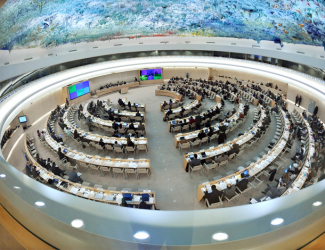
A general view of participants at the 16th session of the Human Rights Council in Geneva, Switzerland.
Analyses Spéciales
L´AWID est une organisation féministe mondiale qui consacre ses efforts à la justice de genre, au développement durable et aux droits humains des femmes
Le Conseil des droits de l'homme (CDH) est un organe intergouvernemental clé du système des Nations Unies, responsable de la promotion et la protection des droits humains autour du globe. Il se réunit trois fois par an en session ordinaire, en Mars, Juin et Septembre. Le Bureau du Haut-Commissariat des Nations Unies aux Droits de l’Homme (HCDH) constitue le secrétariat pour le CDH.
Le CDH :
Débat et adopte des résolutions sur les questions globales des droits humains ainsi que sur la situation des droits humains dans des pays particuliers
Examine les plaintes des victimes de violations des droits humains et des organisations activistes, au nom des victimes de violations des droits humains
Nomme des experts indépendants (que l'on connaît sous le nom de « Procédures Spéciales ») pour réviser les cas de violation des droits humains dans des pays spécifiques, ainsi que pour examiner et suivre des questions globales relatives aux droits humains
Prend part à des discussions avec les experts et les gouvernements sur les questions de droits humains
Évalue les bilans des États membres de l'ONU en matière de droits humains tous les quatre ans et demi, dans le cadre de l'examen périodique universel.
La prochaine session du CDH a lieu à Genève, en Suisse, du 30 juin au 17 juillet 2020.
AWID travaille avec des partenaires féministes, progressistes et du domaine des droits humains pour partager nos connaissances clé, convoquer dialogues et évènements avec la société civile, et influencer les négociations et les résultats de la session.
Avec nos partenaires, notre travail consiste à :
◾️ Suivre, surveiller et analyser les acteurs, discours et stratégies anti-droits et leur impact sur les résolutions du CDH.
◾️ Co-développer un plaidoyer collectif pour contrer les acteurs anti-droits et discuter plus en détails les résultats du Rapport de tendances 2017 du OURs
◾️ Soutenir, coordoner et développer de manière collaborative le Caucus féministe qui émerge au CDH.
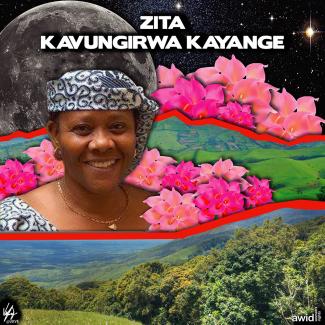
Zita was a women’s rights activist who defended the rights of rural women in Greater Kivu.
She was the first Executive Director of UWAKI - a well known women’s organisation. Through her work with Women's Network for Rights and Peace (RFDP), and the Women's Caucus of South Kivu for Peace, she committed her life to helping to restore peace in the Eastern DRC. She spoke out strongly against the use of sexual violence as a weapon of war.
In 2006, she put herself forward as a candidate in the first democratic elections in the DRC. Although she did not win, she continued to advocate for women’s rights and the South Kivu community remembers her fondly.
Our values - esponsibility, Accountability, and Integrity
Responsibility, Accountability, and Integrity
We strive for transparency, responsible use of our resources, fairness in our collaborations and accountability and integrity with our members, partners, funders and the movements with(in) which we work. We are committed to reflecting on our experiences, sharing our learnings openly, and striving to change our practices accordingly.
Я прошла(-шел) опрос, но передумала(-л) и хочу отозвать ответы – что мне делать?
Les frais d’inscription au Forum de l’AWID pour tou-te-s les participant-e-s couvrent :
Accès complet aux quatre jours du Forum
Déjeuners et pauses café/thé pendant les journées du Forum
Documentation
Traduction simultanée lors des sessions plénières et quelques sessions/activités sélectionnées en petits groupes (anglais, français, espagnol et langue locale)
Participation au dîner/à la fête de célébration
Application mobile avec programme final et fonction “chat” intégrée
Service WiFi gratuit dans les locaux du Forum
Accueil à l’aéroport et transport hôtel-site-hôtel.
Freeing the Church, Decolonizing the Bible for West Papuan Women
By Rode Wanimbo (@rodwan986), Jayapura, Papua Province of Indonesia
“Lord, we are unworthy. We are the ones who committed sin for Eve ate the fruit in Eden. We are just women who grow sweet potatoes, look after pigs and give birth to children. We believe you died on the cross to set us free. Thank you, In Jesus’s name Amen.”
This is a typical prayer of women I have heard during my visits to ministries in several villages. Even I said the same prayer for many years.
I was born and grew up in Agamua, the Central Highlands of West Papua. My father belongs to the Lani tribe and my mother comes from Walak.
In Lani and Walak languages - languages spoken in the Central Highlands - tiru means a pillar. There are four tiru (pillars) standing firmly in the middle of the Lani roundhouse (honai), around wun’awe or a furnace. Tiru is always made of the strongest type of wood called a’pe (ironwood tree). The longer the wood gets heated and smoked from the fire in the honai, the stronger it becomes. Without tiru, the honai cannot stand firm. West Papuan women are these tiru.
West Papua is located in the western part of the New Guinea island, containing some of the world’s highest mountains, densest jungle, and richest mineral resources. It is home to over 250 groups and has an incredible biodiversity. Due to its natural wealth, West Papua has, over the centuries, been targeted by foreign occupiers. Until 1963, we were colonized by the Dutch. However in 1969, after a manipulative political act, we were transferred from the Dutch to Indonesia.
The first German missionaries arrived in Mansinam Island, Manokwari, in 1855. Then, in the 1950s, Christianity was brought to the Central Highlands of West Papua by Protestant missionaries of European descent from America, Canada, Australia and New Zealand.
According to Scripture in Genesis 1: 26-27, Man and Woman are created in the image of God. It means all humanity is made with the call and capacity to exercise dominion. Radah, the Hebrew word for dominion, means stewardship. Radah is not a call to exercise imperial power as declared by Pope Nicolas V, granting Catholic nations the right to “discover” and claim dominion over non-Christian lands. To diminish the capacity of humans to exercise dominion, is to diminish the image of God on earth (Lisa Sharon Harper, The Very Good Gospel).
The Evangelical Church of Indonesia (GIDI) was established as an institution in 1963. In the Sunday Service liturgy of GIDI, Women are considered unworthy to take any responsibility except collecting offerings. In 2003, after 40 years, the Department of Women was introduced within the structure of the Synod leadership.
In November 2013, I was entrusted to be a chairperson of the Women’s Department of the GIDI Synod.
Together with several other women leaders, we started a cell group that is committed to “decolonizing the Bible.” We learn together how to reconstruct the interpretation of biblical texts to champion women.
A feminist theologian named Elisabeth S Florenza calls it a feminist hermeneutic theory (Josina Wospakrik, Biblical Interpretation and Marginalization of Woman in the Churches of West Papua).
Besides the cell group, we interview our elderly women to collect our ancestors’ wisdom and values. As Bernard Narakobi in his book The Melanesian Way said: “Our history did not begin with contact with the Western explorers. Our civilization did not start with the coming of the Christian missionaries. Because we have an ancient civilization. It is important for us to give proper dignity and place to our history”.
Yum is a knotted net or woven bag handmade from wood fiber or leaves. Yum is highly valued for it symbolizes life and hope. When women of Lani and Walak get married, our maternal aunts put yum on our heads. It means we bear the responsibility for giving life and for providing food. Yum is used to carry garden produce as well as being used as a container to put a baby to sleep in as it gives warmth and a sense of security.
“West Papuan Women are Yum and Tiru” became the prime references as we contextualized women in the eyes of Jesus Christ in seminar and focus group discussions. From 2013 to 2018, we focused on reconstructing the view of women in GIDI and in gaining a healthy self-image. We are still in the process of understanding who we are to Jesus, rather than who we have been told we are by theologians and the fathers of the early Churches. Josina Wospakrik, a West Papuan Theologian said “The Gospel is incredibly rich but it was impoverished due to human ambitions and agendas.”
Since 2018, the GIDI Women Leadership team and I have formulated four priority programs: Decolonizing the Bible, Storytelling in a circle, Training of trainers for Literacy and Gender. The fourth, supported simple bookkeeping and savings groups workshops facilitated by Yapelin and Yasumat, which are faith based organizations established by GIDI leaders to reach the economic, social and health needs of women in the communities.
Storytelling in a Circle
In this programme we create a safe space for women to talk - each woman has a story. We all sit together and learn how to be good listeners.
“I became Christian and was taught that the government is God’s representative. Why did the government do nothing when the army burnt down my village and killed my relatives?” asked one woman in the storytelling circle. “My aunt was raped.” She stopped for a while. Could not talk. She cried. We all did.
The process of storytelling has driven us into deep conversation. We began to contextualize Biblical texts within our daily realities.
We started asking questions amongst ourselves: Where is God in our toughest times? Does the state government truly represent God on earth? Why does the Creator allow privileged people to destroy His own image in the name of Christianity and Development? During the process, I realized that I have been reading the Bible using somebody else’s glasses.
The church has to be a safe place to share stories and be a place of comfort to be still and rest. As we reflect on the testimonies, those who tell their stories begin the process of recovering from wounds and trauma.
Financial Literacy for Women
Culturally, West Papuans invest in relationships. The concept of saving is understood as an investment in relations, not in a bank account. And while the Indonesian central government has granted special autonomy to respond to West Papuans’ demand for self-determination, many government policies harm the quality of family life and they do not account for women’s lives. High illiteracy rates amongst women mean most women do not have access to a bank account. With no money saved, access to medical services becomes a struggle.
Through the priority programmes, Yapelin, with the active involvement and support of women, created saving groups in Bokondini and Jayapura. The saving groups are chaired by women who have access to a bank.
In coordination with Yayasan Bethany Indonesia (YBI) and Yayasan Suluh, a faith-based organization (FBO) based in Jayapura, we facilitated four literacy workshops. The literacy team facilitated the training of trainers in three different dioceses: Merauke, Sentani, and Benawa. We now have 30 facilitators in different congregations who run literacy programs.
Lack of financial support for our programs will not stop us. Being stigmatized as rebels will not stop us from standing up and speaking in church evaluation meetings and conferences. It is stressful but I am committed together with several women leaders to calling on the power-holders within to free the church.
The Gospel known as Good News should become news that liberates women from a very patriarchal circle of power, liberates women from social stigma and returns women to the original purpose of The Creator.
The Gospel must be a mirror to reflect who we are collectively. As Lisa Sharon Harper, in her book The Very Good Gospel said “The Gospel is not only about an individual’s reconciliation with God, self and communities. But also speaks on systemic justice, peace between people groups and freedom for the oppressed”.
Rode Wanimbo is the chairperson of the Women’s Department of Evangelical Church of Indonesia (GIDI).
“Offerings for Black Life”
By Sokari Ekine (@blacklooks), New Orleans
Coming from a place of healing and self-care is a political act that guides us to be focused and to move as one. In New Orleans, we created and will be creating altars in honour of those murdered by police and white supremacists vigilantes!
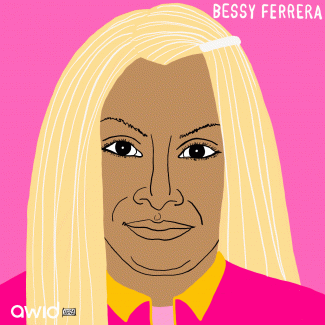
Bessy Ferrera was a lifelong defender of the human rights of trans people, sex workers and HIV positive people in Honduras.
Bessy was also a member of Arcoíris, an organisation which supports the LGBTI+ community. She was also a focal point person for the Right Here, Right Now (Derechos aquí y Ahora) Platform of Honduras, and advocated strongly for full citizenship of trans people, and the passing of a gender identity law that would allow trans people to change their gender identity legally.
"Since the beginning of the year [2019] the trans community has been suffering a series of attacks, for defending, for demanding rights." - Rihanna Ferrera (Bessy’s sister)
Bessy was a sex worker, and in early July 2019, was shot to death by two men while working in the streets of Comayagüela. Her assailants were subsequently arrested.
Bessy is one of many LGBTI+ rights defenders in Honduras, who were murdered because of their identities and work. Other companeras include: Cynthia Nicole, Angy Ferreira, Estefania "Nia" Zuniga, Gloria Carolina Hernandez Vasquez, Paola Barraza, Violeta Rivas, and Sherly Montoya.
Bessy’s case is emblematic of injustice and a much larger problem of the systematic violence the LGBTI+ community faces in Honduras as the state fails to guarantee rights offer and fails to offer protection. This has created a culture of impunity.
Despite the risks LGBTI+ defenders in Honduras face, they continue their work to challenge and resist violence, and fight stigma and discrimination on a daily basis.
“If I die, let it be for something good not for something futile. I don’t want to die running away, being a coward. If I die, I want people to say that I died fighting for what is mine.” - member of Arcoíris
14th AWID international Forum is cancelled (forum page)
El 14°Foro Internacional de AWID ha sido cancelado
Dada la situación global, nuestra Junta Directiva tomó la difícil decisión de cancelar el Foro que estaba programado en 2021, enTaipei.
Posso compartilhar o inquérito com outras pessoas?
Claro que sim! Encorajamo-lo a compartilhar a ligação do nosso inquérito com as suas redes. Quanto mais perspetivas diversas recolhermos, melhor será a nossa compreensão do cenário financeiro para a organização feminista.
Je ne suis pas en mesure d’assister au Forum en personne, de quelle autre façon puis-je participer?
Plus qu’un simple évènement, le Forum de l’AWID s’inscrit dans notre voyage d’exploration des réalités féministes, qui offre de nombreux espaces où se réunir, en ligne et hors ligne, afin d’échanger, discuter, élaborer des stratégies et co-créer des réalités féministes.
Nous explorons actuellement les possibilités de participer virtuellement au Forum et veillerons à vous partager l'information lorsque nous saurons ce que nous sommes en mesure de vous proposer.
Principios de participación para el Festival
¡Bienvenidxs a Crear | Résister | Transform: un festival para movimientos feministas!
Principios de participación para el Festival
AWID está comprometida con la creación de un espacio virtual que nos invite y desafíe a todxs a funcionar desde un lugar de valentía, curiosidad, generosidad y responsabilidad compartida.
Te invitamos a crear conjuntamente con nosotrxs espacios libres de acoso y violencia, donde todas las personas sean respetadas en su identidad y expresión de género, raza, capacidad, clase, religión, idioma, etnia, edad, ocupación, tipo de educación, sexualidad, tamaño corporal y apariencia física. Espacios donde reconozcamos las desigualdades que prevalecen en nuestro mundo, y nos esforcemos por transformarlas.
Queremos crear un espacio donde:
podamos estar “presentes”:
Esto significa escucharnos, comprendernos y vincularnos. Sentirnos cerca, a pesar de la virtualidad. Para eso, contaremos con interpretación y abriremos canales (como el chat y otras herramientas) para reaccionar y compartir. Para lograr escucharnos mejor, les invitamos a utilizar audífonos o auriculares durante la sesión. Si puedes hacerlo, te sugerimos cerrar tus correos electrónicos y cualquier otra posible distracción mientras estás en la conversación.
todas las formas de conocimiento son valoradas:
Celebremos los distintos saberes y las múltiples formas en que estos se expresan. Nos acercamos al espacio con curiosidad y apertura para aprender de otrxs y permitiéndonos desaprender y reaprender a partir del intercambio, sentando las posibilidades para la construcción colectiva de conocimiento.
todxs nos sintamos bienvenidxs:
Estamos comprometidxs con un enfoque holístico de la accesibilidad, conscientes de las diferentes necesidades físicas, mentales, de idioma y de seguridad. Queremos un espacio que acoja a gente de contextos, creencias, capacidades y experiencias diversas. Seremos proactivxs, pero también te pedimos que nos comuniques tus necesidades, para que, dentro de nuestras posibilidades, nos ocupemos de satisfacerlas.
todxs nos sintamos segurxs y respetadxs:
Asumimos compromisos individuales y colectivos de respetar la privacidad y contar con el consentimiento de otrxs para difundir imágenes o contenido generado durante la conversación.
Crear un ambiente más seguro, respetuoso y disfrutable para las conversaciones es responsabilidad de todxs.
Cómo reportar
Si notas que alguien se está comportando de forma discriminatoria u ofensiva, por favor, contacta a la persona de referencia que se indicará al comienzo de la sesión.
Cualquier participante que se exprese con lenguaje opresivo o imágenes ofensivas será eliminadx de la videoconferencia y no será admitidx nuevamente. No interactuaremos con esa persona de ninguna manera.
Yelena Grigoriyeva, a menudo conocida entre sus amigxs como Lena, fue una destacada defensora de los derechos LGBT en Rusia.
Formó parte de movimientos democráticos, anti-guerra y LGBT. En su activismo, fue una crítica feroz del Presidente Vladimir Putin y su administración, y expresó su oposición a la anexión por parte de Rusia de la península de Crimea de Ucrania y al maltrato de prisionerxs.
Yelena se declaró bisexual a principios de 2019. "Su salida del armario fue una sorpresa para mí, y no la aprobé. Le dije: ‘Escucha, Lena, ya estás en la mira por tu actividad política. Te acabas de clavar otro blanco en el pecho’". - Olga Smirnova
Yelena, de hecho, recibió múltiples amenazas de muerte y, según algunxs de sus conocidxs, figuraba en un sitio web homofóbico que instaba a sus visitantes a que persiguieran a las personas LGBT. Yelena denunció las amenazas a la policía, pero el Estado ruso no le proporcionó ningún tipo de protección.
Sin embargo, Yelena, a pesar de vivir en una sociedad en la que la oposición política, así como lxs integrantes de la comunidad LGBT y lxs defensores de sus derechos, se enfrentan a una violencia continua y creciente, siguió haciendo campaña por la justicia social y la igualdad.
"No se perdió ni una sola acción. Y la detuvieron tantas veces que hasta perdí la cuenta", Olga Smirnova (compañera activista de la oposición y amiga).
Yelena fue asesinada el 21 de julio de 2019, cerca de su casa. Las autoridades detuvieron a una persona sospechosa pero, según algunas fuentes, muchxs amigxs y compañerxs activistas creen que es un chivo expiatorio y que, en realidad, se trata de un asesinato político deliberado.
Para los familiares y amigxs de Yelena, su caso sigue sin resolverse aunque la persona sospechosa haya confesado.
En 2013, Rusia aprobó una ley que prohíbe la difusión de lo que describió como "propaganda gay". En 2014, Human Rights Watch publicó un informe al respecto.
“Where is the Money for Women’s Rights?" AWID’s WITM Toolkit (landing page intro) FR
Une nouvelle édition de la recherche Où est l'argent ? est en cours.
L’AWID propose la Boîte à outils « Où est l’argent pour les droits des femmes? » (« Where Is The Money for Women's Rights? », WITM) pour soutenir les individus et les organisations qui souhaitent mener leur propre recherche sur les tendances de financement en adaptant la méthodologie de recherche de l’AWID à une région, une question ou une population spécifique.
La Boîte à outils WITM de l’AWID est le produit de dix ans de recherches. La rméthologie WITM de l’AWID proposent une démonstration politique et pratique des ressources et des étapes qu’exige une solide recherche-action.
L’équipe 'Ressources des mouvements féministes' offre également un soutien technique et politique, avant et pendant le processus de recherche. Parcourez la boîte à outils et contactez fundher@awid.org si vous souhaitez plus de renseignements.
Membership why page - Loyiso Lindani
Tengo la convicción de que las mujeres empoderadas dotan de empoderamiento a otras mujeres, y es por ello que la he pasado tan bien como afiliada de AWID. Todo lo que sé y lo que entiendo de feminismo e interseccionalidad se ha ampliado gracias a los contactos que tuve como parte del Equipo de la Calle de la Comunidad AWID. Espero que más mujeres se sumen y compartan temas e ideas que ayuden a otras mujeres. - Loyiso Lindani, Sudáfrica.
Le Forum de l'AWID est-il maintenu à Taipei étant donné la situation liée au COVID-19 ?
L’AWID examine avec attention la situation mondiale liée au COVID-19, et considère à ce jour pouvoir poursuivre la planification initialement prévue pour le Forum.
Si la situation exige un changement, nous vous en informerons immédiatement..
Le 14ème Forum international de l’AWID devrait ainsi se tenir du 20 au 23 septembre 2021, à Taipei.
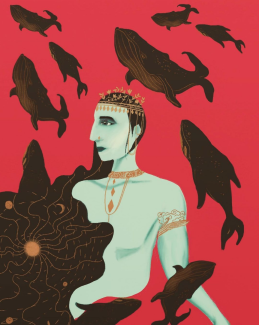
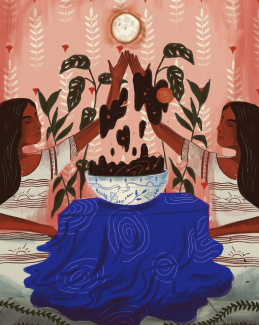
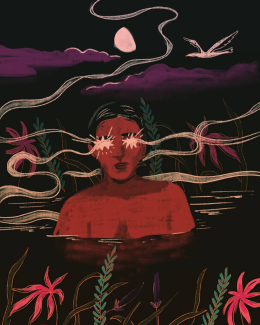
Forgotten Song (Chanson Oubliée)Ode to the Moon (Ode à la Lune)Vapour and Fire (Vapeur et Feu)
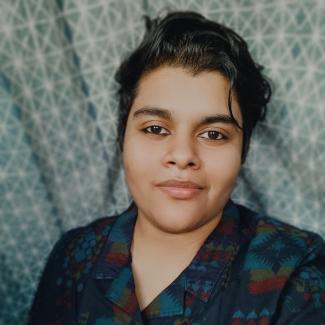
À propos d’Upasana Agarwal
Upasana est un·e illustrateurice et artiste non binaire basé·e à Kolkata, en Inde. Son travail explore l'identité et les récits personnels en partant d’un vestige visuel ou d’une preuve des contextes avec lesquels iel travaille. Iel est particulièrement attiré·e par les motifs qui, selon Upasana, communiquent des vérités complexes sur le passé, le présent et l'avenir. Quand Upasana n'est pas en train de dessiner, iel organise et dirige un centre d'art communautaire queer et trans dans la ville.