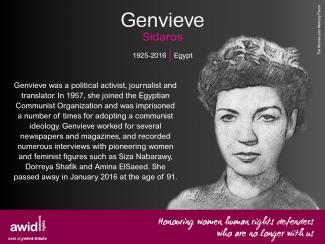
Genvieve Sidaros
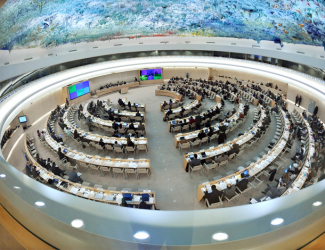
El Consejo de Derechos Humanos (CDH) es el cuerpo intergubernamental del sistema de las Naciones Unidas responsable de la promoción y protección de todos los derechos humanos en todo el mundo. El HRC se reúne en sesión ordinaria tres veces al año, en marzo, junio y septiembre. La La Oficina del Alto Comisionado para los Derechos Humanos (ACNUDH) es la secretaría del Consejo de Derechos Humanos.
Debate y aprueba resoluciones sobre cuestiones mundiales de derechos humanos y el estado de los derechos humanos en determinados países
Examina las denuncias de víctimas de violaciones a los derechos humanos o las de organizaciones activistas, quienes interponen estas denuncias representando a lxs víctimas.
Nombra a expertos independientes que ejecutarán los «Procedimientos Especiales» revisando y presentado informes sobre las violaciones a los derechos humanos desde una perspectiva temática o en relación a un país específico
Participa en discusiones con expertos y gobiernos respecto a cuestiones de derechos humanos.
A través del Examen Periódico Universal, cada cuatro años y medio, se evalúan los expedientes de derechos humanos de todos los Estados Miembro de las Naciones Unidas
Se está llevarando a cabo en Ginebra, Suiza del 30 de junio al 17 de julio de 2020.
AWID trabaja con socios feministas, progresistas y de derechos humanos para compartir conocimientos clave, convocar diálogos y eventos de la sociedad civil, e influir en las negociaciones y los resultados de la sesión.
As world leaders gather in Brazil, feminist movements are advocating, gathering and disrupting the status quo- at COP30 and beyond! We're heading alongside other feminists to Belém, Brazil for COP30, from 10 November – 21 November 2025, where we will continue to denounce false solutions.
Le corps est une entité puissante. En tant que femmes, notre corps est contrôlé, opprimé et policé depuis l'utérus. Notre apparence, nos mouvements, nos vêtements, notre façon de marcher, de parler, nos gestes et notre rire. Je me suis souvent interrogée sur les raisons des peurs patriarcales liées au pouvoir du corps féminin.

Là d'où je viens, le travail du sexe et les travailleur.se.s du sexe étaient évoqué.e.s avec un mélange de mépris, de dégoût, de fascination, de pitié et de condamnation.
J'ai entré en contact avec le travail du sexe et les travailleur.se.s du sexe pour la première fois à l'âge de 22 ans. À partir de simples conversations, assis.e.s en cercle, autour d'un café ou d'un thé, nous avons exploré la vie, les expériences, les pensées et les sentiments de chacun.e.
Pour les travailleur.se.s du sexe, le travail du sexe était le choix le plus intéressant parmi toutes les autres options : payer les factures, soutenir la famille, bénéficier d’horaires de travail plus flexibles, avoir des relations sexuelles. Tout comme j'ai choisi mon travail comme étant le choix le plus intéressant pour payer les factures, soutenir la famille, avoir des heures de travail plus flexibles.
Ces personnes, femmes et hommes, m'ont appris que je prenais mes propres décisions concernant mon corps... duquel je concentre sa vie et son énergie, si je l'utilise pour le plaisir ou la douleur, si je l'échange ou le donne librement, et comment je veux m’y sentir. Cette prise de conscience était aussi excitante qu’autonomisante.
Crear | Résister | Transform : un festival pour les mouvements féministes - 2021... vous m'avez accompagnée dans une série de moments qui ont changé ma vie (!!!)
Nous appelons cela des « événements », mais en réalité, vos espaces d'apprentissage féministes sont selon moi des lieux où je prends un peu de ce que j'ai en moi, un peu de ce que disent vos intervenants et un peu des discussions pour approfondir notre compréhension.
Partager... Participer... S'immerger...
dans la force, dans la vulnérabilité, dans le plaisir.
Être simplement la féministe transformatrice que je suis, sans prétentions, sans appréhensions...
Accueillir la féministe transformatrice que j'ai toujours été, sans même connaître le terme ou le reconnaître de cette manière ou en ces termes...
Trouver un foyer pour la féministe transformatrice féroce qui vit en moi...
Malgré la colère, la rage et la frustration de ne pas être traitée sur un pied d'égalité et d'être traitée comme « moins __ que ».
Je ne me suis pas toujours considérée comme une féministe ni reconnue dans le mouvement ou le discours féministe... En réalité, j'apprécie que l'on m'ouvre les portes, que l'on me tire les chaises pour m'asseoir, que l'on reconnaisse ma féminité en tant que femme.
Parfois, j'ai rejeté le patriarcat avec agacement, parfois j'ai réagi avec frustration et colère, mais je ne l'ai pas abordé... Je n'ai pas remarqué sa toxicité sinistre et insidieuse... J'étais assez privilégiée de pouvoir travailler à travers lui, d'y survivre, de le surmonter, d'exceller malgré lui... Je n'ai pas suffisamment remis en question, pas suffisamment défié, pas suffisamment repoussé mes limites... Je n'en ai pas fait assez...
se connecter avec les travailleur.se.s du sexe, explorer la sexualité, et les femmes pour la paix et la sécurité....
Jusqu'à ce que je prenne pleinement conscience et comprenne que les implications des privilèges et de l'oppression étaient intersectionnelles.
Jusqu'à ce que je réalise ce que signifie se battre pour la justice de genre et pas seulement pour « l'égalité pour tous ».
Je ne suis plus une praticienne et une animatrice, mais bien une praticienne et une animatrice féministe transformatrice.
Être féministe signifie que je vais agir
Plonger dans un avenir incertain, fragile, complexe (et peut-être assez violent)...
Je vous suis profondément reconnaissante et je promets de rester féroce dans la prise en compte et le redressement des questions problématiques liées au genre, à la race, à l'ethnicité, à la classe sociale, à l'orientation sexuelle et aux capacités, et de rester présente et fidèle à la lutte pour l'inclusion, l'équité et la justice.
Khin Khin
Notre fonds d'accès offrira un nombre limité de bourses pour financer la participation d'activistes qui ne pourraient autrement pas se rendre sur place, sachant qu’ils·elles ne bénéficient pas du soutien de bailleurs de fonds leur permettant de couvrir leur participation. Si d'autres possibilités s'offrent à vous, n'hésitez pas à les explorer. Nous ferons de notre mieux pour accorder un maximum de bourses, et échangerons plus d'informations concernant cette procédure et les modalités de candidature au début de l’année 2024.
El informe más reciente del Observatorio sobre la Universalidad de los Derechos desarma discursos como los de la «ideología de género», el «genocidio prenatal» y el «imperialismo cultural». También investiga los flujos de fondos para CitizenGo, la Alliance Defending Freedom/ADF Internacional y otros grupos anti-derechos. En este informe también se puede encontrar un análisis de los sistemas regionales de derechos humanos así como de las estrategias exitosas y los logros feministas.
Enciende tu fuego feminista leyendo nuestras investigaciones y publicaciones varias sobre financiamiento, defensoras de derechos humanos, construcción de movimientos, fundamentalismos, justicia económica, seguimiento y evaluación feminista y más
Across the world and social movements, those who want to innovate tend to feel lonely and powerless before the ‘movement status quo’. Historically, the AWID Forums have played a role in supporting these innovators by offering them a platform where their ideas and practices are welcomed and strengthened by the thoughts and actions of others – in different regions and communities – who have already explored them. Sara Abu Ghazal, Palestinian feminist in Lebanon, tells the story of what the Forums meant for a new generation of feminists in the MENA (Middle East and North Africa) region that introduced new ways of organising, new understandings of feminism and new issues to the regional women’s rights landscape.
We will reconnect with past partners, to ensure past efforts are honored. If your contact information has changed since the last Forum process, please update us so that we may reach you.
Suivez notre super-héroïne alors qu'elle se lance dans une quête pour récupérer le récit des acteurs anti-droits à travers le monde.
Du 27 au 30 avril 2026, l’AWID participera à la Conférence Women Deliver 2026, en co‑créant un espace politique avec les mouvements féministes et de justice de genre, ancré dans le care et la solidarité transnationaux.
À une époque où le fascisme et la militarisation continuent de progresser à l’échelle mondiale, la connexion féministe et la solidarité au‑delà des frontières sont plus que jamais essentielles. Nous organisons plusieurs espaces, à Women Deliver et en ligne, pour connecter les mouvements entre eux à travers des espaces de dialogue, afin de construire des agendas féministes de solidarité et d’action.
Cette politique régit toutes les pages hébergées sur le site www.awid.org, et tout autre site web géré par l'AWID, ainsi que les pages d’inscription à ces sites. Elle ne s'applique pas aux pages hébergées par des organisations autres que l'AWID auxquelles nous pouvons nous associer, et dont les politiques de confidentialité peuvent différer. Veuillez lire le document suivant pour comprendre notre politique de confidentialité concernant la nature, le but, l'utilisation et le partage de vos données personnelles collectées via ce site web.
D’une manière générale, vous pouvez naviguer sur ce site web sans nous soumettre vos informations personnelles. Cependant, dans certaines circonstances, nous vous demanderons de nous fournir certaines données personnelles.
Lorsque vous êtes sur le site web et que nous vous demandons des données personnelles, ces informations ne sont pas partagées en dehors de l’AWID.
1.1.1 Les données que vous fournissez pour obtenir des mises à jour de l'AWID :
Lorsque vous vous inscrivez pour avoir accès au site web - par exemple, que vous vous abonnez pour recevoir des courriels de notre part ou que vous demandez à devenir membre – nous vous demandons de fournir des données personnelles telles que votre nom, pays, langue, courriel pour recevoir les mises à jour. Vous nous transmettez ces informations grâce à des formulaires sécurisés et elles sont stockées sur des serveurs sécurisés.
1.1.2 Les données de paiement que vous envoyez pour devenir membre ou vous inscrire à un événement :
En devenant membre ou en vous inscrivant à des événements, vous devrez peut-être également fournir des données de paiement. L’AWID ne stocke aucune information de carte de crédit sur ses serveurs et utilise des systèmes de paiement sécurisés pour traiter ces informations.
1.1.3 Les informations facultatives que vous avez choisi de nous fournir (avec votre consentement) :
Lorsque vous communiquez avec l’AWID ou que vous fournissez des informations facultatives via des formulaires en-ligne ou utilisez le site pour communiquer avec d'autres membres, nous recueillons ces informations et toute information que vous choisissez de donner.
1.1.4 Les données que nous recueillons via des formulaires de contact ou lorsque vous communiquez directement avec nous :
Lorsque vous communiquez avec nous, nous recueillons ces données ainsi que toute autre information que vous choisissez de nous fournir.
Nous collectons et stockons également certaines autres informations concernant l'utilisation de notre site web par nos utilisateurs-trices afin que des tiers puissent nous fournir des rapports et des analyses concernant l'utilisation et les modes de navigation des utilisateurs-trices.
Pour plus d'informations sur les cookies, veuillez consulter la page suivante : www.allaboutcookies.org/fr/.
Si vous ne souhaitez pas recevoir de cookies, vous pouvez facilement modifier le paramétrage de votre navigateur web pour refuser de recevoir des cookies, ou pour demander d’être informé-e lorsque vous recevez un nouveau cookie. Cliquez ici pour voir comment procéder.
L'AWID utilise les informations collectées à propos de vous pour :
Si vous vous êtes abonné-e aux bulletins électroniques de l'AWID ou à des mises à jour par courrier électronique ou si vous êtes devenu-e membre, nous vous enverrons régulièrement des informations, ainsi qu’indiqué dans la section correspondante du site web. Vous pouvez vous désabonner à tout moment des bulletins électroniques ou des mises à jour par courriel en suivant les liens vers les informations de désabonnement incluses dans nos courriels.
L'exactitude des données vous concernant personnellement est importante pour l'AWID. Nous sommes en permanence à la recherche de moyens pour vous faciliter l’accès aux données que l'AWID conserve à votre sujet via notre site web et à la possibilité et les modifier. Si vous changez votre adresse e-mail, ou si l'une des autres informations que nous détenons est inexacte ou n’est plus d’actualité, merci de nous contacter ici.
Si vous avez consenti à ce que l’AWID utilise vos données personnelles, vous pouvez néanmoins changer d’avis à tout moment en nous contactant et en spécifiant l’autorisation que vous annulez. Veuillez noter que le retrait de votre consentement n'affecte pas la légalité des activités de traitement basées sur ce consentement avant son retrait.
Excepté dans le cas détaillé ci-dessous, l'AWID ne divulgue aucune de vos informations personnelles et ne vend ni ne loue des listes contenant vos informations à des tiers. L'AWID peut divulguer des informations quand elle a votre permission de le faire ou dans des circonstances particulières, par exemple lorsqu’elle croit de bonne foi que la loi l'exige.
Nous mettons continuellement en œuvre et mettons à jour les mesures de sécurité administratives, techniques et physiques afin de protéger vos données contre tout accès non autorisé, perte, destruction ou altération de celles-ci. Certaines des mesures de protection que nous utilisons pour protéger vos informations sont les pare-feu, le cryptage des données et les contrôles d'accès aux informations. Si vous savez, ou avez des raisons de croire, que vos informations d'identification AWID ont été perdues, volées, détournées ou autrement compromises, ou en cas d'utilisation non autorisée réelle ou suspectée de votre compte d'adhésion à l’AWID, veuillez nous contacter.
Cette politique est susceptible d’être modifiée de temps à autre. La dernière version de la politique sera postée sur notre site web, ainsi que la date de sa dernière mise à jour. En cas de modification(s) apportées à cette politique, vous recevrez une mise à jour par courriel. Au cas où vous ne seriez pas d'accord avec la politique ainsi révisée, vous aurez la possibilité d'annuler votre (vos) abonnement(s) chez nous. N’hésitez pas à nous contacter. Tous vos commentaires au sujet de cette politique sont les bienvenus !
Dernière mise à jour : mai 2019
Para preguntas adicionales, por favor utiliza nuestro formulario de contacto. ¡Continuaremos actualizando este documento en base a las consultas que vayamos recibiendo de ustedes!
Avec Lindiwe Rasekoala, Lizzie Kiama, Jovana Drodevic et Malaka Grant.
📅 Mardi 28 avril
🕒 6 18 h 30 – 21 h 30
🏢 Venue: River’s Edge, 18-31 Siddeley St
(à 5 minutes à pied du Melbourne Convention and Exhibition Centre, de l’autre côté de la rivière)
RSVP requis
réception pour les membres, partenaires et amis d'AWID apprenez-en plus ici !